Minnesota's Guaranteed
Energy Savings Program
(GESP)
CERTs Mission: Connect individuals and their
communities to the resources they need to identify and
implement community-based clean energy projects
CERTs: Our Misson
• Division of Energy Resources Role
• Energy Savings Performance Contracting
• The Power of Bundling Energy Conservation
Measures
• Minnesota’s new Guaranteed Energy Savings
Program
• Project Development Process
3
• Makes existing systems more efficient
• Retro-commissioning
• System additions and enhancements
• Operation & Maintenance improvements
• Renews facility infrastructure by performing
deep energy retrofits
• System re-design
• Equipment replacement
• Assures intended results continue to be achieved
• On-going savings Measurement & Verification
• Performance Guarantee
4
Energy Savings Programs
Peter Berger
Eric Rehm
www.energy.mn.gov
5
• Program Development and Administration
• Pre-qualify ESCOs (contractors)
• Master Contract and Procurement Documents
• Opportunity Assessment
• B3 Benchmarking Data
• Needs, Issues and Goals
• Technical Assistance
• Project Development Assistance
• Project Implementation Oversight
• Annual Project Performance Evaluation 6
“The use of guaranteed savings gained from the maintenance, operations and
utilities budgets, as capital to make needed upgrades to your building
environmental systems, that is financed over a specified period of time.”
U.S. Department of Energy
Before Improvements After Improvements
7
• Benchmark your buildings
• Identify the worst performers
• First implement No-Cost Energy Conservation
Measures (ECMs)
• Next use available funds to implement
Low-Cost ECMs
• Continue up the payback ladder until available
funds are gone
• Move on to the next worst performing building
when additional funds become available
8
Oak Ridge National Laboratory
Mixing Appropriations and Private
Financing to Meet Federal Energy
Management Goals
June 2012
Prepared by: John Shonder
Source:
http://www.ornl.gov/sci/ees/etsd/btric/publications/ORNL%20TM%202012_235.pdf
9
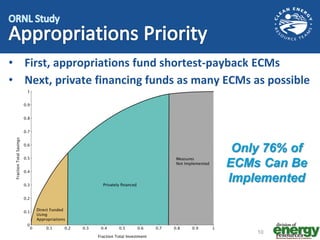
• First, appropriations fund shortest-payback ECMs
• Next, private financing funds as many ECMs as possible
Only 76% of
ECMs Can Be
Implemented
10
• First, private financing funds as many ECMs as possible
• Next, use appropriations on long payback ECMs
95% of ECMs
Can Be
Implemented!
11
Best Financing Strategy
• Use private financing to fund as
many ECMs as possible
beginning with the shortest-
payback ECMs
• Use available appropriations as
a one-time buy-down or to
fund longer-payback ECMs that
cannot be included in the
project
“Using
appropriations
to fund short
payback Energy
Conservation
Measures is like
eating your seed
corn.”
John Shonder
Oak Ridge National Laboratory
The Power of Bundling ECMs
12
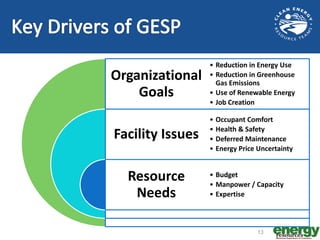
Organizational
Goals
Facility Issues
Resource
Needs
• Reduction in Energy Use
• Reduction in Greenhouse
Gas Emissions
• Use of Renewable Energy
• Job Creation
• Occupant Comfort
• Health & Safety
• Deferred Maintenance
• Energy Price Uncertainty
• Budget
• Manpower / Capacity
• Expertise
13
Reduce
Energy Use
Operation &
Maintenance
Costs
Renew
Facility
Infrastructure
Occupant
Comfort, Health &
Safety
Achieve
GHG Emission
Reduction
Job Creation
Use of Renewable
Energy
Budget Neutral – No Bond Funds Required
14
• Vetted Master Contract with Pre-qualified ESCO’s
• Open Book Pricing, Maximum Markups and Fees, GMP
• Competitive Bidding of Trade Work and Equipment
with Pre-qualified Sub’s and Spec’s
• Savings Guarantee requires savings be met each year of
the guarantee
• Measure & Verification Guidelines
• Startup & Commissioning Guidelines
• Third-Party Review of Annual M&V Report
• State provided Technical, Financial and Contractual
Assistance 15
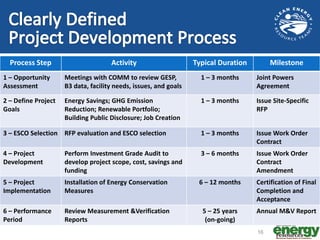
Process Step Activity Typical Duration Milestone
1 – Opportunity
Assessment
Meetings with COMM to review GESP,
B3 data, facility needs, issues, and goals
1 – 3 months Joint Powers
Agreement
2 – Define Project
Goals
Energy Savings; GHG Emission
Reduction; Renewable Portfolio;
Building Public Disclosure; Job Creation
1 – 3 months Issue Site-Specific
RFP
3 – ESCO Selection RFP evaluation and ESCO selection 1 – 3 months Issue Work Order
Contract
4 – Project
Development
Perform Investment Grade Audit to
develop project scope, cost, savings and
funding
3 – 6 months Issue Work Order
Contract
Amendment
5 – Project
Implementation
Installation of Energy Conservation
Measures
6 – 12 months Certification of Final
Completion and
Acceptance
6 – Performance
Period
Review Measurement &Verification
Reports
5 – 25 years
(on-going)
Annual M&V Report
16
Guaranteed Energy Savings
Program Contacts
Peter Berger, LEED AP BD&C
GESP Program Manager
651-539-1850
peter.berger@state.mn.us
Lindsay Wimmer
GESP Outreach Coordinator
612-625-9634
wimm0020@umn.edu
Website:
http://mn.gov/commerce/energy/topics/financial/
Energy-Savings-
Programs/Government/Guaranteed-Energy-
Savings-Program/Program-Resources/GESP-
Program-Master-Contract.jsp
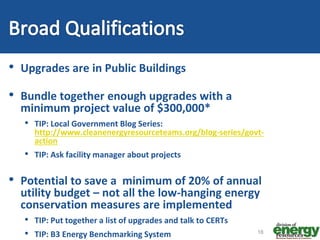
• Upgrades are in Public Buildings
• Bundle together enough upgrades with a
minimum project value of $300,000*
• TIP: Local Government Blog Series:
http://www.cleanenergyresourceteams.org/blog-series/govt-
action
• TIP: Ask facility manager about projects
• Potential to save a minimum of 20% of annual
utility budget – not all the low-hanging energy
conservation measures are implemented
• TIP: Put together a list of upgrades and talk to CERTs
• TIP: B3 Energy Benchmarking System 18
What?
• Building energy management system for
public buildings in Minnesota,
administered by the state
• Free to use
• https://mn.b3benchmarking.com/Defaul
t.aspx 19
• Pay for that project:
• With the savings in the operations budgets
• With the savings in the maintenance
budgets
• Buy down the project cost with bonds,
grants, other funds
• Pay for the project between 5 – 25 years
20
• City Council, County Board, or School
Board is open to approve an alternative
method of contracting and financing
enabled by state statute to implement
the upgrades
21
• Answer your questions
• Go through broad qualifications and get
you started with GESP
Lindsay Wimmer
Guaranteed Energy Savings Program
Outreach Coordinator
Clean Energy Resource Teams (CERTs)
wimm0020@umn.edu 612.625.9634
22
23
24
25
26
27

Overview: MN Guaranteed Energy Savings Program

  • 1.
  • 2.
    CERTs Mission: Connectindividuals and their communities to the resources they need to identify and implement community-based clean energy projects CERTs: Our Misson
  • 3.
    • Division ofEnergy Resources Role • Energy Savings Performance Contracting • The Power of Bundling Energy Conservation Measures • Minnesota’s new Guaranteed Energy Savings Program • Project Development Process 3
  • 4.
    • Makes existingsystems more efficient • Retro-commissioning • System additions and enhancements • Operation & Maintenance improvements • Renews facility infrastructure by performing deep energy retrofits • System re-design • Equipment replacement • Assures intended results continue to be achieved • On-going savings Measurement & Verification • Performance Guarantee 4
  • 5.
    Energy Savings Programs PeterBerger Eric Rehm www.energy.mn.gov 5
  • 6.
    • Program Developmentand Administration • Pre-qualify ESCOs (contractors) • Master Contract and Procurement Documents • Opportunity Assessment • B3 Benchmarking Data • Needs, Issues and Goals • Technical Assistance • Project Development Assistance • Project Implementation Oversight • Annual Project Performance Evaluation 6
  • 7.
    “The use ofguaranteed savings gained from the maintenance, operations and utilities budgets, as capital to make needed upgrades to your building environmental systems, that is financed over a specified period of time.” U.S. Department of Energy Before Improvements After Improvements 7
  • 8.
    • Benchmark yourbuildings • Identify the worst performers • First implement No-Cost Energy Conservation Measures (ECMs) • Next use available funds to implement Low-Cost ECMs • Continue up the payback ladder until available funds are gone • Move on to the next worst performing building when additional funds become available 8
  • 9.
    Oak Ridge NationalLaboratory Mixing Appropriations and Private Financing to Meet Federal Energy Management Goals June 2012 Prepared by: John Shonder Source: http://www.ornl.gov/sci/ees/etsd/btric/publications/ORNL%20TM%202012_235.pdf 9
  • 10.
    • First, appropriationsfund shortest-payback ECMs • Next, private financing funds as many ECMs as possible Only 76% of ECMs Can Be Implemented 10
  • 11.
    • First, privatefinancing funds as many ECMs as possible • Next, use appropriations on long payback ECMs 95% of ECMs Can Be Implemented! 11
  • 12.
    Best Financing Strategy •Use private financing to fund as many ECMs as possible beginning with the shortest- payback ECMs • Use available appropriations as a one-time buy-down or to fund longer-payback ECMs that cannot be included in the project “Using appropriations to fund short payback Energy Conservation Measures is like eating your seed corn.” John Shonder Oak Ridge National Laboratory The Power of Bundling ECMs 12
  • 13.
    Organizational Goals Facility Issues Resource Needs • Reductionin Energy Use • Reduction in Greenhouse Gas Emissions • Use of Renewable Energy • Job Creation • Occupant Comfort • Health & Safety • Deferred Maintenance • Energy Price Uncertainty • Budget • Manpower / Capacity • Expertise 13
  • 14.
    Reduce Energy Use Operation & Maintenance Costs Renew Facility Infrastructure Occupant Comfort,Health & Safety Achieve GHG Emission Reduction Job Creation Use of Renewable Energy Budget Neutral – No Bond Funds Required 14
  • 15.
    • Vetted MasterContract with Pre-qualified ESCO’s • Open Book Pricing, Maximum Markups and Fees, GMP • Competitive Bidding of Trade Work and Equipment with Pre-qualified Sub’s and Spec’s • Savings Guarantee requires savings be met each year of the guarantee • Measure & Verification Guidelines • Startup & Commissioning Guidelines • Third-Party Review of Annual M&V Report • State provided Technical, Financial and Contractual Assistance 15
  • 16.
    Process Step ActivityTypical Duration Milestone 1 – Opportunity Assessment Meetings with COMM to review GESP, B3 data, facility needs, issues, and goals 1 – 3 months Joint Powers Agreement 2 – Define Project Goals Energy Savings; GHG Emission Reduction; Renewable Portfolio; Building Public Disclosure; Job Creation 1 – 3 months Issue Site-Specific RFP 3 – ESCO Selection RFP evaluation and ESCO selection 1 – 3 months Issue Work Order Contract 4 – Project Development Perform Investment Grade Audit to develop project scope, cost, savings and funding 3 – 6 months Issue Work Order Contract Amendment 5 – Project Implementation Installation of Energy Conservation Measures 6 – 12 months Certification of Final Completion and Acceptance 6 – Performance Period Review Measurement &Verification Reports 5 – 25 years (on-going) Annual M&V Report 16
  • 17.
    Guaranteed Energy Savings ProgramContacts Peter Berger, LEED AP BD&C GESP Program Manager 651-539-1850 peter.berger@state.mn.us Lindsay Wimmer GESP Outreach Coordinator 612-625-9634 wimm0020@umn.edu Website: http://mn.gov/commerce/energy/topics/financial/ Energy-Savings- Programs/Government/Guaranteed-Energy- Savings-Program/Program-Resources/GESP- Program-Master-Contract.jsp
  • 18.
    • Upgrades arein Public Buildings • Bundle together enough upgrades with a minimum project value of $300,000* • TIP: Local Government Blog Series: http://www.cleanenergyresourceteams.org/blog-series/govt- action • TIP: Ask facility manager about projects • Potential to save a minimum of 20% of annual utility budget – not all the low-hanging energy conservation measures are implemented • TIP: Put together a list of upgrades and talk to CERTs • TIP: B3 Energy Benchmarking System 18
  • 19.
    What? • Building energymanagement system for public buildings in Minnesota, administered by the state • Free to use • https://mn.b3benchmarking.com/Defaul t.aspx 19
  • 20.
    • Pay forthat project: • With the savings in the operations budgets • With the savings in the maintenance budgets • Buy down the project cost with bonds, grants, other funds • Pay for the project between 5 – 25 years 20
  • 21.
    • City Council,County Board, or School Board is open to approve an alternative method of contracting and financing enabled by state statute to implement the upgrades 21
  • 22.
    • Answer yourquestions • Go through broad qualifications and get you started with GESP Lindsay Wimmer Guaranteed Energy Savings Program Outreach Coordinator Clean Energy Resource Teams (CERTs) wimm0020@umn.edu 612.625.9634 22
  • 23.
  • 24.
  • 25.
  • 26.
  • 27.