ENERGY EFFICIENCY
TECHNOLOGY FOR FLUID
ENVIRONMENTS
By Deborah Garfinkel,VP,TWT
08/09/14 1
Original Content Copyright © 2002 Triangular Wave Technologies, Inc. &
Deborah Garfinkel. All rights reserved. Use without prior written permission
strictly forbidden.
INTRODUCTION
 This presentation is designed to communicate the
concepts of an energy and water-saving technology.
 This technology forms the foundation of a class of
equipment that, due to the important efficiencies it
provides, should play a significant role at the vanguard of
energy management programs and activities.
 The goal is to impress upon those working in the field
the value of making these concepts a part of the
everyday considerations that make up energy
management initiatives and programs.
08/09/14 2
TOPICS OF DISCUSSION
 Water quality has a direct effect on the energy
consumption and efficiency of all industrial, commercial, and
residential water-fed equipment
 Energy-Efficient equipment and appliances allow improved
outcomes
 Energy-Efficiency devices and systems take a very important
next step in obtaining best results and should be part of
Best Practices
08/09/14 3
WATER QUALITY HAS A DIRECT EFFECT
ON …
THE ENERGY CONSUMPTION AND EFFICIENCY
OF ALLWATER-FED EQUIPMENT
 Example: Boiler & cooling tower blowdown optimization
 Savings and payback period demonstrate reduced
consumption and increased operating efficiency
08/09/14 4
08/09/14 5
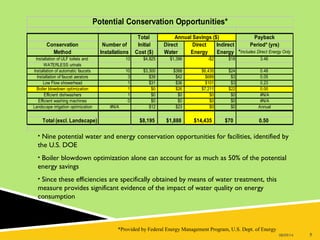
Potential Conservation Opportunities*
Total Annual Savings ($) Payback
Conservation Number of Initial Direct Direct Indirect Period* (yrs)
Method Installations Cost ($) Water Energy Energy *Includes Direct Energy Only
Installation of ULF toilets and 13 $4,825 $1,396 -$2 $18 3.46
WATERLESS urinals
Installation of automatic faucets 10 $3,300 $388 $6,435 $24 0.48
Installation of faucet aerators 3 $39 $42 $689 $3 0.05
Low Flow showerhead 1 $31 $36 $101 $3 0.23
Boiler blowdown optimization 1 $0 $26 $7,211 $22 0.00
Efficient dishwashers 1 $0 $0 $0 $0 #N/A
Efficient washing machines 0 $0 $0 $0 $0 #N/A
Landscape irrigation optimization #N/A $12 $23 $0 $0 Annual
Total (excl. Landscape) $8,195 $1,888 $14,435 $70 0.50
• Nine potential water and energy conservation opportunities for facilities, identified by
the U.S. DOE
• Boiler blowdown optimization alone can account for as much as 50% of the potential
energy savings
• Since these efficiencies are specifically obtained by means of water treatment, this
measure provides significant evidence of the impact of water quality on energy
consumption
*Provided by Federal Energy Management Program, U.S. Dept. of Energy
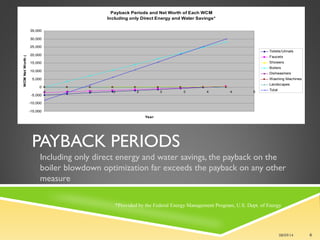
PAYBACK PERIODS
Including only direct energy and water savings, the payback on the
boiler blowdown optimization far exceeds the payback on any other
measure
08/09/14 6
Payback Periods and Net Worth of Each WCM
Including only Direct Energy and Water Savings*
-15,000
-10,000
-5,000
0
5,000
10,000
15,000
20,000
25,000
30,000
35,000
0 1 1 2 2 3 3 4 4 5
Year
WCMNetWorth($)
Toilets/Urinals
Faucets
Showers
Boilers
Dishwashers
Washing Machines
Landscapes
Total
*Provided by the Federal Energy Management Program, U.S. Dept. of Energy
ENERGY-EFFICIENT EQUIPMENT
 EnergyStar and other efficiency and improvement programs
raise consciousness, achieve positive results
 Rebates and subsidies encourage their use
 But …operating efficiency will still diminish based on water
quality conditions
08/09/14 7
ENERGY-EFFICIENCY DEVICES & SYSTEMS
 A class of fluid treatment equipment that takes water and
energy conservation to the next level
 Non-chemical, environmentally friendly technology
 Easily retrofitted to existing equipment, easily installed with
new equipment to maintain and improve operating
efficiency
 Helps keep equipment operating to rated levels and
maintain compliance
08/09/14 8
REAL LIFE
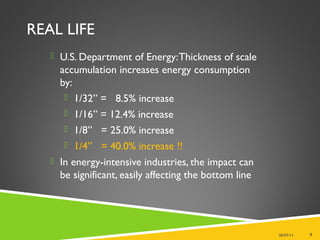
 U.S. Department of Energy:Thickness of scale
accumulation increases energy consumption
by:
 1/32” = 8.5% increase
 1/16” = 12.4% increase
 1/8” = 25.0% increase
 1/4” = 40.0% increase !!
 In energy-intensive industries, the impact can
be significant, easily affecting the bottom line
08/09/14 9
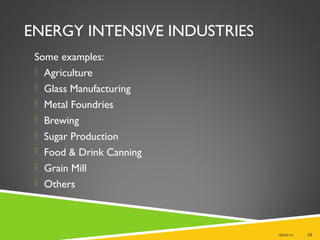
ENERGY INTENSIVE INDUSTRIES
Some examples:
 Agriculture
 Glass Manufacturing
 Metal Foundries
 Brewing
 Sugar Production
 Food & Drink Canning
 Grain Mill
 Others
08/09/14 10
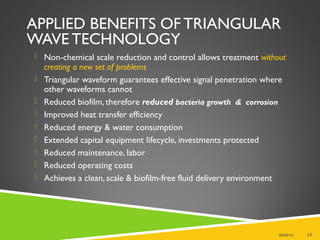
APPLIED BENEFITS OF TRIANGULAR
WAVE TECHNOLOGY
 Non-chemical scale reduction and control allows treatment without
creating a new set of problems
 Triangular waveform guarantees effective signal penetration where
other waveforms cannot
 Reduced biofilm, therefore reduced bacteria growth & corrosion
 Improved heat transfer efficiency
 Reduced energy & water consumption
 Extended capital equipment lifecycle, investments protected
 Reduced maintenance, labor
 Reduced operating costs
 Achieves a clean, scale & biofilm-free fluid delivery environment
08/09/14 11
COMBINED BENEFITS OF ENERGY-
EFFICIENT AND ENERGY EFFICIENCY
SYSTEMS
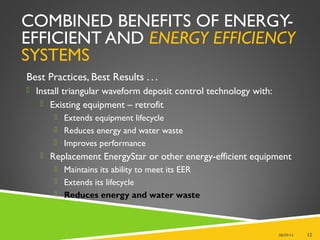
Best Practices, Best Results . . .
 Install triangular waveform deposit control technology with:
 Existing equipment – retrofit
 Extends equipment lifecycle
 Reduces energy and water waste
 Improves performance
 Replacement EnergyStar or other energy-efficient equipment
 Maintains its ability to meet its EER
 Extends its lifecycle
 Reduces energy and water waste
08/09/14 12

Energy efficiency technology for fluid environments green

  • 1.
    ENERGY EFFICIENCY TECHNOLOGY FORFLUID ENVIRONMENTS By Deborah Garfinkel,VP,TWT 08/09/14 1 Original Content Copyright © 2002 Triangular Wave Technologies, Inc. & Deborah Garfinkel. All rights reserved. Use without prior written permission strictly forbidden.
  • 2.
    INTRODUCTION  This presentationis designed to communicate the concepts of an energy and water-saving technology.  This technology forms the foundation of a class of equipment that, due to the important efficiencies it provides, should play a significant role at the vanguard of energy management programs and activities.  The goal is to impress upon those working in the field the value of making these concepts a part of the everyday considerations that make up energy management initiatives and programs. 08/09/14 2
  • 3.
    TOPICS OF DISCUSSION Water quality has a direct effect on the energy consumption and efficiency of all industrial, commercial, and residential water-fed equipment  Energy-Efficient equipment and appliances allow improved outcomes  Energy-Efficiency devices and systems take a very important next step in obtaining best results and should be part of Best Practices 08/09/14 3
  • 4.
    WATER QUALITY HASA DIRECT EFFECT ON … THE ENERGY CONSUMPTION AND EFFICIENCY OF ALLWATER-FED EQUIPMENT  Example: Boiler & cooling tower blowdown optimization  Savings and payback period demonstrate reduced consumption and increased operating efficiency 08/09/14 4
  • 5.
    08/09/14 5 Potential ConservationOpportunities* Total Annual Savings ($) Payback Conservation Number of Initial Direct Direct Indirect Period* (yrs) Method Installations Cost ($) Water Energy Energy *Includes Direct Energy Only Installation of ULF toilets and 13 $4,825 $1,396 -$2 $18 3.46 WATERLESS urinals Installation of automatic faucets 10 $3,300 $388 $6,435 $24 0.48 Installation of faucet aerators 3 $39 $42 $689 $3 0.05 Low Flow showerhead 1 $31 $36 $101 $3 0.23 Boiler blowdown optimization 1 $0 $26 $7,211 $22 0.00 Efficient dishwashers 1 $0 $0 $0 $0 #N/A Efficient washing machines 0 $0 $0 $0 $0 #N/A Landscape irrigation optimization #N/A $12 $23 $0 $0 Annual Total (excl. Landscape) $8,195 $1,888 $14,435 $70 0.50 • Nine potential water and energy conservation opportunities for facilities, identified by the U.S. DOE • Boiler blowdown optimization alone can account for as much as 50% of the potential energy savings • Since these efficiencies are specifically obtained by means of water treatment, this measure provides significant evidence of the impact of water quality on energy consumption *Provided by Federal Energy Management Program, U.S. Dept. of Energy
  • 6.
    PAYBACK PERIODS Including onlydirect energy and water savings, the payback on the boiler blowdown optimization far exceeds the payback on any other measure 08/09/14 6 Payback Periods and Net Worth of Each WCM Including only Direct Energy and Water Savings* -15,000 -10,000 -5,000 0 5,000 10,000 15,000 20,000 25,000 30,000 35,000 0 1 1 2 2 3 3 4 4 5 Year WCMNetWorth($) Toilets/Urinals Faucets Showers Boilers Dishwashers Washing Machines Landscapes Total *Provided by the Federal Energy Management Program, U.S. Dept. of Energy
  • 7.
    ENERGY-EFFICIENT EQUIPMENT  EnergyStarand other efficiency and improvement programs raise consciousness, achieve positive results  Rebates and subsidies encourage their use  But …operating efficiency will still diminish based on water quality conditions 08/09/14 7
  • 8.
    ENERGY-EFFICIENCY DEVICES &SYSTEMS  A class of fluid treatment equipment that takes water and energy conservation to the next level  Non-chemical, environmentally friendly technology  Easily retrofitted to existing equipment, easily installed with new equipment to maintain and improve operating efficiency  Helps keep equipment operating to rated levels and maintain compliance 08/09/14 8
  • 9.
    REAL LIFE  U.S.Department of Energy:Thickness of scale accumulation increases energy consumption by:  1/32” = 8.5% increase  1/16” = 12.4% increase  1/8” = 25.0% increase  1/4” = 40.0% increase !!  In energy-intensive industries, the impact can be significant, easily affecting the bottom line 08/09/14 9
  • 10.
    ENERGY INTENSIVE INDUSTRIES Someexamples:  Agriculture  Glass Manufacturing  Metal Foundries  Brewing  Sugar Production  Food & Drink Canning  Grain Mill  Others 08/09/14 10
  • 11.
    APPLIED BENEFITS OFTRIANGULAR WAVE TECHNOLOGY  Non-chemical scale reduction and control allows treatment without creating a new set of problems  Triangular waveform guarantees effective signal penetration where other waveforms cannot  Reduced biofilm, therefore reduced bacteria growth & corrosion  Improved heat transfer efficiency  Reduced energy & water consumption  Extended capital equipment lifecycle, investments protected  Reduced maintenance, labor  Reduced operating costs  Achieves a clean, scale & biofilm-free fluid delivery environment 08/09/14 11
  • 12.
    COMBINED BENEFITS OFENERGY- EFFICIENT AND ENERGY EFFICIENCY SYSTEMS Best Practices, Best Results . . .  Install triangular waveform deposit control technology with:  Existing equipment – retrofit  Extends equipment lifecycle  Reduces energy and water waste  Improves performance  Replacement EnergyStar or other energy-efficient equipment  Maintains its ability to meet its EER  Extends its lifecycle  Reduces energy and water waste 08/09/14 12