Changing the World
one building
at a time
Save Energy
Save Money
Save The Earth
Sustainable Green Creative Solutions “SGCS”
901-230-2476 sgcsusa@gmail.com
TVA PPN #1304456
Presented by: Larry Hoover
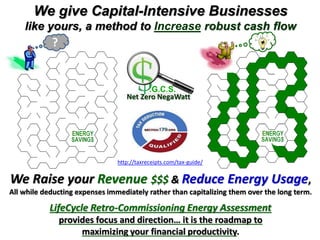
LifeCycle Retro-Commissioning Energy Assessment
provides focus and direction… it is the roadmap to
maximizing your financial productivity.
We give Capital-Intensive Businesses
like yours, a method to Increase robust cash flow
We Raise your Revenue $$$ & Reduce Energy Usage,
All while deducting expenses immediately rather than capitalizing them over the long term.
?
http://taxreceipts.com/tax-guide/
Net Zero NegaWatt
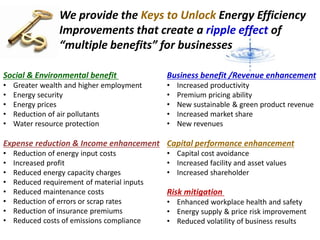
Social & Environmental benefit
• Greater wealth and higher employment
• Energy security
• Energy prices
• Reduction of air pollutants
• Water resource protection
Expense reduction & Income enhancement
• Reduction of energy input costs
• Increased profit
• Reduced energy capacity charges
• Reduced requirement of material inputs
• Reduced maintenance costs
• Reduction of errors or scrap rates
• Reduction of insurance premiums
• Reduced costs of emissions compliance
Business benefit /Revenue enhancement
• Increased productivity
• Premium pricing ability
• New sustainable & green product revenue
• Increased market share
• New revenues
Capital performance enhancement
• Capital cost avoidance
• Increased facility and asset values
• Increased shareholder
Risk mitigation
• Enhanced workplace health and safety
• Energy supply & price risk improvement
• Reduced volatility of business results
We provide the Keys to Unlock Energy Efficiency
Improvements that create a ripple effect of
“multiple benefits” for businesses
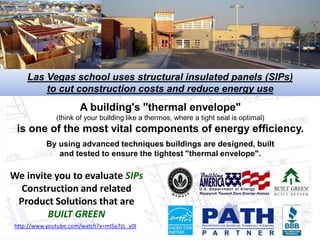
We invite you to evaluate SIPs
Construction and related
Product Solutions that are
BUILT GREEN
A building's "thermal envelope"
(think of your building like a thermos, where a tight seal is optimal)
is one of the most vital components of energy efficiency.
By using advanced techniques buildings are designed, built
and tested to ensure the tightest "thermal envelope".
http://www.youtube.com/watch?v=mISa7zL_y0I
Las Vegas school uses structural insulated panels (SIPs)
to cut construction costs and reduce energy use
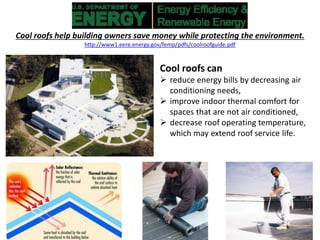
Cool roofs help building owners save money while protecting the environment.
http://www1.eere.energy.gov/femp/pdfs/coolroofguide.pdf
Cool roofs can
 reduce energy bills by decreasing air
conditioning needs,
 improve indoor thermal comfort for
spaces that are not air conditioned,
 decrease roof operating temperature,
which may extend roof service life.
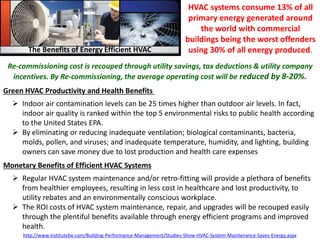
The Benefits of Energy Efficient HVAC
HVAC systems consume 13% of all
primary energy generated around
the world with commercial
buildings being the worst offenders
using 30% of all energy produced.
Re-commissioning cost is recouped through utility savings, tax deductions & utility company
incentives. By Re-commissioning, the average operating cost will be reduced by 8-20%.
Green HVAC Productivity and Health Benefits
Monetary Benefits of Efficient HVAC Systems
 Indoor air contamination levels can be 25 times higher than outdoor air levels. In fact,
indoor air quality is ranked within the top 5 environmental risks to public health according
to the United States EPA.
 By eliminating or reducing inadequate ventilation; biological contaminants, bacteria,
molds, pollen, and viruses; and inadequate temperature, humidity, and lighting, building
owners can save money due to lost production and health care expenses
 Regular HVAC system maintenance and/or retro-fitting will provide a plethora of benefits
from healthier employees, resulting in less cost in healthcare and lost productivity, to
utility rebates and an environmentally conscious workplace.
 The ROI costs of HVAC system maintenance, repair, and upgrades will be recouped easily
through the plentiful benefits available through energy efficient programs and improved
health.
http://www.institutebe.com/Building-Performance-Management/Studies-Show-HVAC-System-Maintenance-Saves-Energy.aspx
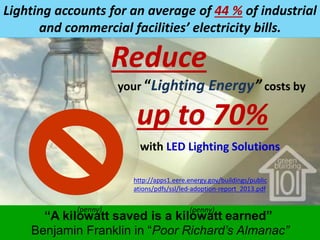
Lighting accounts for an average of 44 % of industrial
and commercial facilities’ electricity bills.
Reduce
your “Lighting Energy” costs by
up to 70%
with LED Lighting Solutions
“A kilowatt saved is a kilowatt earned”
Benjamin Franklin in “Poor Richard’s Almanac”
http://apps1.eere.energy.gov/buildings/public
ations/pdfs/ssl/led-adoption-report_2013.pdf
(penny) (penny)
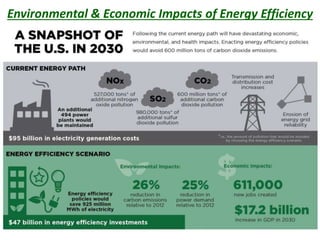
Environmental & Economic Impacts of Energy Efficiency
Energy Efficiency Capital:
An Introduction to Capital Leasing
We give Building owners preservation of working capital, cash reserves, or other
available business credit for business needs, rather than spending it on Energy Efficient
retrofits, creating a robust cash flow to keep operations moving
Whether upgrading HVAC, improving a building's
"thermal envelope", upgrading lighting systems or
bundling projects under a whole-building retrofit,
energy efficiency projects require large upfront
investments.
Capital leasing draws on the dollars to be saved for
future utility bills, Energy efficient incentives & tax
benefits to pay for new, energy-efficient equipment.
For the building owner who prefers to enjoy the benefits of ownership of the assets without
actually owning the energy efficiency project assets, a capital lease may be the best financing
vehicle. It is still a lease where the building owner is a lessee, but the lessee has access to any
tax and depreciation benefits that the equipment may have.
Lease payments are typically set to match estimated energy cost savings providing net positive
cash flow with little or no up-front cost. There is also the prospective for the building owner to
capture tax benefits (Capital lease)
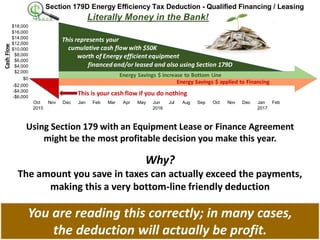
Section 179D Energy Efficiency Tax Deduction - Qualified Financing / Leasing
Literally Money in the Bank!
$18,000
$16,000
$14,000
$12,000
$10,000
$8,000
$6,000
$4,000
$2,000
$0
-$2,000
-$4,000
-$6,000
Oct Nov Dec Jan Feb Mar Apr May Jun Jul Aug Sep Oct Nov Dec Jan Feb
2015 2016 2017
This is your cash flow if you do nothing
This represents your
cumulative cash flow with $50K
worth of Energy efficient equipment
financedand/or leased and also using Section 179D
CashFlow
Energy Savings $ increase to Bottom Line
Energy Savings $ applied to Financing
Why?
The amount you save in taxes can actually exceed the payments,
making this a very bottom-line friendly deduction
You are reading this correctly; in many cases,
the deduction will actually be profit.
Using Section 179 with an Equipment Lease or Finance Agreement
might be the most profitable decision you make this year.
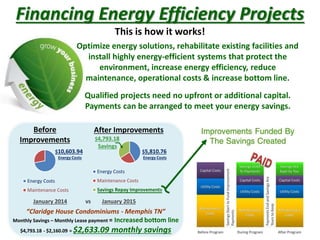
Optimize energy solutions, rehabilitate existing facilities and
install highly energy-efficient systems that protect the
environment, increase energy efficiency, reduce
maintenance, operational costs & increase bottom line.
Qualified projects need no upfront or additional capital.
Payments can be arranged to meet your energy savings.
Financing Energy Efficiency Projects
This is how it works!
January 2014 vs January 2015
“Claridge House Condominiums - Memphis TN”
Monthly Savings – Monthly Lease payment = Increased bottom line
$4,793.18 - $2,160.09 = $2,633.09 monthly savings
Before
Improvements
Energy Costs
Maintenance Costs
After Improvements
Energy Costs
Maintenance Costs
Savings Repay Improvements
$10,603.94
Energy Costs
$5,810.76
Energy Costs
$4,793.18
Savings
RETRO-COMMISSIONING
ENERGY AUDITING SERVICES
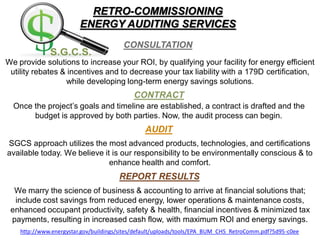
We provide solutions to increase your ROI, by qualifying your facility for energy efficient
utility rebates & incentives and to decrease your tax liability with a 179D certification,
while developing long-term energy savings solutions.
Once the project’s goals and timeline are established, a contract is drafted and the
budget is approved by both parties. Now, the audit process can begin.
SGCS approach utilizes the most advanced products, technologies, and certifications
available today. We believe it is our responsibility to be environmentally conscious & to
enhance health and comfort.
We marry the science of business & accounting to arrive at financial solutions that;
include cost savings from reduced energy, lower operations & maintenance costs,
enhanced occupant productivity, safety & health, financial incentives & minimized tax
payments, resulting in increased cash flow, with maximum ROI and energy savings.
http://www.energystar.gov/buildings/sites/default/uploads/tools/EPA_BUM_CH5_RetroComm.pdf?5d95-c0ee

Energy Efficient Retro Commissioning

  • 1.
    Changing the World onebuilding at a time Save Energy Save Money Save The Earth Sustainable Green Creative Solutions “SGCS” 901-230-2476 sgcsusa@gmail.com TVA PPN #1304456 Presented by: Larry Hoover
  • 2.
    LifeCycle Retro-Commissioning EnergyAssessment provides focus and direction… it is the roadmap to maximizing your financial productivity. We give Capital-Intensive Businesses like yours, a method to Increase robust cash flow We Raise your Revenue $$$ & Reduce Energy Usage, All while deducting expenses immediately rather than capitalizing them over the long term. ? http://taxreceipts.com/tax-guide/ Net Zero NegaWatt
  • 3.
    Social & Environmentalbenefit • Greater wealth and higher employment • Energy security • Energy prices • Reduction of air pollutants • Water resource protection Expense reduction & Income enhancement • Reduction of energy input costs • Increased profit • Reduced energy capacity charges • Reduced requirement of material inputs • Reduced maintenance costs • Reduction of errors or scrap rates • Reduction of insurance premiums • Reduced costs of emissions compliance Business benefit /Revenue enhancement • Increased productivity • Premium pricing ability • New sustainable & green product revenue • Increased market share • New revenues Capital performance enhancement • Capital cost avoidance • Increased facility and asset values • Increased shareholder Risk mitigation • Enhanced workplace health and safety • Energy supply & price risk improvement • Reduced volatility of business results We provide the Keys to Unlock Energy Efficiency Improvements that create a ripple effect of “multiple benefits” for businesses
  • 4.
    We invite youto evaluate SIPs Construction and related Product Solutions that are BUILT GREEN A building's "thermal envelope" (think of your building like a thermos, where a tight seal is optimal) is one of the most vital components of energy efficiency. By using advanced techniques buildings are designed, built and tested to ensure the tightest "thermal envelope". http://www.youtube.com/watch?v=mISa7zL_y0I Las Vegas school uses structural insulated panels (SIPs) to cut construction costs and reduce energy use
  • 5.
    Cool roofs helpbuilding owners save money while protecting the environment. http://www1.eere.energy.gov/femp/pdfs/coolroofguide.pdf Cool roofs can  reduce energy bills by decreasing air conditioning needs,  improve indoor thermal comfort for spaces that are not air conditioned,  decrease roof operating temperature, which may extend roof service life.
  • 6.
    The Benefits ofEnergy Efficient HVAC HVAC systems consume 13% of all primary energy generated around the world with commercial buildings being the worst offenders using 30% of all energy produced. Re-commissioning cost is recouped through utility savings, tax deductions & utility company incentives. By Re-commissioning, the average operating cost will be reduced by 8-20%. Green HVAC Productivity and Health Benefits Monetary Benefits of Efficient HVAC Systems  Indoor air contamination levels can be 25 times higher than outdoor air levels. In fact, indoor air quality is ranked within the top 5 environmental risks to public health according to the United States EPA.  By eliminating or reducing inadequate ventilation; biological contaminants, bacteria, molds, pollen, and viruses; and inadequate temperature, humidity, and lighting, building owners can save money due to lost production and health care expenses  Regular HVAC system maintenance and/or retro-fitting will provide a plethora of benefits from healthier employees, resulting in less cost in healthcare and lost productivity, to utility rebates and an environmentally conscious workplace.  The ROI costs of HVAC system maintenance, repair, and upgrades will be recouped easily through the plentiful benefits available through energy efficient programs and improved health. http://www.institutebe.com/Building-Performance-Management/Studies-Show-HVAC-System-Maintenance-Saves-Energy.aspx
  • 7.
    Lighting accounts foran average of 44 % of industrial and commercial facilities’ electricity bills. Reduce your “Lighting Energy” costs by up to 70% with LED Lighting Solutions “A kilowatt saved is a kilowatt earned” Benjamin Franklin in “Poor Richard’s Almanac” http://apps1.eere.energy.gov/buildings/public ations/pdfs/ssl/led-adoption-report_2013.pdf (penny) (penny)
  • 8.
    Environmental & EconomicImpacts of Energy Efficiency
  • 9.
    Energy Efficiency Capital: AnIntroduction to Capital Leasing We give Building owners preservation of working capital, cash reserves, or other available business credit for business needs, rather than spending it on Energy Efficient retrofits, creating a robust cash flow to keep operations moving Whether upgrading HVAC, improving a building's "thermal envelope", upgrading lighting systems or bundling projects under a whole-building retrofit, energy efficiency projects require large upfront investments. Capital leasing draws on the dollars to be saved for future utility bills, Energy efficient incentives & tax benefits to pay for new, energy-efficient equipment. For the building owner who prefers to enjoy the benefits of ownership of the assets without actually owning the energy efficiency project assets, a capital lease may be the best financing vehicle. It is still a lease where the building owner is a lessee, but the lessee has access to any tax and depreciation benefits that the equipment may have. Lease payments are typically set to match estimated energy cost savings providing net positive cash flow with little or no up-front cost. There is also the prospective for the building owner to capture tax benefits (Capital lease)
  • 10.
    Section 179D EnergyEfficiency Tax Deduction - Qualified Financing / Leasing Literally Money in the Bank! $18,000 $16,000 $14,000 $12,000 $10,000 $8,000 $6,000 $4,000 $2,000 $0 -$2,000 -$4,000 -$6,000 Oct Nov Dec Jan Feb Mar Apr May Jun Jul Aug Sep Oct Nov Dec Jan Feb 2015 2016 2017 This is your cash flow if you do nothing This represents your cumulative cash flow with $50K worth of Energy efficient equipment financedand/or leased and also using Section 179D CashFlow Energy Savings $ increase to Bottom Line Energy Savings $ applied to Financing Why? The amount you save in taxes can actually exceed the payments, making this a very bottom-line friendly deduction You are reading this correctly; in many cases, the deduction will actually be profit. Using Section 179 with an Equipment Lease or Finance Agreement might be the most profitable decision you make this year.
  • 11.
    Optimize energy solutions,rehabilitate existing facilities and install highly energy-efficient systems that protect the environment, increase energy efficiency, reduce maintenance, operational costs & increase bottom line. Qualified projects need no upfront or additional capital. Payments can be arranged to meet your energy savings. Financing Energy Efficiency Projects This is how it works! January 2014 vs January 2015 “Claridge House Condominiums - Memphis TN” Monthly Savings – Monthly Lease payment = Increased bottom line $4,793.18 - $2,160.09 = $2,633.09 monthly savings Before Improvements Energy Costs Maintenance Costs After Improvements Energy Costs Maintenance Costs Savings Repay Improvements $10,603.94 Energy Costs $5,810.76 Energy Costs $4,793.18 Savings
  • 12.
    RETRO-COMMISSIONING ENERGY AUDITING SERVICES Weprovide solutions to increase your ROI, by qualifying your facility for energy efficient utility rebates & incentives and to decrease your tax liability with a 179D certification, while developing long-term energy savings solutions. Once the project’s goals and timeline are established, a contract is drafted and the budget is approved by both parties. Now, the audit process can begin. SGCS approach utilizes the most advanced products, technologies, and certifications available today. We believe it is our responsibility to be environmentally conscious & to enhance health and comfort. We marry the science of business & accounting to arrive at financial solutions that; include cost savings from reduced energy, lower operations & maintenance costs, enhanced occupant productivity, safety & health, financial incentives & minimized tax payments, resulting in increased cash flow, with maximum ROI and energy savings. http://www.energystar.gov/buildings/sites/default/uploads/tools/EPA_BUM_CH5_RetroComm.pdf?5d95-c0ee