Educational
                Technology
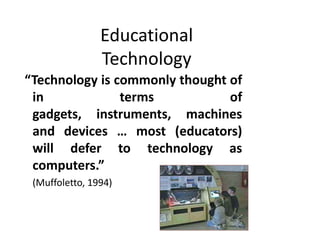
“Technology is commonly thought of
 in             terms           of
 gadgets, instruments, machines
 and devices … most (educators)
 will defer to technology as
 computers.”
 (Muffoletto, 1994)
The history of “Educational technology … can
be traced back to the time when tribal priests
systemized bodies of knowledge, and early
cultures invented pictographs or sign writing
to record and transmit information.”
(Paul Saettler, 1990)
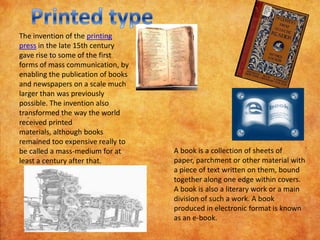
The invention of the printing
press in the late 15th century
gave rise to some of the first
forms of mass communication, by
enabling the publication of books
and newspapers on a scale much
larger than was previously
possible. The invention also
transformed the way the world
received printed
materials, although books
remained too expensive really to
be called a mass-medium for at      A book is a collection of sheets of
least a century after that.         paper, parchment or other material with
                                    a piece of text written on them, bound
                                    together along one edge within covers.
                                    A book is also a literary work or a main
                                    division of such a work. A book
                                    produced in electronic format is known
                                    as an e-book.
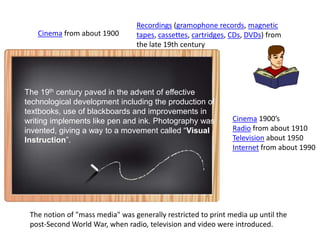
Recordings (gramophone records, magnetic
   Cinema from about 1900        tapes, cassettes, cartridges, CDs, DVDs) from
                                 the late 19th century


The 19th century paved in the advent of effective
technological development including the production of
textbooks, use of blackboards and improvements in
writing implements like pen and ink. Photography was           Cinema 1900’s
invented, giving a way to a movement called “Visual            Radio from about 1910
Instruction”.                                                  Television about 1950
                                                               Internet from about 1990


 The notion of "mass media" was generally restricted to print media up until the
 post-Second World War, when radio, television and video were introduced.
By 1920, visual media
 became widely accepted.
 Then came the publication of
 audio-visual media texts.

 In 1926, educational films
 were used as instructional
 media.

In 1932, the first instructional
television program was aired at the
State University of Iowa. About
the same time, the 16 mm sound
motion picture was developed and
this served as the educational
workhorse during the audio-visual
movement of the time.
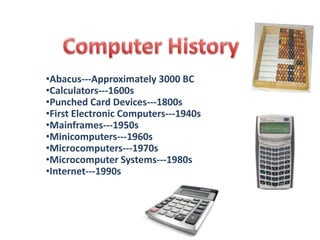
•Abacus---Approximately 3000 BC
•Calculators---1600s
•Punched Card Devices---1800s
•First Electronic Computers---1940s
•Mainframes---1950s
•Minicomputers---1960s
•Microcomputers---1970s
•Microcomputer Systems---1980s
•Internet---1990s
Introduced in late 1970’s.
Adopted by public school systems during 1980’s.
    •Apple II
Software

  Minnesota Educational
  Computing Consortium (MECC)
    Initially largest provider of
    educational software. Funded by
    National Science Foundation.
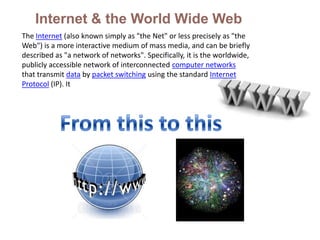
Internet & the World Wide Web
The Internet (also known simply as "the Net" or less precisely as "the
Web") is a more interactive medium of mass media, and can be briefly
described as "a network of networks". Specifically, it is the worldwide,
publicly accessible network of interconnected computer networks
that transmit data by packet switching using the standard Internet
Protocol (IP). It
• While many schools restrict access to blogs,
  WIKI’s etc…


                               …others embrace it.
Social Networking Tools
• 96% percent of U.S. students ages 9 to 17 who
  have internet access use social-networking
  technology to connect with their peers
  (chatting, text-messaging, blogging, or visiting
  online communities such as
  Facebook, MySpace, and Webkinz)
   – One of the most common topics of
     discussion…education
   – Nearly 60 percent of students report discussing
     education-related topics
Four Different Views
        Of Educational Technology
1. Association for Educational Communications &
   Technology (AECT)
     Audiovisual Media Communications: Begun in 1923. Initially centered on radio.
     Quickly extended focus to include instructional film strips and educational
     television. Today, it includes global satellite broadcasting, two-way audio, and
     visual communications.

   “Branch of educational theory and practice concerned primarily with the design
    and use of messages which control the learning process.” (Saettler, 1990, p. 9)


      Resource: AECT website: http://www.aect.org/newsite/
Four Different Views


2. ISPI:
Instructional systems approach based on Behaviorist theories
“Systematic approach to designing, developing, and delivering
instruction matched to carefully identified needs.”

                   (Heinich, Molenda, Russell, & Smaldino, 1997)


         Website: http://www.afc-ispi.org/
INTERNATIONAL TECHNOLOGY AND
                       ENGINEERING EDUCATORS ASSOCIATION


3. International Technology and Engineering Educators
   Association (ITEEA) is the professional organization for
   technology, innovation, design, and engineering
   educators. Instructional systems approach based on
   Behaviorist theories.

Industry trainers and vocational teachers.
Schools should prepare students for work force Learning
about technology as used in the “real world” is essential.
Includes robotics, manufacturing systems, computer-
assisted design (CAD).

 ITEEA website: http://www.iteea.org/Resources/resources.htm
4. ISTE
Primary focus encompassed both instructional and
support applications of computers. This group began by
trainers and educators who predicted that computers
would revolutionize education. ISTE is influenced by
technical personnel, such as programmers and systems
analysts.


                 ISTE website.
EDUCATIONAL TECHNOLOGY


                          Uses                               Governed by


 Techniques, Theories & methods                 Tools:                     Goal oriented problem-
from multiple knowledge domains            Film, Video, Co                    solving systems
   which are standardized and                  mputers                            approach
          reproducible


                                                       to
                                                                 Guide change agency and
      Design, develop and evaluate
                                                               transformation of educational
    human and mechanistic resources
                                                                   systems and practices
        effectively & efficiently


                   In order to                                     In order to

                                      Facilitate and                                    Contribute to
                                       leverage all                                     change within
                                        aspects of                                         society
                                         learning.
Our Definition:
  “A combination of the processes and tools
  involved in addressing educational needs
  and problems, with an emphasis on
  applying the most current tools:
  computers and their related
  technologies.”
                    (Roblyer, 2000)

Educational Technology History

  • 1.
    Educational Technology “Technology is commonly thought of in terms of gadgets, instruments, machines and devices … most (educators) will defer to technology as computers.” (Muffoletto, 1994)
  • 2.
    The history of“Educational technology … can be traced back to the time when tribal priests systemized bodies of knowledge, and early cultures invented pictographs or sign writing to record and transmit information.” (Paul Saettler, 1990)
  • 5.
    The invention ofthe printing press in the late 15th century gave rise to some of the first forms of mass communication, by enabling the publication of books and newspapers on a scale much larger than was previously possible. The invention also transformed the way the world received printed materials, although books remained too expensive really to be called a mass-medium for at A book is a collection of sheets of least a century after that. paper, parchment or other material with a piece of text written on them, bound together along one edge within covers. A book is also a literary work or a main division of such a work. A book produced in electronic format is known as an e-book.
  • 11.
    Recordings (gramophone records,magnetic Cinema from about 1900 tapes, cassettes, cartridges, CDs, DVDs) from the late 19th century The 19th century paved in the advent of effective technological development including the production of textbooks, use of blackboards and improvements in writing implements like pen and ink. Photography was Cinema 1900’s invented, giving a way to a movement called “Visual Radio from about 1910 Instruction”. Television about 1950 Internet from about 1990 The notion of "mass media" was generally restricted to print media up until the post-Second World War, when radio, television and video were introduced.
  • 13.
    By 1920, visualmedia became widely accepted. Then came the publication of audio-visual media texts. In 1926, educational films were used as instructional media. In 1932, the first instructional television program was aired at the State University of Iowa. About the same time, the 16 mm sound motion picture was developed and this served as the educational workhorse during the audio-visual movement of the time.
  • 15.
    •Abacus---Approximately 3000 BC •Calculators---1600s •PunchedCard Devices---1800s •First Electronic Computers---1940s •Mainframes---1950s •Minicomputers---1960s •Microcomputers---1970s •Microcomputer Systems---1980s •Internet---1990s
  • 16.
    Introduced in late1970’s. Adopted by public school systems during 1980’s. •Apple II
  • 17.
    Software MinnesotaEducational Computing Consortium (MECC) Initially largest provider of educational software. Funded by National Science Foundation.
  • 18.
    Internet & theWorld Wide Web The Internet (also known simply as "the Net" or less precisely as "the Web") is a more interactive medium of mass media, and can be briefly described as "a network of networks". Specifically, it is the worldwide, publicly accessible network of interconnected computer networks that transmit data by packet switching using the standard Internet Protocol (IP). It
  • 20.
    • While manyschools restrict access to blogs, WIKI’s etc… …others embrace it.
  • 21.
    Social Networking Tools •96% percent of U.S. students ages 9 to 17 who have internet access use social-networking technology to connect with their peers (chatting, text-messaging, blogging, or visiting online communities such as Facebook, MySpace, and Webkinz) – One of the most common topics of discussion…education – Nearly 60 percent of students report discussing education-related topics
  • 22.
    Four Different Views Of Educational Technology 1. Association for Educational Communications & Technology (AECT) Audiovisual Media Communications: Begun in 1923. Initially centered on radio. Quickly extended focus to include instructional film strips and educational television. Today, it includes global satellite broadcasting, two-way audio, and visual communications.  “Branch of educational theory and practice concerned primarily with the design and use of messages which control the learning process.” (Saettler, 1990, p. 9) Resource: AECT website: http://www.aect.org/newsite/
  • 23.
    Four Different Views 2.ISPI: Instructional systems approach based on Behaviorist theories “Systematic approach to designing, developing, and delivering instruction matched to carefully identified needs.” (Heinich, Molenda, Russell, & Smaldino, 1997) Website: http://www.afc-ispi.org/
  • 24.
    INTERNATIONAL TECHNOLOGY AND ENGINEERING EDUCATORS ASSOCIATION 3. International Technology and Engineering Educators Association (ITEEA) is the professional organization for technology, innovation, design, and engineering educators. Instructional systems approach based on Behaviorist theories. Industry trainers and vocational teachers. Schools should prepare students for work force Learning about technology as used in the “real world” is essential. Includes robotics, manufacturing systems, computer- assisted design (CAD). ITEEA website: http://www.iteea.org/Resources/resources.htm
  • 25.
    4. ISTE Primary focusencompassed both instructional and support applications of computers. This group began by trainers and educators who predicted that computers would revolutionize education. ISTE is influenced by technical personnel, such as programmers and systems analysts. ISTE website.
  • 26.
    EDUCATIONAL TECHNOLOGY Uses Governed by Techniques, Theories & methods Tools: Goal oriented problem- from multiple knowledge domains Film, Video, Co solving systems which are standardized and mputers approach reproducible to Guide change agency and Design, develop and evaluate transformation of educational human and mechanistic resources systems and practices effectively & efficiently In order to In order to Facilitate and Contribute to leverage all change within aspects of society learning.
  • 27.
    Our Definition: “A combination of the processes and tools involved in addressing educational needs and problems, with an emphasis on applying the most current tools: computers and their related technologies.” (Roblyer, 2000)

Editor's Notes

  • #27 I firmly believe that the future of Educational Technology is now in the hands of those conceptualizing technology concerned with mental processes and products to serve human purposes .