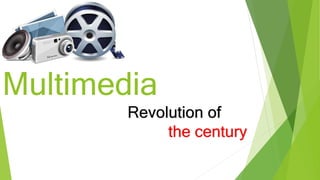
Multimedia
Revolution of
the century
PRESENTED BY
Nittanado Sarker 162-15-****
Mahmudul Hasan 162-15-****
Samin Yasar 162-15-****
Nihas 162-15-****
INTRODUCTION
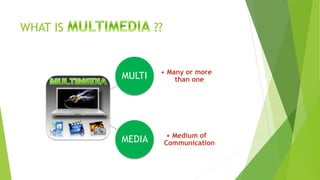
WHAT IS ??
MULTI • Many or more
than one
MEDIA • Medium of
Communication
MULTIMEDIA..
 Multimedia is media and content that uses a combination of
different content forms.
 The term is used in contrast to media which only use traditional forms of
printed or hand-produced material.
 Multimedia includes a combination of
 Audio
 Still images
 Animation video
 Interactivity content forms….
History…..
 The term “MULTIMEDIA” was first used by BOB GOLDSTEIN in July 1996 to
promote opening of his light works.
 In 1970s the term was used to describe presentations consisting of multi-
projector slide shows timed to an audio track. In 1990s “MULTIMEDIA” took
on its current meaning.
 Computers marketed in 1990s were referred to as “MULTIMEDIA COMPUTERS”
because they contained a CD-ROM drive.
 TAY VAUGHAN declared “Multimedia as combination of text, graphic art,
sound, animation, and video that is delivered by computer.
CATEGORIZATION….
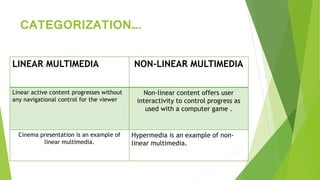
LINEAR MULTIMEDIA NON-LINEAR MULTIMEDIA
Linear active content progresses without
any navigational control for the viewer
Non-linear content offers user
interactivity to control progress as
used with a computer game .
Cinema presentation is an example of
linear multimedia.
Hypermedia is an example of non-
linear multimedia.
CHARACTERISTICS….
 Multimedia presentations can be viewed in person on stage, projected,
transmitted, or played locally with a media player.
 Broadcasts and recordings can be either analog or digital electronic media
technology.
 The various formats of technological or digital multimedia may be intended to
enhance the users' experience.
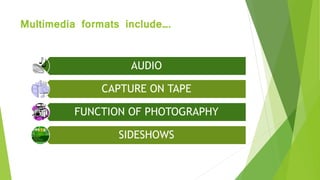
Multimedia formats include….
AUDIO
CAPTURE ON TAPE
FUNCTION OF PHOTOGRAPHY
SIDESHOWS
 The following extensions commonly used to lay up multimedia
documentation:
 .MOV
 .MP4
 .3GP
 .VOB
 .FLV
 Files with augmentation .MOV are used to lay up capture on film and song in
order.
 .MP4 is fundamentally identical to MOV format and lone differs by provided
that roughly added metadata.
 .MP4 put on record augmentation is supported by multiple applications with
Apple ITunes, XBox 360.
 MPEG is a align of compressions methods designed for audio and visual data.
 File Extension VOB (Video Object) is commonly locate such documents in
DVD-Video media.
 File Extension FLV is used to deposit Macromedia Flash Player collection. It
can assign vector graphics, spill videocassette, audio and text.
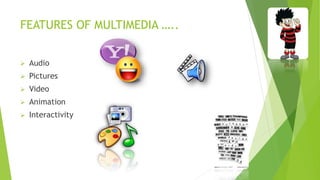
FEATURES OF MULTIMEDIA …..
 Audio
 Pictures
 Video
 Animation
 Interactivity
 Audio refers to sound. Multimedia can include files which contain sounds.
 Pictures(images) is a two-dimensional screen display, and as well as a three-
dimensional, such as a statue or hologram. Graphs, pie-charts, painting etc.
all come under images.
 The advantage of integrating video into a multimedia presentation is the
capacity to effectively convey a great deal of information in the least amount
of time.
 Animation is the rapid display of a sequence of images of 2-D or 3-D artwork
or model positions in order to create an illusion of movement.
 Interactive multimedia refers to the multimedia applications that allow users
to actively participate rather than being passive recipients of information.
MULTIMEDIA TODAY…
 Multimedia and its related applications have almost become synonymous
with modern technology; given the kind of explosion the technological realm
has seem.
 Multimedia makes our life easier several times fold. It is through multimedia
that mobile phones can be used for a number of purposes.
 Video conferencing which enables people across global borders to
communicate with each other in real time is an excellent example of how
multimedia has benefited the world of communications and telephony.
 The technology of multimedia design utilizes various features like animation,
video, graphics, audio and sound to impress the users.
 Multimedia technology is used for 3D cinema applications and mobile 3DTV
environments.
 Animation is also being used in titling films, creating special effects or in web
entertainment programs. Thus scope of animation is huge in context to
market.
 Multimedia is also used in advertising purposes.
FUTURE OF MULTIMEDIA…
ADVANTAGES…
 Multimedia enhances the effect of text presentations. Improves the quality
of presentation and retains the attention of audience.
 It can be used for educational as well as entertainment purpose.
 It is quick and easier to operate for the instructor.
 Multimedia presentations can be modified very easily.
 Multimedia is Entertaining as Well as Educational.
Dis-advantages:-
 Non-interactive – if one-way, no feedback.
 Complex to create.
 Time consuming.
 Use of multimedia is expensive.
 COMMERCIAL
 Much of the electronic old and new media used by commercial
artists is multimedia.
 Exciting presentations are used to grab and keep attention
in advertising.
 ENTERTAINMENT AND FINE ARTS
 Multimedia is heavily used in the entertainment industry, especially to
develop special effects in movies and animations.
 Multimedia games are also very popular.
 EDUCATION
 Multimedia is used to produce computer-based training courses.
 Edutainment is an informal term used to describe combining
education with entertainment, especially multimedia entertainment.
 ENGINEERING
 Software engineers may use multimedia in Computer Simulations.
 Multimedia for software interfaces are often done as a collaboration
between creative professionals and software engineers.
 And this is the CONCLUSION multimedia can help to gain and hold
attention, make points clearer, stimulate discussion, and in general, enhance
the learning process, if it also includes the appropriate human elements.
The End

CSE-113

  • 1.
  • 2.
    PRESENTED BY Nittanado Sarker162-15-**** Mahmudul Hasan 162-15-**** Samin Yasar 162-15-**** Nihas 162-15-****
  • 3.
  • 4.
    WHAT IS ?? MULTI• Many or more than one MEDIA • Medium of Communication
  • 5.
    MULTIMEDIA..  Multimedia ismedia and content that uses a combination of different content forms.  The term is used in contrast to media which only use traditional forms of printed or hand-produced material.  Multimedia includes a combination of  Audio  Still images  Animation video  Interactivity content forms….
  • 6.
    History…..  The term“MULTIMEDIA” was first used by BOB GOLDSTEIN in July 1996 to promote opening of his light works.  In 1970s the term was used to describe presentations consisting of multi- projector slide shows timed to an audio track. In 1990s “MULTIMEDIA” took on its current meaning.  Computers marketed in 1990s were referred to as “MULTIMEDIA COMPUTERS” because they contained a CD-ROM drive.  TAY VAUGHAN declared “Multimedia as combination of text, graphic art, sound, animation, and video that is delivered by computer.
  • 7.
    CATEGORIZATION…. LINEAR MULTIMEDIA NON-LINEARMULTIMEDIA Linear active content progresses without any navigational control for the viewer Non-linear content offers user interactivity to control progress as used with a computer game . Cinema presentation is an example of linear multimedia. Hypermedia is an example of non- linear multimedia.
  • 8.
    CHARACTERISTICS….  Multimedia presentationscan be viewed in person on stage, projected, transmitted, or played locally with a media player.  Broadcasts and recordings can be either analog or digital electronic media technology.  The various formats of technological or digital multimedia may be intended to enhance the users' experience.
  • 9.
    Multimedia formats include…. AUDIO CAPTUREON TAPE FUNCTION OF PHOTOGRAPHY SIDESHOWS
  • 10.
     The followingextensions commonly used to lay up multimedia documentation:  .MOV  .MP4  .3GP  .VOB  .FLV  Files with augmentation .MOV are used to lay up capture on film and song in order.  .MP4 is fundamentally identical to MOV format and lone differs by provided that roughly added metadata.  .MP4 put on record augmentation is supported by multiple applications with Apple ITunes, XBox 360.
  • 11.
     MPEG isa align of compressions methods designed for audio and visual data.  File Extension VOB (Video Object) is commonly locate such documents in DVD-Video media.  File Extension FLV is used to deposit Macromedia Flash Player collection. It can assign vector graphics, spill videocassette, audio and text.
  • 12.
    FEATURES OF MULTIMEDIA…..  Audio  Pictures  Video  Animation  Interactivity
  • 13.
     Audio refersto sound. Multimedia can include files which contain sounds.  Pictures(images) is a two-dimensional screen display, and as well as a three- dimensional, such as a statue or hologram. Graphs, pie-charts, painting etc. all come under images.  The advantage of integrating video into a multimedia presentation is the capacity to effectively convey a great deal of information in the least amount of time.  Animation is the rapid display of a sequence of images of 2-D or 3-D artwork or model positions in order to create an illusion of movement.  Interactive multimedia refers to the multimedia applications that allow users to actively participate rather than being passive recipients of information.
  • 14.
    MULTIMEDIA TODAY…  Multimediaand its related applications have almost become synonymous with modern technology; given the kind of explosion the technological realm has seem.  Multimedia makes our life easier several times fold. It is through multimedia that mobile phones can be used for a number of purposes.  Video conferencing which enables people across global borders to communicate with each other in real time is an excellent example of how multimedia has benefited the world of communications and telephony.
  • 15.
     The technologyof multimedia design utilizes various features like animation, video, graphics, audio and sound to impress the users.  Multimedia technology is used for 3D cinema applications and mobile 3DTV environments.  Animation is also being used in titling films, creating special effects or in web entertainment programs. Thus scope of animation is huge in context to market.  Multimedia is also used in advertising purposes. FUTURE OF MULTIMEDIA…
  • 16.
    ADVANTAGES…  Multimedia enhancesthe effect of text presentations. Improves the quality of presentation and retains the attention of audience.  It can be used for educational as well as entertainment purpose.  It is quick and easier to operate for the instructor.  Multimedia presentations can be modified very easily.  Multimedia is Entertaining as Well as Educational. Dis-advantages:-  Non-interactive – if one-way, no feedback.  Complex to create.  Time consuming.  Use of multimedia is expensive.
  • 17.
     COMMERCIAL  Muchof the electronic old and new media used by commercial artists is multimedia.  Exciting presentations are used to grab and keep attention in advertising.  ENTERTAINMENT AND FINE ARTS  Multimedia is heavily used in the entertainment industry, especially to develop special effects in movies and animations.  Multimedia games are also very popular.  EDUCATION  Multimedia is used to produce computer-based training courses.  Edutainment is an informal term used to describe combining education with entertainment, especially multimedia entertainment.  ENGINEERING  Software engineers may use multimedia in Computer Simulations.  Multimedia for software interfaces are often done as a collaboration between creative professionals and software engineers.
  • 18.
     And thisis the CONCLUSION multimedia can help to gain and hold attention, make points clearer, stimulate discussion, and in general, enhance the learning process, if it also includes the appropriate human elements.
  • 19.