Index
• 1. Abstract
•2. Introduction
• 3. Problem Statement
• 4. Proposed System
• 5.Modules
• 6. System Requirements
• 7. Methodology
• 8.Conclusion
3.
Abstract
• The RoommateFinder project aims to provide
a secure, reliable, and efficient digital platform
for finding suitable roommates and shared
housing. The system focuses on compatibility,
user safety, and ease of access, overcoming
the limitations of traditional methods such as
classifieds and social media groups.
4.
Introduction
• Finding asuitable roommate is challenging
due to mismatched expectations, unreliable
sources, and lack of verification. The project
introduces a modern digital solution to
simplify this process, especially for students,
professionals, and newcomers.
5.
Problem Statement
• Traditionalroommate search methods
(classifieds, word of mouth, social media) are
time-consuming, unreliable, and lack security.
• Issues such as mismatched budgets, habits,
and preferences often result in conflicts. A
structured platform is required for secure and
efficient roommate matching.
6.
Proposed System
• Aweb and mobile platform to find compatible
roommates.
• Advanced search filters: budget, location,
lifestyle, gender preference.
• Matching algorithm for compatibility.
• Secure communication and user verification.
7.
Modules
• User Module– Registration, login, profile
creation.
• Search & Filter Module – Find
roommates/rooms by preferences.
• Listing Module – Post and manage
room/accommodation ads.
• Admin Module – Manage users, listings, and
reports.
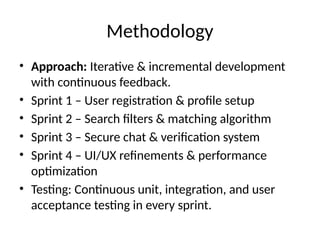
Methodology
• Approach: Iterative& incremental development
with continuous feedback.
• Sprint 1 – User registration & profile setup
• Sprint 2 – Search filters & matching algorithm
• Sprint 3 – Secure chat & verification system
• Sprint 4 – UI/UX refinements & performance
optimization
• Testing: Continuous unit, integration, and user
acceptance testing in every sprint.
10.
Conclusion
• The RoommateFinder ensures a safe, quick,
and reliable way to connect with compatible
roommates using filters, matching, and secure
communication.
#9 Unit testing = checks small code pieces work individually.
Integration testing = checks modules/services work together.
User acceptance testing = checks the whole system meets user/business needs.
Continuous = these tests run automatically and frequently (CI/CD) to catch issues early.