Therapeutic
Communication
Dr. James Malce Alo,
RN,MAN,MAP,PHD
WHAT IS THERAPEUTIC
COMMUNICATION?
 Interpersonal interaction between the
nurse and client during which the nurse
focuses on the client’s specific needs to
promote an effective exchange of
information.
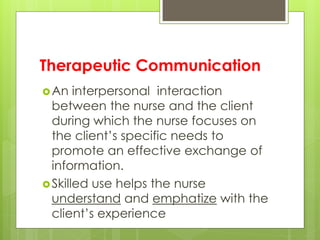
Therapeutic Communication
An interpersonal interaction
between the nurse and the client
during which the nurse focuses on
the client’s specific needs to
promote an effective exchange of
information.
Skilled use helps the nurse
understand and emphatize with the
client’s experience
Goals of Therapeutic
Communication
 Establish a therapeutic nurse-client relationship.
 Identify the most important client concern at
that moment (the client-centered goal).
 Assess the client’s perception of the problem as
it unfolds. This includes detailed actions
(behaviors and messages) of the people
involved and the client’s thoughts and feelings
about the situation, others, and self.
Facilitate the client’s expression of
emotions.
Teach the client and family necessary
self-care skills.
Recognize the client’s needs.
Guide the client toward identifying a
plan of action to a satisfying and socially
acceptable situation.
Communication
 is the process that people use to
exchange information.
 Messages are simultaneously sent and
received on two levels:
1) verbally through the use of words and
2) nonverbally by behaviors that
accompany the words (Balzer Riley, 2000).
Verbal communication
 consists of the words a person uses to
speak to one or more listeners.
1. Content - the literal words that a person
speaks.
2. Context is the environment in which
communication occurs and can include
the time and the physical, social,
emotional, and cultural environment
(Weaver, 1996).
Nonverbal communication
 is the behavior that accompanies verbal
content such as body language, eye
contact, facial expression, tone of voice,
speed and hesitations in speech, grunts
and groans, and distance from the
listener.
 Nonverbal communication can indicate
the speaker’s thoughts, feelings, needs,
and values that the speaker acts out
mostly unconsciously.
Congruent message
 is when content and process agree.
 For example, a client says, “I know I haven’t
been myself. I need help.” She has a sad
facial expression and a genuine and
sincere voice tone.
Incongruent message
 content and process disagree—when
what the speaker says and what he or she
does do not agree.
Therapeutic communication can help
nurses to accomplish many goals:
 Establish a
therapeutic nurse–
client relationship
 Identify
 Assess
 Facilitate
 Teach
 Recognize
 Guide
Proxemics
 is the study of distance zones between people
during communication.
 four distance zones:
 Intimate zone (0 to 18 inches between people):
parents with young children.
 Personal zone (18 to 36 inches): family and
friends who are talking.
 Social zone (4 to 12 feet): in social, work, and
business settings.
 Public zone (12 to 25 feet): speaker and an
audience, small groups, and other informal
functions (Hall, 1963).
Touch
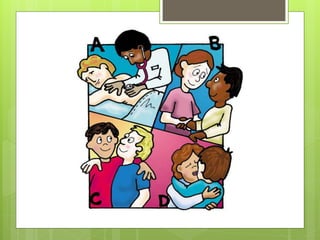
 Functional-professional touch is used in
examinations or procedures.
 Social-polite touch is used in greeting,
such as a handshake.
 Friendship-warmth touch involves a hug in
greeting, an arm thrown around the
shoulder of a good friend, or the back
slapping some men use to greet friends
and relatives.
 Love-intimacy touch involves tight hugs
and kisses between lovers or close
relatives.
 Sexual-arousal touch is used by lovers.
Active listening
 means refraining from other internal
mental activities and concentrating
exclusively on what the client says.
Active observation
 means watching the speaker’s nonverbal
actions as he or she communicates
Conditions Affecting
Communication
 Values
 Attitudes
 Beliefs
 Perceptions
 Culture or Religion
 Social Status
 Gender
 Age or
developmental
level
 Environment
Enhancing Communication
 Silence
 Support/reassurance
 Sharing Observations
 Acknowledge
feelings
 Broad – open ended
statements
 Information giving
 Interpretation
 Restating
 Reflecting
 Clarification
 Confrontation
 Offering
Alternatives
 Voicing doubt
 Role-playing
 Use of Humor – use
cautiously/discretel
y
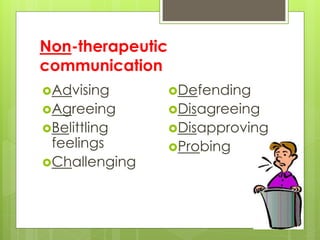
Non-therapeutic
communication
Advising
Agreeing
Belittling
feelings
Challenging
Defending
Disagreeing
Disapproving
Probing
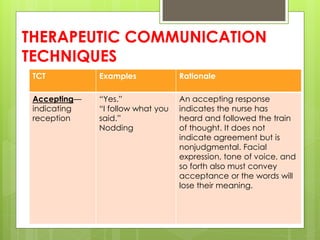
THERAPEUTIC COMMUNICATION
TECHNIQUES
TCT Examples Rationale
Accepting—
indicating
reception
“Yes.”
“I follow what you
said.”
Nodding
An accepting response
indicates the nurse has
heard and followed the train
of thought. It does not
indicate agreement but is
nonjudgmental. Facial
expression, tone of voice, and
so forth also must convey
acceptance or the words will
lose their meaning.
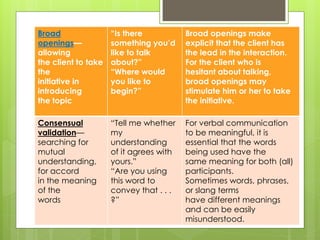
Broad
openings—
allowing
the client to take
the
initiative in
introducing
the topic
“Is there
something you’d
like to talk
about?”
“Where would
you like to
begin?”
Broad openings make
explicit that the client has
the lead in the interaction.
For the client who is
hesitant about talking,
broad openings may
stimulate him or her to take
the initiative.
Consensual
validation—
searching for
mutual
understanding,
for accord
in the meaning
of the
words
“Tell me whether
my
understanding
of it agrees with
yours.”
“Are you using
this word to
convey that . . .
?”
For verbal communication
to be meaningful, it is
essential that the words
being used have the
same meaning for both (all)
participants.
Sometimes words, phrases,
or slang terms
have different meanings
and can be easily
misunderstood.
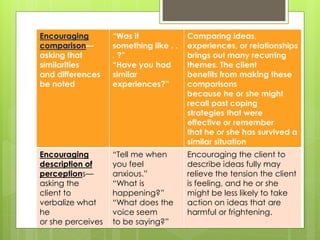
Encouraging
comparison—
asking that
similarities
and differences
be noted
“Was it
something like . .
. ?”
“Have you had
similar
experiences?”
Comparing ideas,
experiences, or relationships
brings out many recurring
themes. The client
benefits from making these
comparisons
because he or she might
recall past coping
strategies that were
effective or remember
that he or she has survived a
similar situation
Encouraging
description of
perceptions—
asking the
client to
verbalize what
he
or she perceives
“Tell me when
you feel
anxious.”
“What is
happening?”
“What does the
voice seem
to be saying?”
Encouraging the client to
describe ideas fully may
relieve the tension the client
is feeling, and he or she
might be less likely to take
action on ideas that are
harmful or frightening.
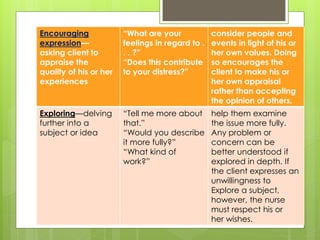
Encouraging
expression—
asking client to
appraise the
quality of his or her
experiences
“What are your
feelings in regard to .
. . ?”
“Does this contribute
to your distress?”
consider people and
events in light of his or
her own values. Doing
so encourages the
client to make his or
her own appraisal
rather than accepting
the opinion of others.
Exploring—delving
further into a
subject or idea
“Tell me more about
that.”
“Would you describe
it more fully?”
“What kind of
work?”
help them examine
the issue more fully.
Any problem or
concern can be
better understood if
explored in depth. If
the client expresses an
unwillingness to
Explore a subject,
however, the nurse
must respect his or
her wishes.
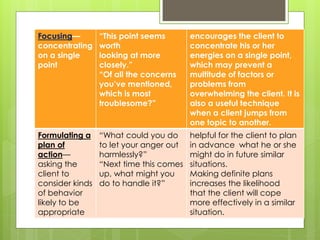
Focusing—
concentrating
on a single
point
“This point seems
worth
looking at more
closely.”
“Of all the concerns
you’ve mentioned,
which is most
troublesome?”
encourages the client to
concentrate his or her
energies on a single point,
which may prevent a
multitude of factors or
problems from
overwhelming the client. It is
also a useful technique
when a client jumps from
one topic to another.
Formulating a
plan of
action—
asking the
client to
consider kinds
of behavior
likely to be
appropriate
“What could you do
to let your anger out
harmlessly?”
“Next time this comes
up, what might you
do to handle it?”
helpful for the client to plan
in advance what he or she
might do in future similar
situations.
Making definite plans
increases the likelihood
that the client will cope
more effectively in a similar
situation.
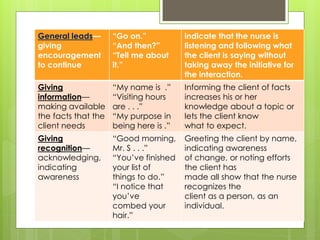
General leads—
giving
encouragement
to continue
“Go on.”
“And then?”
“Tell me about
it.”
indicate that the nurse is
listening and following what
the client is saying without
taking away the initiative for
the interaction.
Giving
information—
making available
the facts that the
client needs
“My name is .”
“Visiting hours
are . . .”
“My purpose in
being here is .”
Informing the client of facts
increases his or her
knowledge about a topic or
lets the client know
what to expect.
Giving
recognition—
acknowledging,
indicating
awareness
“Good morning,
Mr. S . . .”
“You’ve finished
your list of
things to do.”
“I notice that
you’ve
combed your
hair.”
Greeting the client by name,
indicating awareness
of change, or noting efforts
the client has
made all show that the nurse
recognizes the
client as a person, as an
individual.
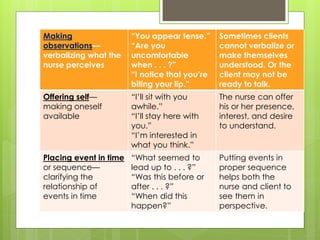
Making
observations—
verbalizing what the
nurse perceives
“You appear tense.”
“Are you
uncomfortable
when . . . ?”
“I notice that you’re
biting your lip.”
Sometimes clients
cannot verbalize or
make themselves
understood. Or the
client may not be
ready to talk.
Offering self—
making oneself
available
“I’ll sit with you
awhile.”
“I’ll stay here with
you.”
“I’m interested in
what you think.”
The nurse can offer
his or her presence,
interest, and desire
to understand.
Placing event in time
or sequence—
clarifying the
relationship of
events in time
“What seemed to
lead up to . . . ?”
“Was this before or
after . . . ?”
“When did this
happen?”
Putting events in
proper sequence
helps both the
nurse and client to
see them in
perspective.
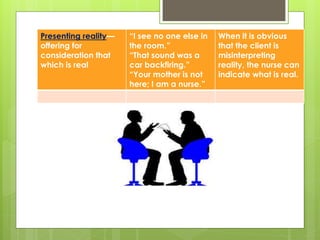
Presenting reality—
offering for
consideration that
which is real
“I see no one else in
the room.”
“That sound was a
car backfiring.”
“Your mother is not
here; I am a nurse.”
When it is obvious
that the client is
misinterpreting
reality, the nurse can
indicate what is real.
Thank YOU!
- Dr. James Malce Alo

Therapeutic Communication.drjma

  • 1.
  • 2.
    WHAT IS THERAPEUTIC COMMUNICATION? Interpersonal interaction between the nurse and client during which the nurse focuses on the client’s specific needs to promote an effective exchange of information.
  • 3.
    Therapeutic Communication An interpersonalinteraction between the nurse and the client during which the nurse focuses on the client’s specific needs to promote an effective exchange of information. Skilled use helps the nurse understand and emphatize with the client’s experience
  • 4.
    Goals of Therapeutic Communication Establish a therapeutic nurse-client relationship.  Identify the most important client concern at that moment (the client-centered goal).  Assess the client’s perception of the problem as it unfolds. This includes detailed actions (behaviors and messages) of the people involved and the client’s thoughts and feelings about the situation, others, and self.
  • 5.
    Facilitate the client’sexpression of emotions. Teach the client and family necessary self-care skills. Recognize the client’s needs. Guide the client toward identifying a plan of action to a satisfying and socially acceptable situation.
  • 6.
    Communication  is theprocess that people use to exchange information.  Messages are simultaneously sent and received on two levels: 1) verbally through the use of words and 2) nonverbally by behaviors that accompany the words (Balzer Riley, 2000).
  • 7.
    Verbal communication  consistsof the words a person uses to speak to one or more listeners. 1. Content - the literal words that a person speaks. 2. Context is the environment in which communication occurs and can include the time and the physical, social, emotional, and cultural environment (Weaver, 1996).
  • 8.
    Nonverbal communication  isthe behavior that accompanies verbal content such as body language, eye contact, facial expression, tone of voice, speed and hesitations in speech, grunts and groans, and distance from the listener.  Nonverbal communication can indicate the speaker’s thoughts, feelings, needs, and values that the speaker acts out mostly unconsciously.
  • 9.
    Congruent message  iswhen content and process agree.  For example, a client says, “I know I haven’t been myself. I need help.” She has a sad facial expression and a genuine and sincere voice tone.
  • 10.
    Incongruent message  contentand process disagree—when what the speaker says and what he or she does do not agree.
  • 11.
    Therapeutic communication canhelp nurses to accomplish many goals:  Establish a therapeutic nurse– client relationship  Identify  Assess  Facilitate  Teach  Recognize  Guide
  • 12.
    Proxemics  is thestudy of distance zones between people during communication.  four distance zones:  Intimate zone (0 to 18 inches between people): parents with young children.  Personal zone (18 to 36 inches): family and friends who are talking.  Social zone (4 to 12 feet): in social, work, and business settings.  Public zone (12 to 25 feet): speaker and an audience, small groups, and other informal functions (Hall, 1963).
  • 13.
    Touch  Functional-professional touchis used in examinations or procedures.  Social-polite touch is used in greeting, such as a handshake.  Friendship-warmth touch involves a hug in greeting, an arm thrown around the shoulder of a good friend, or the back slapping some men use to greet friends and relatives.  Love-intimacy touch involves tight hugs and kisses between lovers or close relatives.  Sexual-arousal touch is used by lovers.
  • 15.
    Active listening  meansrefraining from other internal mental activities and concentrating exclusively on what the client says.
  • 16.
    Active observation  meanswatching the speaker’s nonverbal actions as he or she communicates
  • 17.
    Conditions Affecting Communication  Values Attitudes  Beliefs  Perceptions  Culture or Religion  Social Status  Gender  Age or developmental level  Environment
  • 18.
    Enhancing Communication  Silence Support/reassurance  Sharing Observations  Acknowledge feelings  Broad – open ended statements  Information giving  Interpretation  Restating  Reflecting  Clarification  Confrontation  Offering Alternatives  Voicing doubt  Role-playing  Use of Humor – use cautiously/discretel y
  • 19.
  • 20.
    THERAPEUTIC COMMUNICATION TECHNIQUES TCT ExamplesRationale Accepting— indicating reception “Yes.” “I follow what you said.” Nodding An accepting response indicates the nurse has heard and followed the train of thought. It does not indicate agreement but is nonjudgmental. Facial expression, tone of voice, and so forth also must convey acceptance or the words will lose their meaning.
  • 21.
    Broad openings— allowing the client totake the initiative in introducing the topic “Is there something you’d like to talk about?” “Where would you like to begin?” Broad openings make explicit that the client has the lead in the interaction. For the client who is hesitant about talking, broad openings may stimulate him or her to take the initiative. Consensual validation— searching for mutual understanding, for accord in the meaning of the words “Tell me whether my understanding of it agrees with yours.” “Are you using this word to convey that . . . ?” For verbal communication to be meaningful, it is essential that the words being used have the same meaning for both (all) participants. Sometimes words, phrases, or slang terms have different meanings and can be easily misunderstood.
  • 22.
    Encouraging comparison— asking that similarities and differences benoted “Was it something like . . . ?” “Have you had similar experiences?” Comparing ideas, experiences, or relationships brings out many recurring themes. The client benefits from making these comparisons because he or she might recall past coping strategies that were effective or remember that he or she has survived a similar situation Encouraging description of perceptions— asking the client to verbalize what he or she perceives “Tell me when you feel anxious.” “What is happening?” “What does the voice seem to be saying?” Encouraging the client to describe ideas fully may relieve the tension the client is feeling, and he or she might be less likely to take action on ideas that are harmful or frightening.
  • 23.
    Encouraging expression— asking client to appraisethe quality of his or her experiences “What are your feelings in regard to . . . ?” “Does this contribute to your distress?” consider people and events in light of his or her own values. Doing so encourages the client to make his or her own appraisal rather than accepting the opinion of others. Exploring—delving further into a subject or idea “Tell me more about that.” “Would you describe it more fully?” “What kind of work?” help them examine the issue more fully. Any problem or concern can be better understood if explored in depth. If the client expresses an unwillingness to Explore a subject, however, the nurse must respect his or her wishes.
  • 24.
    Focusing— concentrating on a single point “Thispoint seems worth looking at more closely.” “Of all the concerns you’ve mentioned, which is most troublesome?” encourages the client to concentrate his or her energies on a single point, which may prevent a multitude of factors or problems from overwhelming the client. It is also a useful technique when a client jumps from one topic to another. Formulating a plan of action— asking the client to consider kinds of behavior likely to be appropriate “What could you do to let your anger out harmlessly?” “Next time this comes up, what might you do to handle it?” helpful for the client to plan in advance what he or she might do in future similar situations. Making definite plans increases the likelihood that the client will cope more effectively in a similar situation.
  • 25.
    General leads— giving encouragement to continue “Goon.” “And then?” “Tell me about it.” indicate that the nurse is listening and following what the client is saying without taking away the initiative for the interaction. Giving information— making available the facts that the client needs “My name is .” “Visiting hours are . . .” “My purpose in being here is .” Informing the client of facts increases his or her knowledge about a topic or lets the client know what to expect. Giving recognition— acknowledging, indicating awareness “Good morning, Mr. S . . .” “You’ve finished your list of things to do.” “I notice that you’ve combed your hair.” Greeting the client by name, indicating awareness of change, or noting efforts the client has made all show that the nurse recognizes the client as a person, as an individual.
  • 26.
    Making observations— verbalizing what the nurseperceives “You appear tense.” “Are you uncomfortable when . . . ?” “I notice that you’re biting your lip.” Sometimes clients cannot verbalize or make themselves understood. Or the client may not be ready to talk. Offering self— making oneself available “I’ll sit with you awhile.” “I’ll stay here with you.” “I’m interested in what you think.” The nurse can offer his or her presence, interest, and desire to understand. Placing event in time or sequence— clarifying the relationship of events in time “What seemed to lead up to . . . ?” “Was this before or after . . . ?” “When did this happen?” Putting events in proper sequence helps both the nurse and client to see them in perspective.
  • 27.
    Presenting reality— offering for considerationthat which is real “I see no one else in the room.” “That sound was a car backfiring.” “Your mother is not here; I am a nurse.” When it is obvious that the client is misinterpreting reality, the nurse can indicate what is real.
  • 28.
    Thank YOU! - Dr.James Malce Alo