Japanese occupation of Korea   1895 Signing of the Treaty of Shimonoseki to stop the Chinese-Japanese war.   Assassination of Queen Min by the Japanese in Korea   The Treaty of Shimonoseki was signed on April 17, 1895.  Main consequences: - Japanese sovereignty over Taiwan. - Japanese protectorate over Korea.   Myeonseong, known as Queen Min was the last empress of Korea.  Established foreign relations with Russia and China to prevent the Japanese from taking over Korea.   She was killed by the Japanese on 1895, which received many criticisms.
1907 Russo-Japanese War 1904-1905 The Emperor Kojong of Korea, refused to sign the agreement that gave the power over the Korean protectorate to Japan, and abdicated.  He was succeeded by his son Sunjong more manipunable.  1910 Korea was annexed to the Japanese Empire in 1910 with the Taft-Katsura Covenant.  Extinction of the Joseon Dynasty.
1917 Proclamation of the Declaration of Independence of Korea by a group of patriots in Manchuria.  Prohibition of publication of magazines and newspapers, meetings and associations of any kind in Korea by the Japanese government.  Obligation to carry sword and uniform for all staff.  1919 A strong anti-japan feeling appeared. March 11: peaceful independence movement sated with bloodshed.   April 11: Korean government was established in exile in Shanghai.  Kim Yeongnang
1926 Death of Emperor Sunjong.   Demonstrations in favor of independence in Seoul.   1929 Violent anti-Japanese student movements 1931-1934 Emperor Pu Yi With little resistance, Japan conquered Manchuria in 1931.   The Japanese stated that this conquest was a liberation from Chinese in Manchuria. They did so to appease anti-Japanese sentiment and mislead the international media.  In 1934, former Chinese emperor Pu Yi became emperor of Manchukuo (Manchuria).   However, the power over Manchuria actually fell on the Japanese government.
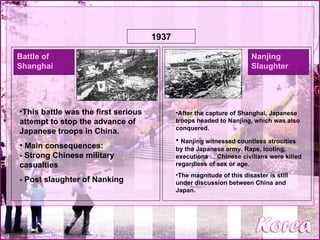
1937 Battle of Shanghai   Nanjing Slaughter   This battle was the first serious attempt to stop the advance of Japanese troops in China.   Main consequences: - Strong Chinese military casualties   - Post slaughter of Nanking  After the capture of Shanghai, Japanese troops headed to Nanjing, which was also conquered.  Nanjing witnessed countless atrocities by the Japanese army. Rape, looting, executions ... Chinese civilians were killed regardless of sex or age. The magnitude of this disaster is still under discussion between China and Japan.
1938 Japan takes up the entire coast of China, and controls its five largest cities.  1940 1940-1942 1941 In order to avoid the U.S. supply to China, Japan decided to invade French Indochina.  Taking advantage of French weakness, Japan signed a treaty with that country which allowed the presence of a number of Japanese soldiers in the territory.  The treaty was violated by the Japanese, and so began the fighting. The victory went to Japan.   Promulgation of the decree that forced Koreans to Japanize their names.  Ban Korean newspapers publish “Tonga Ibo” and “Choson Ibo”.  Japan attacks Pearl Harbour
Map of the Japanese Empire
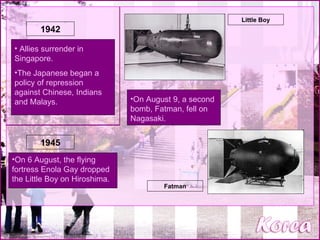
1942 Allies surrender in Singapore.  The Japanese began a policy of repression against Chinese, Indians and Malays.  1945 On 6 August, the flying fortress Enola Gay dropped the Little Boy on Hiroshima.  Little Boy On August 9, a second bomb, Fatman, fell on Nagasaki.  Fatman
1945 The Soviet Union declares war on Japan.  Invasion of Soviet troops in Korea  End of World War II  Defeat of Japan   Korea's division into two zones along the 38th parallel and occupation of both by Soviet and American.   1948 Syngman Rhee was elected president of the First Republic, the only state recognized by the UN.  Syngman Rhee
 

Presentación1

  • 1.
  • 2.
    Japanese occupation ofKorea 1895 Signing of the Treaty of Shimonoseki to stop the Chinese-Japanese war. Assassination of Queen Min by the Japanese in Korea The Treaty of Shimonoseki was signed on April 17, 1895. Main consequences: - Japanese sovereignty over Taiwan. - Japanese protectorate over Korea. Myeonseong, known as Queen Min was the last empress of Korea. Established foreign relations with Russia and China to prevent the Japanese from taking over Korea. She was killed by the Japanese on 1895, which received many criticisms.
  • 3.
    1907 Russo-Japanese War1904-1905 The Emperor Kojong of Korea, refused to sign the agreement that gave the power over the Korean protectorate to Japan, and abdicated. He was succeeded by his son Sunjong more manipunable. 1910 Korea was annexed to the Japanese Empire in 1910 with the Taft-Katsura Covenant. Extinction of the Joseon Dynasty.
  • 4.
    1917 Proclamation ofthe Declaration of Independence of Korea by a group of patriots in Manchuria. Prohibition of publication of magazines and newspapers, meetings and associations of any kind in Korea by the Japanese government. Obligation to carry sword and uniform for all staff. 1919 A strong anti-japan feeling appeared. March 11: peaceful independence movement sated with bloodshed. April 11: Korean government was established in exile in Shanghai. Kim Yeongnang
  • 5.
    1926 Death ofEmperor Sunjong. Demonstrations in favor of independence in Seoul. 1929 Violent anti-Japanese student movements 1931-1934 Emperor Pu Yi With little resistance, Japan conquered Manchuria in 1931. The Japanese stated that this conquest was a liberation from Chinese in Manchuria. They did so to appease anti-Japanese sentiment and mislead the international media. In 1934, former Chinese emperor Pu Yi became emperor of Manchukuo (Manchuria). However, the power over Manchuria actually fell on the Japanese government.
  • 6.
    1937 Battle ofShanghai Nanjing Slaughter This battle was the first serious attempt to stop the advance of Japanese troops in China. Main consequences: - Strong Chinese military casualties - Post slaughter of Nanking After the capture of Shanghai, Japanese troops headed to Nanjing, which was also conquered. Nanjing witnessed countless atrocities by the Japanese army. Rape, looting, executions ... Chinese civilians were killed regardless of sex or age. The magnitude of this disaster is still under discussion between China and Japan.
  • 7.
    1938 Japan takesup the entire coast of China, and controls its five largest cities. 1940 1940-1942 1941 In order to avoid the U.S. supply to China, Japan decided to invade French Indochina. Taking advantage of French weakness, Japan signed a treaty with that country which allowed the presence of a number of Japanese soldiers in the territory. The treaty was violated by the Japanese, and so began the fighting. The victory went to Japan. Promulgation of the decree that forced Koreans to Japanize their names. Ban Korean newspapers publish “Tonga Ibo” and “Choson Ibo”. Japan attacks Pearl Harbour
  • 8.
    Map of theJapanese Empire
  • 9.
    1942 Allies surrenderin Singapore. The Japanese began a policy of repression against Chinese, Indians and Malays. 1945 On 6 August, the flying fortress Enola Gay dropped the Little Boy on Hiroshima. Little Boy On August 9, a second bomb, Fatman, fell on Nagasaki. Fatman
  • 10.
    1945 The SovietUnion declares war on Japan. Invasion of Soviet troops in Korea End of World War II Defeat of Japan Korea's division into two zones along the 38th parallel and occupation of both by Soviet and American. 1948 Syngman Rhee was elected president of the First Republic, the only state recognized by the UN. Syngman Rhee
  • 11.