Jeannie Logan / New Trier High School / loganj@nths.net

“Age of Western Dominance”
Concerns
Complicate the master narrative
Imperialism Narrative

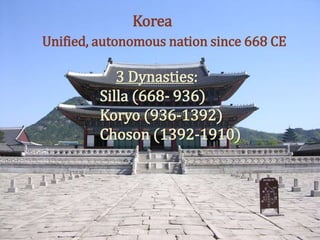
Korea
Unified, autonomous nation since 668 CE
3 Dynasties:
Silla (668- 936)
Koryo (936-1392)
Choson (1392-1910)

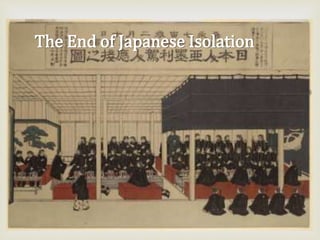
The End of Japanese Isolation
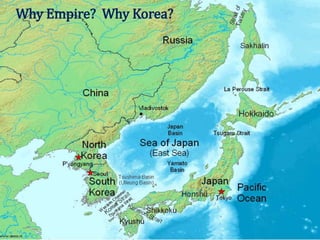
Why Empire? Why Korea?

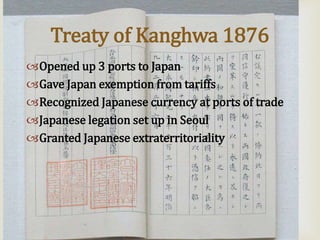
Treaty of Kanghwa 1876
Opened up 3 ports to Japan
Gave Japan exemption from tariffs
Recognized Japanese currency at ports of trade
Japanese legation set up in Seoul
Granted Japanese extraterritoriality

Tonghak movement (1860s)
By 1894, major crisis
Korea seeks assistance from China
Japan also sends troops
Japan gains Taiwan
Korea dislodged as China’s tributary
state
Sino-Japanese War
1894-1895

Russia & Japan now jockey for
preeminence on the peninsula
Stunning defeat
Korea: Japanese Protectorate
Russo-Japanese War
1904-1905

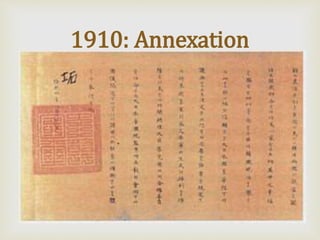
1910: Annexation

“For those of us who live in the
Orient, unless we want to prevent
the coming of Western civilization
with a firm resolve, it is best that we
cast our lot with them.”
Fukuzawa Yukichi (1885)
“From the perspectives of civilized Westerners,
they may see what is happening in China and
Korea and judge Japan accordingly, because of the
three countries’ geographical proximity. The
governments of China and Korea still retain their
autocratic manners and do not abide by the rule
of law. Westerners many consider Japan likewise
a lawless society. Natives of China and Korea are
deep in their hocus pocus of nonscientific
behavior. Western scholars may think that Japan
still remains a country dedicated to the yin and
yang and five elements. Chinese are mean-
spirited and shameless, and the chivalry of the
Japanese people is lost to the Westerners… How
unfortunate it is for Japan.”
“It is stated in two famous Chinese histories…
that Korea is bounded on the east and west by
sea and borders Japan on the south. If Japanese
territory had not extended to the Korean
peninsula over the sea in those days, such
record would never have been written; but the
sea would have been represented as
circumscribing Korea not only on the east and
west but also on the south. It is thus
reasonable to infer that Japanese domination
extended to the Korean peninsula beyond the
sea…”
Komatsu Midori (1910)
“Judging from the facts so far pointed out in
general outline it is not unreasonable to conclude
that the Japanese and Korean peoples formed for
a long time one and the same nation. The recent
annexation of Korea by Japan is therefore not the
incorporation of two different countries
inhabited by different races, but, it may rather be
said to be the reunion of two sections of the one
and same nation after a long period of separation.
Indeed it is nothing more nor less than the old
state of things restored…”

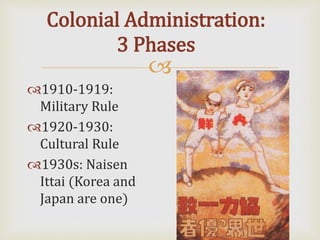
Colonial Administration:
3 Phases
1910-1919:
Military Rule
1920-1930:
Cultural Rule
1930s: Naisen
Ittai (Korea and
Japan are one)

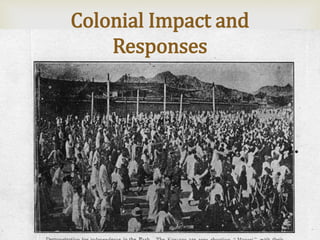
Colonial Impact and
Responses

We hereby declare that Korea is an independent state and
that Koreans are a self-governing people. We proclaim it
to the nations of the world in affirmation of the principle
of the equality of all nations… We make this declaration
on the strength of five thousand years of history as an
expression of the devotion and loyalty of 20 million
people. We claim independence in the interest of the
eternal and free development of our people and in
accordance with the great movement for world reform
based on the awakening conscience of mankind.
Declaration of Independence
March 1, 1919

 For the first time in several thousand years, we have
suffered the agony of alien suppression for a decade,
becoming victim of the policies of aggression and coercion,
which are relics from a bygone era…
 Japan’s scholars and officials, indulging in a conqueror’s
exuberance, have denigrated the accomplishments of our
ancestors and treated our civilized people like barbarians…
 From the outset the union of the two countries did not
emanate from the wishes of the people, and its outcome has
been oppressive coercion, discriminatory injustice,
fabrication of statistical data, thereby deepening the
eternally irreconcilable chasm of ill will between the two
nations.
Declaration of Independence
March 1, 1919

 First 3 years (1920-1923): ~7000 new Korean
communications organizations were created
 Most widely read Korean daily newspaper had
37,000 subscribers
 Official government gazette had circulation of 23,000
 By 1929 total subscriptions to 4 major newspapers
reached 100,000
Easing of Restrictions




 Korean language newspapers shut down
 All instruction in schools in Japanese, Korean banned
 Shinto shrines built throughout the country
 Schoolchildren required to show ritual deference to
Japanese emperor
 Decree “encouraging” Koreans to adopt Japanese
names (1939)
1930s: Aggressive Assimilation

 1925: Japanese established a committee to rewrite
Korea’s history
 Japanese relocated tens of thousands of cultural
artifacts to Japan
 Many public monuments and buildings were altered
Cultural Destruction

 Pak Songp’il:
Describes his struggle over changing his name
 Chong Chansu:
Drafted to work in shipyards, describes conditions
 Kang Pyongju:
College educated, describes the disparity in
treatment between Koreans and Japanese
Oral Histories

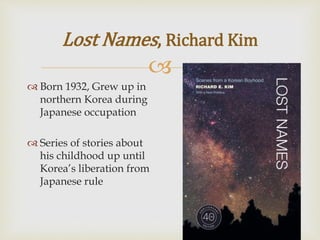
Lost Names, Richard Kim
 Born 1932, Grew up in
northern Korea during
Japanese occupation
 Series of stories about
his childhood up until
Korea’s liberation from
Japanese rule
Then the teacher gestures abruptly, as if to touch my face. “I am
sorry,” he says.
My father gives him a slight bow of his head.
“Even the British wouldn’t have thought of doing this sort of
primitive thing in India,” says the Japanese.
I am at a loss, trying to comprehend what he says and means.
“…inflicting on you this humiliation…” he is saying, “…unthinkable
for one Asian people to another Asian people, especially we Asians
who should have greater respect for our ancestors…”
“The whole world is going mad, sir,” says my father quietly, “going
back into another dark age. Japan is no exception.”
My teacher nods. “As one Asian to another, sir, I am deeply
ashamed.”
“I am ashamed, too, sir,” says my father, “perhaps for a reason
different from yours.”
My teacher, without a word, bows to my father, turns round, and
disappears into the blinding snow.
“It is a small beginning,” says my father…
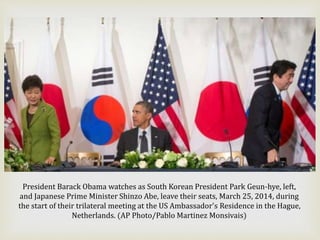
President Barack Obama watches as South Korean President Park Geun-hye, left,
and Japanese Prime Minister Shinzo Abe, leave their seats, March 25, 2014, during
the start of their trilateral meeting at the US Ambassador's Residence in the Hague,
Netherlands. (AP Photo/Pablo Martinez Monsivais)
Jeannie Logan
New Trier High School
loganj@nths.net

Imperialist Encounters in the Asian World: An Alternative to the Western Narrative

  • 1.
    Jeannie Logan /New Trier High School / loganj@nths.net
  • 3.
     “Age of WesternDominance” Concerns Complicate the master narrative Imperialism Narrative
  • 4.
     Korea Unified, autonomous nationsince 668 CE 3 Dynasties: Silla (668- 936) Koryo (936-1392) Choson (1392-1910)
  • 5.
     The End ofJapanese Isolation
  • 6.
  • 7.
     Treaty of Kanghwa1876 Opened up 3 ports to Japan Gave Japan exemption from tariffs Recognized Japanese currency at ports of trade Japanese legation set up in Seoul Granted Japanese extraterritoriality
  • 8.
     Tonghak movement (1860s) By1894, major crisis Korea seeks assistance from China Japan also sends troops Japan gains Taiwan Korea dislodged as China’s tributary state Sino-Japanese War 1894-1895
  • 9.
     Russia & Japannow jockey for preeminence on the peninsula Stunning defeat Korea: Japanese Protectorate Russo-Japanese War 1904-1905
  • 10.
  • 11.
     “For those ofus who live in the Orient, unless we want to prevent the coming of Western civilization with a firm resolve, it is best that we cast our lot with them.” Fukuzawa Yukichi (1885)
  • 12.
    “From the perspectivesof civilized Westerners, they may see what is happening in China and Korea and judge Japan accordingly, because of the three countries’ geographical proximity. The governments of China and Korea still retain their autocratic manners and do not abide by the rule of law. Westerners many consider Japan likewise a lawless society. Natives of China and Korea are deep in their hocus pocus of nonscientific behavior. Western scholars may think that Japan still remains a country dedicated to the yin and yang and five elements. Chinese are mean- spirited and shameless, and the chivalry of the Japanese people is lost to the Westerners… How unfortunate it is for Japan.”
  • 13.
    “It is statedin two famous Chinese histories… that Korea is bounded on the east and west by sea and borders Japan on the south. If Japanese territory had not extended to the Korean peninsula over the sea in those days, such record would never have been written; but the sea would have been represented as circumscribing Korea not only on the east and west but also on the south. It is thus reasonable to infer that Japanese domination extended to the Korean peninsula beyond the sea…” Komatsu Midori (1910)
  • 14.
    “Judging from thefacts so far pointed out in general outline it is not unreasonable to conclude that the Japanese and Korean peoples formed for a long time one and the same nation. The recent annexation of Korea by Japan is therefore not the incorporation of two different countries inhabited by different races, but, it may rather be said to be the reunion of two sections of the one and same nation after a long period of separation. Indeed it is nothing more nor less than the old state of things restored…”
  • 15.
     Colonial Administration: 3 Phases 1910-1919: MilitaryRule 1920-1930: Cultural Rule 1930s: Naisen Ittai (Korea and Japan are one)
  • 16.
  • 17.
     We hereby declarethat Korea is an independent state and that Koreans are a self-governing people. We proclaim it to the nations of the world in affirmation of the principle of the equality of all nations… We make this declaration on the strength of five thousand years of history as an expression of the devotion and loyalty of 20 million people. We claim independence in the interest of the eternal and free development of our people and in accordance with the great movement for world reform based on the awakening conscience of mankind. Declaration of Independence March 1, 1919
  • 18.
      For thefirst time in several thousand years, we have suffered the agony of alien suppression for a decade, becoming victim of the policies of aggression and coercion, which are relics from a bygone era…  Japan’s scholars and officials, indulging in a conqueror’s exuberance, have denigrated the accomplishments of our ancestors and treated our civilized people like barbarians…  From the outset the union of the two countries did not emanate from the wishes of the people, and its outcome has been oppressive coercion, discriminatory injustice, fabrication of statistical data, thereby deepening the eternally irreconcilable chasm of ill will between the two nations. Declaration of Independence March 1, 1919
  • 19.
      First 3years (1920-1923): ~7000 new Korean communications organizations were created  Most widely read Korean daily newspaper had 37,000 subscribers  Official government gazette had circulation of 23,000  By 1929 total subscriptions to 4 major newspapers reached 100,000 Easing of Restrictions
  • 20.
  • 21.
  • 22.
  • 23.
      Korean languagenewspapers shut down  All instruction in schools in Japanese, Korean banned  Shinto shrines built throughout the country  Schoolchildren required to show ritual deference to Japanese emperor  Decree “encouraging” Koreans to adopt Japanese names (1939) 1930s: Aggressive Assimilation
  • 24.
      1925: Japaneseestablished a committee to rewrite Korea’s history  Japanese relocated tens of thousands of cultural artifacts to Japan  Many public monuments and buildings were altered Cultural Destruction
  • 25.
      Pak Songp’il: Describeshis struggle over changing his name  Chong Chansu: Drafted to work in shipyards, describes conditions  Kang Pyongju: College educated, describes the disparity in treatment between Koreans and Japanese Oral Histories
  • 26.
     Lost Names, RichardKim  Born 1932, Grew up in northern Korea during Japanese occupation  Series of stories about his childhood up until Korea’s liberation from Japanese rule
  • 27.
    Then the teachergestures abruptly, as if to touch my face. “I am sorry,” he says. My father gives him a slight bow of his head. “Even the British wouldn’t have thought of doing this sort of primitive thing in India,” says the Japanese. I am at a loss, trying to comprehend what he says and means. “…inflicting on you this humiliation…” he is saying, “…unthinkable for one Asian people to another Asian people, especially we Asians who should have greater respect for our ancestors…” “The whole world is going mad, sir,” says my father quietly, “going back into another dark age. Japan is no exception.” My teacher nods. “As one Asian to another, sir, I am deeply ashamed.” “I am ashamed, too, sir,” says my father, “perhaps for a reason different from yours.” My teacher, without a word, bows to my father, turns round, and disappears into the blinding snow. “It is a small beginning,” says my father…
  • 28.
    President Barack Obamawatches as South Korean President Park Geun-hye, left, and Japanese Prime Minister Shinzo Abe, leave their seats, March 25, 2014, during the start of their trilateral meeting at the US Ambassador's Residence in the Hague, Netherlands. (AP Photo/Pablo Martinez Monsivais)
  • 29.
    Jeannie Logan New TrierHigh School loganj@nths.net

Editor's Notes

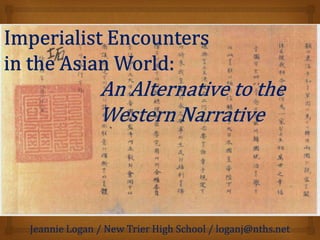
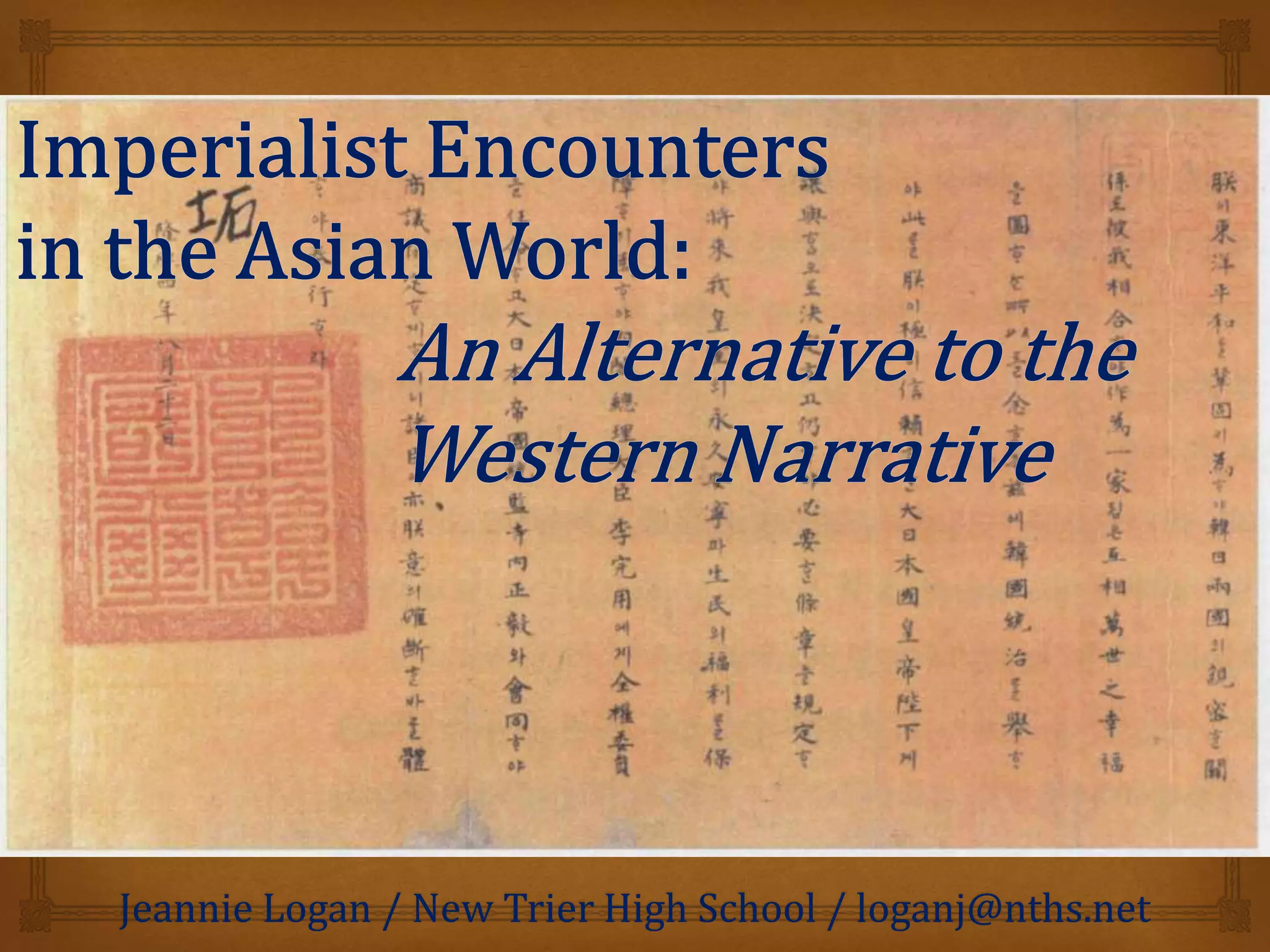
  • #2 Article 1: His Majesty the Emperor of Korea concedes completely and definitely his entire sovereignty over the whole Korean territory to His Majesty the Emperor of Japan. Article 2: His Majesty the Emperor of Japan accepts the concession stated in the previous article and consents to the annexation of Korea to the Empire of Japan.
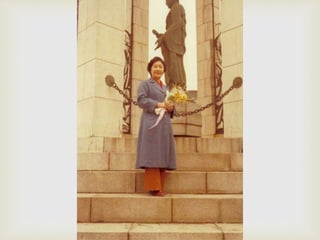
  • #3 Personal interest in Japanese Colonialism in Korea
  • #5 Gyeonbokgung: Royal palace during Choson dynasty
  • #6 Reception for Commodore Perry by Japanese Noblemen Medium: Color woodblock print Place Made: Japan Dates: ca. 1887 Period: Meiji Era Credit Line: Brooklyn Museum Collection Rights Statement: No known copyright restrictions Caption: Reception for Commodore Perry by Japanese Noblemen, ca. 1887. Color woodblock print, 14 x 20 3/8 in. (35.6 x 51.8 cm). Brooklyn Museum, Brooklyn Museum Collection, X729.3 Image: overall, X729.3_PS2.jpg. Brooklyn Museum photograph, 2009 Catalogue Description: This scene shows a Japanese reception for American officers, who were brought to Japan by Commodore Matthew Perry in 1854. At the reception, the American officers are shown wearing naval uniforms; the Japanese officers wear traditional formal garments (monpuku). Those in the foreground sit in the traditional pose, holding swords and facing inward. A black curtain hangs above the guests platform at the right. This curtain indicates the higher rank of the officers seated under it. This event is recorded as having taken place on February 10th, 1854 at Yokohama. Under the order of the governor of Uranga, Izawa Mimasaka no kami, the artist Takagawa Bunsen painted the original design which here has been reproduced by the printmaker Sensai Eiko. The copyright and the right of publication are held by the publisher Akiyama Mataro (Tokyo). The title of the reception is given above the picture
  • #7 MAP: http://commons.wikimedia.org/wiki/Atlas_of_South_Korea
  • #8 "Japan Korea Treaty of Amity 26 February 1876" by World Imaging - Own work, Japan Diplomatic Archives. Licensed under CC BY-SA 3.0 via Wikimedia Commons - http://commons.wikimedia.org/wiki/File:Japan_Korea_Treaty_of_Amity_26_February_1876.jpg#/media/File:Japan_Korea_Treaty_of_Amity_26_February_1876.jpg
  • #16 Image: http://www.japanfocus.org/-Kenneth-Ruoff/3498