Manchuria
Manchuria
•   The Nationalist government of China led
by Chiang Kai-shek was weak, corrupt
and busy fighting the Communists.
•   Because of the Great Depression, Japan
wanted to build an empire to secure
supplies of raw materials.
•   The Japanese government was controlled by the
army
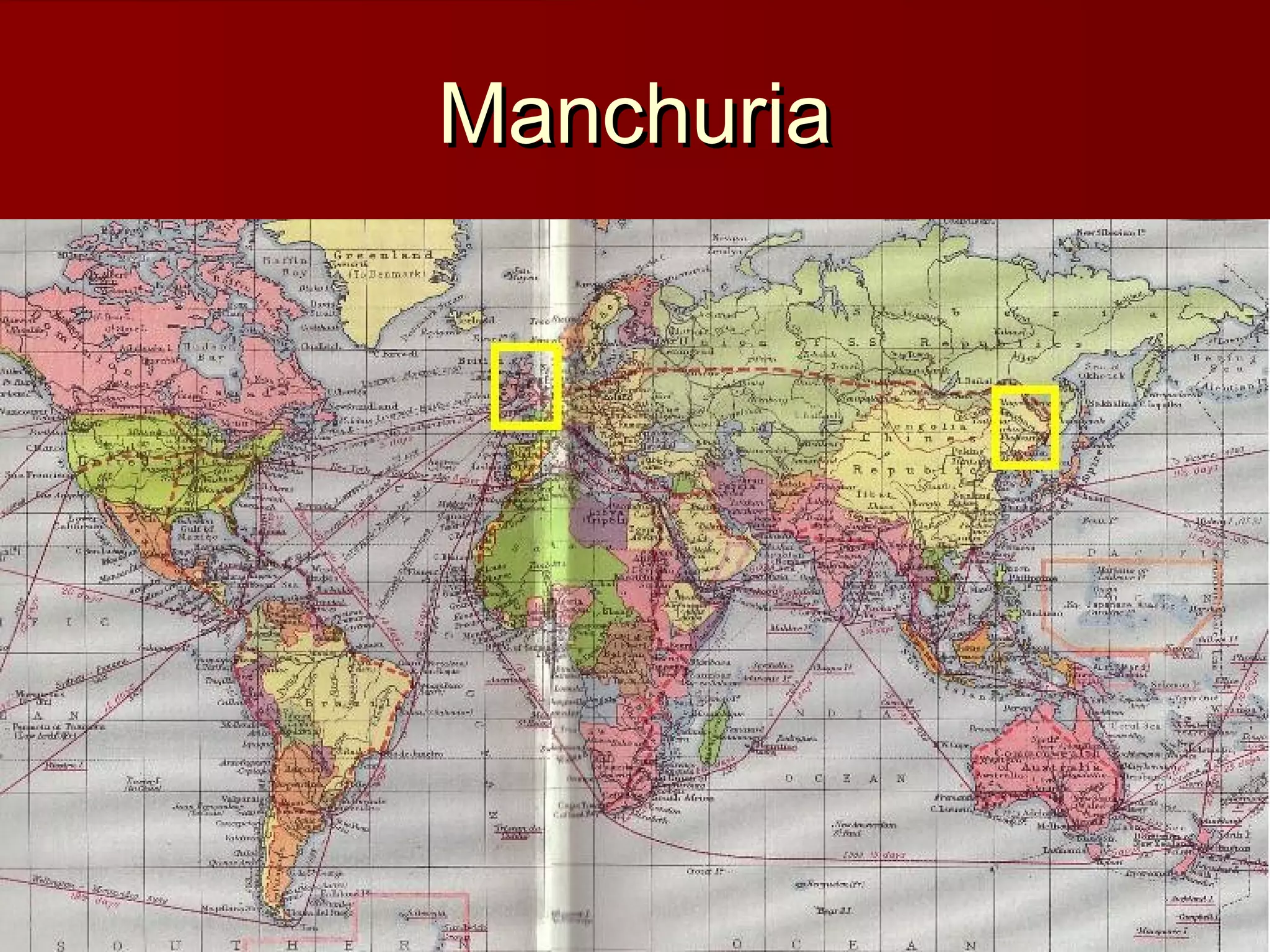
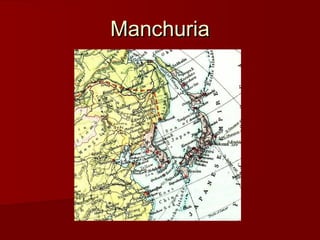
•   China ruled Manchuria, but the Japanese army
ran the railway there, and ruled in Korea.
Manchuria
Manchuria
•   Sept 1931: There was some vandalism on the
Manchurian railway; Japan claimed the Chinese
had sabotaged the railway.  
•   They invaded Manchuria and set up the
'independent' (i.e. Japanese-controlled) state of
Manchukuo under the former Emperor of China,
Henry P'ui.  
•   China appealed to the League.
Manchuria
•   Dec 1931: the League appointed a commission
led by Lord Lytton to investigate.  
•   He did not go to Manchuria until April 1932
and did not report until October.
•   Oct 1932: Lytton's report stated that Japan was
the aggressor and should leave.
•   24 Feb 1933: The Assembly voted that Japan
should leave Manchuria
•  Japan walked out of the meeting.
Manchuria
•   Japan stayed in Manchuria.  
•   The League could not agree economic sanctions
or an arms sales ban.
•   In 1933 Japan resigned from the League, and
invaded/ conquered Jehol (next to Manchuria).
Manchuria
A SPECTACULAR failure:
1. The Japanese continued to expand:
•     they kept Manchuria
• they invaded Jehol in 1933 and China in 1937.
Manchuria
A SPECTACULAR failure:
2.  The League was discredited/ Manchuria showed:
•     It was slow (the Lytton Report took almost a year)
•     A country could get its own way if it ignored it
•     ‘Collective security' was useless against big
countries - especially during the Great Depression.
•     Even the great powers within the League (Japan
was on the Council) were happy to ignore it.

Manchuria IGCSE History

  • 1.
  • 2.
    Manchuria •   The Nationalistgovernment of China led by Chiang Kai-shek was weak, corrupt and busy fighting the Communists. •   Because of the Great Depression, Japan wanted to build an empire to secure supplies of raw materials. •   The Japanese government was controlled by the army •   China ruled Manchuria, but the Japanese army ran the railway there, and ruled in Korea.
  • 3.
  • 4.
    Manchuria •   Sept 1931:There was some vandalism on the Manchurian railway; Japan claimed the Chinese had sabotaged the railway.   •   They invaded Manchuria and set up the 'independent' (i.e. Japanese-controlled) state of Manchukuo under the former Emperor of China, Henry P'ui.   •   China appealed to the League.
  • 5.
    Manchuria •   Dec 1931:the League appointed a commission led by Lord Lytton to investigate.   •   He did not go to Manchuria until April 1932 and did not report until October. •   Oct 1932: Lytton's report stated that Japan was the aggressor and should leave. •   24 Feb 1933: The Assembly voted that Japan should leave Manchuria •  Japan walked out of the meeting.
  • 6.
    Manchuria •   Japan stayedin Manchuria.   •   The League could not agree economic sanctions or an arms sales ban. •   In 1933 Japan resigned from the League, and invaded/ conquered Jehol (next to Manchuria).
  • 7.
    Manchuria A SPECTACULAR failure: 1.The Japanese continued to expand: •     they kept Manchuria • they invaded Jehol in 1933 and China in 1937.
  • 8.
    Manchuria A SPECTACULAR failure: 2.  TheLeague was discredited/ Manchuria showed: •     It was slow (the Lytton Report took almost a year) •     A country could get its own way if it ignored it •     ‘Collective security' was useless against big countries - especially during the Great Depression. •     Even the great powers within the League (Japan was on the Council) were happy to ignore it.