UNIDAD EDUCATIVA
“PELILEO”
SUBJECT:
ENGLISH
TEACHER:
LCDA. LORENA AGUAGÜIÑA
2018-2019
SIMPLE PRESENT
VS
PRESENT CONTINOUS
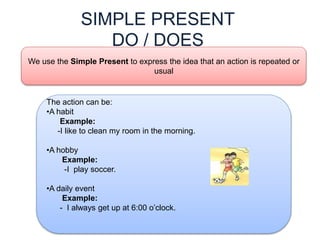
SIMPLE PRESENT
DO / DOES
We use the Simple Present to express the idea that an action is repeated or
usual
The action can be:
•A habit
Example:
-I like to clean my room in the morning.
•A hobby
Example:
-I play soccer.
•A daily event
Example:
- I always get up at 6:00 o’clock.
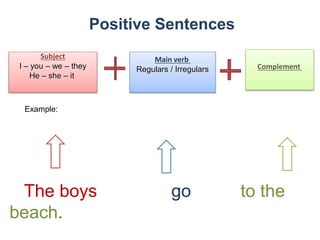
Positive Sentences
Subject
I – you – we – they
He – she – it
Main verb
Regulars / Irregulars Complement
The boys go to the
beach.
Example:
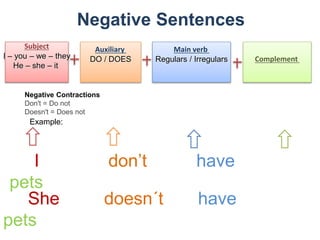
Negative Sentences
Subject
I – you – we – they
He – she – it
Auxiliary
DO / DOES
Main verb
Regulars / Irregulars Complement
Example:
I don’t have
pets
She doesn´t have
pets
Negative Contractions
Don't = Do not
Doesn't = Does not
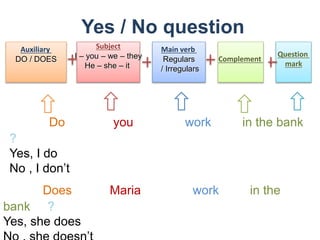
Yes / No question
Auxiliary
DO / DOES
Subject
I – you – we – they
He – she – it
Main verb
Regulars
/ Irregulars
Complement
Do you work in the bank
?
Yes, I do
No , I don’t
Question
mark
Does Maria work in the
bank ?
Yes, she does
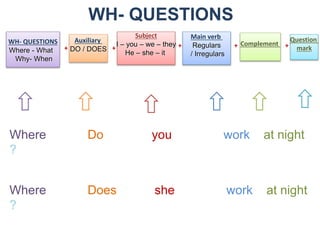
WH- QUESTIONS
Auxiliary
DO / DOES
WH- QUESTIONS
Where - What
Why- When
Subject
I – you – we – they
He – she – it
Main verb
Regulars
/ Irregulars
Complement
Question
mark+ + + + +
Where Do you work at night
?
Where Does she work at night
?
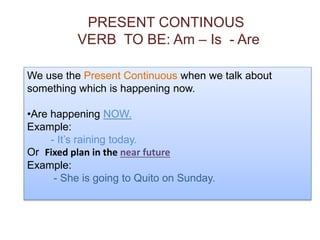
PRESENT CONTINOUS
VERB TO BE: Am – Is - Are
We use the Present Continuous when we talk about
something which is happening now.
•Are happening NOW.
Example:
- It’s raining today.
Or Fixed plan in the near future
Example:
- She is going to Quito on Sunday.
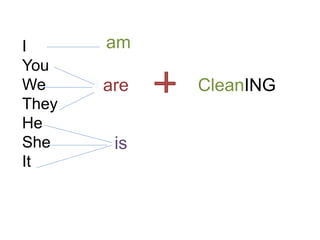
I
You
We
They
He
She
It
am
are
is
CleanING
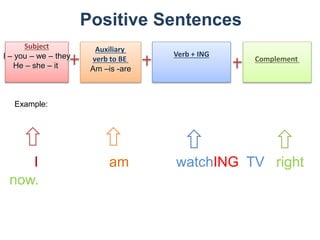
Positive Sentences
Subject
I – you – we – they
He – she – it
Auxiliary
verb to BE
Am –is -are
Verb + ING
Complement
Example:
I am watchING TV right
now.
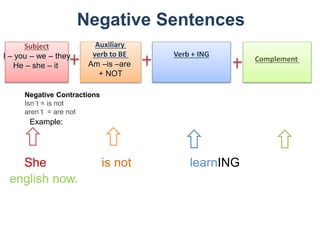
Negative Sentences
Subject
I – you – we – they
He – she – it
Complement
Example:
She is not learnING
english now.
Negative Contractions
Isn´t = is not
aren´t = are not
Auxiliary
verb to BE
Am –is –are
+ NOT
Verb + ING
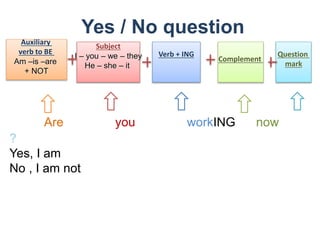
Yes / No question
Subject
I – you – we – they
He – she – it
Complement
Are you workING now
?
Yes, I am
No , I am not
Question
mark
Auxiliary
verb to BE
Am –is –are
+ NOT
Verb + ING
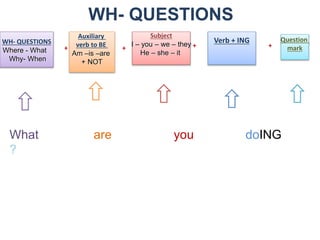
WH- QUESTIONS
WH- QUESTIONS
Where - What
Why- When
Subject
I – you – we – they
He – she – it
Question
mark+ + + +
What are you doING
?
Auxiliary
verb to BE
Am –is –are
+ NOT
Verb + ING
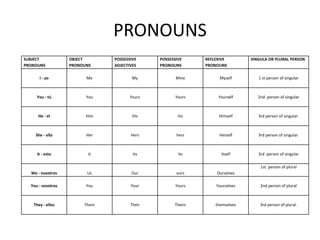
PRONOUNS
SUBJECT
PRONOUNS
OBJECT
PRONOUNS
POSSESSIVE
ADJECTIVES
POSSESSIVE
PRONOUNS
REFLEXIVE
PRONOUNS
SINGULA OR PLURAL PERSON
I - yo Me My Mine Myself 1 st person of singular
You - tú You Yours Yours Yourself 2nd person of singular
He - el Him His his Himself 3rd person of singular.
She - ella Her Hers hers Herself 3rd person of singular.
It - esto It Its Its Itself 3rd person of singular
We - nosotros Us Our ours Ourselves
1st person of plural
You - vosotros You Your Yours Yourselves 2nd person of plural
They - ellos Them Their Theirs themselves 3rd person of plural.

Present simple and present continiuos

  • 1.
  • 2.
  • 3.
    SIMPLE PRESENT DO /DOES We use the Simple Present to express the idea that an action is repeated or usual The action can be: •A habit Example: -I like to clean my room in the morning. •A hobby Example: -I play soccer. •A daily event Example: - I always get up at 6:00 o’clock.
  • 4.
    Positive Sentences Subject I –you – we – they He – she – it Main verb Regulars / Irregulars Complement The boys go to the beach. Example:
  • 5.
    Negative Sentences Subject I –you – we – they He – she – it Auxiliary DO / DOES Main verb Regulars / Irregulars Complement Example: I don’t have pets She doesn´t have pets Negative Contractions Don't = Do not Doesn't = Does not
  • 6.
    Yes / Noquestion Auxiliary DO / DOES Subject I – you – we – they He – she – it Main verb Regulars / Irregulars Complement Do you work in the bank ? Yes, I do No , I don’t Question mark Does Maria work in the bank ? Yes, she does
  • 7.
    WH- QUESTIONS Auxiliary DO /DOES WH- QUESTIONS Where - What Why- When Subject I – you – we – they He – she – it Main verb Regulars / Irregulars Complement Question mark+ + + + + Where Do you work at night ? Where Does she work at night ?
  • 8.
    PRESENT CONTINOUS VERB TOBE: Am – Is - Are We use the Present Continuous when we talk about something which is happening now. •Are happening NOW. Example: - It’s raining today. Or Fixed plan in the near future Example: - She is going to Quito on Sunday.
  • 9.
  • 10.
    Positive Sentences Subject I –you – we – they He – she – it Auxiliary verb to BE Am –is -are Verb + ING Complement Example: I am watchING TV right now.
  • 11.
    Negative Sentences Subject I –you – we – they He – she – it Complement Example: She is not learnING english now. Negative Contractions Isn´t = is not aren´t = are not Auxiliary verb to BE Am –is –are + NOT Verb + ING
  • 12.
    Yes / Noquestion Subject I – you – we – they He – she – it Complement Are you workING now ? Yes, I am No , I am not Question mark Auxiliary verb to BE Am –is –are + NOT Verb + ING
  • 13.
    WH- QUESTIONS WH- QUESTIONS Where- What Why- When Subject I – you – we – they He – she – it Question mark+ + + + What are you doING ? Auxiliary verb to BE Am –is –are + NOT Verb + ING
  • 14.
    PRONOUNS SUBJECT PRONOUNS OBJECT PRONOUNS POSSESSIVE ADJECTIVES POSSESSIVE PRONOUNS REFLEXIVE PRONOUNS SINGULA OR PLURALPERSON I - yo Me My Mine Myself 1 st person of singular You - tú You Yours Yours Yourself 2nd person of singular He - el Him His his Himself 3rd person of singular. She - ella Her Hers hers Herself 3rd person of singular. It - esto It Its Its Itself 3rd person of singular We - nosotros Us Our ours Ourselves 1st person of plural You - vosotros You Your Yours Yourselves 2nd person of plural They - ellos Them Their Theirs themselves 3rd person of plural.