PRESENT PROGRESSIVE OR CONTINUOUS

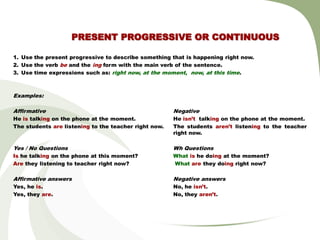
1. Use the present progressive to describe something that is happening right now.
2. Use the verb be and the ing form with the main verb of the sentence.
3. Use time expressions such as: right now, at the moment, now, at this time.


Examples:

Affirmative                                            Negative
He is talking on the phone at the moment.              He isn’t talking on the phone at the moment.
The students are listening to the teacher right now.   The students aren’t listening to the teacher
                                                       right now.

Yes / No Questions                                     Wh Questions
Is he talking on the phone at this moment?             What is he doing at the moment?
Are they listening to teacher right now?               What are they doing right now?

Affirmative answers                                    Negative answers
Yes, he is.                                            No, he isn’t.
Yes, they are.                                         No, they aren’t.
PRESENT PROGRESSIVE OR CONTINUOUS

4. Use the present progressive to describe temporary situations and actions.
5. Use time expressions such as: this week, these days, this month, this season, this year.

Examples:

Affirmative                                           Negative
He is travelling on business this month.              He isn’t travelling on business this month.
They are studying in France this year.                They aren’t studying in France this year.

Yes / No Questions                                    Wh Questions
Is he travelling on business this month?              What is your brother doing these days?
Are they studying in France this year?                Which hotel are you staying at?

Affirmative answers                                   Negative answers
Yes, he is.                                           No, he isn’t.
Yes, they are.                                        No, they aren’t.
PRESENT PROGRESSIVE OR CONTINUOUS

6. Use the present progressive to describe an action or event in the future, which has already been
   planned or prepared.
7. Use time expressions such as: tomorrow, next week, next winter, tonight, this evening.

Examples:

Affirmative                                          Negative
He is visiting his parents next winter.              He isn’t visiting his parents next winter.
We are going on holiday tomorrow.                    We aren’t going on holiday tomorrow.


Yes / No Questions                                   Wh Questions
Is he visiting his parents next winter?              Where is he going next winter?
Are they going on holiday tomorrow?                  When are you seeing your doctor?

Affirmative answers                                  Negative answers
Yes, he is.                                          No, he isn’t.
Yes, we are.                                         No, we aren’t.
PRESENT PROGRESSIVE OR CONTINUOUS

8. Add ING after the verbs.

Examples:

Work        working              stand      standing                learn     learning

9. When the verb ends in an e, we drop the e and add ing

Examples:

Come        coming               have       having                  write     writing

10. If a one syllable (with only one vowel sound) verb ends in one consonant (for example p, t, r) that
follows one vowel (for example a, o, e), we double the consonant.

Examples:

Swim        swimming             get        getting                 stop      stopping
PRESENT PROGRESSIVE OR CONTINUOUS


11. Some verbs have irregular ing form

Examples:

Lie         lying               die      dying
PRESENT PROGRESSIVE OR CONTINUOUS

BIBLIOGRAPHY:

1. Grammar Express :
https://docs.google.com/viewer?a=v&pid=sites&srcid=ZGVmYXVsdGRvbWFpbn
xkZXBhcnRhbWVudG9sZW5ndWFzdWNlbnRyYWx8Z3g6MWI2ZWFmMDliMTJkZD
Y5NQ


http://www.eclecticenglish.com/grammar/PresentContinuous1G.html


                                                                  RMDC

Present progressive or continuous

  • 1.
    PRESENT PROGRESSIVE ORCONTINUOUS 1. Use the present progressive to describe something that is happening right now. 2. Use the verb be and the ing form with the main verb of the sentence. 3. Use time expressions such as: right now, at the moment, now, at this time. Examples: Affirmative Negative He is talking on the phone at the moment. He isn’t talking on the phone at the moment. The students are listening to the teacher right now. The students aren’t listening to the teacher right now. Yes / No Questions Wh Questions Is he talking on the phone at this moment? What is he doing at the moment? Are they listening to teacher right now? What are they doing right now? Affirmative answers Negative answers Yes, he is. No, he isn’t. Yes, they are. No, they aren’t.
  • 2.
    PRESENT PROGRESSIVE ORCONTINUOUS 4. Use the present progressive to describe temporary situations and actions. 5. Use time expressions such as: this week, these days, this month, this season, this year. Examples: Affirmative Negative He is travelling on business this month. He isn’t travelling on business this month. They are studying in France this year. They aren’t studying in France this year. Yes / No Questions Wh Questions Is he travelling on business this month? What is your brother doing these days? Are they studying in France this year? Which hotel are you staying at? Affirmative answers Negative answers Yes, he is. No, he isn’t. Yes, they are. No, they aren’t.
  • 3.
    PRESENT PROGRESSIVE ORCONTINUOUS 6. Use the present progressive to describe an action or event in the future, which has already been planned or prepared. 7. Use time expressions such as: tomorrow, next week, next winter, tonight, this evening. Examples: Affirmative Negative He is visiting his parents next winter. He isn’t visiting his parents next winter. We are going on holiday tomorrow. We aren’t going on holiday tomorrow. Yes / No Questions Wh Questions Is he visiting his parents next winter? Where is he going next winter? Are they going on holiday tomorrow? When are you seeing your doctor? Affirmative answers Negative answers Yes, he is. No, he isn’t. Yes, we are. No, we aren’t.
  • 4.
    PRESENT PROGRESSIVE ORCONTINUOUS 8. Add ING after the verbs. Examples: Work working stand standing learn learning 9. When the verb ends in an e, we drop the e and add ing Examples: Come coming have having write writing 10. If a one syllable (with only one vowel sound) verb ends in one consonant (for example p, t, r) that follows one vowel (for example a, o, e), we double the consonant. Examples: Swim swimming get getting stop stopping
  • 5.
    PRESENT PROGRESSIVE ORCONTINUOUS 11. Some verbs have irregular ing form Examples: Lie lying die dying
  • 6.
    PRESENT PROGRESSIVE ORCONTINUOUS BIBLIOGRAPHY: 1. Grammar Express : https://docs.google.com/viewer?a=v&pid=sites&srcid=ZGVmYXVsdGRvbWFpbn xkZXBhcnRhbWVudG9sZW5ndWFzdWNlbnRyYWx8Z3g6MWI2ZWFmMDliMTJkZD Y5NQ http://www.eclecticenglish.com/grammar/PresentContinuous1G.html RMDC