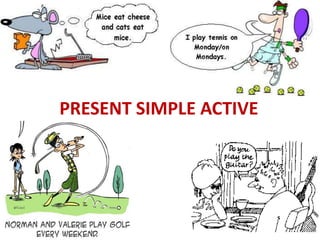
PRESENT SIMPLE ACTIVE
• People need food to survive. 
• Plants die without water. 
• It snows in winter. 
• She works in a bank. 
• I don’t like apples. 
• She doesn’t have a job. 
• Where do you live? 
• Does he smoke? 
• How often do they visit you? 
• At the weekend, we usually 
go to the cinema with our 
friends. 
• The train to Moscow leaves 
at eleven. 
• What time does the film 
start? 
• I won't go out until it stops 
raining. 
• I will call you when I come 
home.
Adverbs of Frequency 
We usually put these adverbs in the middle of the 
sentence, between the subject and the verb: 
o always; 
o usually 
o normally, generally (обычно, как правило) 
o often, frequently (часто) 
o sometimes 
o occasionally (иногда, изредка, время от времени) 
o seldom; rarely (редко) 
o hardly ever (почти никогда) 
o never
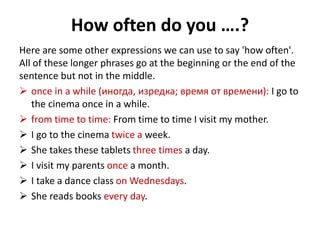
How often do you ….? 
Here are some other expressions we can use to say 'how often'. 
All of these longer phrases go at the beginning or the end of the 
sentence but not in the middle. 
 once in a while (иногда, изредка; время от времени): I go to 
the cinema once in a while. 
 from time to time: From time to time I visit my mother. 
 I go to the cinema twice a week. 
 She takes these tablets three times a day. 
 I visit my parents once a month. 
 I take a dance class on Wednesdays. 
 She reads books every day.
SOME OTHER CASES 
We use the simple present to talk about what 
happens in books, plays, or films: 
 The hero dies at the end of the film. 
 A young woman travels through Europe, 
where she meets different people, and finally 
falls in love. 
 In this book, an army invades Britain. 
 The main character is very pretty and works in 
a bookshop.
SOME OTHER CASES 
We need to use this simple tense with stative verbs 
(verbs which we don't use in continuous tenses), in 
situations where we'd usually use the present 
continuous: 
• This soup tastes great. 
• You look fabulous. 
• I think she is very pretty. 
• I hate rude people. 
• I promise I will help you. 
• I see a bird on the tree.
SUMMARY

Present simple active

  • 1.
  • 9.
    • People needfood to survive. • Plants die without water. • It snows in winter. • She works in a bank. • I don’t like apples. • She doesn’t have a job. • Where do you live? • Does he smoke? • How often do they visit you? • At the weekend, we usually go to the cinema with our friends. • The train to Moscow leaves at eleven. • What time does the film start? • I won't go out until it stops raining. • I will call you when I come home.
  • 10.
    Adverbs of Frequency We usually put these adverbs in the middle of the sentence, between the subject and the verb: o always; o usually o normally, generally (обычно, как правило) o often, frequently (часто) o sometimes o occasionally (иногда, изредка, время от времени) o seldom; rarely (редко) o hardly ever (почти никогда) o never
  • 12.
    How often doyou ….? Here are some other expressions we can use to say 'how often'. All of these longer phrases go at the beginning or the end of the sentence but not in the middle.  once in a while (иногда, изредка; время от времени): I go to the cinema once in a while.  from time to time: From time to time I visit my mother.  I go to the cinema twice a week.  She takes these tablets three times a day.  I visit my parents once a month.  I take a dance class on Wednesdays.  She reads books every day.
  • 14.
    SOME OTHER CASES We use the simple present to talk about what happens in books, plays, or films:  The hero dies at the end of the film.  A young woman travels through Europe, where she meets different people, and finally falls in love.  In this book, an army invades Britain.  The main character is very pretty and works in a bookshop.
  • 15.
    SOME OTHER CASES We need to use this simple tense with stative verbs (verbs which we don't use in continuous tenses), in situations where we'd usually use the present continuous: • This soup tastes great. • You look fabulous. • I think she is very pretty. • I hate rude people. • I promise I will help you. • I see a bird on the tree.
  • 17.