by Miss Stefanie Herzberg
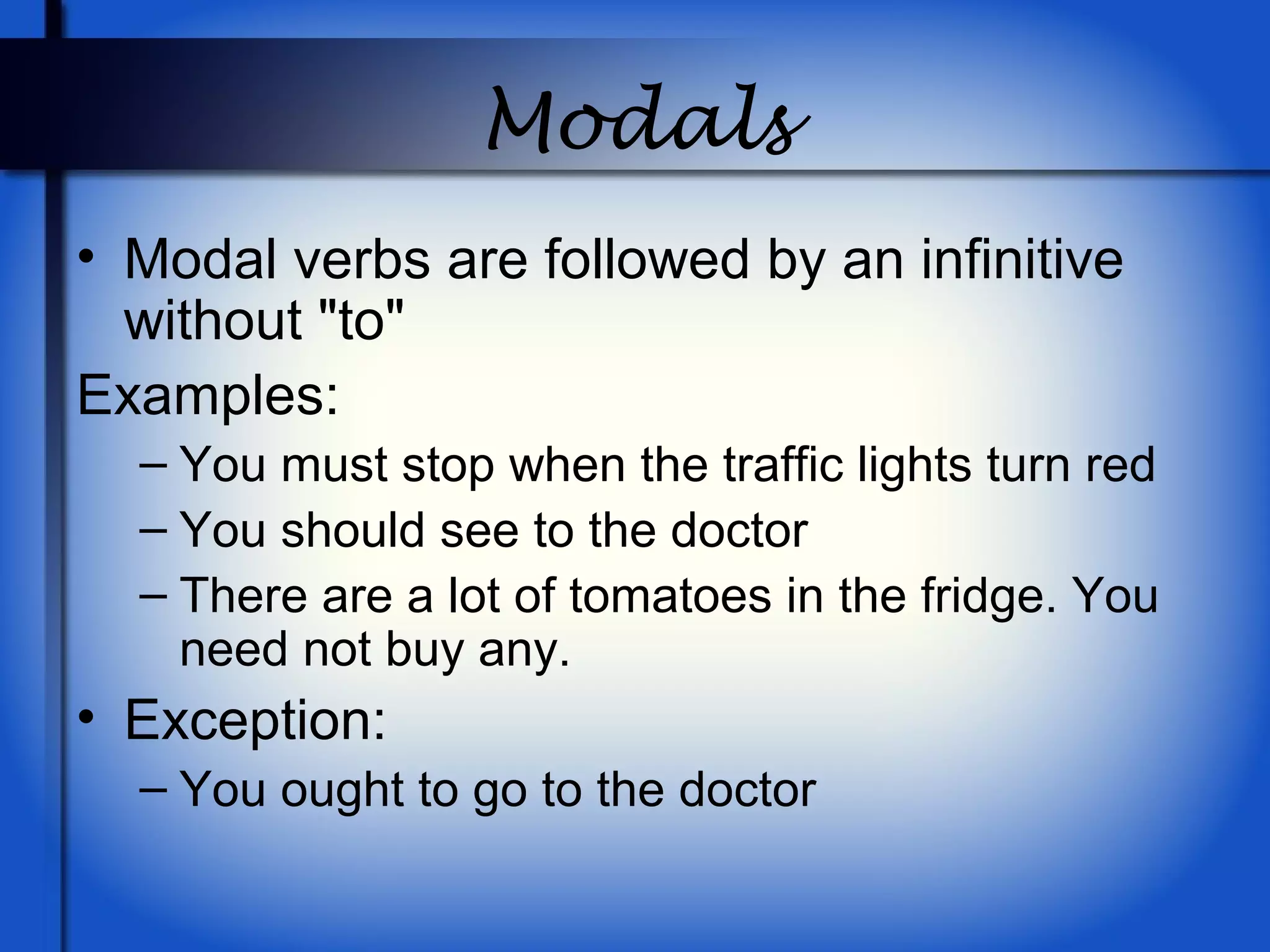
Modals
• Modal verbs are followed by an infinitive
without "to"
Examples:
– You must stop when the traffic lights turn red
– You should see to the doctor
– There are a lot of tomatoes in the fridge. You
need not buy any.
• Exception:
– You ought to go to the doctor
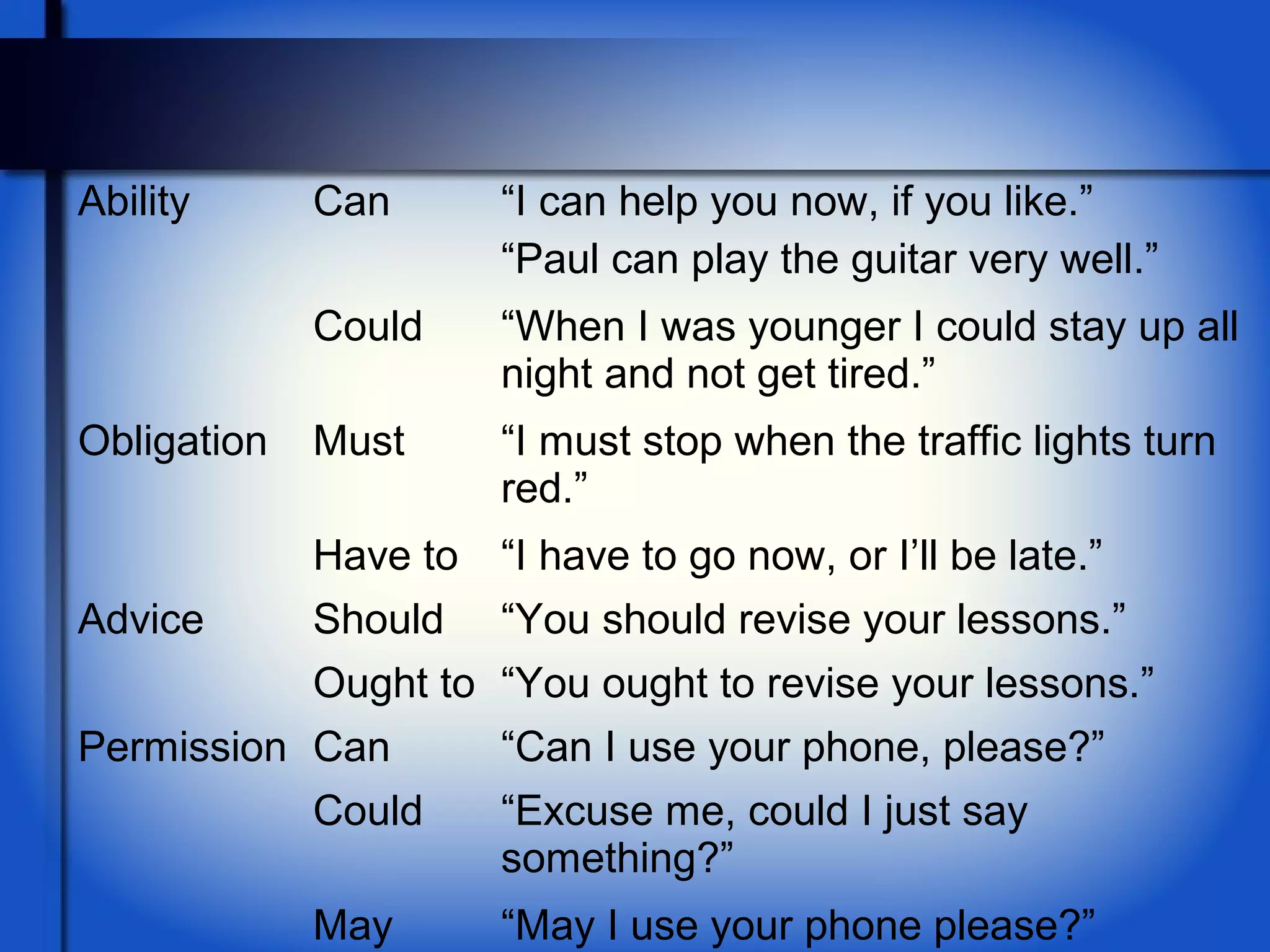
Ability Can “I can help you now, if you like.”
“Paul can play the guitar very well.”
Could “When I was younger I could stay up all
night and not get tired.”
Obligation Must “I must stop when the traffic lights turn
red.”
Have to “I have to go now, or I’ll be late.”
Advice Should “You should revise your lessons.”
Ought to “You ought to revise your lessons.”
Permission Can “Can I use your phone, please?”
Could “Excuse me, could I just say
something?”
May “May I use your phone please?”
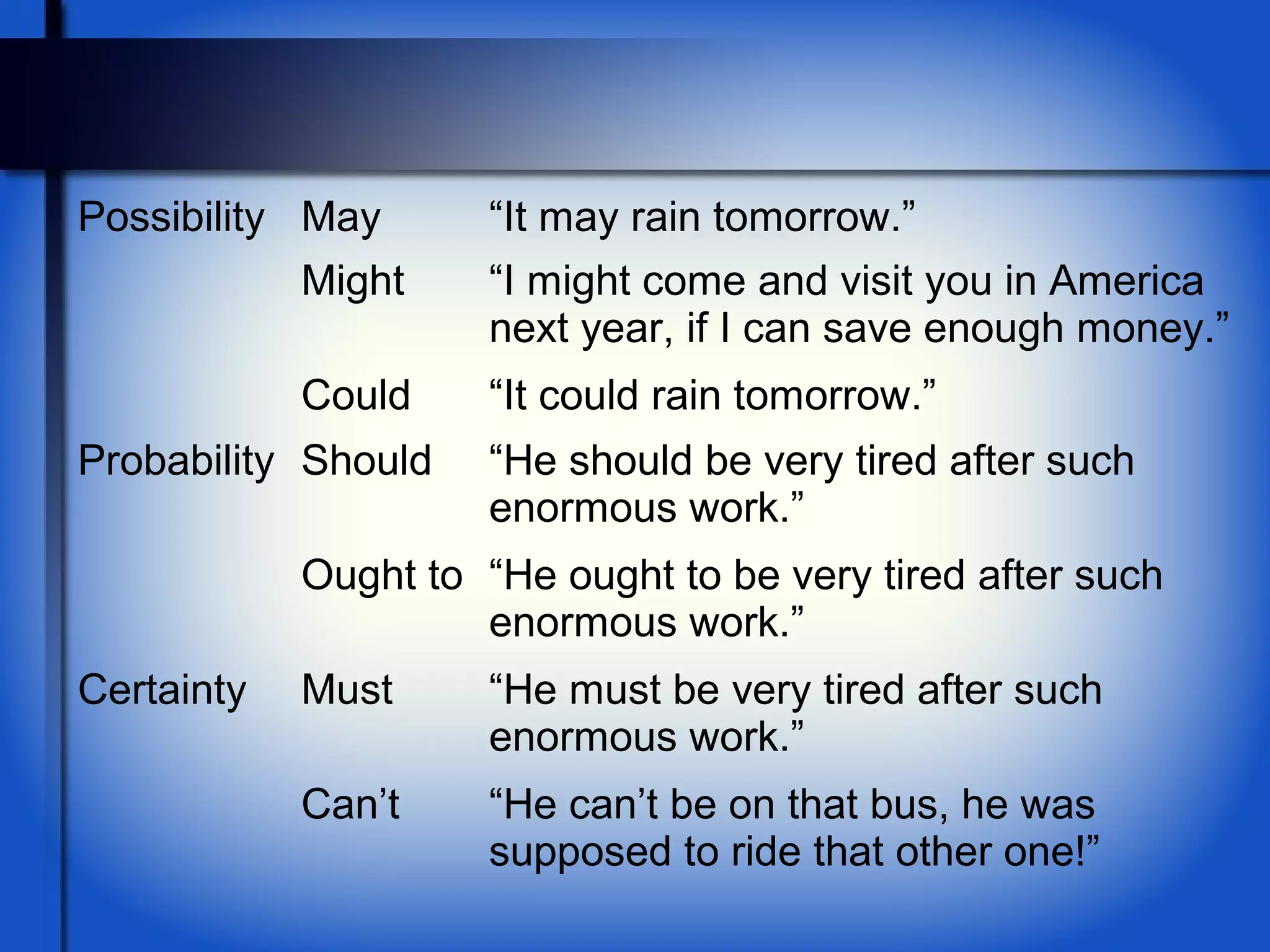
Possibility May “It may rain tomorrow.”
Might “I might come and visit you in America
next year, if I can save enough money.”
Could “It could rain tomorrow.”
Probability Should “He should be very tired after such
enormous work.”
Ought to “He ought to be very tired after such
enormous work.”
Certainty Must “He must be very tired after such
enormous work.”
Can’t “He can’t be on that bus, he was
supposed to ride that other one!”
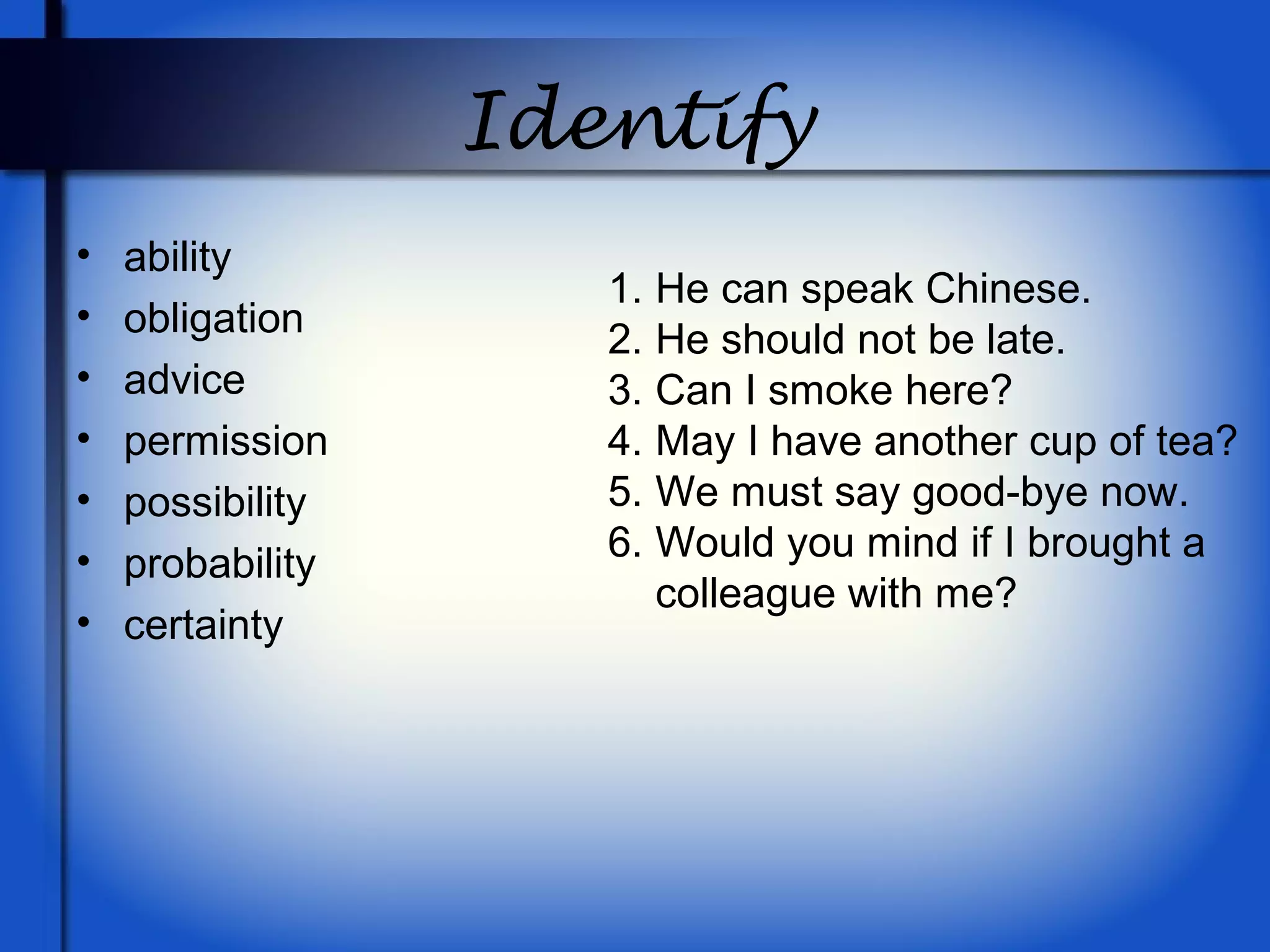
Identify
• ability
• obligation
• advice
• permission
• possibility
• probability
• certainty
1. He can speak Chinese.
2. He should not be late.
3. Can I smoke here?
4. May I have another cup of tea?
5. We must say good-bye now.
6. Would you mind if I brought a
colleague with me?
References
• My English Pages. (2013). Modal Verb
and their Meaning. Retrieved from http://
www.myenglishpages.com/site_php_files/
grammar-lesson-modals.php
References
• My English Pages. (2013). Modal Verb
and their Meaning. Retrieved from http://
www.myenglishpages.com/site_php_files/
grammar-lesson-modals.php

Modals

  • 1.
  • 2.
    Modals • Modal verbsare followed by an infinitive without "to" Examples: – You must stop when the traffic lights turn red – You should see to the doctor – There are a lot of tomatoes in the fridge. You need not buy any. • Exception: – You ought to go to the doctor
  • 3.
    Ability Can “Ican help you now, if you like.” “Paul can play the guitar very well.” Could “When I was younger I could stay up all night and not get tired.” Obligation Must “I must stop when the traffic lights turn red.” Have to “I have to go now, or I’ll be late.” Advice Should “You should revise your lessons.” Ought to “You ought to revise your lessons.” Permission Can “Can I use your phone, please?” Could “Excuse me, could I just say something?” May “May I use your phone please?”
  • 4.
    Possibility May “Itmay rain tomorrow.” Might “I might come and visit you in America next year, if I can save enough money.” Could “It could rain tomorrow.” Probability Should “He should be very tired after such enormous work.” Ought to “He ought to be very tired after such enormous work.” Certainty Must “He must be very tired after such enormous work.” Can’t “He can’t be on that bus, he was supposed to ride that other one!”
  • 5.
    Identify • ability • obligation •advice • permission • possibility • probability • certainty 1. He can speak Chinese. 2. He should not be late. 3. Can I smoke here? 4. May I have another cup of tea? 5. We must say good-bye now. 6. Would you mind if I brought a colleague with me?
  • 6.
    References • My EnglishPages. (2013). Modal Verb and their Meaning. Retrieved from http:// www.myenglishpages.com/site_php_files/ grammar-lesson-modals.php
  • 7.
    References • My EnglishPages. (2013). Modal Verb and their Meaning. Retrieved from http:// www.myenglishpages.com/site_php_files/ grammar-lesson-modals.php