Present Perfect basic information, its main uses and some examoles
1.
San Jose School
EnglishClass
“ English all the time, English everywhere”
Teacher: Oscar Arciniegas
Oporapa
2024
2.
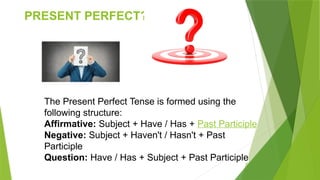
PRESENT PERFECT?
The PresentPerfect Tense is formed using the
following structure:
Affirmative: Subject + Have / Has + Past Participle
Negative: Subject + Haven't / Hasn't + Past
Participle
Question: Have / Has + Subject + Past Participle
3.
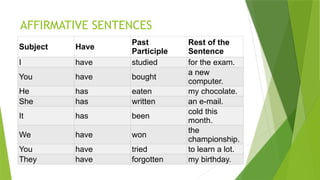
AFFIRMATIVE SENTENCES
Subject Have
Past
Participle
Restof the
Sentence
I have studied for the exam.
You have bought
a new
computer.
He has eaten my chocolate.
She has written an e-mail.
It has been
cold this
month.
We have won
the
championship.
You have tried to learn a lot.
They have forgotten my birthday.
4.
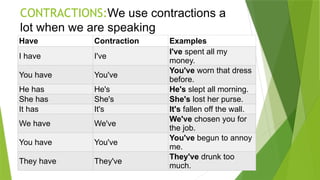
CONTRACTIONS:We use contractionsa
lot when we are speaking
Have Contraction Examples
I have I've
I've spent all my
money.
You have You've
You've worn that dress
before.
He has He's He's slept all morning.
She has She's She's lost her purse.
It has It's It's fallen off the wall.
We have We've
We've chosen you for
the job.
You have You've
You've begun to annoy
me.
They have They've
They've drunk too
much.
5.
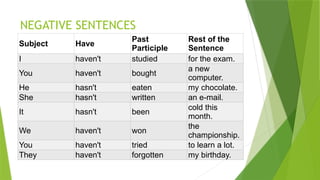
NEGATIVE SENTENCES
Subject Have
Past
Participle
Restof the
Sentence
I haven't studied for the exam.
You haven't bought
a new
computer.
He hasn't eaten my chocolate.
She hasn't written an e-mail.
It hasn't been
cold this
month.
We haven't won
the
championship.
You haven't tried to learn a lot.
They haven't forgotten my birthday.
6.
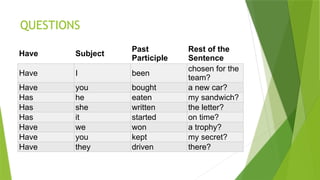
QUESTIONS
Have Subject
Past
Participle
Rest ofthe
Sentence
Have I been
chosen for the
team?
Have you bought a new car?
Has he eaten my sandwich?
Has she written the letter?
Has it started on time?
Have we won a trophy?
Have you kept my secret?
Have they driven there?
7.
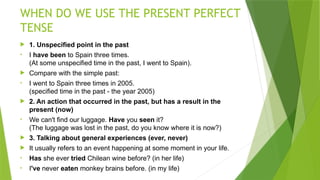
WHEN DO WEUSE THE PRESENT PERFECT
TENSE
1. Unspecified point in the past
• I have been to Spain three times.
(At some unspecified time in the past, I went to Spain).
Compare with the simple past:
• I went to Spain three times in 2005.
(specified time in the past - the year 2005)
2. An action that occurred in the past, but has a result in the
present (now)
• We can't find our luggage. Have you seen it?
(The luggage was lost in the past, do you know where it is now?)
3. Talking about general experiences (ever, never)
It usually refers to an event happening at some moment in your life.
• Has she ever tried Chilean wine before? (in her life)
• I've never eaten monkey brains before. (in my life)
8.
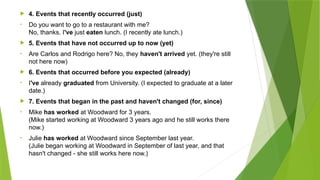
4. Eventsthat recently occurred (just)
• Do you want to go to a restaurant with me?
No, thanks. I've just eaten lunch. (I recently ate lunch.)
5. Events that have not occurred up to now (yet)
• Are Carlos and Rodrigo here? No, they haven't arrived yet. (they're still
not here now)
6. Events that occurred before you expected (already)
• I've already graduated from University. (I expected to graduate at a later
date.)
7. Events that began in the past and haven't changed (for, since)
• Mike has worked at Woodward for 3 years.
(Mike started working at Woodward 3 years ago and he still works there
now.)
• Julie has worked at Woodward since September last year.
(Julie began working at Woodward in September of last year, and that
hasn't changed - she still works here now.)