PRESENT CONTINUOUS
 We use the Present Continuous for actions
  that take place at the current moment:

     I am speaking  Estoy hablando.
     You are listening  Estáis escuchando.
     We are studying English  Estamos
         estudiando inglés.
PRESENT CONTINUOUS
 Formation:
                   AFFIRMATIVE


      NEGATIVE
                                 TIME EXPRESIONS


                 INTERROGATIVE
PRESENT CONTINUOUS
 AFFIRMATIVE:
                                          SJ + BE + Ving+ C
              The man is sleeping.                           The cat is eating.


                                The crocodile is walking.

If the verb ends in “e”, we omit the –e    With verbs of one syllable that end in vowel +
and add -ing: write, dance, make…          consonant, we double the consonant and add –ing:
                                           get, swim, run…
  My brother is writing.
                                                      Your sister is running.
With verbs that end in «-l», we double
the «-l»: travel  travelling

  He is travelling through Europe.
PRESENT CONTINUOUS
   NEGATIVE:
                   SJ +            + Ving+ C
    I am not dancing.               The cat isn’t eating.
    The crocodile isn’t walking.    The man isn’t sleeping.
   My brother isn’t writing.        Your sister isn’t running.
                  You aren’t watching a film.
            He isn’t travelling through Europe.
PRESENT CONTINUOUS
 INTERROGATIVE:                       + SJ + Ving (+ C)?
  Are you studying English? Yes, I am / No, I am not.
  Are your friends watching a film? Yes, they are / No, they aren’t.
  Are you eating? Yes, I am / No, I am not.
  Is the man sleeping? Yes, he is / No he isn’t.
  Is your sister running? Yes, she is / No, she isn’t.
  Is the crocodile walking? Yes, it is / No, it isn’t.
PRESENT CONTINUOUS
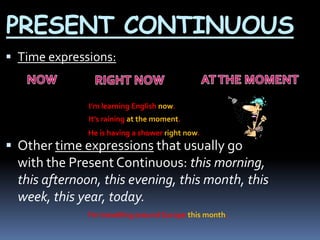
 Time expressions:


               I’m learning English now.
               It’s raining at the moment.
              He is having a shower right now.
 Other time expressions that usually go
  with the Present Continuous: this morning,
  this afternoon, this evening, this month, this
  week, this year, today.
              I’m travelling around Europe this month.

Present continuous

  • 1.
    PRESENT CONTINUOUS  Weuse the Present Continuous for actions that take place at the current moment: I am speaking  Estoy hablando. You are listening  Estáis escuchando. We are studying English  Estamos estudiando inglés.
  • 2.
    PRESENT CONTINUOUS  Formation: AFFIRMATIVE NEGATIVE TIME EXPRESIONS INTERROGATIVE
  • 3.
    PRESENT CONTINUOUS  AFFIRMATIVE: SJ + BE + Ving+ C The man is sleeping. The cat is eating. The crocodile is walking. If the verb ends in “e”, we omit the –e With verbs of one syllable that end in vowel + and add -ing: write, dance, make… consonant, we double the consonant and add –ing: get, swim, run… My brother is writing. Your sister is running. With verbs that end in «-l», we double the «-l»: travel  travelling He is travelling through Europe.
  • 4.
    PRESENT CONTINUOUS  NEGATIVE: SJ + + Ving+ C I am not dancing. The cat isn’t eating. The crocodile isn’t walking. The man isn’t sleeping. My brother isn’t writing. Your sister isn’t running. You aren’t watching a film. He isn’t travelling through Europe.
  • 5.
    PRESENT CONTINUOUS  INTERROGATIVE: + SJ + Ving (+ C)? Are you studying English? Yes, I am / No, I am not. Are your friends watching a film? Yes, they are / No, they aren’t. Are you eating? Yes, I am / No, I am not. Is the man sleeping? Yes, he is / No he isn’t. Is your sister running? Yes, she is / No, she isn’t. Is the crocodile walking? Yes, it is / No, it isn’t.
  • 6.
    PRESENT CONTINUOUS  Timeexpressions: I’m learning English now. It’s raining at the moment. He is having a shower right now.  Other time expressions that usually go with the Present Continuous: this morning, this afternoon, this evening, this month, this week, this year, today. I’m travelling around Europe this month.