JNANA PRABODHINI 1
PREPARING FOR
EXAMINATION
VIVEK PONKSHE
JNANA PRABODHINI 2
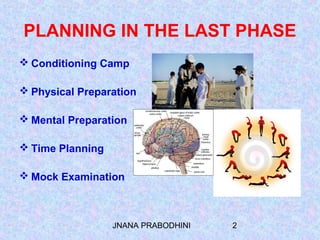
PLANNING IN THE LAST PHASE
 Conditioning Camp
 Physical Preparation
 Mental Preparation
 Time Planning
 Mock Examination
JNANA PRABODHINI 3
CONDITIONING CAMP
Adaptation to examination atmosphere
Proper physical and mental condition to
create competitive spirit
Motivation to win
JNANA PRABODHINI 4
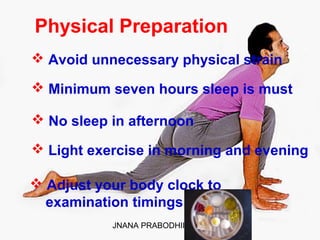
Physical Preparation
 Avoid unnecessary physical strain
 Minimum seven hours sleep is must
 No sleep in afternoon
 Light exercise in morning and evening
 Adjust your body clock to
examination timings
JNANA PRABODHINI 5
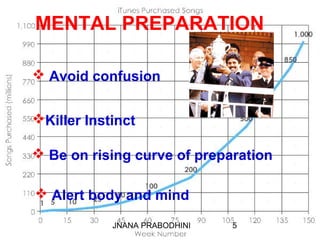
MENTAL PREPARATION
 Avoid confusion
 Be on rising curve of preparation
 Alert body and mind
Killer Instinct
JNANA PRABODHINI 6
TIME PLANNING
 Ten to twelve hours a day
study
 Analyze solved answer papers
Compare your scores with your
objective
Re-plan your weightage of study time
for each subject
JNANA PRABODHINI 7
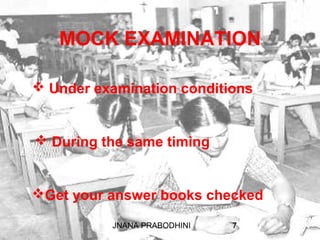
MOCK EXAMINATION
 Under examination conditions
 During the same timing
Get your answer books checked
JNANA PRABODHINI 8
REVISION IN LAST PHASE
• Visualization
• Use of Cards
• Explaining others
• Use of Charts
• Micro Notes
JNANA PRABODHINI 9
VISUALIZATION
1. Recall important points
2. Comprehensive thinking
3. Putting all points in logical order
4. Create a memory chain
5. Visualize all pictorial information
6. Think of various questions which can be
asked around that point
7. Make rough sketch of what you are recalling
JNANA PRABODHINI 10
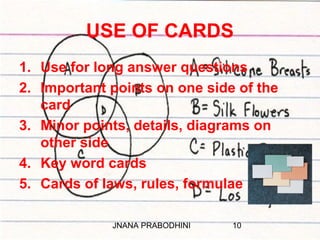
USE OF CARDS
1. Use for long answer questions
2. Important points on one side of the
card
3. Minor points, details, diagrams on
other side
4. Key word cards
5. Cards of laws, rules, formulae
JNANA PRABODHINI 11
EXPLAINING TO OTHERS
1. Paired task
2. Choose difficult topics
3. Explain in your own language
4. Draw figures, diagrams if necessary
5. Invite questions
6. Sum up together
JNANA PRABODHINI 12
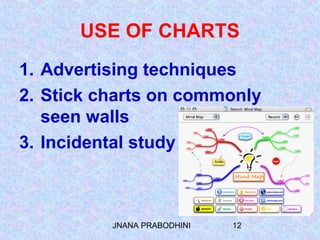
USE OF CHARTS
1. Advertising techniques
2. Stick charts on commonly
seen walls
3. Incidental study
JNANA PRABODHINI 13
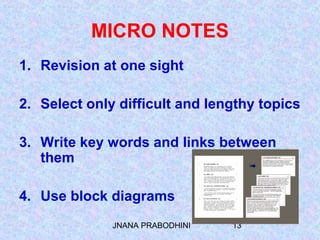
MICRO NOTES
1. Revision at one sight
2. Select only difficult and lengthy topics
3. Write key words and links between
them
4. Use block diagrams
JNANA PRABODHINI 14
DURING EXAMINATION DAYS
1. Go to sleep early
2. Get up early
3. Avoid distracters such as story books, films, T V
serials, Internet
4. Take just enough food before starting for
examination
5. Individual study is the best strategy
6. Use relaxation technique under stress condition
7. No discussion half an hour before examination
8. No discussion after coming out of examination hall
JNANA PRABODHINI 15
REMEMBER WHILE WRITING
ANSWER PAPERS
• Write all necessary personal information
• Draw margins if necessary
• Read question paper carefully
• Select questions and their order of writing
• Write important formulae, keywords by
pencil on back page of answer book
• Write question numbers carefully
• Don’t spend more time on single question
JNANA PRABODHINI 16
REMEMBER WHILE WRITING
ANSWER PAPERS (contd)
• If you remember some important pt of
answer of other question then write down
somewhere
• Mark the question after answering
• Leave some gap after each answer
• Long answers may be started on new page
• Under line important pts to draw attention of
examiner
• Make paragraphs in long answers
• Number pts in your answers
JNANA PRABODHINI 17
REMEMBER WHILE WRITING
ANSWER PAPERS (contd)
• In maths under line intermediate answers and write
final answer in block
• Draw to the scale figures
• Do your rough work nearby to the final answer
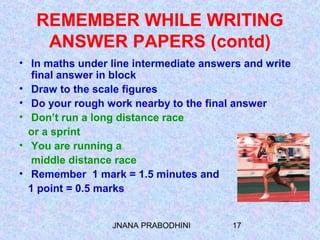
• Don’t run a long distance race
or a sprint
• You are running a
middle distance race
• Remember 1 mark = 1.5 minutes and
1 point = 0.5 marks
JNANA PRABODHINI 18
CHECKING THE ANSWERPAPER
• Underline
• Write any point left
• Check whether required no of questions are
attempted
• Check question nos
• In languages check spellings, grammar,
sentence construction, tenses
• In Maths check calculations, figures in
problems and in your solutions, decimal
place, units, scale, values of t ratios
JNANA PRABODHINI 19
CHECKING THE ANSWERPAPER
(contd)
• In Science check wording of definitions,
units, formulae, calculations, no of examples
to give explanation, balancing chemical
equations, labels given in figures, biological
terms, etc
• In Social Science check order of events,
details in your answers, map index, etc
• No of supplements, your roll no

Preparing for examination

  • 1.
    JNANA PRABODHINI 1 PREPARINGFOR EXAMINATION VIVEK PONKSHE
  • 2.
    JNANA PRABODHINI 2 PLANNINGIN THE LAST PHASE  Conditioning Camp  Physical Preparation  Mental Preparation  Time Planning  Mock Examination
  • 3.
    JNANA PRABODHINI 3 CONDITIONINGCAMP Adaptation to examination atmosphere Proper physical and mental condition to create competitive spirit Motivation to win
  • 4.
    JNANA PRABODHINI 4 PhysicalPreparation  Avoid unnecessary physical strain  Minimum seven hours sleep is must  No sleep in afternoon  Light exercise in morning and evening  Adjust your body clock to examination timings
  • 5.
    JNANA PRABODHINI 5 MENTALPREPARATION  Avoid confusion  Be on rising curve of preparation  Alert body and mind Killer Instinct
  • 6.
    JNANA PRABODHINI 6 TIMEPLANNING  Ten to twelve hours a day study  Analyze solved answer papers Compare your scores with your objective Re-plan your weightage of study time for each subject
  • 7.
    JNANA PRABODHINI 7 MOCKEXAMINATION  Under examination conditions  During the same timing Get your answer books checked
  • 8.
    JNANA PRABODHINI 8 REVISIONIN LAST PHASE • Visualization • Use of Cards • Explaining others • Use of Charts • Micro Notes
  • 9.
    JNANA PRABODHINI 9 VISUALIZATION 1.Recall important points 2. Comprehensive thinking 3. Putting all points in logical order 4. Create a memory chain 5. Visualize all pictorial information 6. Think of various questions which can be asked around that point 7. Make rough sketch of what you are recalling
  • 10.
    JNANA PRABODHINI 10 USEOF CARDS 1. Use for long answer questions 2. Important points on one side of the card 3. Minor points, details, diagrams on other side 4. Key word cards 5. Cards of laws, rules, formulae
  • 11.
    JNANA PRABODHINI 11 EXPLAININGTO OTHERS 1. Paired task 2. Choose difficult topics 3. Explain in your own language 4. Draw figures, diagrams if necessary 5. Invite questions 6. Sum up together
  • 12.
    JNANA PRABODHINI 12 USEOF CHARTS 1. Advertising techniques 2. Stick charts on commonly seen walls 3. Incidental study
  • 13.
    JNANA PRABODHINI 13 MICRONOTES 1. Revision at one sight 2. Select only difficult and lengthy topics 3. Write key words and links between them 4. Use block diagrams
  • 14.
    JNANA PRABODHINI 14 DURINGEXAMINATION DAYS 1. Go to sleep early 2. Get up early 3. Avoid distracters such as story books, films, T V serials, Internet 4. Take just enough food before starting for examination 5. Individual study is the best strategy 6. Use relaxation technique under stress condition 7. No discussion half an hour before examination 8. No discussion after coming out of examination hall
  • 15.
    JNANA PRABODHINI 15 REMEMBERWHILE WRITING ANSWER PAPERS • Write all necessary personal information • Draw margins if necessary • Read question paper carefully • Select questions and their order of writing • Write important formulae, keywords by pencil on back page of answer book • Write question numbers carefully • Don’t spend more time on single question
  • 16.
    JNANA PRABODHINI 16 REMEMBERWHILE WRITING ANSWER PAPERS (contd) • If you remember some important pt of answer of other question then write down somewhere • Mark the question after answering • Leave some gap after each answer • Long answers may be started on new page • Under line important pts to draw attention of examiner • Make paragraphs in long answers • Number pts in your answers
  • 17.
    JNANA PRABODHINI 17 REMEMBERWHILE WRITING ANSWER PAPERS (contd) • In maths under line intermediate answers and write final answer in block • Draw to the scale figures • Do your rough work nearby to the final answer • Don’t run a long distance race or a sprint • You are running a middle distance race • Remember 1 mark = 1.5 minutes and 1 point = 0.5 marks
  • 18.
    JNANA PRABODHINI 18 CHECKINGTHE ANSWERPAPER • Underline • Write any point left • Check whether required no of questions are attempted • Check question nos • In languages check spellings, grammar, sentence construction, tenses • In Maths check calculations, figures in problems and in your solutions, decimal place, units, scale, values of t ratios
  • 19.
    JNANA PRABODHINI 19 CHECKINGTHE ANSWERPAPER (contd) • In Science check wording of definitions, units, formulae, calculations, no of examples to give explanation, balancing chemical equations, labels given in figures, biological terms, etc • In Social Science check order of events, details in your answers, map index, etc • No of supplements, your roll no