For Class IX & X
For Preparation of Board Exams
Prepared by Miss Tehmina Fiazan
FOR TEACHERS!!!!!!!
RESPONSIBILITY OF INVIGILATION
• (i) Teachers should respect invigilation schedule and
abide by it.
• (ii) In case of an emergency they should inform
examination in charge to avoid last minute hassle.
• (iii) Proper instructions have to be typed on question
paper to avoid any confusion.
• (iv) Concerned teacher should take a round when the
examination is going on.
• (v) A teacher should check papers on time and give the
feedback promptly.
REMEMBER !!!!!!!
• To define and communicate learning expectations to
students
• To evaluate students’ performances in an objective, fair
and timely manner
• To use student assessment data to guide changes in
instruction and practice, and to improve student
learning
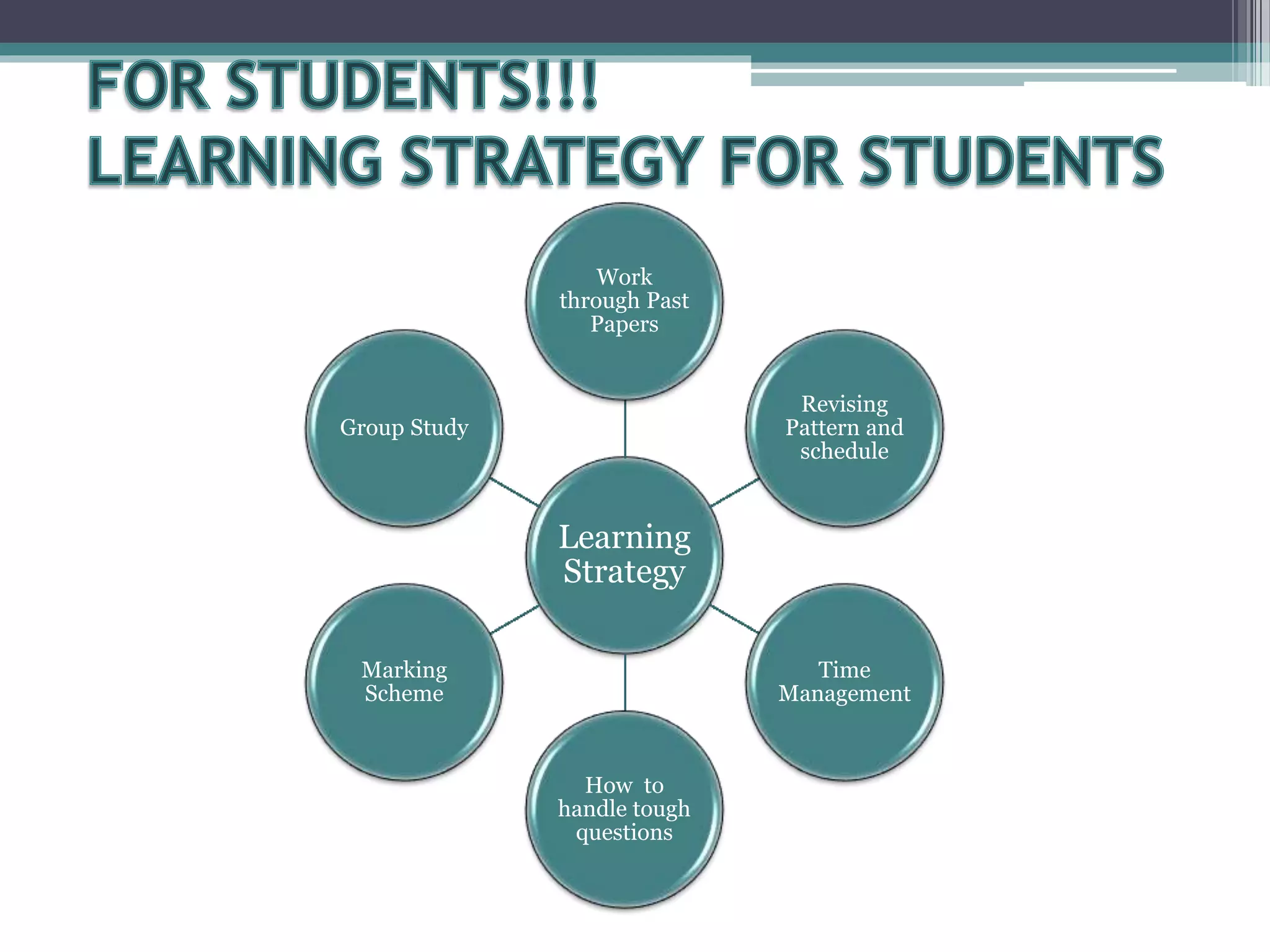
Learning
Strategy
Work
through Past
Papers
Revising
Pattern and
schedule
Time
Management
How to
handle tough
questions
Marking
Scheme
Group Study
• Students need to keep working through past papers
and pushing hard with the marking schemes.
• the most helpful ways of efficiently revising is to get the
students working in groups – helping each other. when a
student explains the material to someone else, they are
effectively testing themselves
.
• Don’t loose confidence
• If you are not getting
anywhere with the
question, then move on
• Don’t waste your time on
it
• As it is hard so it will be
marked poorly
Get an early start
Reduce the load
Raise the spirit
Support the effort
Strategic support systems
Also remember to say your five times
prayer and dua
Teachers Syllabus Notes
Past papers
and marked
schemes
Textbooks
and revision
guides
Study
partners and
study space
• ORDER: It is absolutely vital that you are organized
and lead a well structured life.
•O Organization – Make a structured revision plan for the next
few weeks
•R REDUCE – trim down, lessen your syllabus
• D Diagrams – Try using visual ways to show topics.
•E Exam techniques – Don’t throw away all you have done by
messing up during the exam. Manage the exam well.
•R Rigidity – You must be disciplined and discriminating with your
time and energy. Without Order and Discipline, everything else is
ineffective.
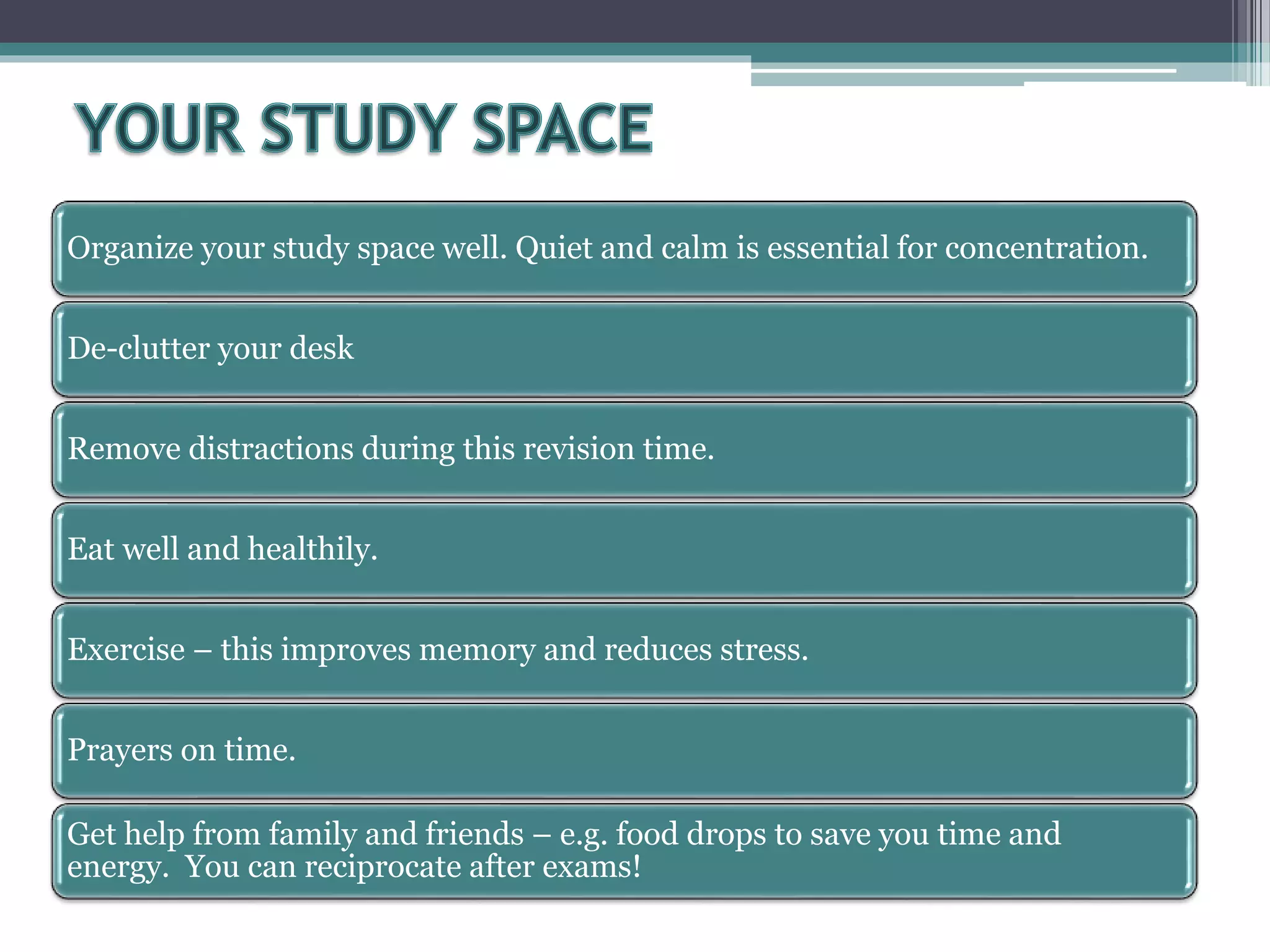
Organize your study space well. Quiet and calm is essential for concentration.
De-clutter your desk
Remove distractions during this revision time.
Eat well and healthily.
Exercise – this improves memory and reduces stress.
Prayers on time.
Get help from family and friends – e.g. food drops to save you time and
energy. You can reciprocate after exams!
Make your revision timetable for the remaining weeks and days – start from the exam
dates and work backwards
Be realistic about the amount of time and energy you will need to revise. Time
management is a real skill.
Priorities the subjects – those you need to do best in, the most difficult subjects (often
Math, Physics, Chemistry) and those with the most content to review (Urdu, Islamiat,
Pakistan studies).
Priorities the topics within each subject – are these compulsory topics? – those that
must be done?
Know the format of each exam. Look at the mark criteria. The style of the exam
dictates to some extent how you revise.
Get on top of a few topics in depth. It will become easier and quicker to do the
others. How many topics should you revise? If you have an exam with choices, as a
guide, revise at least a couple more than the minimum.
Revise topics 2 or 3 times. It will always be easier
the 2nd and 3rd time around.
Limit the time revising one topic: it won’t help if
you don’t get round to revising several topics.
Tick topics off as you do them, so that you can get a
sense of achievement.
Study difficult topics when you are at your peak
concentration level.
Include some empty slots to allow for unforeseen
events. Be prepared to be flexible.
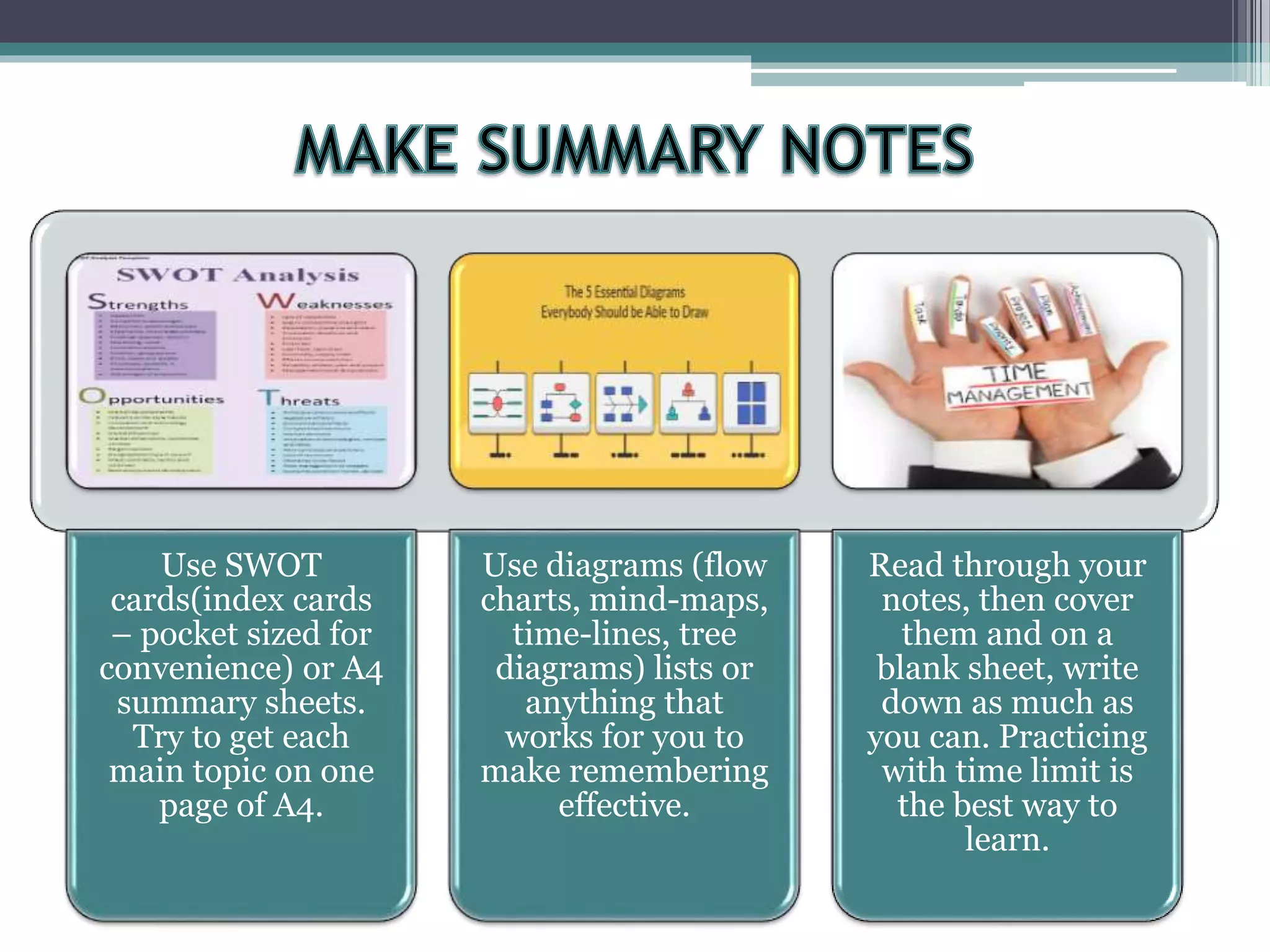
Use SWOT
cards(index cards
– pocket sized for
convenience) or A4
summary sheets.
Try to get each
main topic on one
page of A4.
Use diagrams (flow
charts, mind-maps,
time-lines, tree
diagrams) lists or
anything that
works for you to
make remembering
effective.
Read through your
notes, then cover
them and on a
blank sheet, write
down as much as
you can. Practicing
with time limit is
the best way to
learn.
• Practice answers and essays (including skeleton
answers) from past exam papers.
• Practice writing against the clock.
• Revise the notes, not the books, the night before the
exam. Scan through your summary revision sheets.
• The night before, prepare all materials needed
for the exam. (Be sure you know what you are allowed to take
in – admit card, log book? calculator? Know well ahead what you
are allowed.)
• Remember to pray Salat-ul-Hajaat.
• Arrive in a fit state and in good time at the
examination hall.
• First recite
﴿ ‫درى‬َ‫ص‬ ‫لى‬ ‫ح‬َ‫اشر‬ ِّ‫ب‬َ‫ر‬٢٥﴿ ‫مرى‬َ‫أ‬ ‫لى‬ ‫ر‬ِّ‫س‬َ‫ي‬َ‫و‬ ﴾٢٦﴿ ‫سانى‬ِّ‫ل‬ ‫ن‬ِّ‫م‬ ً‫ة‬َ‫د‬‫ُق‬‫ع‬ ‫ل‬ُ‫ل‬‫اح‬َ‫و‬ ﴾٢٧﴾
‫ولى‬َ‫ق‬ ‫هوا‬َ‫ق‬‫ف‬َ‫ي‬
‫ا‬ً‫م‬‫ل‬ِّ‫ع‬ ‫دنى‬ ِّ‫ز‬ ِّ‫ب‬َ‫ر‬
• Don’t rush! The first 5 to 10 minutes of the exam are
vital. Most marks are lost by students not following instructions or
running out of time.
• Read instructions carefully – including the right number of
questions.
• Budget your time sensibly. Look at the mark allocation for
each question and each sub-section and work out how much time you
have for each question. Jot this down and stick to it. Ideally, allow 5-10
minutes at the end for checking. Keep an eye on the clock.
• Read each question twice; mark the ones you can do.
• First answer those questions you can do best.
• Answer the question. Do not stray from the point. Jot
down any ideas that come to you when you first
read the questions. Also keep in mind the marks
requirement of that question.
• “Go for the jugular”, i.e. the key word(s) or phrase, explain your
interpretation of them clearly. What do the questions ask
you to do e.g. describe, analyze, compare, differentiate,
calculate, explain, criticize, evaluate, argue a point of view, or what?
• If you cannot do a question or part of it, leave it and move
on. It is important that you get to the end of the paper and do all
the questions (and parts) that you have to do.
• Always do all parts of a question at same
place. It makes it easy for the examiner to assess and
give marks.
• If you are writing essay answers, always allow a
few minutes to make a skeleton plan in points
for your answer before writing, and give equal
time for each essay.
• Do not write any irrelevant comments,
remarks or requests on your answer
copy.
•It leaves a bad
impression on examiner
•Try to do all parts of a
section in sequence.
•Always remember to
write A and B copy
numbers
•Always write same
question number as
allotted in paper
• In the last 20 minutes, complete
questions you may not have been
confident about.
• Check your hand-writing and also focus
on your presentation. (Use of cut markers, black
and blue markers and cut pen for (Sindhi).
• After the exam, try not to think about it and get
yourself ready for the next one.
• MAKE SURE YOU DO NOT GET TOO
TIRED OR STRESSED
• You must be ALERT and FRESH on exam
days
Exam techniques

Exam techniques

  • 1.
    For Class IX& X For Preparation of Board Exams Prepared by Miss Tehmina Fiazan
  • 2.
    FOR TEACHERS!!!!!!! RESPONSIBILITY OFINVIGILATION • (i) Teachers should respect invigilation schedule and abide by it. • (ii) In case of an emergency they should inform examination in charge to avoid last minute hassle. • (iii) Proper instructions have to be typed on question paper to avoid any confusion. • (iv) Concerned teacher should take a round when the examination is going on. • (v) A teacher should check papers on time and give the feedback promptly.
  • 3.
    REMEMBER !!!!!!! • Todefine and communicate learning expectations to students • To evaluate students’ performances in an objective, fair and timely manner • To use student assessment data to guide changes in instruction and practice, and to improve student learning
  • 4.
  • 5.
    • Students needto keep working through past papers and pushing hard with the marking schemes. • the most helpful ways of efficiently revising is to get the students working in groups – helping each other. when a student explains the material to someone else, they are effectively testing themselves
  • 6.
  • 7.
    • Don’t looseconfidence • If you are not getting anywhere with the question, then move on • Don’t waste your time on it • As it is hard so it will be marked poorly
  • 8.
    Get an earlystart Reduce the load Raise the spirit Support the effort Strategic support systems Also remember to say your five times prayer and dua
  • 9.
    Teachers Syllabus Notes Pastpapers and marked schemes Textbooks and revision guides Study partners and study space
  • 10.
    • ORDER: Itis absolutely vital that you are organized and lead a well structured life. •O Organization – Make a structured revision plan for the next few weeks •R REDUCE – trim down, lessen your syllabus • D Diagrams – Try using visual ways to show topics. •E Exam techniques – Don’t throw away all you have done by messing up during the exam. Manage the exam well. •R Rigidity – You must be disciplined and discriminating with your time and energy. Without Order and Discipline, everything else is ineffective.
  • 11.
    Organize your studyspace well. Quiet and calm is essential for concentration. De-clutter your desk Remove distractions during this revision time. Eat well and healthily. Exercise – this improves memory and reduces stress. Prayers on time. Get help from family and friends – e.g. food drops to save you time and energy. You can reciprocate after exams!
  • 12.
    Make your revisiontimetable for the remaining weeks and days – start from the exam dates and work backwards Be realistic about the amount of time and energy you will need to revise. Time management is a real skill. Priorities the subjects – those you need to do best in, the most difficult subjects (often Math, Physics, Chemistry) and those with the most content to review (Urdu, Islamiat, Pakistan studies). Priorities the topics within each subject – are these compulsory topics? – those that must be done? Know the format of each exam. Look at the mark criteria. The style of the exam dictates to some extent how you revise. Get on top of a few topics in depth. It will become easier and quicker to do the others. How many topics should you revise? If you have an exam with choices, as a guide, revise at least a couple more than the minimum.
  • 13.
    Revise topics 2or 3 times. It will always be easier the 2nd and 3rd time around. Limit the time revising one topic: it won’t help if you don’t get round to revising several topics. Tick topics off as you do them, so that you can get a sense of achievement. Study difficult topics when you are at your peak concentration level. Include some empty slots to allow for unforeseen events. Be prepared to be flexible.
  • 14.
    Use SWOT cards(index cards –pocket sized for convenience) or A4 summary sheets. Try to get each main topic on one page of A4. Use diagrams (flow charts, mind-maps, time-lines, tree diagrams) lists or anything that works for you to make remembering effective. Read through your notes, then cover them and on a blank sheet, write down as much as you can. Practicing with time limit is the best way to learn.
  • 15.
    • Practice answersand essays (including skeleton answers) from past exam papers. • Practice writing against the clock. • Revise the notes, not the books, the night before the exam. Scan through your summary revision sheets. • The night before, prepare all materials needed for the exam. (Be sure you know what you are allowed to take in – admit card, log book? calculator? Know well ahead what you are allowed.) • Remember to pray Salat-ul-Hajaat. • Arrive in a fit state and in good time at the examination hall.
  • 16.
    • First recite ﴿‫درى‬َ‫ص‬ ‫لى‬ ‫ح‬َ‫اشر‬ ِّ‫ب‬َ‫ر‬٢٥﴿ ‫مرى‬َ‫أ‬ ‫لى‬ ‫ر‬ِّ‫س‬َ‫ي‬َ‫و‬ ﴾٢٦﴿ ‫سانى‬ِّ‫ل‬ ‫ن‬ِّ‫م‬ ً‫ة‬َ‫د‬‫ُق‬‫ع‬ ‫ل‬ُ‫ل‬‫اح‬َ‫و‬ ﴾٢٧﴾ ‫ولى‬َ‫ق‬ ‫هوا‬َ‫ق‬‫ف‬َ‫ي‬ ‫ا‬ً‫م‬‫ل‬ِّ‫ع‬ ‫دنى‬ ِّ‫ز‬ ِّ‫ب‬َ‫ر‬ • Don’t rush! The first 5 to 10 minutes of the exam are vital. Most marks are lost by students not following instructions or running out of time. • Read instructions carefully – including the right number of questions. • Budget your time sensibly. Look at the mark allocation for each question and each sub-section and work out how much time you have for each question. Jot this down and stick to it. Ideally, allow 5-10 minutes at the end for checking. Keep an eye on the clock.
  • 17.
    • Read eachquestion twice; mark the ones you can do. • First answer those questions you can do best. • Answer the question. Do not stray from the point. Jot down any ideas that come to you when you first read the questions. Also keep in mind the marks requirement of that question. • “Go for the jugular”, i.e. the key word(s) or phrase, explain your interpretation of them clearly. What do the questions ask you to do e.g. describe, analyze, compare, differentiate, calculate, explain, criticize, evaluate, argue a point of view, or what? • If you cannot do a question or part of it, leave it and move on. It is important that you get to the end of the paper and do all the questions (and parts) that you have to do.
  • 18.
    • Always doall parts of a question at same place. It makes it easy for the examiner to assess and give marks. • If you are writing essay answers, always allow a few minutes to make a skeleton plan in points for your answer before writing, and give equal time for each essay. • Do not write any irrelevant comments, remarks or requests on your answer copy.
  • 19.
    •It leaves abad impression on examiner •Try to do all parts of a section in sequence. •Always remember to write A and B copy numbers •Always write same question number as allotted in paper
  • 20.
    • In thelast 20 minutes, complete questions you may not have been confident about. • Check your hand-writing and also focus on your presentation. (Use of cut markers, black and blue markers and cut pen for (Sindhi). • After the exam, try not to think about it and get yourself ready for the next one. • MAKE SURE YOU DO NOT GET TOO TIRED OR STRESSED • You must be ALERT and FRESH on exam days

Editor's Notes

  • #7 These can be a real drag on the student’s confidence because they cannot do them.  I suggest that you let students know that if they are not getting anywhere with the question, then move on – it is not worth the time and effort that is being wasted. Remind the students that any question that is ridiculously hard, is hard for everyone and in effect, because everyone will find it tough, it will score poorly and make no difference to the exam – because it does not discriminate.