Benha University Hospital, EGYPT
PREMARITAL COUNSELING
Aboubakr Elnashar
The concept of premarital counseling is well
recognized in developed countries. However, in
developing countries, PMCC are not yet popular.
Is there a need for premarital counseling
clinics(PMCC)?
Aboubakr Elnashar
CONTENTS
I. TARGET POPULATION.
II. MAIN FUNCTIONS.
III. THE PROCEDURE
IV. PREMARITAL SCREENING PROGRAM IN
KSA
Aboubakr Elnashar
1. Couples about to marry.
2. The newly weds.
3. Any individual seeking advise
Aboubakr Elnashar
1. Medical counseling.
2. Genetic counseling.
3. Family planning counseling.
4. Nutritional counseling
5. Sex education
Aboubakr Elnashar
1. MEDICAL COUNSELLING
The aim is diagnosis of diseases
1. Transmitted to the other partner: STD, TB
2. Represent a risk factor during pregnancy:
cardiac disease
chronic renal disease
renal transplantation
Aboubakr Elnashar
3. Affect reproductive function:
Female:
fibroid, genital hypoplasia, anovulation, menstrual
disorders, hirsutism
Male:
undesnded testes, varicocele, azospermia, physical
disability.
Aboubakr Elnashar
2. GENETIC COUNSELLING
Aim:
identify individuals at risk of having a child with genetic
disorder
Aboubakr Elnashar
Indications
1. Age > 35:
Down syndrome: 1/2000 at 20 y
1/500 at 40y
1/32 at 45 y.
2. First cousins:
share large groups of identical genes (1/16):
increasing the risk of recessive diseases particularly if
there is family history.
Aboubakr Elnashar
3. Chromosomal abnormality in either partner.
4. Family history of genetic disorders
5. Ehnic groups:
Blacks: Sickle cell anemia.
Mediterranean's: B thalassemia, Glucose 6
phosphate dehydogenase def.
6. Pregnancy loss in those previously married.
Aboubakr Elnashar
Steps
1. Establishment of a diagnosis.
2. Estimation of a recurrent risk.
3. Communication of relevant information
4. Provision of long term support.
Aboubakr Elnashar
Teratogenic medications:
e.g. Anticonvulsant, antineoplastic,
Oral anticoagulant, isotretinoin
lithium, alcohol, smoking
Effects should be explained.
Aboubakr Elnashar
3. FAMILY PLANNING COUNSELLING
I. Encourage pregnancy
1. > 30 y.
2. A cause of possible impairment of fertility:
fibroid, PCOS, oligomenorrhea, genital hypoplasia.
3. Chronic medical disease which progress with
advancement of age
Aboubakr Elnashar
II. Contraception
 Aim
reduction the hazards of:
a. adolescence pregnancy
b. unnecessary resort to induction of abortion
c. birth of unwanted child.
 Explain the hazards of:
a. uncontrolled fertility
b. high risk pregnancy (too early, too many & too
close together)
Aboubakr Elnashar
Methods:
a. Natural barrier & chemical:
not good choices.
b. IUCD, injectables & implants:
not suitable.
c. Pills
best choice.
d. Emergency contraception (levonorgestrel)
may be required.
Aboubakr Elnashar
4. Nutritional counseling
 BMI:
preferred indicator of nutritional status
 Eating habits:
fasting, pica, eating disorders, megavitamin
 Preconcetional intake of folic acid
Aboubakr Elnashar
5. SEX EDUCATION
Important
{level of sexual knowledge amongst youth is moderate}.
Aboubakr Elnashar
Includes
1. Sensitive sexual sites.
2. Healthy marital relations.
3. Communication skills to
reduce the chance of marital difficulties
increase marital satisfaction.
4. Safe sex & protection against STD.
5. Answers of questions on sexually related issues.
Aboubakr Elnashar
Requirements
1. The partners may be counseled separately or
together.
2. The doctor:
.Good knowledge of different aspects of human
reproduction & sexuality.
.Good listening.
.Encourage them to ask questions.
Aboubakr Elnashar
A. History
B. Examination
C. Investigations
D. Health education
Aboubakr Elnashar
A. History
1. Menstrual.
2. Family.
3. Drug intake
4. Past: STD
Aboubakr Elnashar
B. Examination
1. Female:
BMI, SSC, hair distribution, galactorrhea
2. Male:
External genitalia:
undesended testes, varicocele, hydrocele,
hypospadias
Aboubakr Elnashar
C. Investigations
I. Routine investigations
Female:
RH typing,
Rubella Ab,
Toxoplasmosis Ab,
Pelvic ultrasonography
Male:
semen analysis
Both:
urine analysis,
CBC,
Bl group,
blood sugar, .
liver function
Aboubakr Elnashar
II. Special investigations
1. Hormonal profile:
amenorrhea, oligomenorrhea, galactorhea, PCOS,
hypogonadism.
2. Karyotyping:
at risk cases.
3. Screening for STD:
some cases.
4. Investigations for specific medical diseases:
cardiac ECHO, GTT, kidney function, IVP, CT of skull
in galactorrhea, thyroid function test
Aboubakr Elnashar
D. Health education
1.Family planning
2.Nutritional
3.Sex
Aboubakr Elnashar
IV. PREMARITAL SCREENING PROGRAM
IN KSA
Genetic disorders and in particular
hemoglobinopathies: sickle cell anemia and
thalassemia are common in Saudi Arabia,
particularly in the Eastern and Southern regions.
2004
Saudi Ministry of Health implemented a mandatory
premarital screening program in order to decrease
the incidence of these genetic disorders in future
generations. This program was named “premarital
medical test”. Aboubakr Elnashar
2008
this test was updated to include mandatory screening
for hepatitis B and C viruses and Human
Immunodeficiency virus (HIV). The new updated
program was given the name of “Program of healthy
marriage”.
By law:
marriage certificate will not be issued unless the test
is performed
Aboubakr Elnashar
Where:
Designated Marriage Consultation Centers,
Premarital form:
name, age, gender, national number, address,
and telephone number.
Tests:
CBC
sickle cell test
hemoglobin electrophoresis
screening for HIV, Hepatitis B and C viruses.
Aboubakr Elnashar
PREMARITAL SCREENING
Define:
conducting examination for soon-to-be married in
order to identify if there is any injury with
genetic blood diseases: sickle-cell anemia (SCA)
and Thalassemia
some infectious diseases: hepatitis B, C and HIV
How?:
1. Provide medical consultation on the odds of
transmitting these diseases to the other marriage
partner or the children in the future
2. Give options and alternatives before soon-to-be
married with the aim of helping them plan for a
healthy sound family.
Aboubakr Elnashar
Objectives
1. Limiting the spread of some genetic blood
diseases: sickle-cell anemia (SCA) and
thalassemia, and some infectious diseases:
hepatitis B, C and AIDS/HIV.
2. Reducing the financial burdens resulting from the
treatment of the injured in terms of the family and
community.
3. Reducing pressure over health institutions and
blood banks.
Aboubakr Elnashar
​
4. Avoiding the social and psychological problems for
families whose children suffer.
5. Making those seeking such an check-up feel at
ease.
6. Disseminating awareness with regard to the
concept of the comprehensive, healthy marriage.
Aboubakr Elnashar
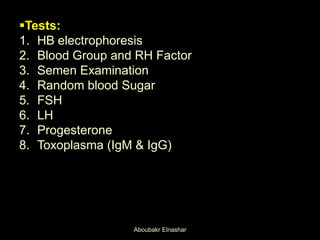
Tests:
1. HB electrophoresis
2. Blood Group and RH Factor
3. Semen Examination
4. Random blood Sugar
5. FSH
6. LH
7. Progesterone
8. Toxoplasma (IgM & IgG)
Aboubakr Elnashar
Benha University Hospital, EGYPT
Email: elnashar53@hotmail.com
Aboubakr Elnashar

PREMARITAL COUNSELING

  • 1.
    Benha University Hospital,EGYPT PREMARITAL COUNSELING Aboubakr Elnashar
  • 2.
    The concept ofpremarital counseling is well recognized in developed countries. However, in developing countries, PMCC are not yet popular. Is there a need for premarital counseling clinics(PMCC)? Aboubakr Elnashar
  • 3.
    CONTENTS I. TARGET POPULATION. II.MAIN FUNCTIONS. III. THE PROCEDURE IV. PREMARITAL SCREENING PROGRAM IN KSA Aboubakr Elnashar
  • 4.
    1. Couples aboutto marry. 2. The newly weds. 3. Any individual seeking advise Aboubakr Elnashar
  • 5.
    1. Medical counseling. 2.Genetic counseling. 3. Family planning counseling. 4. Nutritional counseling 5. Sex education Aboubakr Elnashar
  • 6.
    1. MEDICAL COUNSELLING Theaim is diagnosis of diseases 1. Transmitted to the other partner: STD, TB 2. Represent a risk factor during pregnancy: cardiac disease chronic renal disease renal transplantation Aboubakr Elnashar
  • 7.
    3. Affect reproductivefunction: Female: fibroid, genital hypoplasia, anovulation, menstrual disorders, hirsutism Male: undesnded testes, varicocele, azospermia, physical disability. Aboubakr Elnashar
  • 8.
    2. GENETIC COUNSELLING Aim: identifyindividuals at risk of having a child with genetic disorder Aboubakr Elnashar
  • 9.
    Indications 1. Age >35: Down syndrome: 1/2000 at 20 y 1/500 at 40y 1/32 at 45 y. 2. First cousins: share large groups of identical genes (1/16): increasing the risk of recessive diseases particularly if there is family history. Aboubakr Elnashar
  • 10.
    3. Chromosomal abnormalityin either partner. 4. Family history of genetic disorders 5. Ehnic groups: Blacks: Sickle cell anemia. Mediterranean's: B thalassemia, Glucose 6 phosphate dehydogenase def. 6. Pregnancy loss in those previously married. Aboubakr Elnashar
  • 11.
    Steps 1. Establishment ofa diagnosis. 2. Estimation of a recurrent risk. 3. Communication of relevant information 4. Provision of long term support. Aboubakr Elnashar
  • 12.
    Teratogenic medications: e.g. Anticonvulsant,antineoplastic, Oral anticoagulant, isotretinoin lithium, alcohol, smoking Effects should be explained. Aboubakr Elnashar
  • 13.
    3. FAMILY PLANNINGCOUNSELLING I. Encourage pregnancy 1. > 30 y. 2. A cause of possible impairment of fertility: fibroid, PCOS, oligomenorrhea, genital hypoplasia. 3. Chronic medical disease which progress with advancement of age Aboubakr Elnashar
  • 14.
    II. Contraception  Aim reductionthe hazards of: a. adolescence pregnancy b. unnecessary resort to induction of abortion c. birth of unwanted child.  Explain the hazards of: a. uncontrolled fertility b. high risk pregnancy (too early, too many & too close together) Aboubakr Elnashar
  • 15.
    Methods: a. Natural barrier& chemical: not good choices. b. IUCD, injectables & implants: not suitable. c. Pills best choice. d. Emergency contraception (levonorgestrel) may be required. Aboubakr Elnashar
  • 16.
    4. Nutritional counseling BMI: preferred indicator of nutritional status  Eating habits: fasting, pica, eating disorders, megavitamin  Preconcetional intake of folic acid Aboubakr Elnashar
  • 17.
    5. SEX EDUCATION Important {levelof sexual knowledge amongst youth is moderate}. Aboubakr Elnashar
  • 18.
    Includes 1. Sensitive sexualsites. 2. Healthy marital relations. 3. Communication skills to reduce the chance of marital difficulties increase marital satisfaction. 4. Safe sex & protection against STD. 5. Answers of questions on sexually related issues. Aboubakr Elnashar
  • 19.
    Requirements 1. The partnersmay be counseled separately or together. 2. The doctor: .Good knowledge of different aspects of human reproduction & sexuality. .Good listening. .Encourage them to ask questions. Aboubakr Elnashar
  • 20.
    A. History B. Examination C.Investigations D. Health education Aboubakr Elnashar
  • 21.
    A. History 1. Menstrual. 2.Family. 3. Drug intake 4. Past: STD Aboubakr Elnashar
  • 22.
    B. Examination 1. Female: BMI,SSC, hair distribution, galactorrhea 2. Male: External genitalia: undesended testes, varicocele, hydrocele, hypospadias Aboubakr Elnashar
  • 23.
    C. Investigations I. Routineinvestigations Female: RH typing, Rubella Ab, Toxoplasmosis Ab, Pelvic ultrasonography Male: semen analysis Both: urine analysis, CBC, Bl group, blood sugar, . liver function Aboubakr Elnashar
  • 24.
    II. Special investigations 1.Hormonal profile: amenorrhea, oligomenorrhea, galactorhea, PCOS, hypogonadism. 2. Karyotyping: at risk cases. 3. Screening for STD: some cases. 4. Investigations for specific medical diseases: cardiac ECHO, GTT, kidney function, IVP, CT of skull in galactorrhea, thyroid function test Aboubakr Elnashar
  • 25.
    D. Health education 1.Familyplanning 2.Nutritional 3.Sex Aboubakr Elnashar
  • 26.
    IV. PREMARITAL SCREENINGPROGRAM IN KSA Genetic disorders and in particular hemoglobinopathies: sickle cell anemia and thalassemia are common in Saudi Arabia, particularly in the Eastern and Southern regions. 2004 Saudi Ministry of Health implemented a mandatory premarital screening program in order to decrease the incidence of these genetic disorders in future generations. This program was named “premarital medical test”. Aboubakr Elnashar
  • 27.
    2008 this test wasupdated to include mandatory screening for hepatitis B and C viruses and Human Immunodeficiency virus (HIV). The new updated program was given the name of “Program of healthy marriage”. By law: marriage certificate will not be issued unless the test is performed Aboubakr Elnashar
  • 28.
    Where: Designated Marriage ConsultationCenters, Premarital form: name, age, gender, national number, address, and telephone number. Tests: CBC sickle cell test hemoglobin electrophoresis screening for HIV, Hepatitis B and C viruses. Aboubakr Elnashar
  • 29.
    PREMARITAL SCREENING Define: conducting examinationfor soon-to-be married in order to identify if there is any injury with genetic blood diseases: sickle-cell anemia (SCA) and Thalassemia some infectious diseases: hepatitis B, C and HIV How?: 1. Provide medical consultation on the odds of transmitting these diseases to the other marriage partner or the children in the future 2. Give options and alternatives before soon-to-be married with the aim of helping them plan for a healthy sound family. Aboubakr Elnashar
  • 30.
    Objectives 1. Limiting thespread of some genetic blood diseases: sickle-cell anemia (SCA) and thalassemia, and some infectious diseases: hepatitis B, C and AIDS/HIV. 2. Reducing the financial burdens resulting from the treatment of the injured in terms of the family and community. 3. Reducing pressure over health institutions and blood banks. Aboubakr Elnashar
  • 31.
    ​ 4. Avoiding thesocial and psychological problems for families whose children suffer. 5. Making those seeking such an check-up feel at ease. 6. Disseminating awareness with regard to the concept of the comprehensive, healthy marriage. Aboubakr Elnashar
  • 32.
    Tests: 1. HB electrophoresis 2.Blood Group and RH Factor 3. Semen Examination 4. Random blood Sugar 5. FSH 6. LH 7. Progesterone 8. Toxoplasma (IgM & IgG) Aboubakr Elnashar
  • 33.
    Benha University Hospital,EGYPT Email: elnashar53@hotmail.com Aboubakr Elnashar