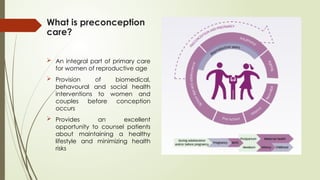
What is preconception
care?
An integral part of primary care
for women of reproductive age
Provision of biomedical,
behavoural and social health
interventions to women and
couples before conception
occurs
Provides an excellent
opportunity to counsel patients
about maintaining a healthy
lifestyle and minimizing health
risks
3.
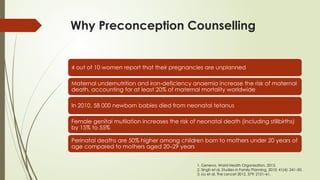
Why Preconception Counselling
4out of 10 women report that their pregnancies are unplanned
Maternal undernutrition and iron-deficiency anaemia increase the risk of maternal
death, accounting for at least 20% of maternal mortality worldwide
In 2010, 58 000 newborn babies died from neonatal tetanus
Female genital mutilation increases the risk of neonatal death (including stillbirths)
by 15% to 55%
Perinatal deaths are 50% higher among children born to mothers under 20 years of
age compared to mothers aged 20–29 years
1. Geneva, World Health Organization, 2013.
2. Singh et al, Studies in Family Planning, 2010; 41(4): 241–50.
3. Liu et al, The Lancet 2012, 379: 2151–61.
4.
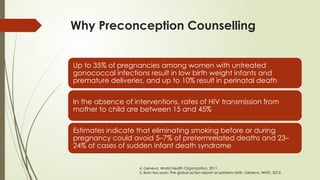
Why Preconception Counselling
Upto 35% of pregnancies among women with untreated
gonococcal infections result in low birth weight infants and
premature deliveries, and up to 10% result in perinatal death
In the absence of interventions, rates of HIV transmission from
mother to child are between 15 and 45%
Estimates indicate that eliminating smoking before or during
pregnancy could avoid 5–7% of pretermrelated deaths and 23–
24% of cases of sudden infant death syndrome
4. Geneva, World Health Organization, 2011.
5. Born too soon: The global action report on preterm birth. Geneva, WHO, 2012.
5.
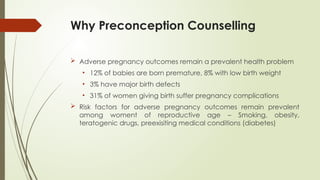
Why Preconception Counselling
Adverse pregnancy outcomes remain a prevalent health problem
• 12% of babies are born premature, 8% with low birth weight
• 3% have major birth defects
• 31% of women giving birth suffer pregnancy complications
Risk factors for adverse pregnancy outcomes remain prevalent
among woment of reproductive age – Smoking, obesity,
teratogenic drugs, preexisiting medical conditions (diabetes)
6.
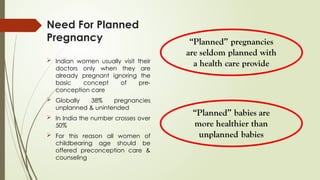
Need For Planned
Pregnancy
Indian women usually visit their
doctors only when they are
already pregnant ignoring the
basic concept of pre-
conception care
Globally 38% pregnancies
unplanned & unintended
In India the number crosses over
50%
For this reason all women of
childbearing age should be
offered preconception care &
counseling
7.
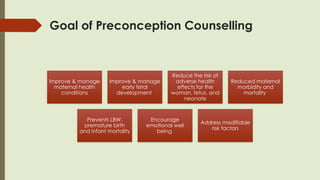
Goal of PreconceptionCounselling
Improve & manage
maternal health
conditions
Improve & manage
early fetal
development
Reduce the risk of
adverse health
effects for the
woman, fetus, and
neonate
Reduced maternal
morbidity and
mortality
Prevents LBW,
premature birth
and infant mortality
Encourage
emotional well
being
Address modifiable
risk factors
Timing of Pre-
pregnancy
Counseling
Because health status and risk factors can change
over time, pre-pregnancy counseling should occur
several times during a woman's reproductive
lifespan,
Leads to increasing her opportunity for education
and potentially maximizing her reproductive and
pregnancy outcomes.
Can be performed by the obstetrician–
gynecologist of an infertile patient before referral
to a reproductive endocrinologist, further
streamlining patient education.
10.
Family
Planning
and
Pregnancy
Spacing
Family planningis a foundational aspect of pre-
pregnancy counseling.
Counseling patients about optimal intervals
between pregnancies may be helpful to reduce
future complications
Women should be advised to avoid
interpregnancy intervals shorter than 6 months and
should be counseled about the risks and benefits of
repeat pregnancy sooner than 18 months
For infertile women planning to use assisted
reproductive technology to become pregnant, a
pregnancy interval less than 18 months but greater
than 6 months may be advisable
11.
Family
Planning
and
Pregnancy
Spacing
An ovulatorywoman younger than 35 years who
desires pregnancy and does not have a clearly
identifiable risk factor for infertility should be
evaluated if she has not become pregnant after 12
months of unprotected intercourse
A woman who is 36 years and older should be
evaluated after 6 months.
For anovulatory women and those with a clearly
identifiable risk factor for infertility, strong
consideration should be given to evaluation and
treatment upon presentation.
12.
Review of Medical,Surgical, and
Psychiatric Histories
Chronic medical conditions such as diabetes, hypertension,
psychiatric illness, and thyroid disease have implications for
pregnancy outcomes
Should be optimally managed before pregnancy
Screening may be appropriate for patients with risk factors (eg, age
greater than 30 years, morbid obesity, history of pregnancy loss,
preterm delivery, or infertility)
13.
Review of
Current
Medications
All prescriptionand non-prescription medications should be
reviewed during pre-pregnancy counseling.
Should include nutritional supplements and herbal products
that patients may not consider to be medication use but
could affect reproduction and pregnancy
Medications with potential teratogenicity should be
reviewed and the specific risks of each individual
medication discussed in detail
Importance of reliable contraception should be emphasized
when a patient is taking potentially teratogenic medications
Lowest effective doses of the safest medications should be
used whenever it is medically reasonable to do so
14.
Review of
Family and
Genetic
History
Agenetic and family history of the patient and her partner
should be obtained
This may include family history of genetic disorders, birth
defects, mental disorders, and breast, ovarian, uterine, and
colon cancer
Women who present for pre-pregnancy counseling should
be offered screening for the same genetic conditions as
recommended for pregnant women
Couples at risk of having children with specific genetic
diseases can be counseled about the disease inheritance
and course and offered referral for potential interventions,
such as preimplantation genetic testing.
15.
Immunizations
Women of reproductiveage should have their
immunization status assessed annually for Tdap,
measles–mumps–rubella, hepatitis B, and varicella.
Tdap vaccine should be given to all women during
each pregnancy between 27–36 weeks regardless of
prepregnancy immunization history.
Vaccinations for rubella and varicella should be
given at least 28 days before pregnancy, or in the
postpartum period if not previously given.
Some advanced-reproductive-age patients may
wish to reproduce, and those age 50 years and older
should also be vaccinated against herpes zoster
16.
Infectious Disease Screening
Assessmentof the need for STI screening should be performed at the time
of prepregnancy counseling.
Gonorrhea, chlamydial infection, syphilis, and human immunodeficiency
virus (HIV) should be screened for based on age and risk factors.
Counseling to reduce STI risk should be provided
Those at high risk of tuberculosis should be screened and treated
appropriately before pregnancy
17.
Infectious Disease Screening
Muchattention has been given to educational
programs to reduce maternal Toxoplasma
gondii infection and, thus, congenital toxoplasmosis
Patients with potential exposure to certain infectious
diseases, such as the Zika virus, should be counseled
regarding travel restrictions and appropriate waiting
time before attempting pregnancy.
18.
Individuals with
Human
Immunodeficiency
Virus
Allreproductive-aged patients living with HIV
should receive pre-pregnancy counseling if
considering pregnancy
Pre-pregnancy counseling should include a
detailed discussion of interventions to reduce the
risk of perinatal transmission, ways to optimize long-
term health, and the possible effects of
antiretroviral medications on the fetus.
Artificial insemination is the safest way for an HIV-
infected couple to become pregnant while
minimizing the risk of HIV transmission to an HIV-
negative partner
19.
Individuals with
Human
Immunodeficiency
Virus
Pre-pregnancyadministration of antiretroviral
preexposure prophylaxis for HIV-uninfected
partners may offer an additional tool to reduce the
risk of sexual transmission
The choice of antiretroviral therapy in women of
childbearing capacity should take into
consideration
• the regimen's effectiveness,
• the women's hepatitis B status,
• the teratogenic potential of the medications,
• potential drug interactions, and
• possible maternal and fetal adverse outcomes
20.
Substance
Use
Assessment
All patientsshould be routinely asked about their
use of alcohol, nicotine products, and drugs,
including prescription opioids and other
medications used for nonmedical reasons
Adverse effects associated with smoking during
pregnancy include
• intrauterine growth restriction,
• placenta previa,
• abruptio placentae,
• decreased maternal thyroid function,
• premature rupture of membranes,
• low birth weight,
• perinatal mortality, and
• ectopic pregnancy
21.
Substance
Use
Assessment
Children bornto women who smoke during
pregnancy are at an increased risk of asthma,
infantile colic, and childhood obesity
Pregnancy appears to motivate women to stop
smoking; 46% of prepregnancy smokers quit
smoking directly before or during pregnancy
Alcohol use patterns should be determined and
patients counseled that there is no safe level or
type of alcohol use during pregnancy.
Fetal alcohol spectrum disorders are the most
severe result of prenatal drinking and are
associated with central nervous system
abnormalities, growth defects, and facial
dysmorphia.
22.
Substance
Use
Assessment
Alcohol-related birthdefects include
• growth deformities,
• facial abnormalities,
• central nervous system impairment,
• behavioral disorders, and
• impaired intellectual development
Brief behavioral counseling interventions can
reduce the risk of alcohol-exposed pregnancies
Marijuana is used by an estimated 2–5% of
pregnant women. Patients who are contemplating
pregnancy should be encouraged to discontinue
marijuana use.
23.
Exposure to
Violence,
Intimate
Partner
Violence,
and
Reproductive
and Sexual
Coercion
Screening for intimate partner violence should
occur during prepregnancy counseling.
Sexual coercion includes a range of behavior that
a partner may use related to sexual decision
making to pressure or coerce a person to have sex
without using physical force
The most common forms of reproductive coercion
include sabotage of contraceptive methods,
pregnancy coercion, and pregnancy pressure
If ongoing abuse is identified, assessment of the
immediate safety of the patient and her family
should be ascertained and community resources
for victims should be provided.
24.
Assess
Nutritional
Status
Female pre-pregnancyfolic acid supplementation
should be encouraged to reduce the risk of neural
tube defects (NTDs).
For average-risk women, supplementation with 400
micrograms per day is adequate.
Most prenatal multivitamins contain adequate
amounts of folic acid for average-risk-women.
Prenatal vitamins use also is associated with a
lower risk of miscarriage
Patients who are at risk of eating disorders should
be screened and counseled
Patients with malabsorptive gastrointestinal
disease, bariatric surgery, or those on a vegan diet
may require vitamin and mineral supplementation.
25.
Achieving
and
Maintaining
a Healthy
Body Weight
Patients should be encouraged to try to attain a BMI in
the normal range before attempting pregnancy
Abnormal high or low BMI is associated with infertility
and maternal and fetal pregnancy complications
The reproductive risks of obesity include, but are not
limited to,
• infertility,
• miscarriage,
• birth defects,
• preterm delivery,
• gestational diabetes,
• gestational hypertension,
• cesarean delivery, and
• thromboembolic events
26.
Achieving
and
Maintaining
a Healthy
Body Weight
Obesity also increases the risk of nonreproductive
diseases, including stroke, heart disease, certain
types of cancer, arthritis, high cholesterol,
hypertension, and diabetes
Pregnant women with low BMI are at risk of having
small-for-gestational-age fetuses and low-birth-
weight infants
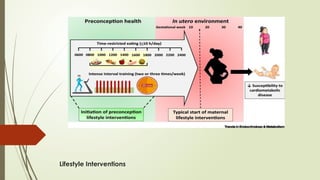
Weight should be optimized before a woman
attempts to becoming pregnant
27.
Assess
Exercise
and Physical
Activity
Regularphysical exercise improves cardiovascular
health, reduces obesity and associated medical
comorbidities, and improves longevity.
Patients should exercise moderately at least 30
minutes a day, 5 days a week, for a minimum of
150 minutes of moderate exercise per week
These levels of exercise are recommended in pre-
pregnancy, during pregnancy, and in postpartum
women.
Dietary modifications in concert with exercise
produce greater weight loss than exercise alone
28.
Assess Exercise andPhysical Activity
Competitive athletes require frequent and closer
supervision because they tend to maintain a more
strenuous training schedule throughout pregnancy
and resume high-intensity postpartum training sooner.
Competitive athletes should pay particular attention to
avoiding hyperthermia, maintaining proper hydration,
and sustaining adequate caloric intake to prevent
weight loss that may adversely affect fetal growth
Assess for Teratogensand Environmental
and Occupational Exposures
There are reproductive and pregnancy risks associated with
environmental pollutants, workplace teratogens, and endocrine
disruptors
Patients can be educated regarding the avoidance of exposure
to toxic agents and, when necessary, referred to occupational
medicine programs.
Providing guidance and information on environmental hazards
and protecting from unnecessary radiation exposure in
occupational, environmental and medical settings
31.
Assess for
Teratogens
and
Environmental
and
Occupational
Exposures
Avoidingunnecessary pesticide use/providing
alternatives to pesticides
Informing women of childbearing age about levels
of methyl mercury in fish
Employment sectors at particular risk of potentially
hazardous exposures during pregnancy include
• agriculture (pesticides),
• manufacturing (organic solvents and heavy metals),
• dry cleaning (solvents), and
• health care (biologics and radiation)
32.
Pregnancy
Dating Women shouldbe counseled to seek medical care
before attempting to become pregnant or as soon
as they believe they are pregnant to aid in correct
dating and to be monitored for any medical
conditions in which treatment should be modified
during pregnancy.
Correct first-trimester pregnancy dating provides
value in managing potential subsequent pregnancy
complications and indications for delivery




![CTEV [ clubfoot] DR ARUN LAL ,DR MOHAMED ASHRAF travancore medical college k...](https://cdn.slidesharecdn.com/ss_thumbnails/ctevclubfootdrarunlaldrmohamedashraftravancoremedicalcollegekollamkeralaindia-260208063247-18fc466c-thumbnail.jpg?width=640&height=640&fit=bounds)


![PERI-PROSTHETIC FRACTURE NAIL-PLATE CONSTRUCT [NPC].pptx](https://cdn.slidesharecdn.com/ss_thumbnails/drarunkumardrmohamedashrafperiprostheticfrasturenail-plateconstructnpc-260209164459-7e9d15a1-thumbnail.jpg?width=640&height=640&fit=bounds)


