PLANNED PARENTHOOD
Sharon Treesa Antony
First year M.sc Nursing
Govt. College of nursing
Kottayam
Preconception care
Set of interventions that aims to identify &
modify biomedical, behavioural & social
risks to
a woman’s health or pregnancy outcome
through prevention & management.
Components
 Early detection & prevention of health risks
 Management high risks before conception
 Active management of fertility
 Creation of awareness among women about
contraception
Objectives
 Maximise the health of prospective parents
and hence their babies
 Reduce perinatal mortality& morbidity
 Provide information to prospective parents to
make informed choices & make them ready
to be parents
 Evaluate need for genetic counselling
 Reduce unplanned pregnancies
 Inform about maternity services
EVERYWOMAN
EVERYVISIT
Preconception health assessment
 Health status
 Sexual history
 Family history-genetic,consanguinous marriage
 Medical/surgical history
 Psychological history
Substance use , occupation
 History of infections
 Obstetric & gynaecological history
 Nutritional history
Screening Tests
 BP,Weight,Urinalysis,Full blood count
 Cardiac &Thyroid function
 Respiratory function
 Sexual health status
 Cervical smear
 Serum screening –
rubella,haemoglobinopathies,TB
 Vitamin,Zn,lead levels
 Hair analysis
 Karyotyping
Preconception classes
1. Nutrition
 Folic acid supplementation-400mcg/day
 Vitamin D(1000 IU/day) & calcium if low intake
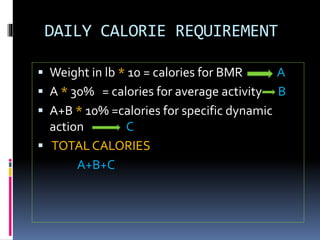
DAILY CALORIE REQUIREMENT
 Weight in lb * 10 = calories for BMR A
 A * 30% = calories for average activity B
 A+B * 10% =calories for specific dynamic
action C
 TOTALCALORIES
A+B+C
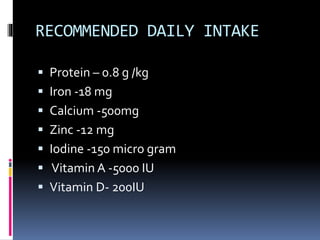
RECOMMENDED DAILY INTAKE
 Protein – 0.8 g /kg
 Iron -18 mg
 Calcium -500mg
 Zinc -12 mg
 Iodine -150 micro gram
 Vitamin A -5000 IU
 Vitamin D- 200IU
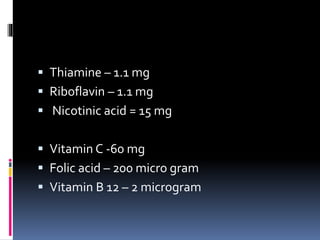
 Thiamine – 1.1 mg
 Riboflavin – 1.1 mg
 Nicotinic acid = 15 mg
 Vitamin C -60 mg
 Folic acid – 200 micro gram
 Vitamin B 12 – 2 microgram
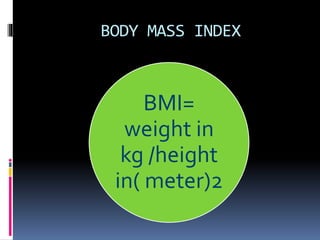
BODY MASS INDEX
BMI=
weight in
kg /height
in( meter)2
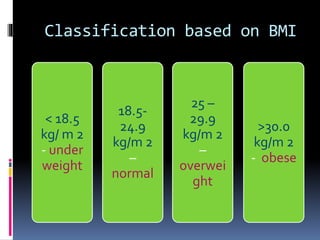
Classification based on BMI
< 18.5
kg/ m 2
- under
weight
18.5-
24.9
kg/m 2
–
normal
25 –
29.9
kg/m 2
–
overwei
ght
>30.0
kg/m 2
- obese
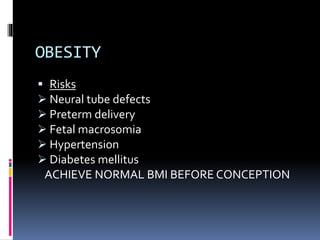
OBESITY
 Risks
 Neural tube defects
 Preterm delivery
 Fetal macrosomia
 Hypertension
 Diabetes mellitus
ACHIEVE NORMAL BMI BEFORE CONCEPTION
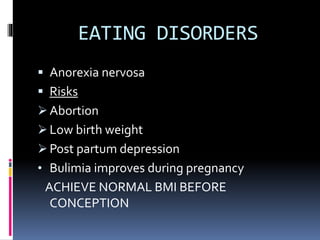
EATING DISORDERS
 Anorexia nervosa
 Risks
 Abortion
 Low birth weight
 Post partum depression
• Bulimia improves during pregnancy
ACHIEVE NORMAL BMI BEFORE
CONCEPTION
VITAMIN DEFICIENCIES
 No need of supplements if healthy diet
 Vitamin A is teratogenic
 Avoid foods high in retinoids
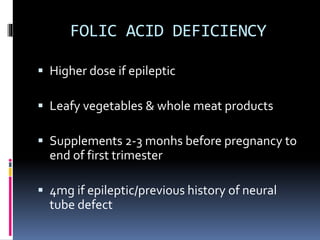
FOLIC ACID DEFICIENCY
 Higher dose if epileptic
 Leafy vegetables & whole meat products
 Supplements 2-3 monhs before pregnancy to
end of first trimester
 4mg if epileptic/previous history of neural
tube defect
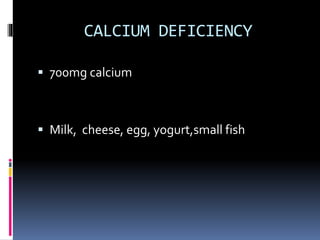
CALCIUM DEFICIENCY
 700mg calcium
 Milk, cheese, egg, yogurt,small fish
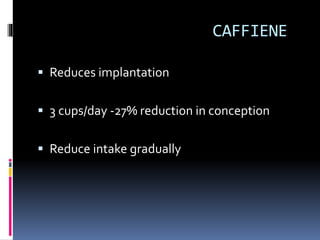
CAFFIENE
 Reduces implantation
 3 cups/day -27% reduction in conception
 Reduce intake gradually
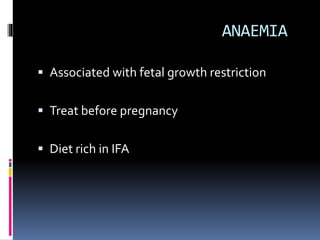
ANAEMIA
 Associated with fetal growth restriction
 Treat before pregnancy
 Diet rich in IFA
2.Infections
 Vaccination if non immune to rubella
 Paternal mumps linked to infertility
 High fever can result in spontaneous abortion
Eg: mumps,measles
RUBELLA
 Risks
 Deafness
 Cataract
 Cardiac malformation
 IUGR
 Retinopathy
 Microcephalus
 Cerebral palsy
 Avoid contact with infected person 7 days
before&5 days after rash appears
 Vaccinate prior to conception
 Avoid pregnancy for 3 months after
vaccination
 Higher fetal risk in first trimster
Erythema Infectiosum
 Avoid children with disease
 Infectious period is 1week before& 1 week
after symptoms
Toxoplasmosis
 Low risk for congenital infecion
 Wash hands after contact with soil, meat,
fruits & vegetables
 Wear gloves while dealing with cat litter box
Tuberculosis
 Treat before conception
 Use barrier methods during treatment
HIV/AIDS
Maintenance of low viral load & high CD4 count
prior to conception
 Treated with zidovudine
 No further unprotected sex
Varicella zoster
 Prior maternal infection protects baby during
pregnancy
 Test for vz antibody
 Vaccinate if needed
 No pregnancy for 3 months after vaccination
 Can lead to spontaneous abortion
Hepatitis B
 Vaccinate before conception if at high risk
 LFT to assess severity of disease
 Vaccination to uninfected family members
Group B streptococcus
 If present in vagina antibiotic therapy in
labour/following ROM
Cyto megalo virus
 May be asymptomatic
 Wash hands before preparing meals
Tetanus
 Wash hands after contact with soil
 TT before /during pregnancy
Syphilis
• Risks
 Still birth
 Abortion
 Infected baby
 Antibiotic therapy during pregnancy
Gonorrhoea
 Risks
 Ophthalmia neonatoram
 Arthritis
• Diagnosed with cervical swabs
• Treated with penicillin during pregnancy
3.MEDICAL CONDITIONS
Diabetes mellitus
 Risks
 Macrosomia
 Malformations
• Control preconception glycemia
• Measure HbA1C
Epilepsy
 Anticonvulsants are teratogenic
 Take folic acid
Phenylketonuria
 Maintain blood phenylalanine level
120-360 micromol/L
 Restrict milk, meat, fish , cheese & eggs
Hypertension
 Control BP
 Increase risk for preeclampsia,
fetal growth retardation
 ACE inhiibitors & angiotensin 2 receptor
blockers cause fetal malformation
Systemic Lupus Erythematosus
 Control associated kidney disease 6 months
prior to conception
 Pregnancy contraindicated in active nervous
system involvement
Thyroid disorders
 Hyperthyroidism leads to
 Hypertension,
 Fetal anomalies
 IUGR
 Preterm birth
 Hypothyroidism leads to
 Dwarfism
 Intellectual impairement
SURVEILLANCE OFTHYROID LEVELS ARE
NEEDED
Cancer
 Cervical smear prior to conception
 Store sperms/ova before chemotherapy
Dental caries , ginguvitis
 Increased chance of preterm labour
4.Genetics
 Screen for genetic disease among high risk
group
 Genetic counselling
GENETIC COUNSELLING
 A communication process that deals with
human
problems associated with occurence or
recurrence of a genetic disorder in a family or
individual at increased risk for a condition that
has a genetic component
Indications
 Parents of affected child
 Positive family history
 Women >35 years
 Risky ethnic group
 Consanguinous marriage
 Affected couple
 Concern about genetic disorder
TESTS
 Biochemical testing-enzyme levels & activity
• DNA testing for mutation
• Chromosomal testing
 Genetic pedigree
 Testing cells of embryo after in vitro
fertilization
 Karyotyping
Ethnicity & Genetic conditions
 Asian –Thalassemia
Asian:southeast/chinese-alpha thalassemia
Asian :Indian-beta thalassemia
• African:sickle cell disease/trait,thalassemia
• Ashkenazi Jewish:cystic fibrosis,Tay sachs
disease,Gaucher’s disease,Niemann-pick
disease,canavan disease,Fanconi anaemia,Blorm
syndrome,
 European,whitish: cystic fibrosis
 Mediterranean : thalassemia
• Autosomal dominant diseases: cystic fibrosis,
sickle cell anaemia , thalassemia
• Autosomal recessive disease:Tay sach’s
disease
Child will have the disease /Will be carrier
5.Environment & lifestyle
 AVOID JOBS INVOLVING:
 Vibrating machines
 Toxic substances
 Excessive cold/heat
 Heavy lifting
 Long travelling times
 Exposure to pesticides / phthalates
 Prolonged standing
 Chronic stress preterm birth
 Exercise
 No new exercise in pregnancy
 Increased core body temperature
spontaneous abortion
 No contact sports
 Smoking
 Reduces sperm count
 Stop smoking 4 months before conception
:both
 Away from smoky environment
• Alcohol
 Reduces sperm count
 Affect ovulation
 Crosses placenta
 Cause fetal alcohol syndrome
 Result in abortion,growth restriction
 Stop alcoholism 4 months prior to conception
 Hazardous substances
 Have organically grown foods
 Wash all foods
 No contact with pesticides /insecticides
 No radiation exposure from 3 months prior to
conception
 Lead
 From drinking water,soil ,exhaust
fumes,utensils,battery,paint
 Wear protective clothing
 Mineral analysis before conception
>10mcg/dl : toxicity
 Filter water
 High levels in men : infertility
 Lead content in mother moves to fetus
 Cadmium
 High levels in men : infertility
 Reduce smoking, alcoholism , contact with
plumbing alloys, paint , batteries ,fertilizers
 Filter water
 Mineral analysis prior to conception
• Zinc
 Found in red meat,cereals ,cheese,nuts.
 Levels reduced in alcohol drinkers
 Low levels in men : infertility
 Mineral analysis prior to conception
 Aluminium
 Mineral analysis prior to conception
 Derived from utensils while cooking ,antacids
 Filter water
 Use stainless steel / glassware
 Mercurry
 Derived from tinned tuna,large fishes,weed
killers,dental amalgam
 Do dental procedures before
conception/involve non mercurry based
amalgam
 Filter water
 Mineral analysis prior to conception
Exercise
 Swimming is the best
 To maintain ideal weight
5.Reproductive sexual
health
 Barrier methods during preparation phase of
pregnancy
 Oral contraception
 Cervical screening
 Cease the use 3 months prior to conception
 Reduces Zn,Mn,vitamin A&B
 Intrauterine contraceptive device
 Discontinue 3 months prior to conception
 May increase copper levels
Interpregnancy interval
 Ideally at least 18 months
 Short interval causes preterm birth,LBW
Advice for men
 Wear loose fitting shorts,trousers
 Cold showers preferred than hot baths
 No smoking and alcoholism
 Ideal weight
 No exposure to chemicals
PHYSICAL PREPARATION
AGE :>18 years for girls
>21 years in boys
 Diet: balanced diet,not anaemic not
malnourished
 No exposure to hazardous substances
 Free of infections
 Stop OCP 3 months before
GENETIC CONSELLING
PSYCHOLOGICAL PREPARATION
 Mentally prepared
 Away from violence
 Mature
FINANCIAL PREPARATION
 Ready to meet increasing demands
 Plan for maternity leave & benefits
BENEFITS
 Increased fertility
 Healthy conception,pregnancy,birth
 Reduced risk of abortion ,premature birth
,abnormality
 Reduced morning sickness
 Improved success rate of IVF
 More chance of natural,intervention free birth
 Low risk for postpartum depression
 Suceessful and long term breast feeding
 Healthy children
Preparation of family
 Sibling education classes
 Grand parent preparation
 Preparing fathers
plannedparenthood-171209073508 (6).pdf

plannedparenthood-171209073508 (6).pdf

  • 1.
    PLANNED PARENTHOOD Sharon TreesaAntony First year M.sc Nursing Govt. College of nursing Kottayam
  • 2.
    Preconception care Set ofinterventions that aims to identify & modify biomedical, behavioural & social risks to a woman’s health or pregnancy outcome through prevention & management.
  • 3.
    Components  Early detection& prevention of health risks  Management high risks before conception  Active management of fertility  Creation of awareness among women about contraception
  • 4.
    Objectives  Maximise thehealth of prospective parents and hence their babies  Reduce perinatal mortality& morbidity  Provide information to prospective parents to make informed choices & make them ready to be parents  Evaluate need for genetic counselling  Reduce unplanned pregnancies  Inform about maternity services
  • 5.
  • 6.
    Preconception health assessment Health status  Sexual history  Family history-genetic,consanguinous marriage  Medical/surgical history  Psychological history Substance use , occupation  History of infections  Obstetric & gynaecological history  Nutritional history
  • 7.
    Screening Tests  BP,Weight,Urinalysis,Fullblood count  Cardiac &Thyroid function  Respiratory function  Sexual health status  Cervical smear  Serum screening – rubella,haemoglobinopathies,TB  Vitamin,Zn,lead levels  Hair analysis  Karyotyping
  • 8.
  • 9.
    1. Nutrition  Folicacid supplementation-400mcg/day  Vitamin D(1000 IU/day) & calcium if low intake
  • 10.
    DAILY CALORIE REQUIREMENT Weight in lb * 10 = calories for BMR A  A * 30% = calories for average activity B  A+B * 10% =calories for specific dynamic action C  TOTALCALORIES A+B+C
  • 11.
    RECOMMENDED DAILY INTAKE Protein – 0.8 g /kg  Iron -18 mg  Calcium -500mg  Zinc -12 mg  Iodine -150 micro gram  Vitamin A -5000 IU  Vitamin D- 200IU
  • 12.
     Thiamine –1.1 mg  Riboflavin – 1.1 mg  Nicotinic acid = 15 mg  Vitamin C -60 mg  Folic acid – 200 micro gram  Vitamin B 12 – 2 microgram
  • 13.
    BODY MASS INDEX BMI= weightin kg /height in( meter)2
  • 14.
    Classification based onBMI < 18.5 kg/ m 2 - under weight 18.5- 24.9 kg/m 2 – normal 25 – 29.9 kg/m 2 – overwei ght >30.0 kg/m 2 - obese
  • 15.
    OBESITY  Risks  Neuraltube defects  Preterm delivery  Fetal macrosomia  Hypertension  Diabetes mellitus ACHIEVE NORMAL BMI BEFORE CONCEPTION
  • 16.
    EATING DISORDERS  Anorexianervosa  Risks  Abortion  Low birth weight  Post partum depression • Bulimia improves during pregnancy ACHIEVE NORMAL BMI BEFORE CONCEPTION
  • 17.
    VITAMIN DEFICIENCIES  Noneed of supplements if healthy diet  Vitamin A is teratogenic  Avoid foods high in retinoids
  • 18.
    FOLIC ACID DEFICIENCY Higher dose if epileptic  Leafy vegetables & whole meat products  Supplements 2-3 monhs before pregnancy to end of first trimester  4mg if epileptic/previous history of neural tube defect
  • 19.
    CALCIUM DEFICIENCY  700mgcalcium  Milk, cheese, egg, yogurt,small fish
  • 20.
    CAFFIENE  Reduces implantation 3 cups/day -27% reduction in conception  Reduce intake gradually
  • 21.
    ANAEMIA  Associated withfetal growth restriction  Treat before pregnancy  Diet rich in IFA
  • 22.
    2.Infections  Vaccination ifnon immune to rubella  Paternal mumps linked to infertility  High fever can result in spontaneous abortion Eg: mumps,measles
  • 23.
    RUBELLA  Risks  Deafness Cataract  Cardiac malformation  IUGR  Retinopathy  Microcephalus  Cerebral palsy
  • 24.
     Avoid contactwith infected person 7 days before&5 days after rash appears  Vaccinate prior to conception  Avoid pregnancy for 3 months after vaccination  Higher fetal risk in first trimster
  • 25.
    Erythema Infectiosum  Avoidchildren with disease  Infectious period is 1week before& 1 week after symptoms
  • 26.
    Toxoplasmosis  Low riskfor congenital infecion  Wash hands after contact with soil, meat, fruits & vegetables  Wear gloves while dealing with cat litter box
  • 27.
    Tuberculosis  Treat beforeconception  Use barrier methods during treatment
  • 28.
    HIV/AIDS Maintenance of lowviral load & high CD4 count prior to conception  Treated with zidovudine  No further unprotected sex
  • 29.
    Varicella zoster  Priormaternal infection protects baby during pregnancy  Test for vz antibody  Vaccinate if needed  No pregnancy for 3 months after vaccination  Can lead to spontaneous abortion
  • 30.
    Hepatitis B  Vaccinatebefore conception if at high risk  LFT to assess severity of disease  Vaccination to uninfected family members
  • 31.
    Group B streptococcus If present in vagina antibiotic therapy in labour/following ROM
  • 32.
    Cyto megalo virus May be asymptomatic  Wash hands before preparing meals
  • 33.
    Tetanus  Wash handsafter contact with soil  TT before /during pregnancy
  • 34.
    Syphilis • Risks  Stillbirth  Abortion  Infected baby  Antibiotic therapy during pregnancy
  • 35.
    Gonorrhoea  Risks  Ophthalmianeonatoram  Arthritis • Diagnosed with cervical swabs • Treated with penicillin during pregnancy
  • 36.
  • 37.
    Diabetes mellitus  Risks Macrosomia  Malformations • Control preconception glycemia • Measure HbA1C
  • 38.
    Epilepsy  Anticonvulsants areteratogenic  Take folic acid
  • 39.
    Phenylketonuria  Maintain bloodphenylalanine level 120-360 micromol/L  Restrict milk, meat, fish , cheese & eggs
  • 40.
    Hypertension  Control BP Increase risk for preeclampsia, fetal growth retardation  ACE inhiibitors & angiotensin 2 receptor blockers cause fetal malformation
  • 41.
    Systemic Lupus Erythematosus Control associated kidney disease 6 months prior to conception  Pregnancy contraindicated in active nervous system involvement
  • 42.
    Thyroid disorders  Hyperthyroidismleads to  Hypertension,  Fetal anomalies  IUGR  Preterm birth  Hypothyroidism leads to  Dwarfism  Intellectual impairement SURVEILLANCE OFTHYROID LEVELS ARE NEEDED
  • 43.
    Cancer  Cervical smearprior to conception  Store sperms/ova before chemotherapy
  • 44.
    Dental caries ,ginguvitis  Increased chance of preterm labour
  • 45.
    4.Genetics  Screen forgenetic disease among high risk group  Genetic counselling
  • 46.
    GENETIC COUNSELLING  Acommunication process that deals with human problems associated with occurence or recurrence of a genetic disorder in a family or individual at increased risk for a condition that has a genetic component
  • 47.
    Indications  Parents ofaffected child  Positive family history  Women >35 years  Risky ethnic group  Consanguinous marriage  Affected couple  Concern about genetic disorder
  • 48.
    TESTS  Biochemical testing-enzymelevels & activity • DNA testing for mutation • Chromosomal testing  Genetic pedigree  Testing cells of embryo after in vitro fertilization  Karyotyping
  • 49.
    Ethnicity & Geneticconditions  Asian –Thalassemia Asian:southeast/chinese-alpha thalassemia Asian :Indian-beta thalassemia • African:sickle cell disease/trait,thalassemia • Ashkenazi Jewish:cystic fibrosis,Tay sachs disease,Gaucher’s disease,Niemann-pick disease,canavan disease,Fanconi anaemia,Blorm syndrome,
  • 50.
     European,whitish: cysticfibrosis  Mediterranean : thalassemia
  • 51.
    • Autosomal dominantdiseases: cystic fibrosis, sickle cell anaemia , thalassemia • Autosomal recessive disease:Tay sach’s disease Child will have the disease /Will be carrier
  • 52.
    5.Environment & lifestyle AVOID JOBS INVOLVING:  Vibrating machines  Toxic substances  Excessive cold/heat  Heavy lifting  Long travelling times  Exposure to pesticides / phthalates  Prolonged standing
  • 53.
     Chronic stresspreterm birth  Exercise  No new exercise in pregnancy  Increased core body temperature spontaneous abortion  No contact sports
  • 54.
     Smoking  Reducessperm count  Stop smoking 4 months before conception :both  Away from smoky environment
  • 55.
    • Alcohol  Reducessperm count  Affect ovulation  Crosses placenta  Cause fetal alcohol syndrome  Result in abortion,growth restriction  Stop alcoholism 4 months prior to conception
  • 56.
     Hazardous substances Have organically grown foods  Wash all foods  No contact with pesticides /insecticides  No radiation exposure from 3 months prior to conception
  • 57.
     Lead  Fromdrinking water,soil ,exhaust fumes,utensils,battery,paint  Wear protective clothing  Mineral analysis before conception >10mcg/dl : toxicity  Filter water  High levels in men : infertility  Lead content in mother moves to fetus
  • 58.
     Cadmium  Highlevels in men : infertility  Reduce smoking, alcoholism , contact with plumbing alloys, paint , batteries ,fertilizers  Filter water  Mineral analysis prior to conception
  • 59.
    • Zinc  Foundin red meat,cereals ,cheese,nuts.  Levels reduced in alcohol drinkers  Low levels in men : infertility  Mineral analysis prior to conception
  • 60.
     Aluminium  Mineralanalysis prior to conception  Derived from utensils while cooking ,antacids  Filter water  Use stainless steel / glassware
  • 61.
     Mercurry  Derivedfrom tinned tuna,large fishes,weed killers,dental amalgam  Do dental procedures before conception/involve non mercurry based amalgam  Filter water  Mineral analysis prior to conception
  • 62.
    Exercise  Swimming isthe best  To maintain ideal weight
  • 63.
    5.Reproductive sexual health  Barriermethods during preparation phase of pregnancy  Oral contraception  Cervical screening  Cease the use 3 months prior to conception  Reduces Zn,Mn,vitamin A&B  Intrauterine contraceptive device  Discontinue 3 months prior to conception  May increase copper levels
  • 64.
    Interpregnancy interval  Ideallyat least 18 months  Short interval causes preterm birth,LBW
  • 65.
    Advice for men Wear loose fitting shorts,trousers  Cold showers preferred than hot baths  No smoking and alcoholism  Ideal weight  No exposure to chemicals
  • 66.
    PHYSICAL PREPARATION AGE :>18years for girls >21 years in boys  Diet: balanced diet,not anaemic not malnourished  No exposure to hazardous substances  Free of infections  Stop OCP 3 months before GENETIC CONSELLING
  • 67.
    PSYCHOLOGICAL PREPARATION  Mentallyprepared  Away from violence  Mature
  • 68.
    FINANCIAL PREPARATION  Readyto meet increasing demands  Plan for maternity leave & benefits
  • 69.
    BENEFITS  Increased fertility Healthy conception,pregnancy,birth  Reduced risk of abortion ,premature birth ,abnormality  Reduced morning sickness  Improved success rate of IVF  More chance of natural,intervention free birth  Low risk for postpartum depression  Suceessful and long term breast feeding  Healthy children
  • 70.
    Preparation of family Sibling education classes  Grand parent preparation  Preparing fathers