Prehospital
Stroke Care
dr. Ade Wijaya, SpS
WHO Stroke Definition
“Rapidly developing clinical signs of focal (or global)
disturbance of cerebral function, lasting more than 24
hours or leading to death, with no apparent cause
other than that of vascular origin.”
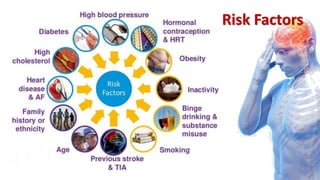
Risk Factors
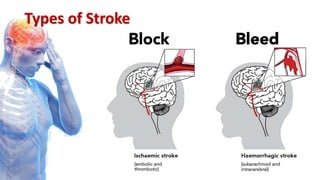
Types of Stroke
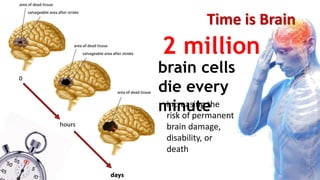
Time is Brain
brain cells
die every
minuteincreasing the
risk of permanent
brain damage,
disability, or
death
2 million
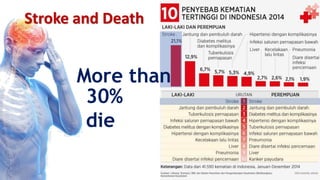
Stroke and Death
30%
die
More than
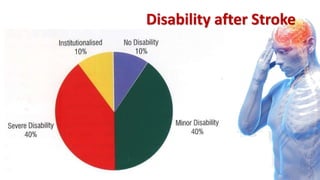
Disability after Stroke
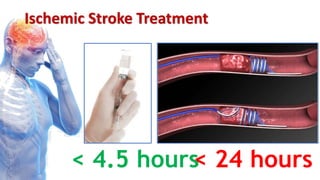
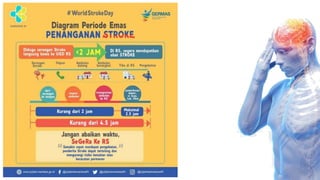
Ischemic Stroke Treatment
< 24 hours< 4.5 hours
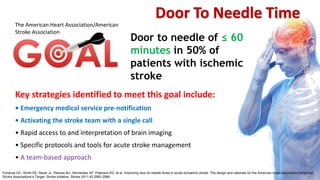
Key strategies identified to meet this goal include:
• Emergency medical service pre-notification
• Activating the stroke team with a single call
• Rapid access to and interpretation of brain imaging
• Specific protocols and tools for acute stroke management
• A team-based approach
Fonarow GC, Smith EE, Saver JL, Reeves MJ, Hernandez AF, Peterson ED, et al. Improving door-to-needle times in acute ischaemic stroke. The design and rationale for the American Heart Association/American
Stroke Associations’s Target: Stroke initiative. Stroke 2011;42:2983-2989.
Door To Needle Time
Door to needle of ≤ 60
minutes in 50% of
patients with ischemic
stroke
The American Heart Association/American
Stroke Association
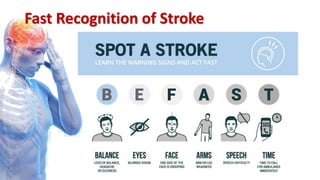
Fast Recognition of Stroke
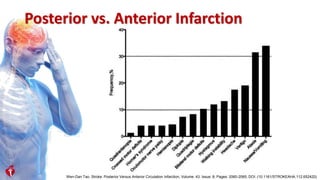
Posterior vs. Anterior Infarction
Wen-Dan Tao. Stroke. Posterior Versus Anterior Circulation Infarction, Volume: 43, Issue: 8, Pages: 2060-2065, DOI: (10.1161/STROKEAHA.112.652420)
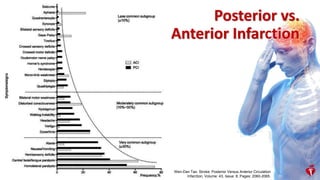
Posterior vs. Anterior Infarction
Posterior vs.
Anterior Infarction
Wen-Dan Tao. Stroke. Posterior Versus Anterior Circulation
Infarction, Volume: 43, Issue: 8, Pages: 2060-2065.
BEFAST vs. FAST
Prehospital
Stroke Care
Where Are We Now?
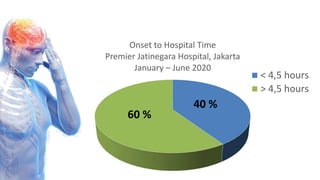
Onset to Hospital Time
Premier Jatinegara Hospital, Jakarta
January – June 2020
< 4,5 hours
> 4,5 hours
60 %
40 %
Prehospital
Stroke Care
What to Achieve in
the Future?
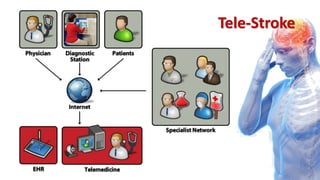
Tele-Stroke
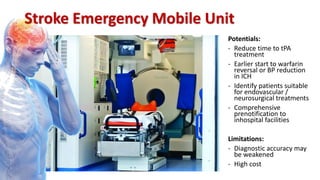
Potentials:
- Reduce time to tPA
treatment
- Earlier start to warfarin
reversal or BP reduction
in ICH
- Identify patients suitable
for endovascular /
neurosurgical treatments
- Comprehensive
prenotification to
inhospital facilities
Limitations:
- Diagnostic accuracy may
be weakened
- High cost
Stroke Emergency Mobile Unit
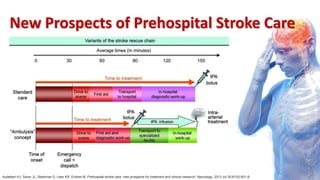
Audebert HJ, Saver JL, Starkman S, Lees KR, Endres M. Prehospital stroke care: new prospects for treatment and clinical research. Neurology. 2013 Jul 30;81(5):501-8.
New Prospects of Prehospital Stroke Care
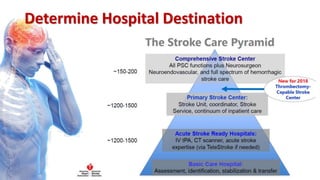
Determine Hospital Destination
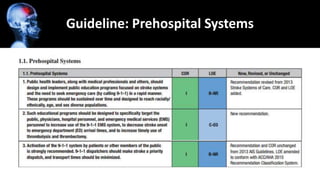
GuidelinesGuideline: Prehospital Systems
Guidelines
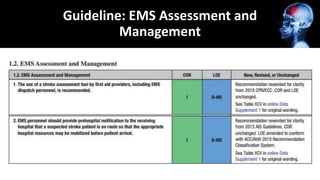
Guideline: EMS Assessment and
Management
Guidelines
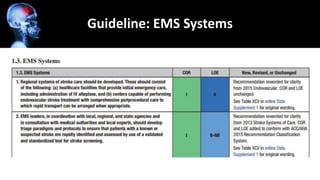
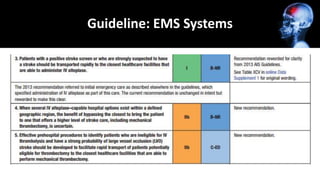
GuidelinesGuideline: EMS Systems
Take Home Messages
• Time is a key factor in stroke care; TIME IS BRAIN
• To reduce time to treatment, good prehospital care is necessary:
- Fast stroke symptoms recognition (BE-FAST)
- Emergency medical service pre-notification
- Telemedicine and stroke emergency mobile unit
• Determine hospital destination before patient transport
GuidelinesTake Home Messages
Thank You

Prehospital Stroke Care