Acute Ischemic Stroke
Nursing’s Pivotal Role
Susie Fisher, RN, BSN
Regional Program Manager
Providence Stroke Center
Portland, OR
Why what we do matters
 Mr. Jones, 57 y/o divorced father of 3 young adult children,
owner of own successful business, severe stroke while @
dinner w/ friends.
 EMS to Primary Stroke Center, NIHSS 20+, received t-PA
and interventional clot retraction, still left with major
deficits: aphasia, R sided weakness, poor swallow.
 What is the impact on Mr. Jones, his family, his business,
his future?
 What role can nursing play?
 Mrs. Smith, 73 y/o female, awoke with inability to speak,
inability to get out of bed.
 9-1-1, EMS to PSC, NIHSS 12, unable to receive t-PA
due to unknown timeframe
 Found to have new-onset atrial fibrillation while on
telemetry on stroke unit.
 What is the impact of nursing care for Mrs. Smith and
what does her future stroke prevention look like?
How common is stroke?
 Third leading cause of death in the U.S.
(270,000 deaths per year)
 Leading cause of adult disability
 Very costly to our health system and individuals/families
◦ Medical costs as well as lost earnings/productivity
 Women suffer 60,000 more strokes per year than men
Circulation 2008 Heart Disease & Stroke Statistics
Types of Stroke
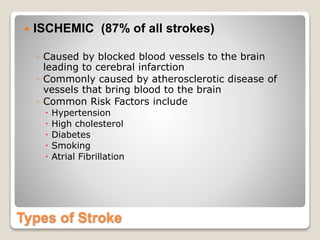
 ISCHEMIC (87% of all strokes)
◦ Caused by blocked blood vessels to the brain
leading to cerebral infarction
◦ Commonly caused by atherosclerotic disease of
vessels that bring blood to the brain
◦ Common Risk Factors include
 Hypertension
 High cholesterol
 Diabetes
 Smoking
 Atrial Fibrillation
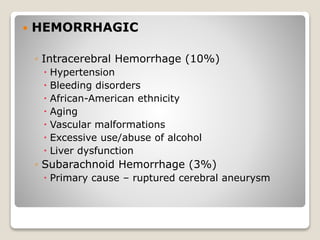
 HEMORRHAGIC
◦ Intracerebral Hemorrhage (10%)
 Hypertension
 Bleeding disorders
 African-American ethnicity
 Aging
 Vascular malformations
 Excessive use/abuse of alcohol
 Liver dysfunction
◦ Subarachnoid Hemorrhage (3%)
 Primary cause – ruptured cerebral aneurysm
Two Phases of Stroke Care
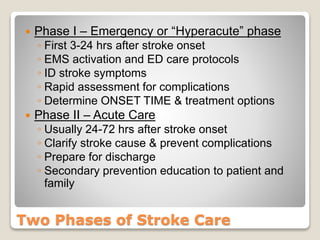
 Phase I – Emergency or “Hyperacute” phase
◦ First 3-24 hrs after stroke onset
◦ EMS activation and ED care protocols
◦ ID stroke symptoms
◦ Rapid assessment for complications
◦ Determine ONSET TIME & treatment options
 Phase II – Acute Care
◦ Usually 24-72 hrs after stroke onset
◦ Clarify stroke cause & prevent complications
◦ Prepare for discharge
◦ Secondary prevention education to patient and
family
Hyperacute Phase: Pre-Hospital and ED
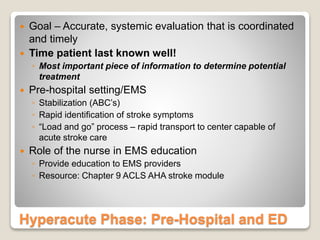
 Goal – Accurate, systemic evaluation that is coordinated
and timely
 Time patient last known well!
◦ Most important piece of information to determine potential
treatment
 Pre-hospital setting/EMS
◦ Stabilization (ABC’s)
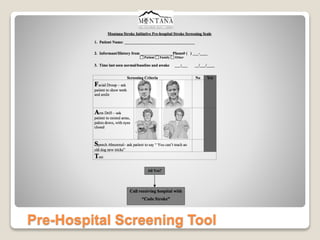
◦ Rapid identification of stroke symptoms
◦ “Load and go” process – rapid transport to center capable of
acute stroke care
 Role of the nurse in EMS education
◦ Provide education to EMS providers
◦ Resource: Chapter 9 ACLS AHA stroke module
Pre-Hospital Screening Tool
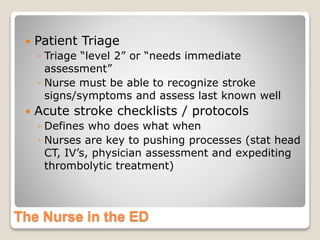
The Nurse in the ED
 Patient Triage
◦ Triage “level 2” or “needs immediate
assessment”
◦ Nurse must be able to recognize stroke
signs/symptoms and assess last known well
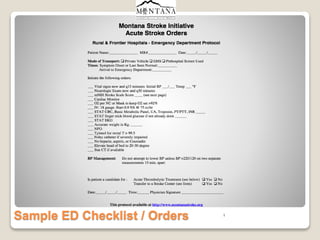
 Acute stroke checklists / protocols
◦ Defines who does what when
◦ Nurses are key to pushing processes (stat head
CT, IV’s, physician assessment and expediting
thrombolytic treatment)
Sample ED Checklist / Orders
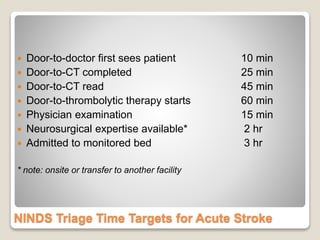
NINDS Triage Time Targets for Acute Stroke
 Door-to-doctor first sees patient 10 min
 Door-to-CT completed 25 min
 Door-to-CT read 45 min
 Door-to-thrombolytic therapy starts 60 min
 Physician examination 15 min
 Neurosurgical expertise available* 2 hr
 Admitted to monitored bed 3 hr
* note: onsite or transfer to another facility
Providing the best nursing care in the ED
 Be familiar with common and uncommon stroke
presentations (eg. Posterior circulation strokes may require
aggressive airway management, also may be confused with
intoxicated presentation)
 Cardiac Monitoring for arrhythmias
 Vital signs no < every 30 minutes
 Hyperthermia assoc. with poor outcome – treat any
fever >99.6°F
 Maintain oxygenation >92%
 NPO until swallow assessed – including oral
medications
 NO ASPIRIN!!!! (until rule out hemorrhage on CT)
Main Objective of Emergency Evaluation
 Is stroke ischemic or hemorrhagic
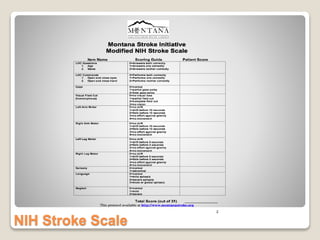
 Identify age, location, and severity (NIH Stroke Scale)
 STAT unenhanced head CT most common
 Nurse’s role:
◦ Pre-notify CT department of suspect acute stroke on the way
◦ Prepare patient, explain procedure, help transport if
necessary
◦ IV and labs drawn/sent if doesn’t delay CT
◦ Do not delay head CT for other procedures (EKG, chest x-ray,
removing all clothing, etc)
◦ Urge rapid completion and results to appropriate physcian
◦ Nursing Nugget – pre-made packets with all checklists,
orders, forms that can be pulled once stroke patient arrives to
expedite processes.
NIH Stroke Scale
IV’s and IV Fluids
 Ideally: 2-3 IV sites if possible thrombolytics
 Draw labs before starting IV fluids, ideally have them
processing while patient in imaging
 AVOID GLUCOSE (D5W) – can have detrimental effects
on brain injury, use Normal Saline
 Maintain normovolemia (75-100ml/hr)
 Observe for hypovolemia may cause hypotension which
may lead to cerebral hypoperfusion (head flat vs
elevated? Fluid bolus?)
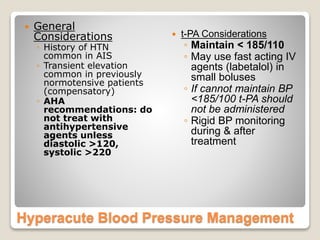
Hyperacute Blood Pressure Management
 General
Considerations
◦ History of HTN
common in AIS
◦ Transient elevation
common in previously
normotensive patients
(compensatory)
◦ AHA
recommendations: do
not treat with
antihypertensive
agents unless
diastolic >120,
systolic >220
 t-PA Considerations
◦ Maintain < 185/110
◦ May use fast acting IV
agents (labetalol) in
small boluses
◦ If cannot maintain BP
<185/100 t-PA should
not be administered
◦ Rigid BP monitoring
during & after
treatment
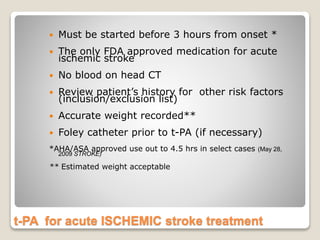
t-PA for acute ISCHEMIC stroke treatment
 Must be started before 3 hours from onset *
 The only FDA approved medication for acute
ischemic stroke
 No blood on head CT
 Review patient’s history for other risk factors
(inclusion/exclusion list)
 Accurate weight recorded**
 Foley catheter prior to t-PA (if necessary)
*AHA/ASA approved use out to 4.5 hrs in select cases (May 28,
2009 STROKE)
** Estimated weight acceptable
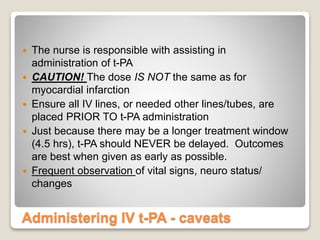
Administering IV t-PA - caveats
 The nurse is responsible with assisting in
administration of t-PA
 CAUTION! The dose IS NOT the same as for
myocardial infarction
 Ensure all IV lines, or needed other lines/tubes, are
placed PRIOR TO t-PA administration
 Just because there may be a longer treatment window
(4.5 hrs), t-PA should NEVER be delayed. Outcomes
are best when given as early as possible.
 Frequent observation of vital signs, neuro status/
changes
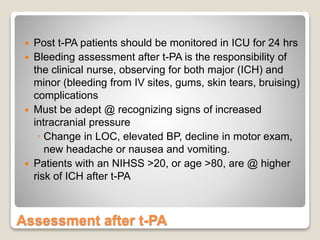
Assessment after t-PA
 Post t-PA patients should be monitored in ICU for 24 hrs
 Bleeding assessment after t-PA is the responsibility of
the clinical nurse, observing for both major (ICH) and
minor (bleeding from IV sites, gums, skin tears, bruising)
complications
 Must be adept @ recognizing signs of increased
intracranial pressure
◦ Change in LOC, elevated BP, decline in motor exam,
new headache or nausea and vomiting.
 Patients with an NIHSS >20, or age >80, are @ higher
risk of ICH after t-PA
Acute Care Phase- critical care, stroke & general units
 Nursing focus on continued stabilization through
frequent evaluation of neuro status, vitals and
prevention of complications
 Dedicated stroke teams, units, coordinated care
improve clinical outcomes in this phase
 Up to 30% of all stroke patients will deteriorate in
the first 24 hrs… NURSES must know acute stroke
care
 Clinical pathways and standing orders provide
succinct, organized stroke care (Brain Attack Coalition)
 Nurses role to coordinate activities of the
multidisciplinary team (physician, nurse, OT, PT, ST,
discharge planner, chaplain)
 Resource for pathways, guidelines, standing orders:
◦ www.americanheart.org or www.stroke-site.org
Most patients don’t qualify for t-PA..
IT’S ALL ABOUT THE NURSING CARE:
 GOAL – Prevent complications, improve outcome
 BLOOD PRESSURE – often elevated in first 24-48 hrs,
a natural response to increase perfusion to injured
area. No treatment recommended unless > 220/110.
 NOTE: rapid lowering of BP may worsen neurological
symptoms
 Temperature – fever is assoc. with increased morbidity
and mortality. RX @ 99.6 F.
 Cardiac Monitoring - Multiple arrhythmias assoc. with
AIS. Paroxysmal atrial fibrillation often found after
admission. May use Holter monitor if necessary.
 Talk to patient & family, assist in communication with
other team members (pre-made packets for
patients/families?)
Why such frequent neuro assessments?
 Frequent neurological assessment
 All AIS patients are at risk for Hemorrhagic
Transformation
 Use of the NIHSS
◦ A great outcome prognostic tool
◦ NIHSS < 5 at 24 hrs = increased likelihood of
discharge to home rather than rehab or SNF
◦ Helpful in working with families on discharge
planning
◦ Excellent communication tool with care team
Cerebral Edema
 Common complication of large strokes
 Usually peaks 3-5 days after infarction, so first 24 hrs
not often a problem
 Higher risk in young people who have no cerebral
atrophy to allow room for swelling
 Early sign: Change in LOC
 Late sign: pupillary changes
 AVOID Nitroprusside for BP – venodilating effects can
worsen ICP
 AVOID hypotonic fluids, observe for hypoxia,
hypercarbia or hypothermia.
 HEAD POSITION: Elevate HOB 20-30°, maintain
neutral head alignment for optimal venous drainage.
And they’re off to yet another test!
Goal: to establish the cause of the stroke, therefore, to
prevent another
 CT – any situation where patient is deteriorating to
assess hemorrhage or infarct progression
 CT angiography or CT perfusion may also be used in
some institutions (looks @ vessels and viable tissue)
 MRI shows evidence of ischemic injury earlier than CT
 Carotid Ultrasound to screen for carotid stenosis
 Cerebral Angiography to accurately measure degree of
stenosis in artery
 Transesophageal or transthoracic Echocardography
◦ ALL stroke/TIA patients should undergo comprehensive
cardiovascular risk assessment
The nurses role with all this testing
 Educate the patient and family regarding each test and
what to expect
◦ Nursing Nugget: Pre-made packets for patient/family
with possible tests and explanations?
 Expedite patient transport/availability for all tests
 Communicate with therapies to enhance ability to work
with patient @ optimal timeframes
 Monitor Vitals and protect periods of rest
People recover faster because of you…
IT’S ALL ABOUT THE BASICS!
 Infection – Pneumonia
◦ Suspect if fever or change in LOC
◦ Serious complication after stroke, often in first 24-72 hrs
◦ Accounts for 15-25% of stroke deaths
◦ Increases length of stay, mortality and hospital costs
◦ Most common cause?.... Aspiration due to dysphagia
 REMEMBER the swallow screen we discussed? Imperative that
swallow assessment completed
 Protect airway, manage nausea and vomiting
 Infection – UTI
◦ Occurs in 15-60% of stroke patients
◦ Independently predicts poor outcome
◦ AVOID indwelling catheters unless absolutely necessary
Basics continued…
 Bowel and bladder care
 Constipation and urinary incontinence not uncommon in
early recovery
 MOBILITY!
◦ Early mobilization (once hemodynamically stable)
reduces risk of atelectasis, pneumonia, DVT and PE
 Immobility complications accounts for up to 51% of
deaths in first 30 days
 DVT and PE’s
◦ All stroke patients at high risk for DVT, especially
with immobility
◦ Start safe ambulation as soon as possible
◦ Pneumatic compression devices and stockings
◦ Low molecular weight heparin (enoxaparin)
Really… it’s still all about the bacis!
 FALLS
◦ Serious risk, most common hip fractures, usually on paretic side.
◦ Caution! R hemispheric strokes w/ neglect have highest fall risk!
◦ Educate all staff/team and family members
◦ POSITION PATIENT, call buttons, belongings to avoid reaching
 SKIN BREAKDOWN
◦ Truly the basics – poor sensation, circulation, paralysis
◦ Handle with care, reposition frequently, keep clean & dry
 DYSPHAGIA, ASPIRATION
◦ Hopefully you’ve gotten this message by now – swallow screen!
◦ About 50% of all aspirations from dysphagia are “silent” and go
undetected until there is a pulmonary manifestation
 NUTRITION
◦ Malnutrition = poor outcome
◦ Utilize team : speech therapy and dietician
Successful discharge planning
 It takes a team to do it all – you are the conductor
 Stroke survivor data:
◦ 30% will recover almost completely
◦ 40% will require subacute care
◦ 10% will require skilled nursing facility
◦ 15% will die soon after stroke onset
 COMMUNICATE frequently with all team members, pull
in family, LISTEN
 Order sets that include referrals to early rehab
intervention can impact length of stay and outcome
 Provide education to patient/family on cause of stroke,
risk factors, signs/symptoms, treatment plan and
resources (both written and verbal)
Summary – YOU make all the difference
 Stroke is a complex disease requiring efforts & skills of
all in the multidisciplinary team
 Nurses are often responsible for coordination of this
care throughout the continuum… the “conductor of the
whole orchestra” so to speak
 This results in improved outcomes, decreased length of
stay and decreased costs.
 It also results in knowing you’ve made a
difference…knowing that your attention to that little
elevated temperature in Ms. Collins, or preventing Mr.
Smith from falling that day, catching that a swallow
screen wasn’t done on Mrs. Jones… you have
potentially changed the whole outcome for that patient
How did your care impact our 2 patients?
 Mr. Jones
 Commun with family, 25 y/o
son is decision maker, pull in
support/resources
 Remember, NIHSS >20, his
likelihood of going home?
 Major swallow precautions,
risk of pneumonia… watch for
signs – DC’d w/o infection!
 Immobility – skin issues,
mobilize
 Educate family for future
prevention
 Awareness of impact on loss
of income and future role in
family – social support
 Mrs. Smith
 Telemetry led to diagnosis of
atrial fib., patient placed on
coumadin (educate)
 NIHSS 12 – likely to improve
some, acute rehab?, may
require some asistance @
home.
 Aphasia – swallow impact?
 Because of support w/ blood
pressure, fever, etc speech
improved some during
hospitalization
 Worked closely with rehab
and speech to move to acute
rehab.
Stroke coordinator’s top picks
 “We used to hurt our patients so badly by dropping their blood
pressure!” Maintain perfusion with higher BP per guidelines (Sandy
Dancer, NP, Providence Portland Stroke Center)
 “Determine the cause of the stroke. If you don't know what causes
it (hypertension, afib, etc.) how do you teach and hopefully provide
secondary prevention?” (Linda Brown, RN, Neurology Nurse Mgr, Sacred
Heart Medical Center, Eugene)
 “The importance of a team approach to stroke care” (Jean Carlton,
RN, Legacy Health System Stroke Patient Care Specialist)
 “Positioning - awareness of the patient’s deficits and providing care
accordingly. We can harm our patients if we are not aware!” (Kathy
Kearns, RN, Providence St. Vincent Stroke Center)
Resources
 AHA Scientific Statement
Comprehensive Overview of Nursing and Interdisciplinary Care of
the Acute Ischemic Stroke Patient
Stroke. 2009; 40 www.stroke.ahajournals.org
 American Stroke Association www.strokeassociation.org
 Brain Attack Coalition www.sttoke-site.org
 Montana Stroke Initiative www.montanastroke.org
 National Institute of Neurological Disorders and Stroke (NINDS)
◦ www.ninds.nih.gov
 National Stroke Association www.stroke.org
 Providence Stroke Center www.providence.org/brain
Suzanne.fisher@providence.org

Updated Nurses Pivotal Role in Stroke.ppt

  • 1.
    Acute Ischemic Stroke Nursing’sPivotal Role Susie Fisher, RN, BSN Regional Program Manager Providence Stroke Center Portland, OR
  • 2.
    Why what wedo matters  Mr. Jones, 57 y/o divorced father of 3 young adult children, owner of own successful business, severe stroke while @ dinner w/ friends.  EMS to Primary Stroke Center, NIHSS 20+, received t-PA and interventional clot retraction, still left with major deficits: aphasia, R sided weakness, poor swallow.  What is the impact on Mr. Jones, his family, his business, his future?  What role can nursing play?
  • 3.
     Mrs. Smith,73 y/o female, awoke with inability to speak, inability to get out of bed.  9-1-1, EMS to PSC, NIHSS 12, unable to receive t-PA due to unknown timeframe  Found to have new-onset atrial fibrillation while on telemetry on stroke unit.  What is the impact of nursing care for Mrs. Smith and what does her future stroke prevention look like?
  • 4.
    How common isstroke?  Third leading cause of death in the U.S. (270,000 deaths per year)  Leading cause of adult disability  Very costly to our health system and individuals/families ◦ Medical costs as well as lost earnings/productivity  Women suffer 60,000 more strokes per year than men Circulation 2008 Heart Disease & Stroke Statistics
  • 5.
    Types of Stroke ISCHEMIC (87% of all strokes) ◦ Caused by blocked blood vessels to the brain leading to cerebral infarction ◦ Commonly caused by atherosclerotic disease of vessels that bring blood to the brain ◦ Common Risk Factors include  Hypertension  High cholesterol  Diabetes  Smoking  Atrial Fibrillation
  • 6.
     HEMORRHAGIC ◦ IntracerebralHemorrhage (10%)  Hypertension  Bleeding disorders  African-American ethnicity  Aging  Vascular malformations  Excessive use/abuse of alcohol  Liver dysfunction ◦ Subarachnoid Hemorrhage (3%)  Primary cause – ruptured cerebral aneurysm
  • 7.
    Two Phases ofStroke Care  Phase I – Emergency or “Hyperacute” phase ◦ First 3-24 hrs after stroke onset ◦ EMS activation and ED care protocols ◦ ID stroke symptoms ◦ Rapid assessment for complications ◦ Determine ONSET TIME & treatment options  Phase II – Acute Care ◦ Usually 24-72 hrs after stroke onset ◦ Clarify stroke cause & prevent complications ◦ Prepare for discharge ◦ Secondary prevention education to patient and family
  • 8.
    Hyperacute Phase: Pre-Hospitaland ED  Goal – Accurate, systemic evaluation that is coordinated and timely  Time patient last known well! ◦ Most important piece of information to determine potential treatment  Pre-hospital setting/EMS ◦ Stabilization (ABC’s) ◦ Rapid identification of stroke symptoms ◦ “Load and go” process – rapid transport to center capable of acute stroke care  Role of the nurse in EMS education ◦ Provide education to EMS providers ◦ Resource: Chapter 9 ACLS AHA stroke module
  • 9.
  • 10.
    The Nurse inthe ED  Patient Triage ◦ Triage “level 2” or “needs immediate assessment” ◦ Nurse must be able to recognize stroke signs/symptoms and assess last known well  Acute stroke checklists / protocols ◦ Defines who does what when ◦ Nurses are key to pushing processes (stat head CT, IV’s, physician assessment and expediting thrombolytic treatment)
  • 11.
  • 12.
    NINDS Triage TimeTargets for Acute Stroke  Door-to-doctor first sees patient 10 min  Door-to-CT completed 25 min  Door-to-CT read 45 min  Door-to-thrombolytic therapy starts 60 min  Physician examination 15 min  Neurosurgical expertise available* 2 hr  Admitted to monitored bed 3 hr * note: onsite or transfer to another facility
  • 13.
    Providing the bestnursing care in the ED  Be familiar with common and uncommon stroke presentations (eg. Posterior circulation strokes may require aggressive airway management, also may be confused with intoxicated presentation)  Cardiac Monitoring for arrhythmias  Vital signs no < every 30 minutes  Hyperthermia assoc. with poor outcome – treat any fever >99.6°F  Maintain oxygenation >92%  NPO until swallow assessed – including oral medications  NO ASPIRIN!!!! (until rule out hemorrhage on CT)
  • 14.
    Main Objective ofEmergency Evaluation  Is stroke ischemic or hemorrhagic  Identify age, location, and severity (NIH Stroke Scale)  STAT unenhanced head CT most common  Nurse’s role: ◦ Pre-notify CT department of suspect acute stroke on the way ◦ Prepare patient, explain procedure, help transport if necessary ◦ IV and labs drawn/sent if doesn’t delay CT ◦ Do not delay head CT for other procedures (EKG, chest x-ray, removing all clothing, etc) ◦ Urge rapid completion and results to appropriate physcian ◦ Nursing Nugget – pre-made packets with all checklists, orders, forms that can be pulled once stroke patient arrives to expedite processes.
  • 15.
  • 16.
    IV’s and IVFluids  Ideally: 2-3 IV sites if possible thrombolytics  Draw labs before starting IV fluids, ideally have them processing while patient in imaging  AVOID GLUCOSE (D5W) – can have detrimental effects on brain injury, use Normal Saline  Maintain normovolemia (75-100ml/hr)  Observe for hypovolemia may cause hypotension which may lead to cerebral hypoperfusion (head flat vs elevated? Fluid bolus?)
  • 17.
    Hyperacute Blood PressureManagement  General Considerations ◦ History of HTN common in AIS ◦ Transient elevation common in previously normotensive patients (compensatory) ◦ AHA recommendations: do not treat with antihypertensive agents unless diastolic >120, systolic >220  t-PA Considerations ◦ Maintain < 185/110 ◦ May use fast acting IV agents (labetalol) in small boluses ◦ If cannot maintain BP <185/100 t-PA should not be administered ◦ Rigid BP monitoring during & after treatment
  • 18.
    t-PA for acuteISCHEMIC stroke treatment  Must be started before 3 hours from onset *  The only FDA approved medication for acute ischemic stroke  No blood on head CT  Review patient’s history for other risk factors (inclusion/exclusion list)  Accurate weight recorded**  Foley catheter prior to t-PA (if necessary) *AHA/ASA approved use out to 4.5 hrs in select cases (May 28, 2009 STROKE) ** Estimated weight acceptable
  • 19.
    Administering IV t-PA- caveats  The nurse is responsible with assisting in administration of t-PA  CAUTION! The dose IS NOT the same as for myocardial infarction  Ensure all IV lines, or needed other lines/tubes, are placed PRIOR TO t-PA administration  Just because there may be a longer treatment window (4.5 hrs), t-PA should NEVER be delayed. Outcomes are best when given as early as possible.  Frequent observation of vital signs, neuro status/ changes
  • 20.
    Assessment after t-PA Post t-PA patients should be monitored in ICU for 24 hrs  Bleeding assessment after t-PA is the responsibility of the clinical nurse, observing for both major (ICH) and minor (bleeding from IV sites, gums, skin tears, bruising) complications  Must be adept @ recognizing signs of increased intracranial pressure ◦ Change in LOC, elevated BP, decline in motor exam, new headache or nausea and vomiting.  Patients with an NIHSS >20, or age >80, are @ higher risk of ICH after t-PA
  • 21.
    Acute Care Phase-critical care, stroke & general units  Nursing focus on continued stabilization through frequent evaluation of neuro status, vitals and prevention of complications  Dedicated stroke teams, units, coordinated care improve clinical outcomes in this phase  Up to 30% of all stroke patients will deteriorate in the first 24 hrs… NURSES must know acute stroke care  Clinical pathways and standing orders provide succinct, organized stroke care (Brain Attack Coalition)  Nurses role to coordinate activities of the multidisciplinary team (physician, nurse, OT, PT, ST, discharge planner, chaplain)  Resource for pathways, guidelines, standing orders: ◦ www.americanheart.org or www.stroke-site.org
  • 22.
    Most patients don’tqualify for t-PA.. IT’S ALL ABOUT THE NURSING CARE:  GOAL – Prevent complications, improve outcome  BLOOD PRESSURE – often elevated in first 24-48 hrs, a natural response to increase perfusion to injured area. No treatment recommended unless > 220/110.  NOTE: rapid lowering of BP may worsen neurological symptoms  Temperature – fever is assoc. with increased morbidity and mortality. RX @ 99.6 F.  Cardiac Monitoring - Multiple arrhythmias assoc. with AIS. Paroxysmal atrial fibrillation often found after admission. May use Holter monitor if necessary.  Talk to patient & family, assist in communication with other team members (pre-made packets for patients/families?)
  • 23.
    Why such frequentneuro assessments?  Frequent neurological assessment  All AIS patients are at risk for Hemorrhagic Transformation  Use of the NIHSS ◦ A great outcome prognostic tool ◦ NIHSS < 5 at 24 hrs = increased likelihood of discharge to home rather than rehab or SNF ◦ Helpful in working with families on discharge planning ◦ Excellent communication tool with care team
  • 24.
    Cerebral Edema  Commoncomplication of large strokes  Usually peaks 3-5 days after infarction, so first 24 hrs not often a problem  Higher risk in young people who have no cerebral atrophy to allow room for swelling  Early sign: Change in LOC  Late sign: pupillary changes  AVOID Nitroprusside for BP – venodilating effects can worsen ICP  AVOID hypotonic fluids, observe for hypoxia, hypercarbia or hypothermia.  HEAD POSITION: Elevate HOB 20-30°, maintain neutral head alignment for optimal venous drainage.
  • 25.
    And they’re offto yet another test! Goal: to establish the cause of the stroke, therefore, to prevent another  CT – any situation where patient is deteriorating to assess hemorrhage or infarct progression  CT angiography or CT perfusion may also be used in some institutions (looks @ vessels and viable tissue)  MRI shows evidence of ischemic injury earlier than CT  Carotid Ultrasound to screen for carotid stenosis  Cerebral Angiography to accurately measure degree of stenosis in artery  Transesophageal or transthoracic Echocardography ◦ ALL stroke/TIA patients should undergo comprehensive cardiovascular risk assessment
  • 26.
    The nurses rolewith all this testing  Educate the patient and family regarding each test and what to expect ◦ Nursing Nugget: Pre-made packets for patient/family with possible tests and explanations?  Expedite patient transport/availability for all tests  Communicate with therapies to enhance ability to work with patient @ optimal timeframes  Monitor Vitals and protect periods of rest
  • 27.
    People recover fasterbecause of you… IT’S ALL ABOUT THE BASICS!  Infection – Pneumonia ◦ Suspect if fever or change in LOC ◦ Serious complication after stroke, often in first 24-72 hrs ◦ Accounts for 15-25% of stroke deaths ◦ Increases length of stay, mortality and hospital costs ◦ Most common cause?.... Aspiration due to dysphagia  REMEMBER the swallow screen we discussed? Imperative that swallow assessment completed  Protect airway, manage nausea and vomiting  Infection – UTI ◦ Occurs in 15-60% of stroke patients ◦ Independently predicts poor outcome ◦ AVOID indwelling catheters unless absolutely necessary
  • 28.
    Basics continued…  Boweland bladder care  Constipation and urinary incontinence not uncommon in early recovery  MOBILITY! ◦ Early mobilization (once hemodynamically stable) reduces risk of atelectasis, pneumonia, DVT and PE  Immobility complications accounts for up to 51% of deaths in first 30 days  DVT and PE’s ◦ All stroke patients at high risk for DVT, especially with immobility ◦ Start safe ambulation as soon as possible ◦ Pneumatic compression devices and stockings ◦ Low molecular weight heparin (enoxaparin)
  • 29.
    Really… it’s stillall about the bacis!  FALLS ◦ Serious risk, most common hip fractures, usually on paretic side. ◦ Caution! R hemispheric strokes w/ neglect have highest fall risk! ◦ Educate all staff/team and family members ◦ POSITION PATIENT, call buttons, belongings to avoid reaching  SKIN BREAKDOWN ◦ Truly the basics – poor sensation, circulation, paralysis ◦ Handle with care, reposition frequently, keep clean & dry  DYSPHAGIA, ASPIRATION ◦ Hopefully you’ve gotten this message by now – swallow screen! ◦ About 50% of all aspirations from dysphagia are “silent” and go undetected until there is a pulmonary manifestation  NUTRITION ◦ Malnutrition = poor outcome ◦ Utilize team : speech therapy and dietician
  • 30.
    Successful discharge planning It takes a team to do it all – you are the conductor  Stroke survivor data: ◦ 30% will recover almost completely ◦ 40% will require subacute care ◦ 10% will require skilled nursing facility ◦ 15% will die soon after stroke onset  COMMUNICATE frequently with all team members, pull in family, LISTEN  Order sets that include referrals to early rehab intervention can impact length of stay and outcome  Provide education to patient/family on cause of stroke, risk factors, signs/symptoms, treatment plan and resources (both written and verbal)
  • 31.
    Summary – YOUmake all the difference  Stroke is a complex disease requiring efforts & skills of all in the multidisciplinary team  Nurses are often responsible for coordination of this care throughout the continuum… the “conductor of the whole orchestra” so to speak  This results in improved outcomes, decreased length of stay and decreased costs.  It also results in knowing you’ve made a difference…knowing that your attention to that little elevated temperature in Ms. Collins, or preventing Mr. Smith from falling that day, catching that a swallow screen wasn’t done on Mrs. Jones… you have potentially changed the whole outcome for that patient
  • 32.
    How did yourcare impact our 2 patients?  Mr. Jones  Commun with family, 25 y/o son is decision maker, pull in support/resources  Remember, NIHSS >20, his likelihood of going home?  Major swallow precautions, risk of pneumonia… watch for signs – DC’d w/o infection!  Immobility – skin issues, mobilize  Educate family for future prevention  Awareness of impact on loss of income and future role in family – social support  Mrs. Smith  Telemetry led to diagnosis of atrial fib., patient placed on coumadin (educate)  NIHSS 12 – likely to improve some, acute rehab?, may require some asistance @ home.  Aphasia – swallow impact?  Because of support w/ blood pressure, fever, etc speech improved some during hospitalization  Worked closely with rehab and speech to move to acute rehab.
  • 33.
    Stroke coordinator’s toppicks  “We used to hurt our patients so badly by dropping their blood pressure!” Maintain perfusion with higher BP per guidelines (Sandy Dancer, NP, Providence Portland Stroke Center)  “Determine the cause of the stroke. If you don't know what causes it (hypertension, afib, etc.) how do you teach and hopefully provide secondary prevention?” (Linda Brown, RN, Neurology Nurse Mgr, Sacred Heart Medical Center, Eugene)  “The importance of a team approach to stroke care” (Jean Carlton, RN, Legacy Health System Stroke Patient Care Specialist)  “Positioning - awareness of the patient’s deficits and providing care accordingly. We can harm our patients if we are not aware!” (Kathy Kearns, RN, Providence St. Vincent Stroke Center)
  • 34.
    Resources  AHA ScientificStatement Comprehensive Overview of Nursing and Interdisciplinary Care of the Acute Ischemic Stroke Patient Stroke. 2009; 40 www.stroke.ahajournals.org  American Stroke Association www.strokeassociation.org  Brain Attack Coalition www.sttoke-site.org  Montana Stroke Initiative www.montanastroke.org  National Institute of Neurological Disorders and Stroke (NINDS) ◦ www.ninds.nih.gov  National Stroke Association www.stroke.org  Providence Stroke Center www.providence.org/brain Suzanne.fisher@providence.org