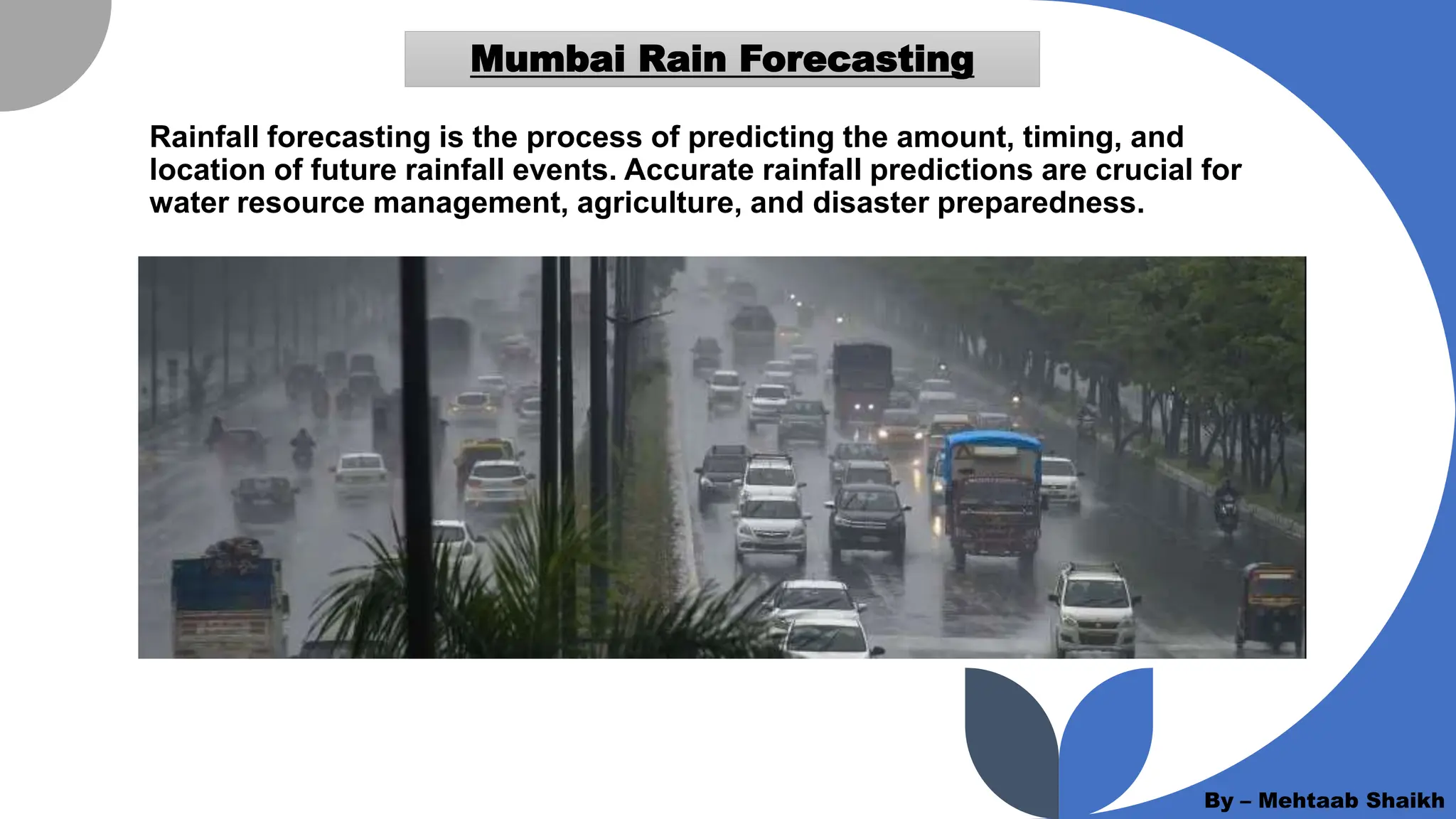
Rainfall forecasting is the process of predicting the amount, timing, and
location of future rainfall events. Accurate rainfall predictions are crucial for
water resource management, agriculture, and disaster preparedness.
Mumbai Rain Forecasting
By – Mehtaab Shaikh
Introduction
By – Mehtaab Shaikh
Mumbai, the country's financial hub with a population of 12 million, faces
significant weather impacts during the southwest monsoon season,
receiving an average rainfall of around 230 cm with high variability. Real-
time rainfall monitoring is crucial, facilitated by a dense network of rain
gauges. This information is vital for stakeholders like the Disaster
Management Department, Municipal Corporation of Greater Mumbai
(MCGM), and transport authorities to enhance disaster preparedness.
Our objective is to glean insights from historical rainfall data spanning
1901 to 2021, including monthly and annual measurements in millimeters
(mm). With 121 rows and 14 columns, this dataset is valuable for studying
rainfall patterns and trends, with applications in water resource
management, agriculture, and climate research.
Importance of Accurate Rainfall Prediction
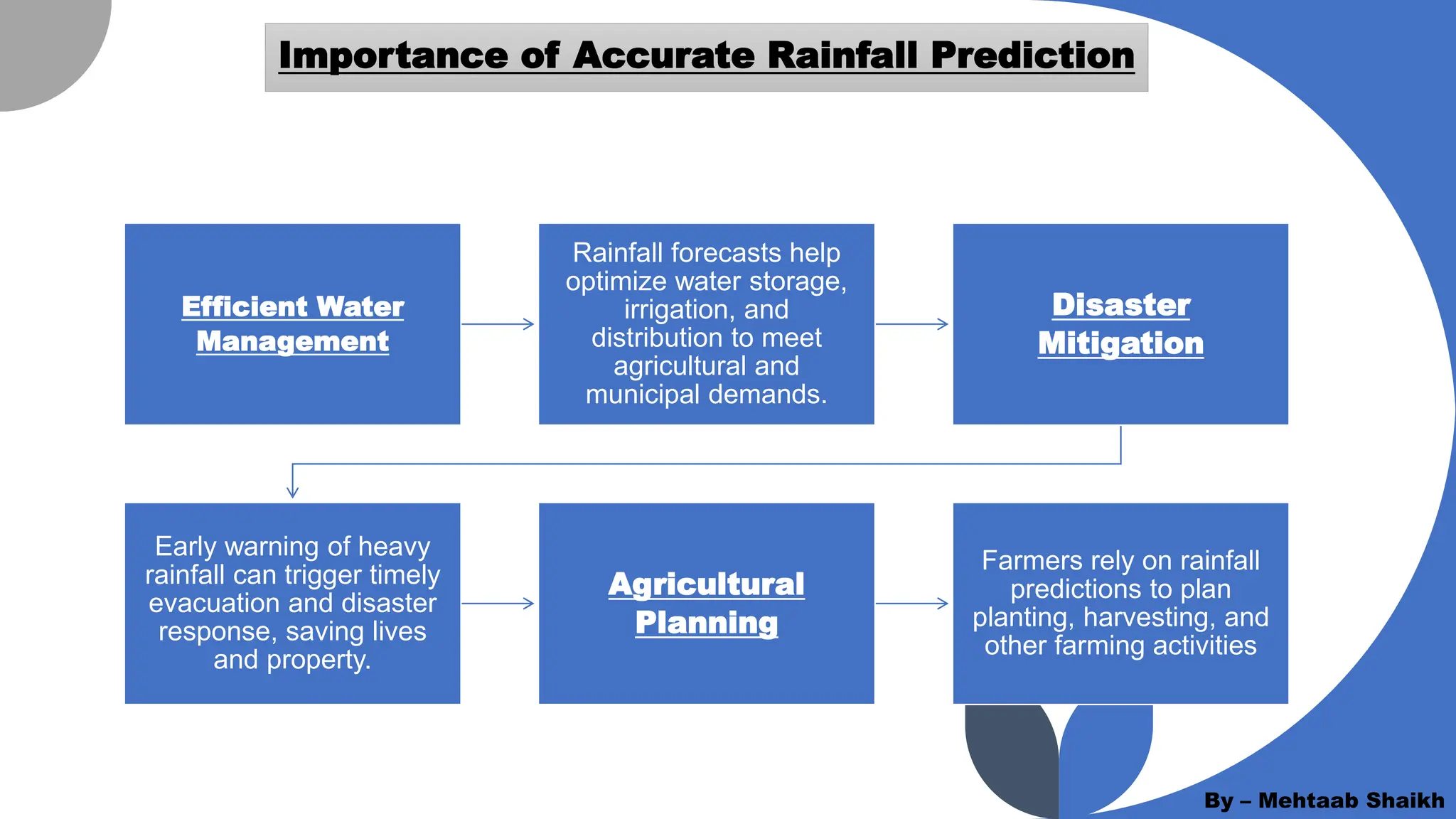
Efficient Water
Management
Rainfall forecasts help
optimize water storage,
irrigation, and
distribution to meet
agricultural and
municipal demands.
Disaster
Mitigation
Early warning of heavy
rainfall can trigger timely
evacuation and disaster
response, saving lives
and property.
Agricultural
Planning
Farmers rely on rainfall
predictions to plan
planting, harvesting, and
other farming activities
By – Mehtaab Shaikh
Limitations of Traditional Forecasting Methods
Complexity
of
Weather
Systems
• Accurately
modeling the
complex
interactions
of
atmospheric
variables is
challenging
for traditional
statistical
models.
Localized
Variation
s
• Conventional
forecasts
often fail to
capture
micro-scale
rainfall
patterns due
to
topography
and other
local factors.
Reliance
on
Historical
Data
• Traditional
methods
struggle to
adapt to
changing
climate
patterns and
extreme
weather
events not
captured in
past data.
By – Mehtaab Shaikh
Machine Learning Approach to Rain Forecasting
Machine Learning
models are great at
spotting complex
pattern in large
weather datasets.
They can keep
getting better at
predicting weather
by learning from new
data as weather
changes. Advanced
machine learning
techniques can even
predict rainfall very
accurately for
specific locations.
Here are some useful
weather forecasting
models.
Autoregressive Integrated Moving Average (ARIMA) – It is a classic time series
forecasting model that considers the dependencies between an observation
and number of lagged observations. It is suitable for capturing linear
relationships in time series data and can be effective for short term rainfall
predictions.
Seasonal Autoregressive Integrated Moving Average (SARIMA), is an extension
of the ARIMA model that specifically addresses seasonality in time series data.
SARIMA models are powerful tools for forecasting time series data that
exhibits seasonal patterns.
Long Short-Term Memory (LSTM) Networks – It is a type of recurrent neural
network (RNN) design to handle sequence dependence. It is also useful for
capturing nonlinear and complex patterns in rainfall data over longer time
horizons, making it suitable for both short-term and long-term forecasting.
By – Mehtaab Shaikh
Data Collection and Preprocessing
Effective data
preprocessing
is crucial for
building
accurate and
robust models
and for
communicating
insights
effectively in a
presentation.
Data Sources – Historical rainfall data spanning 121 years was provided, comprising 14 columns
and 121 rows. A preliminary investigation was conducted to analyze the rainfall patterns in
Mumbai.
Data Cleaning – The dataset underwent filtration to detect discrepancies or missing values;
however, no gaps or missing data were detected. Extract and transform pertinent features from
the raw data to enhance model performance.
Identifying Relevant Features - Conducted data analysis to identify the primary factors
influencing rainfall, including seasonal patterns and trends, using data visualization.
Feature Transformation - Apply techniques like dimensionality reduction and feature scaling to
optimize the input data for the chosen ML algorithm.
Model Evaluation - Evaluated and compared the effectiveness of various machine learning
models, such as ARIMA, SARIMA, and LSTM, to determine the optimal choice.
By – Mehtaab Shaikh
Data Visualization
By – Mehtaab Shaikh
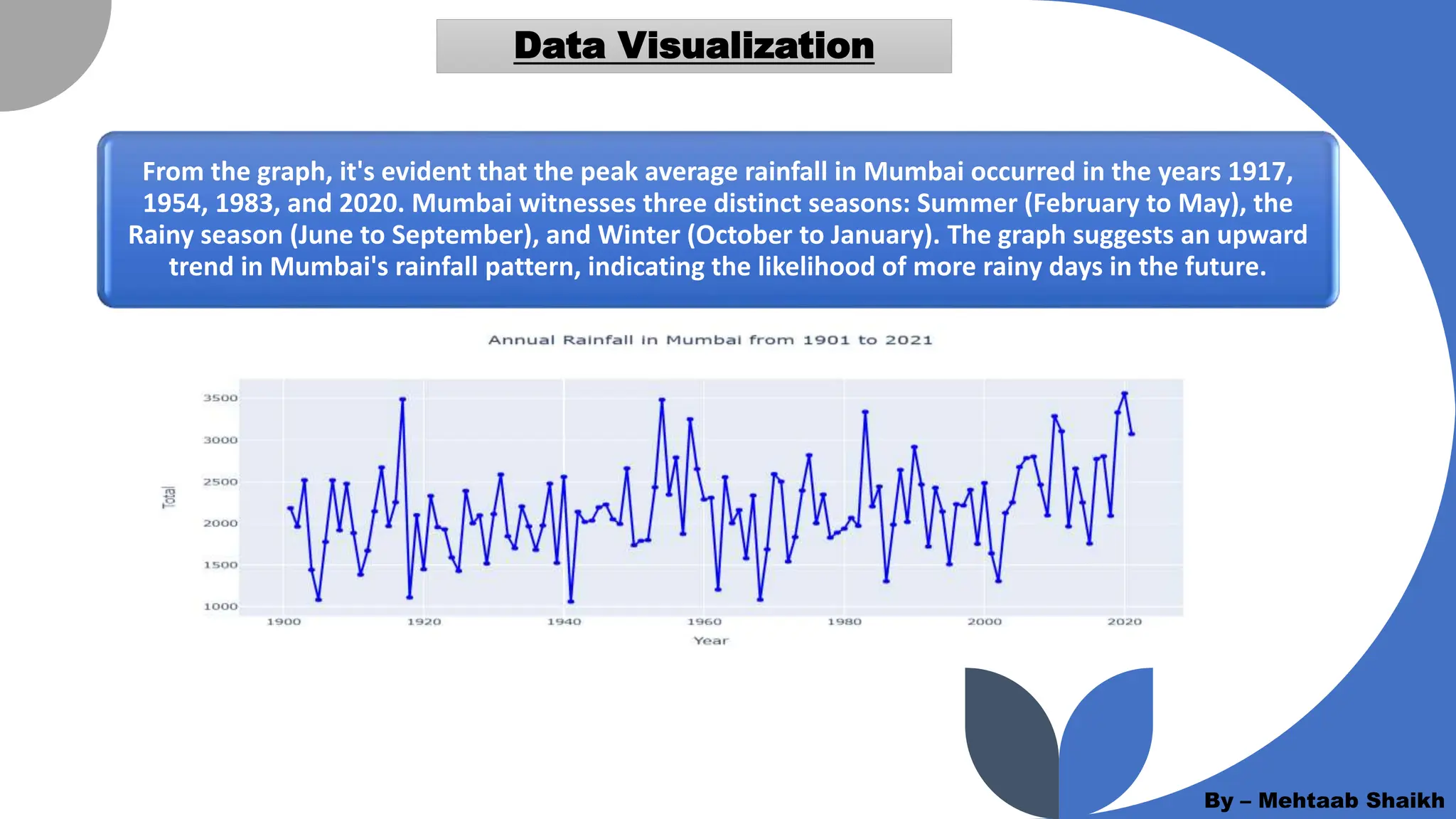
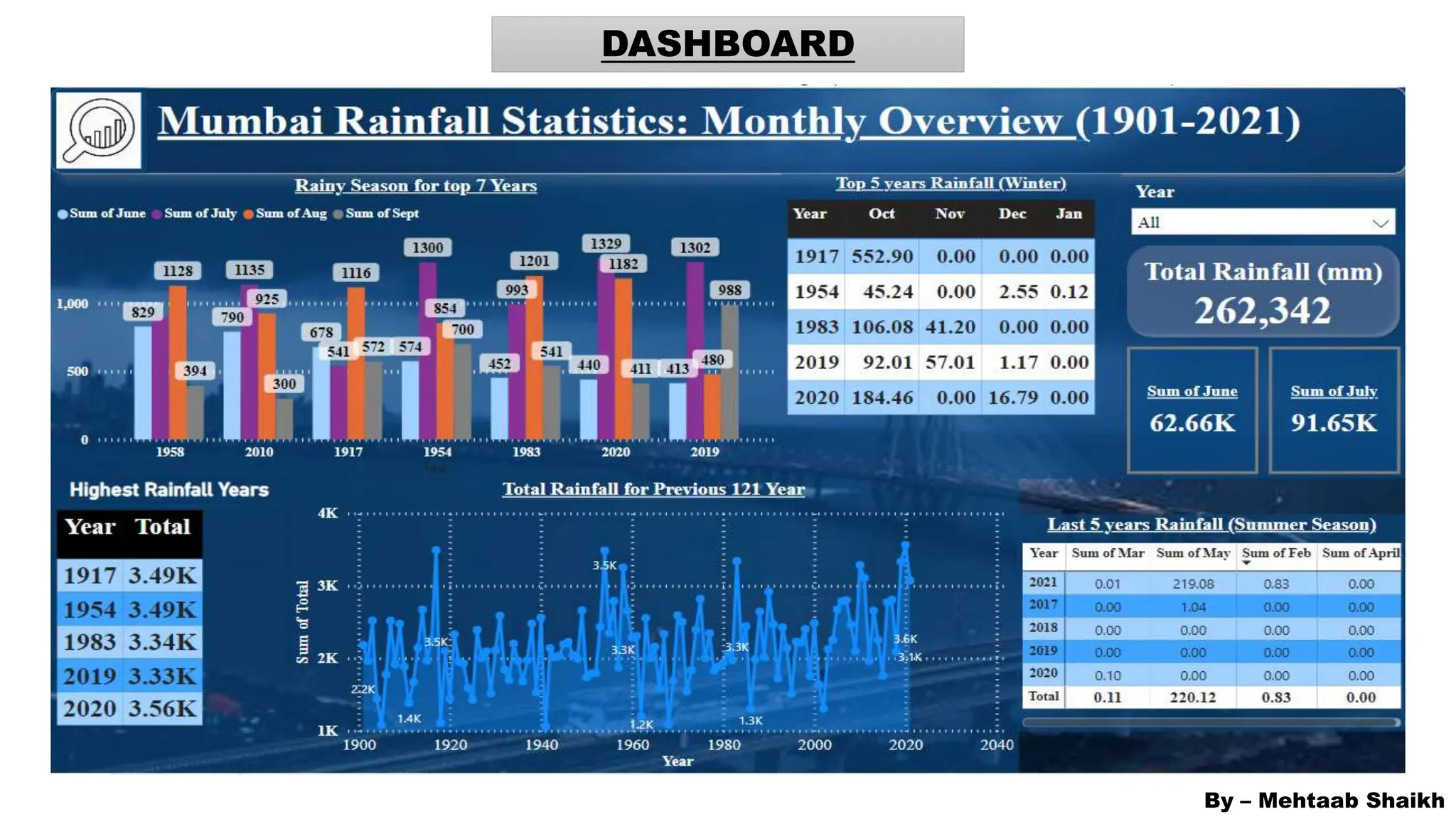
From the graph, it's evident that the peak average rainfall in Mumbai occurred in the years 1917,
1954, 1983, and 2020. Mumbai witnesses three distinct seasons: Summer (February to May), the
Rainy season (June to September), and Winter (October to January). The graph suggests an upward
trend in Mumbai's rainfall pattern, indicating the likelihood of more rainy days in the future.
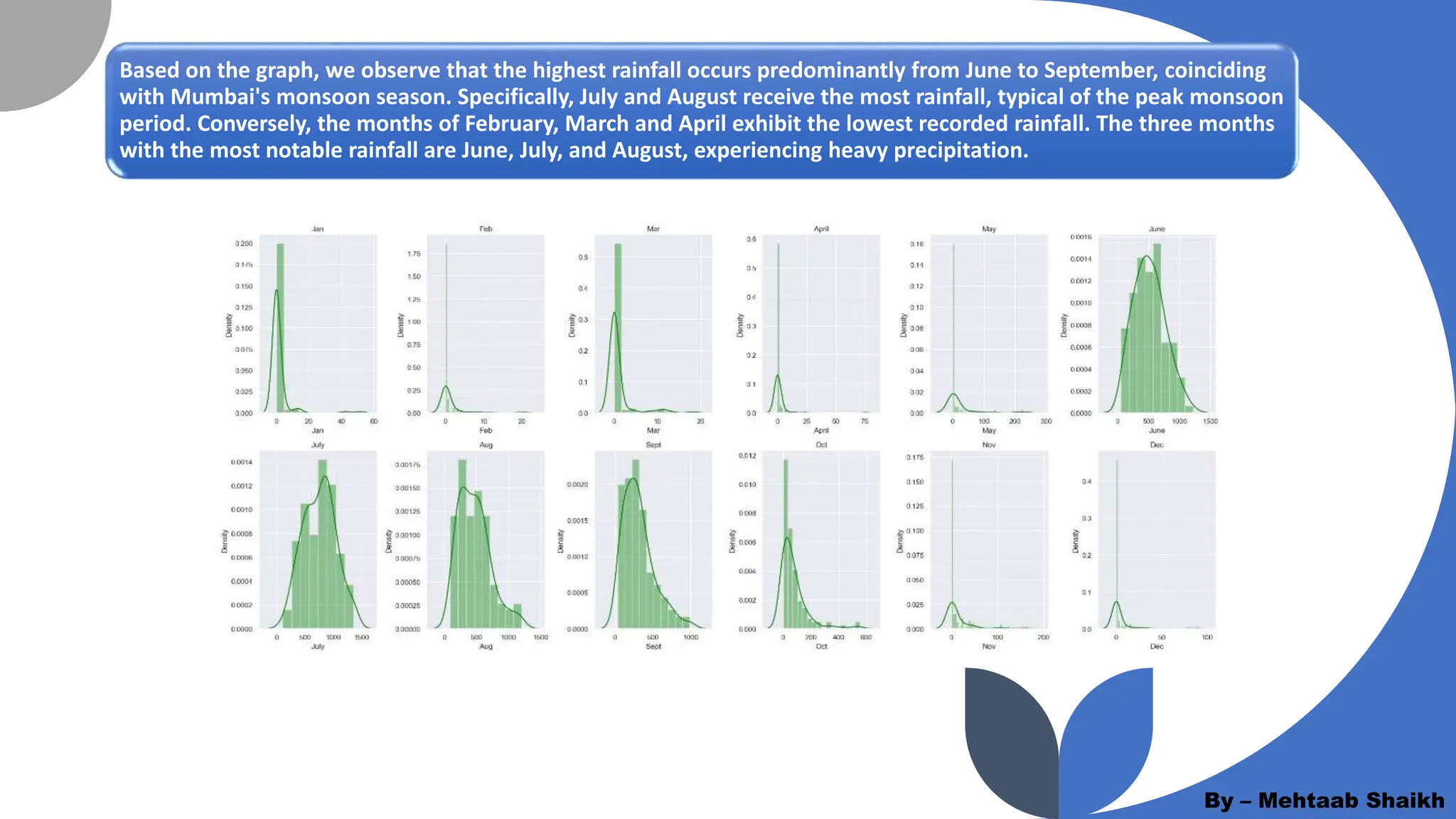
Based on the graph, we observe that the highest rainfall occurs predominantly from June to September, coinciding
with Mumbai's monsoon season. Specifically, July and August receive the most rainfall, typical of the peak monsoon
period. Conversely, the months of February, March and April exhibit the lowest recorded rainfall. The three months
with the most notable rainfall are June, July, and August, experiencing heavy precipitation.
By – Mehtaab Shaikh
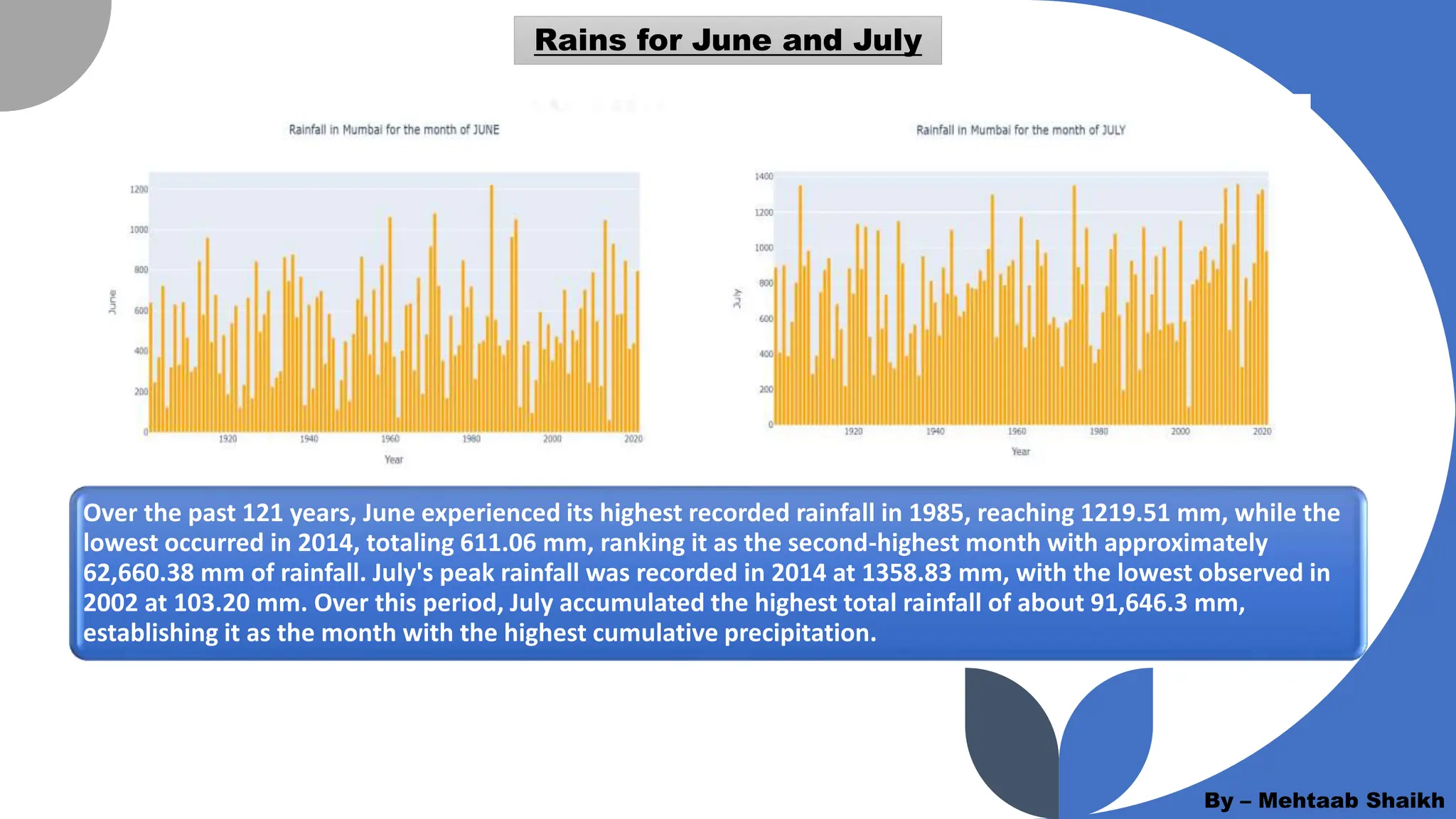
Over the past 121 years, June experienced its highest recorded rainfall in 1985, reaching 1219.51 mm, while the
lowest occurred in 2014, totaling 611.06 mm, ranking it as the second-highest month with approximately
62,660.38 mm of rainfall. July's peak rainfall was recorded in 2014 at 1358.83 mm, with the lowest observed in
2002 at 103.20 mm. Over this period, July accumulated the highest total rainfall of about 91,646.3 mm,
establishing it as the month with the highest cumulative precipitation.
By – Mehtaab Shaikh
Rains for June and July
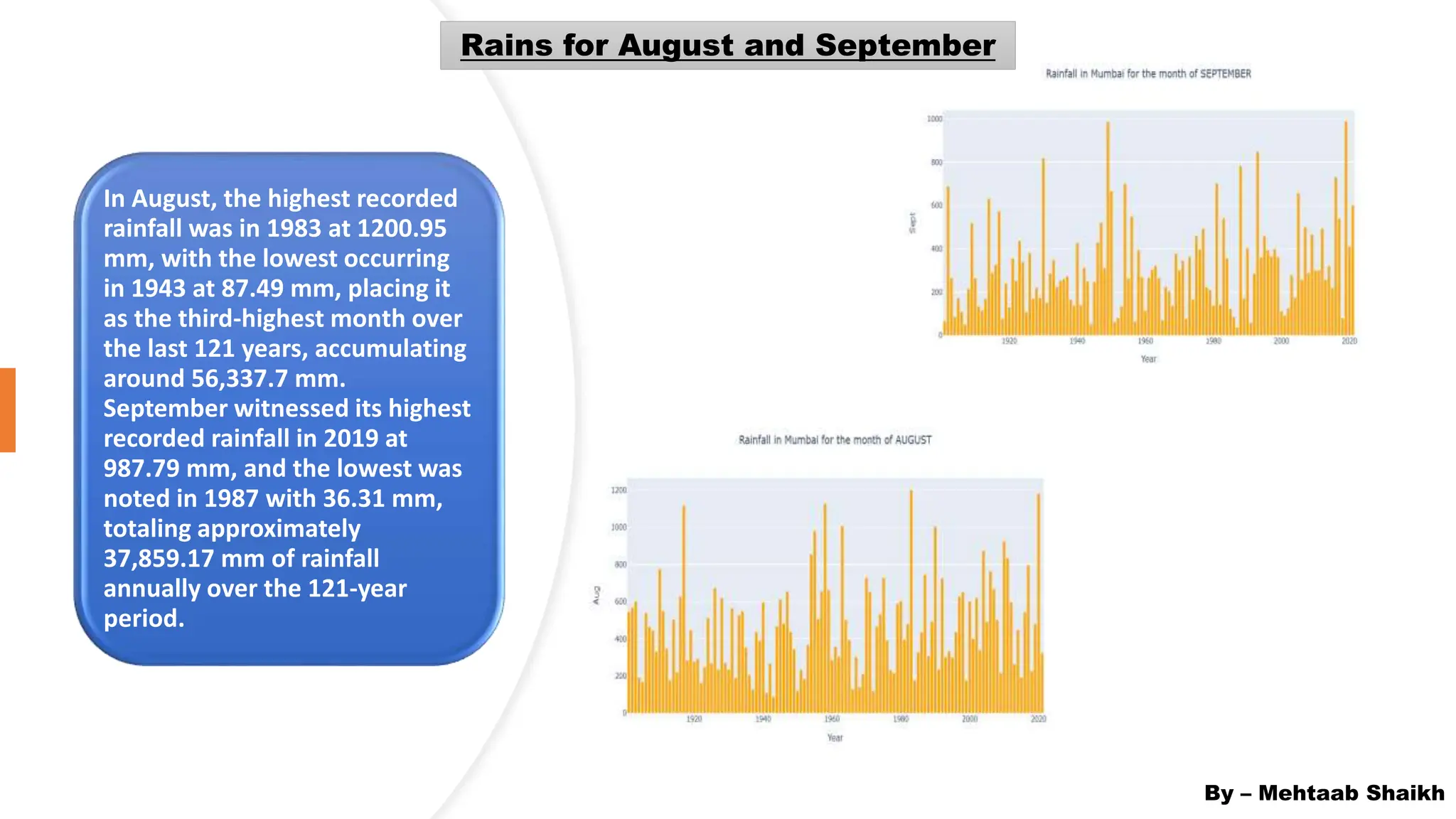
In August, the highest recorded
rainfall was in 1983 at 1200.95
mm, with the lowest occurring
in 1943 at 87.49 mm, placing it
as the third-highest month over
the last 121 years, accumulating
around 56,337.7 mm.
September witnessed its highest
recorded rainfall in 2019 at
987.79 mm, and the lowest was
noted in 1987 with 36.31 mm,
totaling approximately
37,859.17 mm of rainfall
annually over the 121-year
period.
By – Mehtaab Shaikh
Rains for August and September
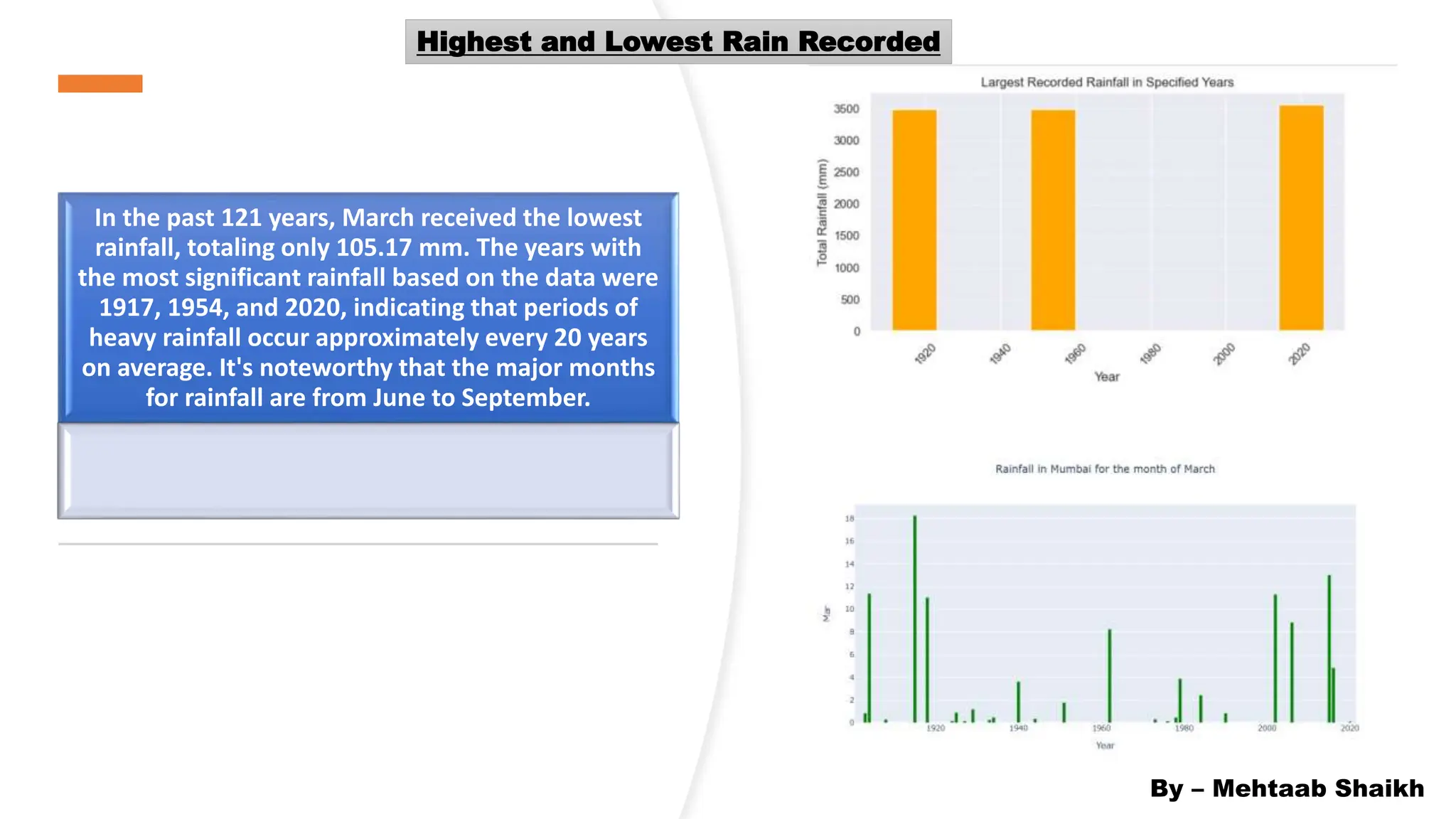
In the past 121 years, March received the lowest
rainfall, totaling only 105.17 mm. The years with
the most significant rainfall based on the data were
1917, 1954, and 2020, indicating that periods of
heavy rainfall occur approximately every 20 years
on average. It's noteworthy that the major months
for rainfall are from June to September.
By – Mehtaab Shaikh
Highest and Lowest Rain Recorded
Model Training and Evaluation
Data Splitting
The dataset is divided into training,
validation, and testing sets to
ensure unbiased model evaluation.
Model Training
Time series analysis involves
studying data collected over time to
identify patterns, trends and
seasonal variations. It includes
machine learning models to select
the most suitable algorithm for
making predictions based on
historical data.
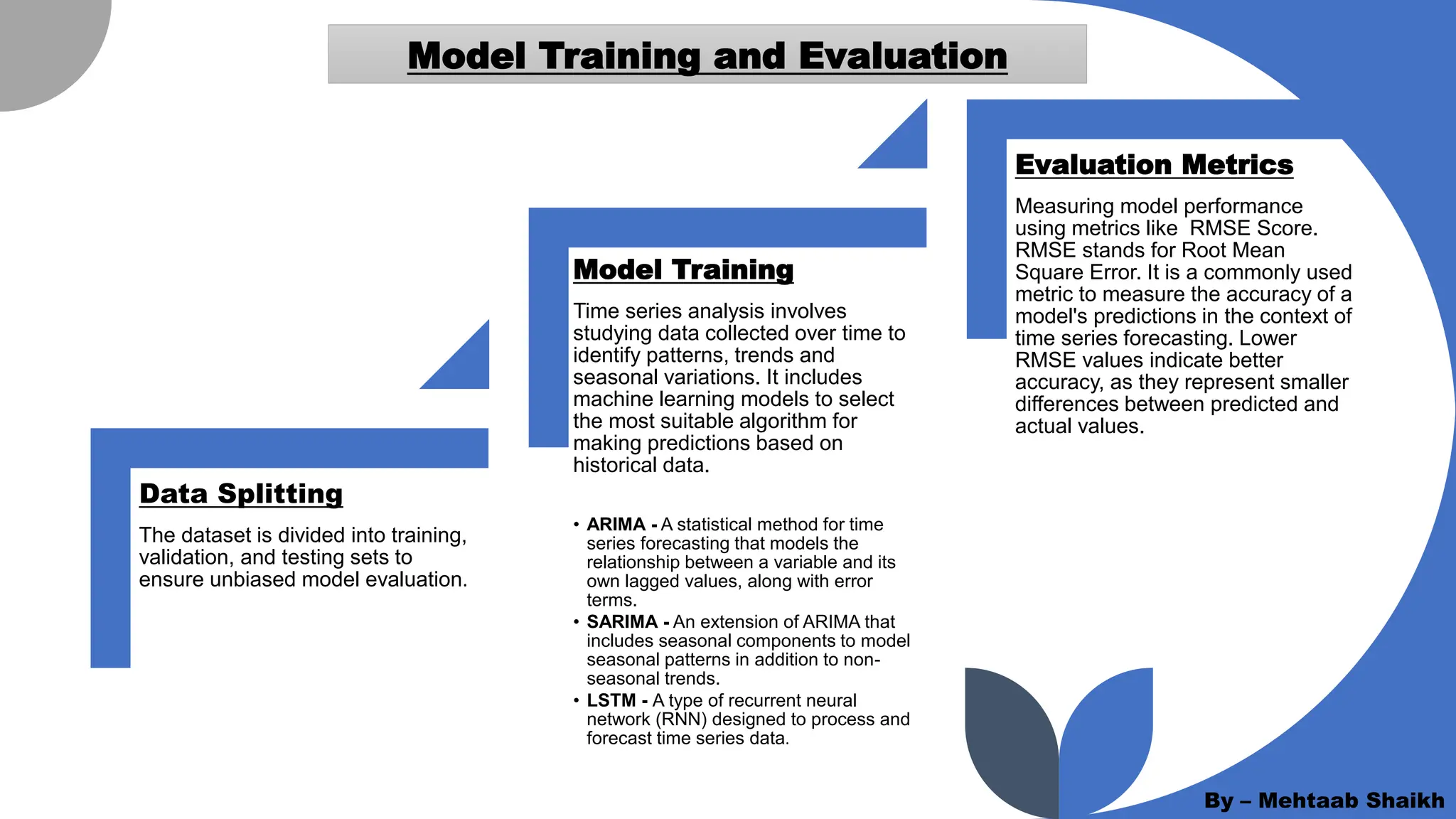
• ARIMA - A statistical method for time
series forecasting that models the
relationship between a variable and its
own lagged values, along with error
terms.
• SARIMA - An extension of ARIMA that
includes seasonal components to model
seasonal patterns in addition to non-
seasonal trends.
• LSTM - A type of recurrent neural
network (RNN) designed to process and
forecast time series data.
Evaluation Metrics
Measuring model performance
using metrics like RMSE Score.
RMSE stands for Root Mean
Square Error. It is a commonly used
metric to measure the accuracy of a
model's predictions in the context of
time series forecasting. Lower
RMSE values indicate better
accuracy, as they represent smaller
differences between predicted and
actual values.
By – Mehtaab Shaikh
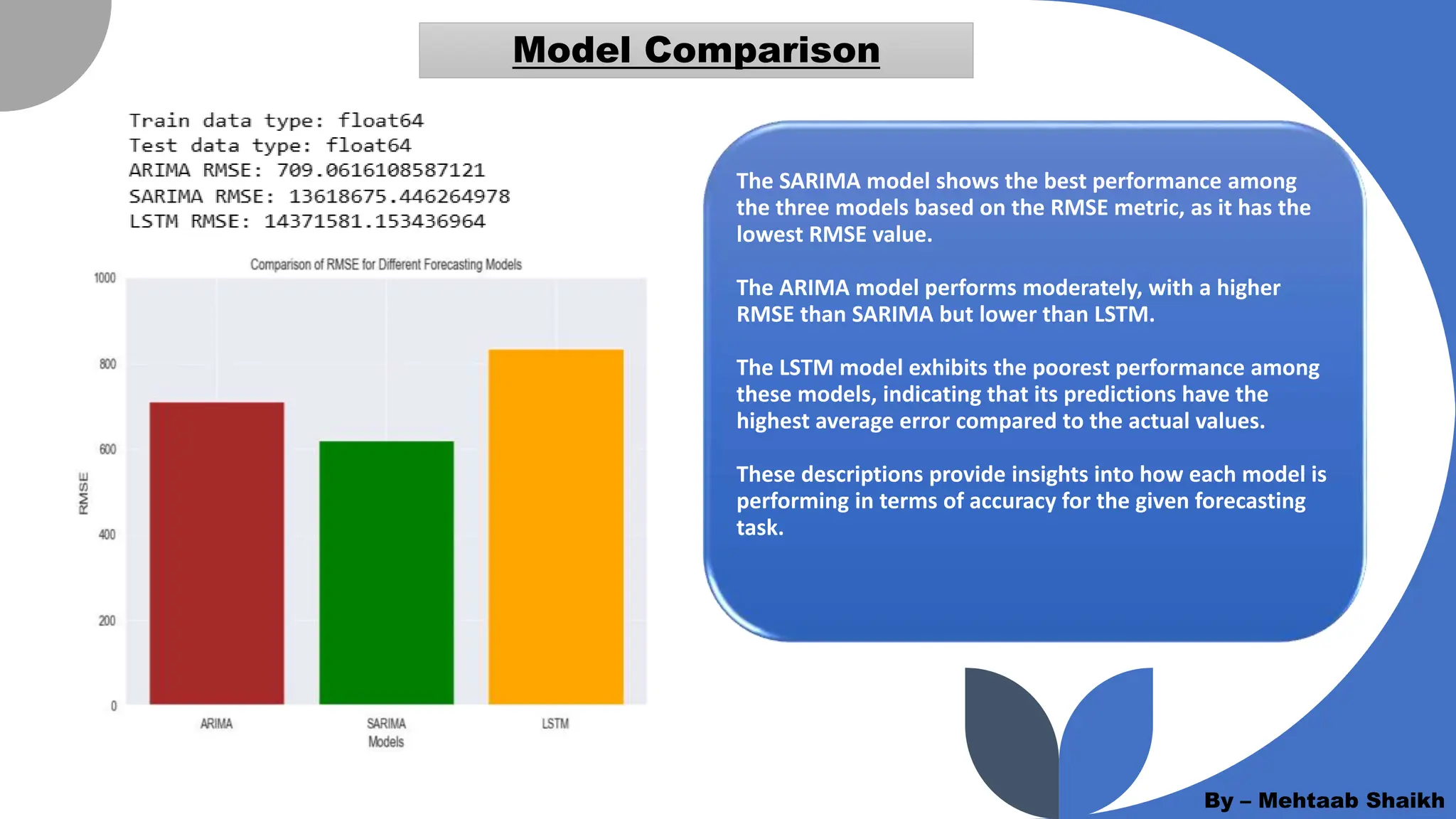
The SARIMA model shows the best performance among
the three models based on the RMSE metric, as it has the
lowest RMSE value.
The ARIMA model performs moderately, with a higher
RMSE than SARIMA but lower than LSTM.
The LSTM model exhibits the poorest performance among
these models, indicating that its predictions have the
highest average error compared to the actual values.
These descriptions provide insights into how each model is
performing in terms of accuracy for the given forecasting
task.
By – Mehtaab Shaikh
Model Comparison
Conclusion
By – Mehtaab Shaikh
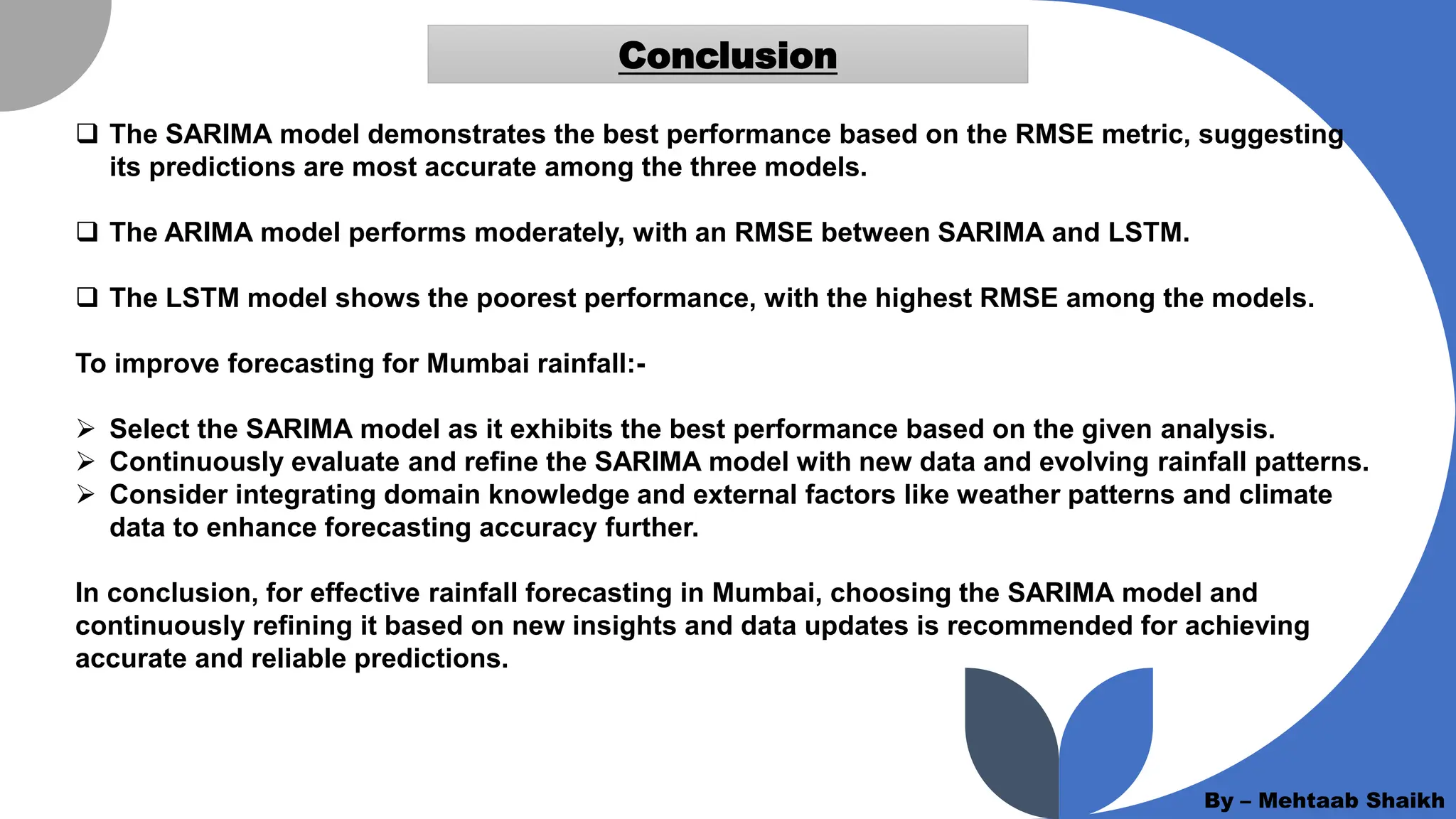
 The SARIMA model demonstrates the best performance based on the RMSE metric, suggesting
its predictions are most accurate among the three models.
 The ARIMA model performs moderately, with an RMSE between SARIMA and LSTM.
 The LSTM model shows the poorest performance, with the highest RMSE among the models.
To improve forecasting for Mumbai rainfall:-
 Select the SARIMA model as it exhibits the best performance based on the given analysis.
 Continuously evaluate and refine the SARIMA model with new data and evolving rainfall patterns.
 Consider integrating domain knowledge and external factors like weather patterns and climate
data to enhance forecasting accuracy further.
In conclusion, for effective rainfall forecasting in Mumbai, choosing the SARIMA model and
continuously refining it based on new insights and data updates is recommended for achieving
accurate and reliable predictions.
Recommendations
By – Mehtaab Shaikh
Here are concise recommendations for improving rainfall forecasting:
 Collaborate with Meteorological Agencies for real-time weather data integration,
enhancing forecast accuracy.
 Develop user friendly apps for personalized rainfall predictions, aiding activity
planning.
 Continuously update models with new data and feedback to improve accuracy
overtime.
 Ensure forecasts are accessible and easy to understand, supporting broad usability.
 Engage meteorologists and experts to refine models for specific regions and
conditions.
 Encourage partnerships to advance rainfall forecasting techniques and innovation.
Implementing these strategies can optimize rainfall prediction accuracy and usefulness
for diverse users and applications.
DASHBOARD
By – Mehtaab Shaikh
By – Mehtaab Shaikh

Predictive Precipitation: Advanced Rain Forecasting Techniques

  • 2.
    Rainfall forecasting isthe process of predicting the amount, timing, and location of future rainfall events. Accurate rainfall predictions are crucial for water resource management, agriculture, and disaster preparedness. Mumbai Rain Forecasting By – Mehtaab Shaikh
  • 3.
    Introduction By – MehtaabShaikh Mumbai, the country's financial hub with a population of 12 million, faces significant weather impacts during the southwest monsoon season, receiving an average rainfall of around 230 cm with high variability. Real- time rainfall monitoring is crucial, facilitated by a dense network of rain gauges. This information is vital for stakeholders like the Disaster Management Department, Municipal Corporation of Greater Mumbai (MCGM), and transport authorities to enhance disaster preparedness. Our objective is to glean insights from historical rainfall data spanning 1901 to 2021, including monthly and annual measurements in millimeters (mm). With 121 rows and 14 columns, this dataset is valuable for studying rainfall patterns and trends, with applications in water resource management, agriculture, and climate research.
  • 4.
    Importance of AccurateRainfall Prediction Efficient Water Management Rainfall forecasts help optimize water storage, irrigation, and distribution to meet agricultural and municipal demands. Disaster Mitigation Early warning of heavy rainfall can trigger timely evacuation and disaster response, saving lives and property. Agricultural Planning Farmers rely on rainfall predictions to plan planting, harvesting, and other farming activities By – Mehtaab Shaikh
  • 5.
    Limitations of TraditionalForecasting Methods Complexity of Weather Systems • Accurately modeling the complex interactions of atmospheric variables is challenging for traditional statistical models. Localized Variation s • Conventional forecasts often fail to capture micro-scale rainfall patterns due to topography and other local factors. Reliance on Historical Data • Traditional methods struggle to adapt to changing climate patterns and extreme weather events not captured in past data. By – Mehtaab Shaikh
  • 6.
    Machine Learning Approachto Rain Forecasting Machine Learning models are great at spotting complex pattern in large weather datasets. They can keep getting better at predicting weather by learning from new data as weather changes. Advanced machine learning techniques can even predict rainfall very accurately for specific locations. Here are some useful weather forecasting models. Autoregressive Integrated Moving Average (ARIMA) – It is a classic time series forecasting model that considers the dependencies between an observation and number of lagged observations. It is suitable for capturing linear relationships in time series data and can be effective for short term rainfall predictions. Seasonal Autoregressive Integrated Moving Average (SARIMA), is an extension of the ARIMA model that specifically addresses seasonality in time series data. SARIMA models are powerful tools for forecasting time series data that exhibits seasonal patterns. Long Short-Term Memory (LSTM) Networks – It is a type of recurrent neural network (RNN) design to handle sequence dependence. It is also useful for capturing nonlinear and complex patterns in rainfall data over longer time horizons, making it suitable for both short-term and long-term forecasting. By – Mehtaab Shaikh
  • 7.
    Data Collection andPreprocessing Effective data preprocessing is crucial for building accurate and robust models and for communicating insights effectively in a presentation. Data Sources – Historical rainfall data spanning 121 years was provided, comprising 14 columns and 121 rows. A preliminary investigation was conducted to analyze the rainfall patterns in Mumbai. Data Cleaning – The dataset underwent filtration to detect discrepancies or missing values; however, no gaps or missing data were detected. Extract and transform pertinent features from the raw data to enhance model performance. Identifying Relevant Features - Conducted data analysis to identify the primary factors influencing rainfall, including seasonal patterns and trends, using data visualization. Feature Transformation - Apply techniques like dimensionality reduction and feature scaling to optimize the input data for the chosen ML algorithm. Model Evaluation - Evaluated and compared the effectiveness of various machine learning models, such as ARIMA, SARIMA, and LSTM, to determine the optimal choice. By – Mehtaab Shaikh
  • 8.
    Data Visualization By –Mehtaab Shaikh From the graph, it's evident that the peak average rainfall in Mumbai occurred in the years 1917, 1954, 1983, and 2020. Mumbai witnesses three distinct seasons: Summer (February to May), the Rainy season (June to September), and Winter (October to January). The graph suggests an upward trend in Mumbai's rainfall pattern, indicating the likelihood of more rainy days in the future.
  • 9.
    Based on thegraph, we observe that the highest rainfall occurs predominantly from June to September, coinciding with Mumbai's monsoon season. Specifically, July and August receive the most rainfall, typical of the peak monsoon period. Conversely, the months of February, March and April exhibit the lowest recorded rainfall. The three months with the most notable rainfall are June, July, and August, experiencing heavy precipitation. By – Mehtaab Shaikh
  • 10.
    Over the past121 years, June experienced its highest recorded rainfall in 1985, reaching 1219.51 mm, while the lowest occurred in 2014, totaling 611.06 mm, ranking it as the second-highest month with approximately 62,660.38 mm of rainfall. July's peak rainfall was recorded in 2014 at 1358.83 mm, with the lowest observed in 2002 at 103.20 mm. Over this period, July accumulated the highest total rainfall of about 91,646.3 mm, establishing it as the month with the highest cumulative precipitation. By – Mehtaab Shaikh Rains for June and July
  • 11.
    In August, thehighest recorded rainfall was in 1983 at 1200.95 mm, with the lowest occurring in 1943 at 87.49 mm, placing it as the third-highest month over the last 121 years, accumulating around 56,337.7 mm. September witnessed its highest recorded rainfall in 2019 at 987.79 mm, and the lowest was noted in 1987 with 36.31 mm, totaling approximately 37,859.17 mm of rainfall annually over the 121-year period. By – Mehtaab Shaikh Rains for August and September
  • 12.
    In the past121 years, March received the lowest rainfall, totaling only 105.17 mm. The years with the most significant rainfall based on the data were 1917, 1954, and 2020, indicating that periods of heavy rainfall occur approximately every 20 years on average. It's noteworthy that the major months for rainfall are from June to September. By – Mehtaab Shaikh Highest and Lowest Rain Recorded
  • 13.
    Model Training andEvaluation Data Splitting The dataset is divided into training, validation, and testing sets to ensure unbiased model evaluation. Model Training Time series analysis involves studying data collected over time to identify patterns, trends and seasonal variations. It includes machine learning models to select the most suitable algorithm for making predictions based on historical data. • ARIMA - A statistical method for time series forecasting that models the relationship between a variable and its own lagged values, along with error terms. • SARIMA - An extension of ARIMA that includes seasonal components to model seasonal patterns in addition to non- seasonal trends. • LSTM - A type of recurrent neural network (RNN) designed to process and forecast time series data. Evaluation Metrics Measuring model performance using metrics like RMSE Score. RMSE stands for Root Mean Square Error. It is a commonly used metric to measure the accuracy of a model's predictions in the context of time series forecasting. Lower RMSE values indicate better accuracy, as they represent smaller differences between predicted and actual values. By – Mehtaab Shaikh
  • 14.
    The SARIMA modelshows the best performance among the three models based on the RMSE metric, as it has the lowest RMSE value. The ARIMA model performs moderately, with a higher RMSE than SARIMA but lower than LSTM. The LSTM model exhibits the poorest performance among these models, indicating that its predictions have the highest average error compared to the actual values. These descriptions provide insights into how each model is performing in terms of accuracy for the given forecasting task. By – Mehtaab Shaikh Model Comparison
  • 15.
    Conclusion By – MehtaabShaikh  The SARIMA model demonstrates the best performance based on the RMSE metric, suggesting its predictions are most accurate among the three models.  The ARIMA model performs moderately, with an RMSE between SARIMA and LSTM.  The LSTM model shows the poorest performance, with the highest RMSE among the models. To improve forecasting for Mumbai rainfall:-  Select the SARIMA model as it exhibits the best performance based on the given analysis.  Continuously evaluate and refine the SARIMA model with new data and evolving rainfall patterns.  Consider integrating domain knowledge and external factors like weather patterns and climate data to enhance forecasting accuracy further. In conclusion, for effective rainfall forecasting in Mumbai, choosing the SARIMA model and continuously refining it based on new insights and data updates is recommended for achieving accurate and reliable predictions.
  • 16.
    Recommendations By – MehtaabShaikh Here are concise recommendations for improving rainfall forecasting:  Collaborate with Meteorological Agencies for real-time weather data integration, enhancing forecast accuracy.  Develop user friendly apps for personalized rainfall predictions, aiding activity planning.  Continuously update models with new data and feedback to improve accuracy overtime.  Ensure forecasts are accessible and easy to understand, supporting broad usability.  Engage meteorologists and experts to refine models for specific regions and conditions.  Encourage partnerships to advance rainfall forecasting techniques and innovation. Implementing these strategies can optimize rainfall prediction accuracy and usefulness for diverse users and applications.
  • 17.
  • 18.