International Journal of ComputerComputerand Technology (IJCET), ISSN 0976 – 6367(Print),
International Journal of Engineering Engineering
ISSN 0976 – 6375(Online) Volume 1, Number 1, May - June (2010), © IAEME
and Technology (IJCET), ISSN 0976 – 6367(Print)                             IJCET
ISSN 0976 – 6375(Online) Volume 1
Number 1, May - June (2010), pp. 103-111                                ©IAEME
© IAEME, http://www.iaeme.com/ijcet.html


        MODELING AND PREDICTING THE MONTHLY
            RAINFALL IN TAMILNADU AS A SEASONAL
                  MULTIVARIATE ARIMA PROCESS
                                      M. Nirmala
                        Research Scholar, Sathyabama University
                     Rajiv Gandhi Road, Jeppiaar Nagar, Chennai – 19
                          Email ID: monishram5002@gmail.com

                                     S. M. Sundaram
                    Department of Mathematics, Sathyabama University
                     Rajiv Gandhi Road, Jeppiaar Nagar, Chennai – 19
                         Email ID: sundarambhu@rediffmail.com

ABSTRACT:
         Amongst all weather happenings, rainfall plays the most imperative role in
human life. The understanding of rainfall variability helps the agricultural management in
planning and decision- making process. The important aspect of this research is to find a
suitable time series seasonal model for the prediction of the amount of rainfall in
Tamilnadu. In this study, Box-Jenkins model is used to build a Multivariate ARIMA
model for predicting the monthly rainfall in Tamilnadu together with a predictor, Sea
Surface Temperature for the period of 59 years (1950 – 2008) with a total of 708
readings.
Keywords: Seasonality, Sea Surface Temperature, Monthly Rainfall, Prediction,
Multivariate ARIMA
INTRODUCTION:
        Time series analysis is an important tool in modeling and forecasting. Among the
most effective approaches for analyzing time series data is the model introduced by Box
and Jenkins [1], Autoregressive Integrated Moving Average (ARIMA). Box-Jenkins
ARIMA modeling has been successfully applied in various water and environmental


                                              103
International Journal of Computer Engineering and Technology (IJCET), ISSN 0976 – 6367(Print),
ISSN 0976 – 6375(Online) Volume 1, Number 1, May - June (2010), © IAEME


management applications. The association between the southwest and northeast monsoon
rainfall over Tamilnadu have been examined for the 100 year period from 1877 – 1976
through a correlation analysis by O.N. Dhar and P.R. Rakhecha [2]. The average rainfall
series of Tamilnadu for the northeast monsoon months of October to December and the
season as a whole were analyzed for trends, periodicities and variability using standard
statistical methods by O. N. Dhar, P. R. Rakhecha, and A. K. Kulkarni [3]. Balachandran
S., Asokan R. and Sridharan S [4] examined the local and teleconnective association
between Northeast Monsoon Rainfall (NEMR) over Tamilnadu and global Surface
Temperature Anomalies (STA) using the monthly gridded STA data for the period 1901-
2004. The trends, periodicities and variability in the seasonal and annual rainfall series of
Tamilnadu were analyzed by O. N. Dhar, P. R. Rakhecha, and A. K. Kulkarni [5]. The
annual rainfall in Tamilnadu was predicted using a suitable Box – Jenkins ARIMA model
by M. Nirmala and S.M.Sundaram [6].


STUDY AREA AND MATERIALS:
         Tamilnadu stretches between 8o 5'-13o 35' N by latitude and between 78o 18'-
80o 20' E by longitude. Tamilnadu is in the southeastern portion of the Deccan in India,
which extends from the Vindhya mountains in the north to Kanyakumari in the south.
Tamilnadu receives rainfall in both the southwest and northeast monsoon. Agriculture is
more dependants on the northeast monsoon. The rainfall during October to December
plays an important role in deciding the fate of the agricultural economy of the state.
Another important agro – climatic zone is the Cauvery river delta zone, which depends
on the southwest monsoon. Tamilnadu should normally receive 979 mm of rainfall every
year. Approximately 33% is from the southwest monsoon and 48 % is from the northeast
monsoon.


                                                104
International Journal of Computer Engineering and Technology (IJCET), ISSN 0976 – 6367(Print),
ISSN 0976 – 6375(Online) Volume 1, Number 1, May - June (2010), © IAEME


                  Figure 1 Geographical location of area of study, Tamilnadu
        A dataset containing a total of 59 years (1950 - 2008) monthly rainfall totals of
Tamilnadu was obtained from Indian Institute of Tropical Meteorology (IITM), Pune,
India. The monthly Sea Surface Temperature of Nino 3.4 indices were obtained from
National Oceanic and Atmospheric Administration, United States, for a period of 59
years (1950 – 2008) with 708 observations.
METHODOLOGY:
BOX-JENKINS SEASONAL MULTIVARIATE ARIMA MODEL:

        Univariate time series analysis using Box-Jenkins ARIMA model is a major tool
in hydrology and has been used extensively, mainly for the prediction of such surface
water processes as precipitation and stream flow events. It is basically a linear statistical
technique and most powerful for modeling the time series and rainfall forecasting due to
ease in its development and implementation. The ARIMA models are a combination of
autoregressive models and moving average models [1]. The autoregressive models AR(p)
base their predictions of the values of a variable xt, on a number p of past values of the


                                                105
International Journal of Computer Engineering and Technology (IJCET), ISSN 0976 – 6367(Print),
ISSN 0976 – 6375(Online) Volume 1, Number 1, May - June (2010), © IAEME


same variable number of autoregressive delays xt−1,xt−2,. . . xt−p and include a random
disturbance et. The moving average models MA(q) generate predictions of a variable xt
based on a number q of past disturbances of the same variable prediction errors of past
values et−1,et−2,. . ., et−q. The combination of the auto regressive and moving average
models AR(p) and MA(q) generates more flexible models called ARMA(p,q) models.
The stationarity of the time series is required for the implementation of all these models.
In 1976, Box and Jenkins proposed the mathematical transformation of the non-stationary
time series into stationary time series by a difference process defined by an order of
integration parameter d. This transforms ARMA (p,q) models for non stationary
transformed time series as the ARIMA (p,d,q) models.

        The ARIMA model building strategy includes iterative identification, estimation,
diagnosis and forecasting stages [7]. Identification of a model may be accomplished on
the basis of the data pattern, time series plot and using their autocorrelation function and
partial autocorrelation function. The parameters are estimated and tested for statistical
significance after identifying the tentative model. If the parameter estimates does not
meet the stationarity condition then a new model should be identified and its parameters
are estimated and tested. After finding the correct model it should be diagnosed. In the
diagnosis process, the autocorrelation of the residuals from the estimated model should
be sufficiently small and should resemble white noise. If the residuals remain
significantly correlated among themselves, a new model should be identified estimated
and diagnosed. Once the model is selected it is used to forecast the monthly rainfall
series. Time series analysis provides great opportunities for detecting, describing and
modeling climatic variability and impacts. Ultimately, to understand the meteorological
information and integrate it into planning and decision making process, it is important to
study the temporal characteristic and predict lead times of the rainfall of a region. This
can be done by identifying the best time series model using Box – Jenkins Seasonal
ARIMA modeling techniques. The Seasonal ARIMA (p,d,q)(P,D,Q)s model is defined as

φ p ( B)Φ P ( B s )∇ d ∇ s D yt = Θ Q ( B s )θ q ( B)ε t                      …………… [1]


                                                106
International Journal of Computer Engineering and Technology (IJCET), ISSN 0976 – 6367(Print),
ISSN 0976 – 6375(Online) Volume 1, Number 1, May - June (2010), © IAEME


Where

φ p ( B ) = 1 − φ1 B − ........... − φ p B p , θ q ( B ) = 1 − θ1 B − ............ − θ q B q
                                                                                                                                                                       …..[2]
Φ P ( B s ) = 1 − Φ 1 B s − ........ − Φ P B sP , Θ Q ( B s ) = 1 − Θ1 B s − ....... − Θ Q B sQ

εt denotes the error term, φ’s and Φ’s are the non seasonal and seasonal autoregressive
parameters and θ’s and Θ’s are the non seasonal and seasonal moving average
parameters.
RESULTS AND DISCUSSIONS:
         A time series is said to be stationary if its underlying generating process is based
on constant mean and constant variance with its autocorrelation function (ACF)
essentially constant through time. The ACF is a measure of the correlation between two
variables composing the stochastic process, which are k temporal lags far away and the
Partial Autocorrelation Function (PACF) measures the net correlation between two
variables, which are k temporal lags far away.

                                       TIME SERIES POLT OF MONTHLY RAINFALL IN TAMILNADU

                                4500
             MONTHLY RAINFALL


                                4000
                                3500
                                3000
                                2500
                                2000
                                1500
                                1000
                                 500
                                   0
                                       1
                                           34
                                                67
                                                     100
                                                           133
                                                                 166
                                                                       199
                                                                             232
                                                                                   265
                                                                                         298
                                                                                               331
                                                                                                     364
                                                                                                           397
                                                                                                                 430
                                                                                                                       463
                                                                                                                             496
                                                                                                                                   529
                                                                                                                                         562
                                                                                                                                               595
                                                                                                                                                     628
                                                                                                                                                           661
                                                                                                                                                                 694


                                                                                               MONTH


                     Figure 2 Time Series Plot of Monthly Rainfall in Tamilnadu (1950 - 2008)
         The visual plot of the time series plot (Figure 2) is often enough to convince a
statistician that the series is stationary or non – stationary [6]. The visual inspection of
the sample autocorrelation function shows that the rainfall series is stationary. If the
Autocorrelation function dies out rapidly, that is, it reaches zero within one or two lag
periods then it indicates that the time series is stationary. From the pattern of ACF and
PACF plots, the monthly rainfall series is stationary but with seasonality.


                                                                                         107
International Journal of Computer Engineering and Technology (IJCET), ISSN 0976 – 6367(Print),
ISSN 0976 – 6375(Online) Volume 1, Number 1, May - June (2010), © IAEME


                              Figure 3 ACF and PACF correlograms
        Seasonality is defined as a pattern that repeats itself over fixed intervals of times.
For a stationary data, seasonality can be found by identifying those autocorrelation
coefficients of more than two or three time lags that are significantly different from zero
[8]. Since the monthly rainfall series consists seasonality of order s = 12, the model
considered here is a seasonal multivariate ARIMA model.
                  Table 1: ACF and PACF coefficients for the first five lags
                        Lag       ACF coefficient         PACF coefficient
                         1            0.457                    0.457
                         2            0.123                   -0.108
                         3           -0.155                   -0.215
                         4           -0.268                   -0.127
                         5           -0.250                   -0.069

        The ACF and PACF correlograms (figure 3) and the coefficients are analyzed
carefully and the tentative multivariate ARIMA model chosen is ARIMA (1,0,1)(1,1,1)12.
The parameter’s estimates are tabulated in table 2.
          Table 2: Parameter’s Estimates of ARIMA (1,0,1)(1,1,1)12 model
                   Model                  Parameters            Parameter’s
                                                                Estimates
                   ARIMA                  AR                    0.475
                   (1,0,1)(1,1,1)12       MA                    0.392
                                          AR, Seasonal          0.072
                                          MA, Seasonal          0.965


                                                108
International Journal of Computer Engineering and Technology (IJCET), ISSN 0976 – 6367(Print),
ISSN 0976 – 6375(Online) Volume 1, Number 1, May - June (2010), © IAEME


        After fitting the appropriate ARIMA model, the goodness of fit can be examined
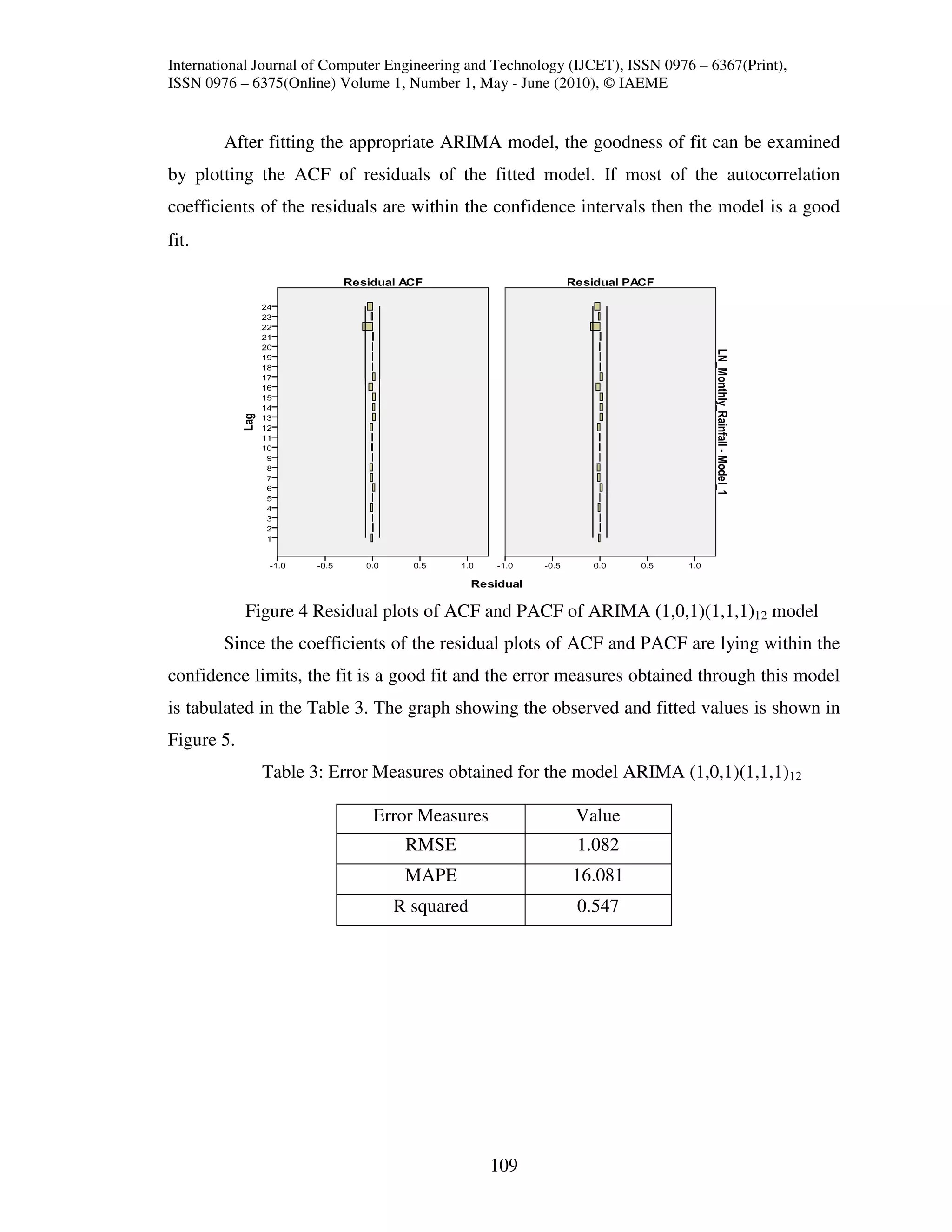
by plotting the ACF of residuals of the fitted model. If most of the autocorrelation
coefficients of the residuals are within the confidence intervals then the model is a good
fit.


            Figure 4 Residual plots of ACF and PACF of ARIMA (1,0,1)(1,1,1)12 model
        Since the coefficients of the residual plots of ACF and PACF are lying within the
confidence limits, the fit is a good fit and the error measures obtained through this model
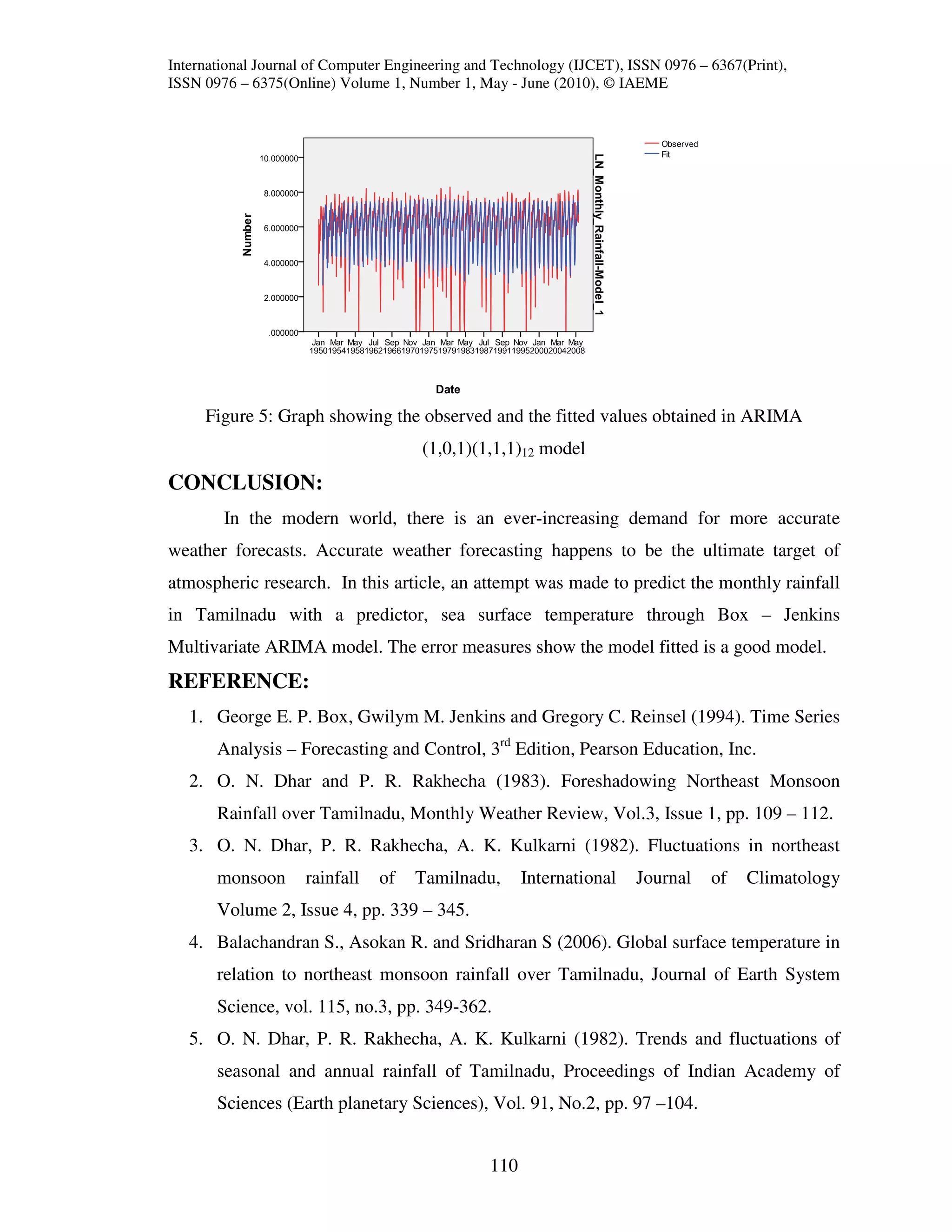
is tabulated in the Table 3. The graph showing the observed and fitted values is shown in
Figure 5.
              Table 3: Error Measures obtained for the model ARIMA (1,0,1)(1,1,1)12

                               Error Measures                Value
                                    RMSE                      1.082
                                   MAPE                      16.081
                                  R squared                   0.547


                                                109
International Journal of Computer Engineering and Technology (IJCET), ISSN 0976 – 6367(Print),
ISSN 0976 – 6375(Online) Volume 1, Number 1, May - June (2010), © IAEME


     Figure 5: Graph showing the observed and the fitted values obtained in ARIMA
                                      (1,0,1)(1,1,1)12 model
CONCLUSION:
        In the modern world, there is an ever-increasing demand for more accurate
weather forecasts. Accurate weather forecasting happens to be the ultimate target of
atmospheric research. In this article, an attempt was made to predict the monthly rainfall
in Tamilnadu with a predictor, sea surface temperature through Box – Jenkins
Multivariate ARIMA model. The error measures show the model fitted is a good model.
REFERENCE:
   1. George E. P. Box, Gwilym M. Jenkins and Gregory C. Reinsel (1994). Time Series
       Analysis – Forecasting and Control, 3rd Edition, Pearson Education, Inc.
   2. O. N. Dhar and P. R. Rakhecha (1983). Foreshadowing Northeast Monsoon
       Rainfall over Tamilnadu, Monthly Weather Review, Vol.3, Issue 1, pp. 109 – 112.
   3. O. N. Dhar, P. R. Rakhecha, A. K. Kulkarni (1982). Fluctuations in northeast
       monsoon      rainfall    of   Tamilnadu,       International    Journal    of   Climatology
       Volume 2, Issue 4, pp. 339 – 345.
   4. Balachandran S., Asokan R. and Sridharan S (2006). Global surface temperature in
       relation to northeast monsoon rainfall over Tamilnadu, Journal of Earth System
       Science, vol. 115, no.3, pp. 349-362.
   5. O. N. Dhar, P. R. Rakhecha, A. K. Kulkarni (1982). Trends and fluctuations of
       seasonal and annual rainfall of Tamilnadu, Proceedings of Indian Academy of
       Sciences (Earth planetary Sciences), Vol. 91, No.2, pp. 97 –104.


                                                110
International Journal of Computer Engineering and Technology (IJCET), ISSN 0976 – 6367(Print),
ISSN 0976 – 6375(Online) Volume 1, Number 1, May - June (2010), © IAEME


   6. Nirmala M and Sundaram S.M. (2009), Rainfall Predicting Model: An Application
       to Tamilnadu Rainfall Series, Proceedings of National Conference on Effect of
       Climatic Change and Sustainable Resource Management, SRM University, and
       Meteorological Department, Chennai India.
   7. Damodar N. Gujarati and Sangeetha (2007). Basic Econometrics, 4th edition, the
       Tata Mcgraw – Hill Publishing Company Limited.
   8. Meaza Demissie (2003). Characterizing trends and identification of rainfall
       predicting model: An application to Melksa observatory Nazreth rainfall series,
       Proceedings of Biometric society, pp.132 – 134.
  9. Nirmala M and Sundaram S.M. (2010), Comparison of Learning Algorithms with
      the ARIMA Model for the Forecasting of Annual Rainfall in Tamilnadu,
      International Journal on Information Sciences and Computing,                     Vol.4, No.1,
      pp.64 – 71.


                                                111

Modeling and predicting the monthly rainfall in tamilnadu

  • 1.
    International Journal ofComputerComputerand Technology (IJCET), ISSN 0976 – 6367(Print), International Journal of Engineering Engineering ISSN 0976 – 6375(Online) Volume 1, Number 1, May - June (2010), © IAEME and Technology (IJCET), ISSN 0976 – 6367(Print) IJCET ISSN 0976 – 6375(Online) Volume 1 Number 1, May - June (2010), pp. 103-111 ©IAEME © IAEME, http://www.iaeme.com/ijcet.html MODELING AND PREDICTING THE MONTHLY RAINFALL IN TAMILNADU AS A SEASONAL MULTIVARIATE ARIMA PROCESS M. Nirmala Research Scholar, Sathyabama University Rajiv Gandhi Road, Jeppiaar Nagar, Chennai – 19 Email ID: monishram5002@gmail.com S. M. Sundaram Department of Mathematics, Sathyabama University Rajiv Gandhi Road, Jeppiaar Nagar, Chennai – 19 Email ID: sundarambhu@rediffmail.com ABSTRACT: Amongst all weather happenings, rainfall plays the most imperative role in human life. The understanding of rainfall variability helps the agricultural management in planning and decision- making process. The important aspect of this research is to find a suitable time series seasonal model for the prediction of the amount of rainfall in Tamilnadu. In this study, Box-Jenkins model is used to build a Multivariate ARIMA model for predicting the monthly rainfall in Tamilnadu together with a predictor, Sea Surface Temperature for the period of 59 years (1950 – 2008) with a total of 708 readings. Keywords: Seasonality, Sea Surface Temperature, Monthly Rainfall, Prediction, Multivariate ARIMA INTRODUCTION: Time series analysis is an important tool in modeling and forecasting. Among the most effective approaches for analyzing time series data is the model introduced by Box and Jenkins [1], Autoregressive Integrated Moving Average (ARIMA). Box-Jenkins ARIMA modeling has been successfully applied in various water and environmental 103
  • 2.
    International Journal ofComputer Engineering and Technology (IJCET), ISSN 0976 – 6367(Print), ISSN 0976 – 6375(Online) Volume 1, Number 1, May - June (2010), © IAEME management applications. The association between the southwest and northeast monsoon rainfall over Tamilnadu have been examined for the 100 year period from 1877 – 1976 through a correlation analysis by O.N. Dhar and P.R. Rakhecha [2]. The average rainfall series of Tamilnadu for the northeast monsoon months of October to December and the season as a whole were analyzed for trends, periodicities and variability using standard statistical methods by O. N. Dhar, P. R. Rakhecha, and A. K. Kulkarni [3]. Balachandran S., Asokan R. and Sridharan S [4] examined the local and teleconnective association between Northeast Monsoon Rainfall (NEMR) over Tamilnadu and global Surface Temperature Anomalies (STA) using the monthly gridded STA data for the period 1901- 2004. The trends, periodicities and variability in the seasonal and annual rainfall series of Tamilnadu were analyzed by O. N. Dhar, P. R. Rakhecha, and A. K. Kulkarni [5]. The annual rainfall in Tamilnadu was predicted using a suitable Box – Jenkins ARIMA model by M. Nirmala and S.M.Sundaram [6]. STUDY AREA AND MATERIALS: Tamilnadu stretches between 8o 5'-13o 35' N by latitude and between 78o 18'- 80o 20' E by longitude. Tamilnadu is in the southeastern portion of the Deccan in India, which extends from the Vindhya mountains in the north to Kanyakumari in the south. Tamilnadu receives rainfall in both the southwest and northeast monsoon. Agriculture is more dependants on the northeast monsoon. The rainfall during October to December plays an important role in deciding the fate of the agricultural economy of the state. Another important agro – climatic zone is the Cauvery river delta zone, which depends on the southwest monsoon. Tamilnadu should normally receive 979 mm of rainfall every year. Approximately 33% is from the southwest monsoon and 48 % is from the northeast monsoon. 104
  • 3.
    International Journal ofComputer Engineering and Technology (IJCET), ISSN 0976 – 6367(Print), ISSN 0976 – 6375(Online) Volume 1, Number 1, May - June (2010), © IAEME Figure 1 Geographical location of area of study, Tamilnadu A dataset containing a total of 59 years (1950 - 2008) monthly rainfall totals of Tamilnadu was obtained from Indian Institute of Tropical Meteorology (IITM), Pune, India. The monthly Sea Surface Temperature of Nino 3.4 indices were obtained from National Oceanic and Atmospheric Administration, United States, for a period of 59 years (1950 – 2008) with 708 observations. METHODOLOGY: BOX-JENKINS SEASONAL MULTIVARIATE ARIMA MODEL: Univariate time series analysis using Box-Jenkins ARIMA model is a major tool in hydrology and has been used extensively, mainly for the prediction of such surface water processes as precipitation and stream flow events. It is basically a linear statistical technique and most powerful for modeling the time series and rainfall forecasting due to ease in its development and implementation. The ARIMA models are a combination of autoregressive models and moving average models [1]. The autoregressive models AR(p) base their predictions of the values of a variable xt, on a number p of past values of the 105
  • 4.
    International Journal ofComputer Engineering and Technology (IJCET), ISSN 0976 – 6367(Print), ISSN 0976 – 6375(Online) Volume 1, Number 1, May - June (2010), © IAEME same variable number of autoregressive delays xt−1,xt−2,. . . xt−p and include a random disturbance et. The moving average models MA(q) generate predictions of a variable xt based on a number q of past disturbances of the same variable prediction errors of past values et−1,et−2,. . ., et−q. The combination of the auto regressive and moving average models AR(p) and MA(q) generates more flexible models called ARMA(p,q) models. The stationarity of the time series is required for the implementation of all these models. In 1976, Box and Jenkins proposed the mathematical transformation of the non-stationary time series into stationary time series by a difference process defined by an order of integration parameter d. This transforms ARMA (p,q) models for non stationary transformed time series as the ARIMA (p,d,q) models. The ARIMA model building strategy includes iterative identification, estimation, diagnosis and forecasting stages [7]. Identification of a model may be accomplished on the basis of the data pattern, time series plot and using their autocorrelation function and partial autocorrelation function. The parameters are estimated and tested for statistical significance after identifying the tentative model. If the parameter estimates does not meet the stationarity condition then a new model should be identified and its parameters are estimated and tested. After finding the correct model it should be diagnosed. In the diagnosis process, the autocorrelation of the residuals from the estimated model should be sufficiently small and should resemble white noise. If the residuals remain significantly correlated among themselves, a new model should be identified estimated and diagnosed. Once the model is selected it is used to forecast the monthly rainfall series. Time series analysis provides great opportunities for detecting, describing and modeling climatic variability and impacts. Ultimately, to understand the meteorological information and integrate it into planning and decision making process, it is important to study the temporal characteristic and predict lead times of the rainfall of a region. This can be done by identifying the best time series model using Box – Jenkins Seasonal ARIMA modeling techniques. The Seasonal ARIMA (p,d,q)(P,D,Q)s model is defined as φ p ( B)Φ P ( B s )∇ d ∇ s D yt = Θ Q ( B s )θ q ( B)ε t …………… [1] 106
  • 5.
    International Journal ofComputer Engineering and Technology (IJCET), ISSN 0976 – 6367(Print), ISSN 0976 – 6375(Online) Volume 1, Number 1, May - June (2010), © IAEME Where φ p ( B ) = 1 − φ1 B − ........... − φ p B p , θ q ( B ) = 1 − θ1 B − ............ − θ q B q …..[2] Φ P ( B s ) = 1 − Φ 1 B s − ........ − Φ P B sP , Θ Q ( B s ) = 1 − Θ1 B s − ....... − Θ Q B sQ εt denotes the error term, φ’s and Φ’s are the non seasonal and seasonal autoregressive parameters and θ’s and Θ’s are the non seasonal and seasonal moving average parameters. RESULTS AND DISCUSSIONS: A time series is said to be stationary if its underlying generating process is based on constant mean and constant variance with its autocorrelation function (ACF) essentially constant through time. The ACF is a measure of the correlation between two variables composing the stochastic process, which are k temporal lags far away and the Partial Autocorrelation Function (PACF) measures the net correlation between two variables, which are k temporal lags far away. TIME SERIES POLT OF MONTHLY RAINFALL IN TAMILNADU 4500 MONTHLY RAINFALL 4000 3500 3000 2500 2000 1500 1000 500 0 1 34 67 100 133 166 199 232 265 298 331 364 397 430 463 496 529 562 595 628 661 694 MONTH Figure 2 Time Series Plot of Monthly Rainfall in Tamilnadu (1950 - 2008) The visual plot of the time series plot (Figure 2) is often enough to convince a statistician that the series is stationary or non – stationary [6]. The visual inspection of the sample autocorrelation function shows that the rainfall series is stationary. If the Autocorrelation function dies out rapidly, that is, it reaches zero within one or two lag periods then it indicates that the time series is stationary. From the pattern of ACF and PACF plots, the monthly rainfall series is stationary but with seasonality. 107
  • 6.
    International Journal ofComputer Engineering and Technology (IJCET), ISSN 0976 – 6367(Print), ISSN 0976 – 6375(Online) Volume 1, Number 1, May - June (2010), © IAEME Figure 3 ACF and PACF correlograms Seasonality is defined as a pattern that repeats itself over fixed intervals of times. For a stationary data, seasonality can be found by identifying those autocorrelation coefficients of more than two or three time lags that are significantly different from zero [8]. Since the monthly rainfall series consists seasonality of order s = 12, the model considered here is a seasonal multivariate ARIMA model. Table 1: ACF and PACF coefficients for the first five lags Lag ACF coefficient PACF coefficient 1 0.457 0.457 2 0.123 -0.108 3 -0.155 -0.215 4 -0.268 -0.127 5 -0.250 -0.069 The ACF and PACF correlograms (figure 3) and the coefficients are analyzed carefully and the tentative multivariate ARIMA model chosen is ARIMA (1,0,1)(1,1,1)12. The parameter’s estimates are tabulated in table 2. Table 2: Parameter’s Estimates of ARIMA (1,0,1)(1,1,1)12 model Model Parameters Parameter’s Estimates ARIMA AR 0.475 (1,0,1)(1,1,1)12 MA 0.392 AR, Seasonal 0.072 MA, Seasonal 0.965 108
  • 7.
    International Journal ofComputer Engineering and Technology (IJCET), ISSN 0976 – 6367(Print), ISSN 0976 – 6375(Online) Volume 1, Number 1, May - June (2010), © IAEME After fitting the appropriate ARIMA model, the goodness of fit can be examined by plotting the ACF of residuals of the fitted model. If most of the autocorrelation coefficients of the residuals are within the confidence intervals then the model is a good fit. Figure 4 Residual plots of ACF and PACF of ARIMA (1,0,1)(1,1,1)12 model Since the coefficients of the residual plots of ACF and PACF are lying within the confidence limits, the fit is a good fit and the error measures obtained through this model is tabulated in the Table 3. The graph showing the observed and fitted values is shown in Figure 5. Table 3: Error Measures obtained for the model ARIMA (1,0,1)(1,1,1)12 Error Measures Value RMSE 1.082 MAPE 16.081 R squared 0.547 109
  • 8.
    International Journal ofComputer Engineering and Technology (IJCET), ISSN 0976 – 6367(Print), ISSN 0976 – 6375(Online) Volume 1, Number 1, May - June (2010), © IAEME Figure 5: Graph showing the observed and the fitted values obtained in ARIMA (1,0,1)(1,1,1)12 model CONCLUSION: In the modern world, there is an ever-increasing demand for more accurate weather forecasts. Accurate weather forecasting happens to be the ultimate target of atmospheric research. In this article, an attempt was made to predict the monthly rainfall in Tamilnadu with a predictor, sea surface temperature through Box – Jenkins Multivariate ARIMA model. The error measures show the model fitted is a good model. REFERENCE: 1. George E. P. Box, Gwilym M. Jenkins and Gregory C. Reinsel (1994). Time Series Analysis – Forecasting and Control, 3rd Edition, Pearson Education, Inc. 2. O. N. Dhar and P. R. Rakhecha (1983). Foreshadowing Northeast Monsoon Rainfall over Tamilnadu, Monthly Weather Review, Vol.3, Issue 1, pp. 109 – 112. 3. O. N. Dhar, P. R. Rakhecha, A. K. Kulkarni (1982). Fluctuations in northeast monsoon rainfall of Tamilnadu, International Journal of Climatology Volume 2, Issue 4, pp. 339 – 345. 4. Balachandran S., Asokan R. and Sridharan S (2006). Global surface temperature in relation to northeast monsoon rainfall over Tamilnadu, Journal of Earth System Science, vol. 115, no.3, pp. 349-362. 5. O. N. Dhar, P. R. Rakhecha, A. K. Kulkarni (1982). Trends and fluctuations of seasonal and annual rainfall of Tamilnadu, Proceedings of Indian Academy of Sciences (Earth planetary Sciences), Vol. 91, No.2, pp. 97 –104. 110
  • 9.
    International Journal ofComputer Engineering and Technology (IJCET), ISSN 0976 – 6367(Print), ISSN 0976 – 6375(Online) Volume 1, Number 1, May - June (2010), © IAEME 6. Nirmala M and Sundaram S.M. (2009), Rainfall Predicting Model: An Application to Tamilnadu Rainfall Series, Proceedings of National Conference on Effect of Climatic Change and Sustainable Resource Management, SRM University, and Meteorological Department, Chennai India. 7. Damodar N. Gujarati and Sangeetha (2007). Basic Econometrics, 4th edition, the Tata Mcgraw – Hill Publishing Company Limited. 8. Meaza Demissie (2003). Characterizing trends and identification of rainfall predicting model: An application to Melksa observatory Nazreth rainfall series, Proceedings of Biometric society, pp.132 – 134. 9. Nirmala M and Sundaram S.M. (2010), Comparison of Learning Algorithms with the ARIMA Model for the Forecasting of Annual Rainfall in Tamilnadu, International Journal on Information Sciences and Computing, Vol.4, No.1, pp.64 – 71. 111