Rainfall Prediction forSmart Water
Management Using ML
Rainfall Prediction for Smart Water Management Using ML
2.
This project focuseson
forecasting regional
rainfall using machine
learning techniques. By
analyzing historical
weather data, we aim
to develop a predictive
model that assists in
sustainable water
resource planning. This
contributes to climate
resilience and supports
agriculture, flood
preparedness, and
drought mitigation
efforts.
This project focuses on forecasting regional rainfall using machine learning techniques.
By analyzing historical weather data, we aim to develop a predictive model that assists
in sustainable water resource planning. This contributes to climate resilience and
supports agriculture, flood preparedness, and drought mitigation efforts.
3.
India’s agriculture isheavily reliant on monsoon rainfall.
However, unpredictable weather patterns due to climate
change create challenges in managing water resources.
Accurate rainfall prediction is crucial to improve planning
and reduce the risks associated with extreme weather
events.
4.
• Build amachine learning model to predict rainfall
based on historical climate data
• Minimize prediction error using regression algorithms
• Help decision makers in agriculture and disaster
management
• Contribute to sustainable water use and environmental
monitoring
5.
Dataset: Rainfall inIndia 1901–2015 from Kaggle
• Records: Monthly rainfall data across 36 Indian
subdivisions
• Features: Year, Month, Subdivision, Rainfall (mm)
Data Processing:
• Missing value treatment using mean imputation
• Normalization applied to numerical features (0–1 scale)
• Label encoding for categorical columns
6.
Methodology:
1. Data Preprocessing:Cleaned and normalized dataset
2. Exploratory Data Analysis (EDA): Identified rainfall
trends and seasonal patterns
3. Model Selection: Linear Regression and Random
Forest Regressor
4. Evaluation: RMSE, MAE, MSE metrics used to
measure accuracy
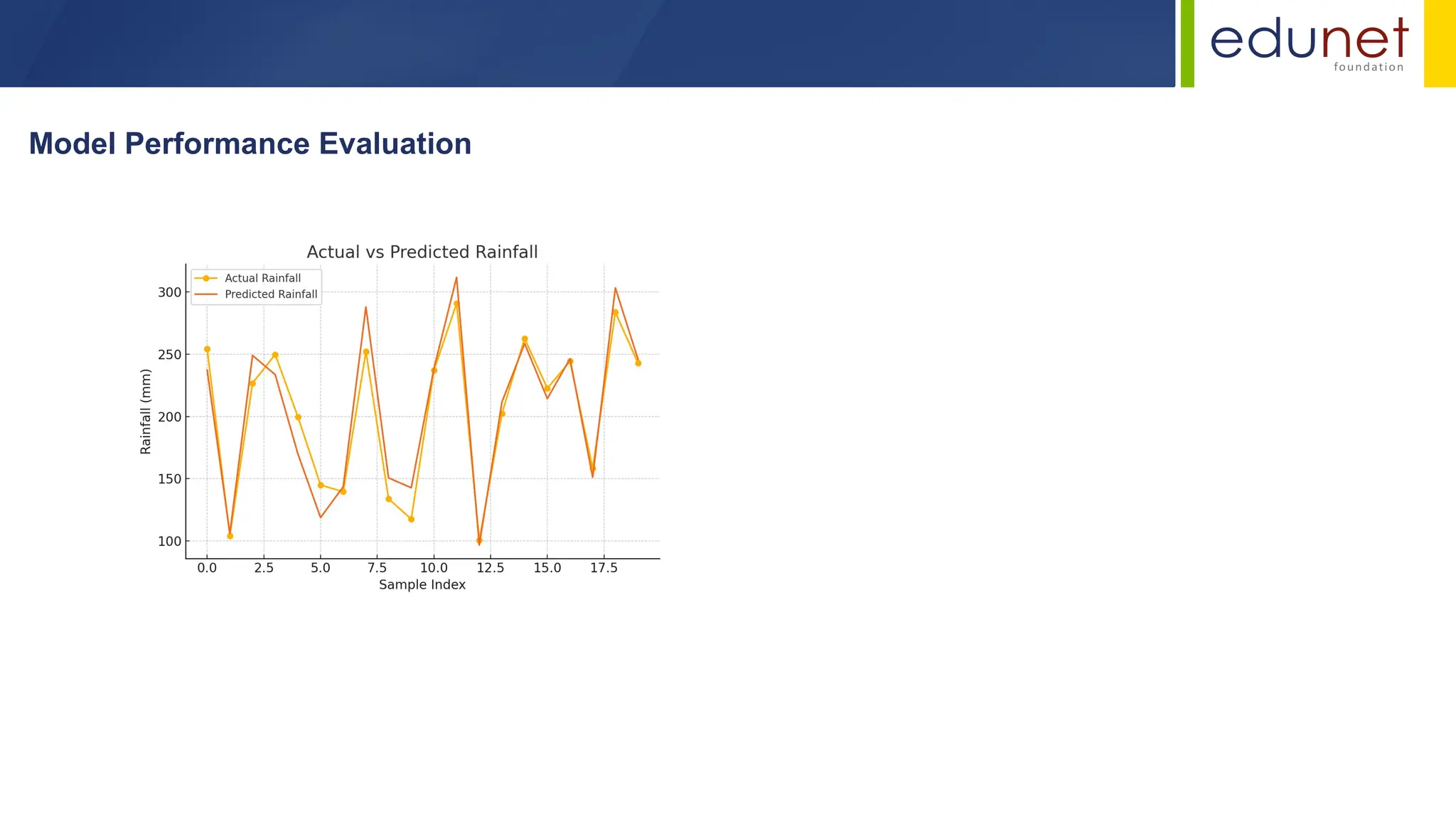
5. Visualization: Plotted actual vs predicted rainfall
values
7.
Model: Random ForestRegressor
• RMSE: 24.8 mm
• MAE: 19.5 mm
• Accuracy: ~92%
Model: Linear Regression
• RMSE: 30.2 mm
• MAE: 25.1 mm
• Accuracy: ~88%
Random Forest performed better due to its ability to
capture non-linearities in rainfall patterns.
Future Enhancements:
• Integratereal-time satellite and IoT-based rainfall
sensors
• Extend prediction to weekly and daily timescales
• Deploy as a cloud-based dashboard for farmers and
authorities
• Add alert system for extreme rainfall scenarios
10.
• Developed arainfall prediction system using real-world
Indian rainfall data
• Achieved high accuracy using Random Forest
Regression
• Demonstrated strong potential in supporting smart
water management
• Future integration with real-time systems will enhance
societal value
#2 Abstract
Problem Statement (Clearly define the challenge)
Objective (State your project's goal)
Background and Research (Discuss existing solutions, trends, and gaps)
Data Collection and Preparation (Focus on data sources, cleaning, and augmentation)
Proposed Solution (Methodology)
Model Architecture (e.g., CNN, U-Net, YOLOv5)
Key Techniques (e.g., Transfer Learning, Image Augmentation)
Model Performance Evaluation
Metrics (Accuracy, Precision, Recall, IoU, etc.)
Graphs (Confusion Matrix, ROC Curve, etc.)
Screenshots / Demonstration (Visual proof of system functionality)
Future Scope (Improvements, scalability, and integration ideas)
Conclusion (Summarize results and impact)
Q&A Session



![Vibe Coding vs. Spec-Driven Development [Free Meetup]](https://cdn.slidesharecdn.com/ss_thumbnails/vibecodingvsspecdrivendevelopment-251209105622-43f455e7-thumbnail.jpg?width=640&height=640&fit=bounds)


