IIIT HYDERABAD
Complexity and Advanced Algorithms (CSE-411)
FUNCTION POLYNOMIAL TIME
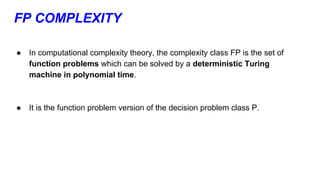
FP COMPLEXITY
● In computational complexity theory, the complexity class FP is the set of
function problems which can be solved by a deterministic Turing
machine in polynomial time.
● It is the function problem version of the decision problem class P.
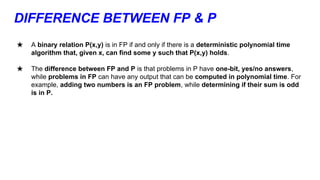
DIFFERENCE BETWEEN FP & P
★ A binary relation P(x,y) is in FP if and only if there is a deterministic polynomial time
algorithm that, given x, can find some y such that P(x,y) holds.
★ The difference between FP and P is that problems in P have one-bit, yes/no answers,
while problems in FP can have any output that can be computed in polynomial time. For
example, adding two numbers is an FP problem, while determining if their sum is odd
is in P.
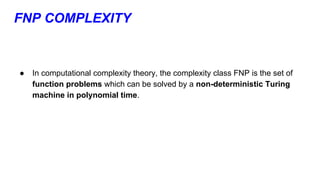
FNP COMPLEXITY
● In computational complexity theory, the complexity class FNP is the set of
function problems which can be solved by a non-deterministic Turing
machine in polynomial time.
FP = FNP??
➢ This is similar to the computation/verification relationship between P and
NP.
➢ In fact, FP = FNP if and only if P = NP.
THANKS

Function polynomial time

  • 1.
    IIIT HYDERABAD Complexity andAdvanced Algorithms (CSE-411) FUNCTION POLYNOMIAL TIME
  • 2.
    FP COMPLEXITY ● Incomputational complexity theory, the complexity class FP is the set of function problems which can be solved by a deterministic Turing machine in polynomial time. ● It is the function problem version of the decision problem class P.
  • 3.
    DIFFERENCE BETWEEN FP& P ★ A binary relation P(x,y) is in FP if and only if there is a deterministic polynomial time algorithm that, given x, can find some y such that P(x,y) holds. ★ The difference between FP and P is that problems in P have one-bit, yes/no answers, while problems in FP can have any output that can be computed in polynomial time. For example, adding two numbers is an FP problem, while determining if their sum is odd is in P.
  • 4.
    FNP COMPLEXITY ● Incomputational complexity theory, the complexity class FNP is the set of function problems which can be solved by a non-deterministic Turing machine in polynomial time.
  • 5.
    FP = FNP?? ➢This is similar to the computation/verification relationship between P and NP. ➢ In fact, FP = FNP if and only if P = NP.
  • 6.