• What is IOT? Why IOT?
• IOT in agriculture
• Applications of IOT
• Smart Agricultural Sensors
• Sensor Outputs
• Pros & Cons
• Conclusion
IN UPCOMING SLIDES
What is IOT? Why IOT?
• The full abbreviation of IOT is “internet of
things”.
•The Internet of Things(IOT) is inter-networking of
physical devices. This system has ability to transfer
data over a network without requiring human-to
human or human-to-computer interaction
•This is a growing trend that will influence
everything from businesses to our daily personal
lives.
•IOT has many applications in agriculture, smart
Cities, smart home, healthcare, business sectors,
Traffic monitoring , Transport etc.
IOT in Agriculture
•The agriculture IoT market is expected to grow from USD
12.7 billion in 2019 to USD 20.9 billion by 2024, at a CAGR
of 10.4% from 2019 to 2024.
•At present, irrigation consumes about 84 % of total
available water in India.
•We conserve water by using soil moisture sensors.
Applications of IOT in Agriculture
•Precision Farming
•Agricultural Drones
•Livestock Monitoring
•Smart Greenhouses
•Crop Water Management
•Pest Management & control
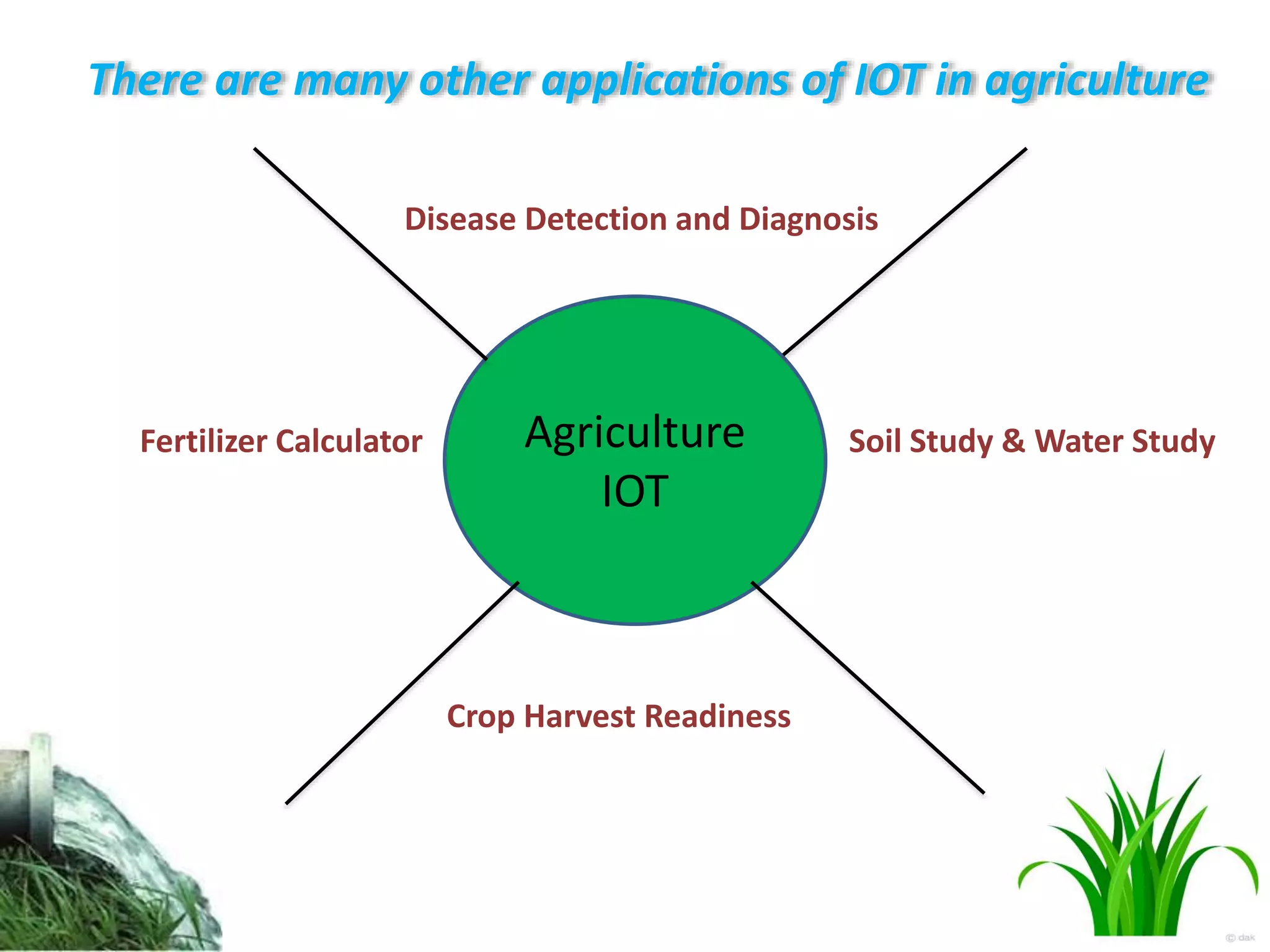
There are many other applications of IOT in agriculture
Agriculture
IOT
Disease Detection and Diagnosis
Fertilizer Calculator Soil Study & Water Study
Crop Harvest Readiness
Agricultural Drones
• The major benefits of using drones include crop health imaging, integrated
mapping, ease of use, saves time, and the potential to increase yields.
•Two types of drones, that is, ground-based and aerial-based drones are being
incorporated in agriculture in many ways such as, for crop health assessment,
irrigation, planting, and soil & field analysis.
Livestock monitoring
•Large farm owners can utilize wireless IOT applications to collect data regarding
the location , well-being, and health of their cattle.
•JMB North America is an organization that offers cow monitoring solutions to
cattle producers.
Smart Greenhouses
•Greenhouses control environmental parameters in two ways; either through
manual intervention or a proportional control mechanism.
•A smart greenhouse through IOT embedded systems not only monitors
intelligently but also controls the climate.
Agricultural Sensors
• Location Sensors
-use signals from GPS satellites to determine latitude,
longitude, and altitude to within feet .
Example- NJR NJG1157PCD-TE1
• Optical Sensors
- use light to measure soil properties.
- The sensors measure different frequencies of light
reflectance in near-infrared, mid-infrared, and polarized light
spectrums.
Example- Vishay
Vishay Photo IC Sensor
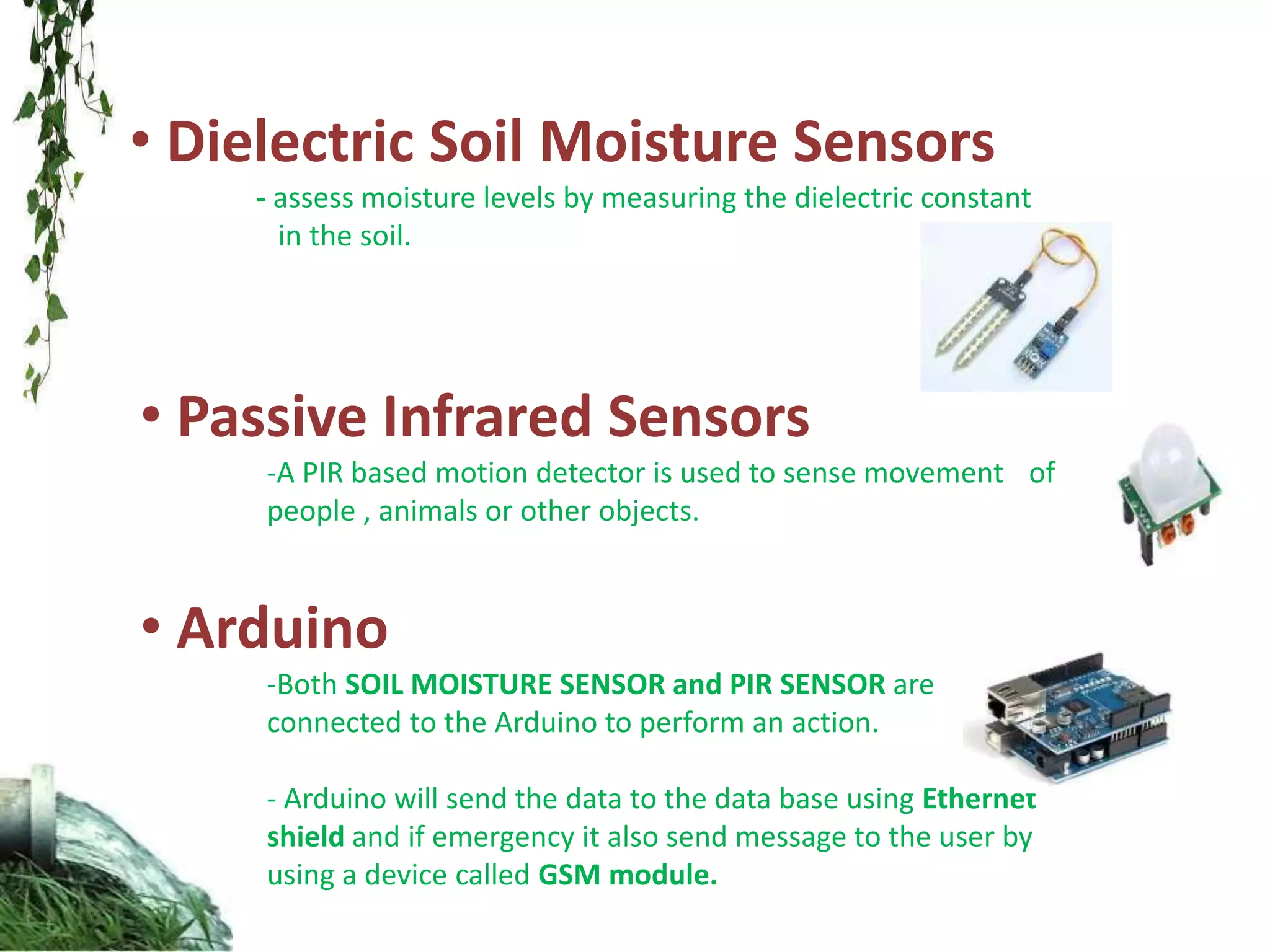
• Dielectric Soil Moisture Sensors
- assess moisture levels by measuring the dielectric constant
in the soil.
• Passive Infrared Sensors
-A PIR based motion detector is used to sense movement of
people , animals or other objects.
• Arduino
-Both SOIL MOISTURE SENSOR and PIR SENSOR are
connected to the Arduino to perform an action.
- Arduino will send the data to the data base using Ethernet
shield and if emergency it also send message to the user by
using a device called GSM module.
Some More Sensors…
• Electrochemical Sensors
• Mechanical Sensors
Example- Honeywell FSG15N1A
• Airflow Sensors
Sensor Outputs
•Yield Monitoring
•Yield Mapping
•Variable Rate Fertilizer
•Variable Spraying
•Topography & Boundaries
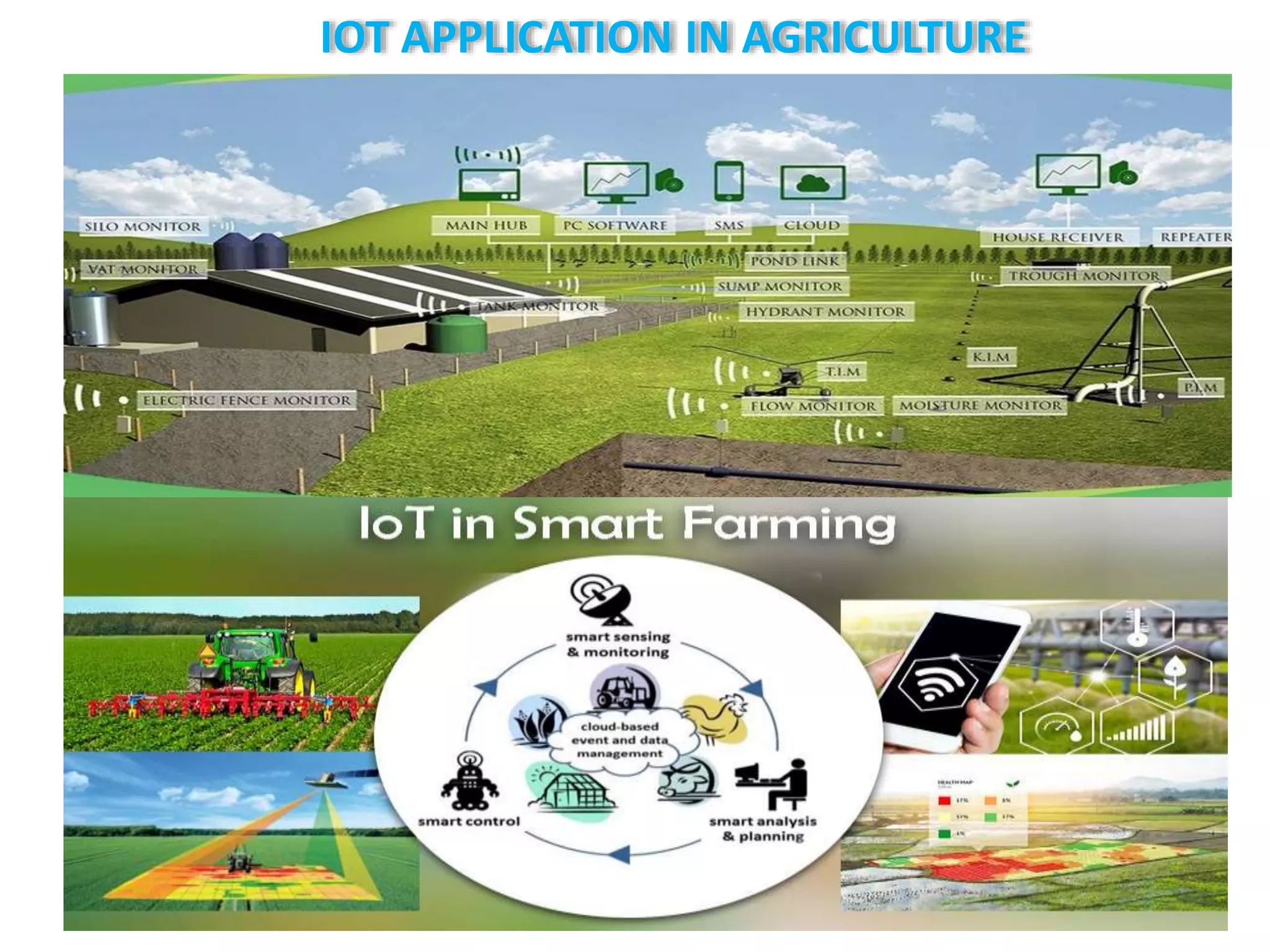
IOT APPLICATION IN AGRICULTURE
Pros
•Cost effective method
•Optimize water use
•Sustain high-yielding
•Automation & efficiency
•Better product’s quality
Cons
•Money needed
•Costly internet
•Fault sensors & data
processing engines
•Difficult to comprehend the
details about IOT for the
farmers of remote areas.
Conclusion
• Prediction of soil moisture level & motion of predators.
• Irrigation system can be monitored .
• Damage caused by predators is reduced.
• Increased productivity.
• Water conservation.
• Profit to farmers.
IOT based Smart Agricultural System

IOT based Smart Agricultural System

  • 2.
    • What isIOT? Why IOT? • IOT in agriculture • Applications of IOT • Smart Agricultural Sensors • Sensor Outputs • Pros & Cons • Conclusion IN UPCOMING SLIDES
  • 3.
    What is IOT?Why IOT? • The full abbreviation of IOT is “internet of things”. •The Internet of Things(IOT) is inter-networking of physical devices. This system has ability to transfer data over a network without requiring human-to human or human-to-computer interaction •This is a growing trend that will influence everything from businesses to our daily personal lives. •IOT has many applications in agriculture, smart Cities, smart home, healthcare, business sectors, Traffic monitoring , Transport etc.
  • 4.
    IOT in Agriculture •Theagriculture IoT market is expected to grow from USD 12.7 billion in 2019 to USD 20.9 billion by 2024, at a CAGR of 10.4% from 2019 to 2024. •At present, irrigation consumes about 84 % of total available water in India. •We conserve water by using soil moisture sensors.
  • 5.
    Applications of IOTin Agriculture •Precision Farming •Agricultural Drones •Livestock Monitoring •Smart Greenhouses •Crop Water Management •Pest Management & control
  • 6.
    There are manyother applications of IOT in agriculture Agriculture IOT Disease Detection and Diagnosis Fertilizer Calculator Soil Study & Water Study Crop Harvest Readiness
  • 7.
    Agricultural Drones • Themajor benefits of using drones include crop health imaging, integrated mapping, ease of use, saves time, and the potential to increase yields. •Two types of drones, that is, ground-based and aerial-based drones are being incorporated in agriculture in many ways such as, for crop health assessment, irrigation, planting, and soil & field analysis. Livestock monitoring •Large farm owners can utilize wireless IOT applications to collect data regarding the location , well-being, and health of their cattle. •JMB North America is an organization that offers cow monitoring solutions to cattle producers. Smart Greenhouses •Greenhouses control environmental parameters in two ways; either through manual intervention or a proportional control mechanism. •A smart greenhouse through IOT embedded systems not only monitors intelligently but also controls the climate.
  • 8.
    Agricultural Sensors • LocationSensors -use signals from GPS satellites to determine latitude, longitude, and altitude to within feet . Example- NJR NJG1157PCD-TE1 • Optical Sensors - use light to measure soil properties. - The sensors measure different frequencies of light reflectance in near-infrared, mid-infrared, and polarized light spectrums. Example- Vishay Vishay Photo IC Sensor
  • 9.
    • Dielectric SoilMoisture Sensors - assess moisture levels by measuring the dielectric constant in the soil. • Passive Infrared Sensors -A PIR based motion detector is used to sense movement of people , animals or other objects. • Arduino -Both SOIL MOISTURE SENSOR and PIR SENSOR are connected to the Arduino to perform an action. - Arduino will send the data to the data base using Ethernet shield and if emergency it also send message to the user by using a device called GSM module.
  • 10.
    Some More Sensors… •Electrochemical Sensors • Mechanical Sensors Example- Honeywell FSG15N1A • Airflow Sensors
  • 11.
    Sensor Outputs •Yield Monitoring •YieldMapping •Variable Rate Fertilizer •Variable Spraying •Topography & Boundaries
  • 12.
    IOT APPLICATION INAGRICULTURE
  • 13.
    Pros •Cost effective method •Optimizewater use •Sustain high-yielding •Automation & efficiency •Better product’s quality Cons •Money needed •Costly internet •Fault sensors & data processing engines •Difficult to comprehend the details about IOT for the farmers of remote areas.
  • 14.
    Conclusion • Prediction ofsoil moisture level & motion of predators. • Irrigation system can be monitored . • Damage caused by predators is reduced. • Increased productivity. • Water conservation. • Profit to farmers.