Urban Precinct Studio – week 4Twentieth century urban design– mainstream concepts of space and structureBarrie Shelton
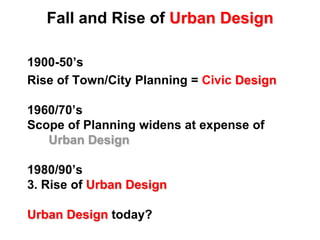
Fall and Rise ofUrban Design1900-50’s Rise of Town/City Planning = Civic Design1960/70’sScope of Planning widens at expense ofUrban Design1980/90’s3. Rise ofUrban DesignUrban Designtoday?
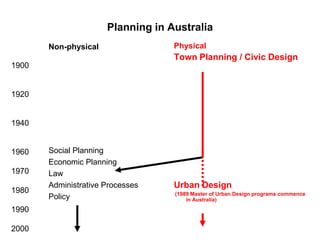
Planning in AustraliaNon-physicalSocial PlanningEconomic PlanningLaw Administrative ProcessesPolicyPhysicalTown Planning / Civic DesignUrban Design(1989 Master of Urban Design programs commence in Australia)19001920194019601970198019902000
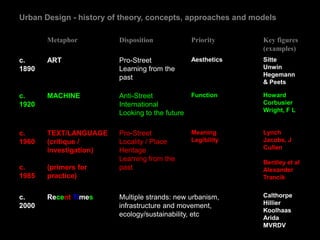
Urban Design - history of theory, concepts, approaches and models
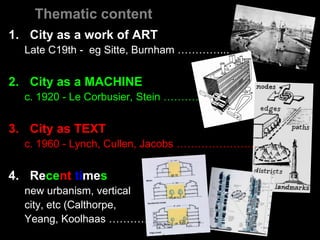
Thematic contentCity as a work of ART Late C19th -  eg Sitte, Burnham …………..…..City as a MACHINE c. 1920 - Le Corbusier, Stein ……………City as TEXT c. 1960 - Lynch, Cullen, Jacobs …………………..Recenttimesnew urbanism, vertical city, etc (Calthorpe, Yeang, Koolhaas ……………..
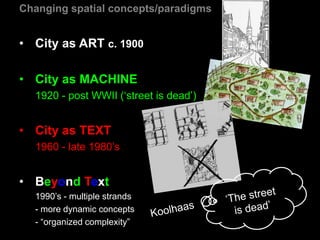
Changing spatial concepts/paradigmsCity as ART c. 1900
City as MACHINE 1920 - post WWII (‘street is dead’)City as TEXT 1960 - late 1980’sBeyondText1990’s -multiple strands - more dynamic concepts - “organized complexity”‘The street is dead’Koolhaas
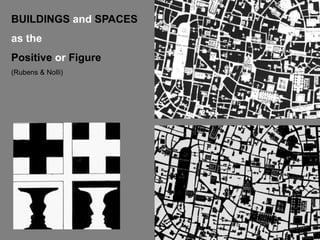
BUILDINGS and SPACESas the Positive or Figure(Rubens & Nolli)
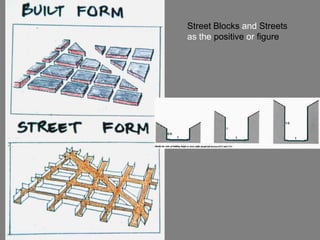
Street Blocks and Streets as the positive or figure
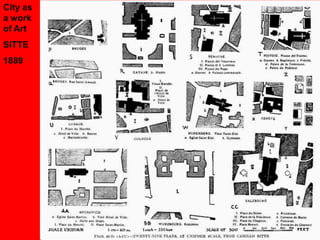
City as a work of ArtSITTE1889
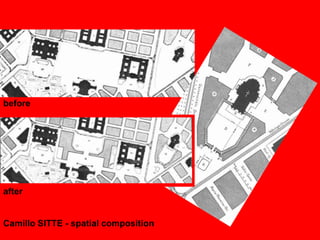
beforeafterCamillo SITTE - spatial composition
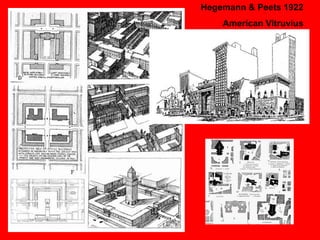
Hegemann & Peets 1922American Vitruvius
“At the beginning of the 20th century two great new inventions took form before our eyes: the aeroplane and the Garden City, both harbingers of new age: the first being gave man wings and the second promised him a better dwelling-place when he came down to earth.”(Lewis Mumford, 1946)City as a Machine
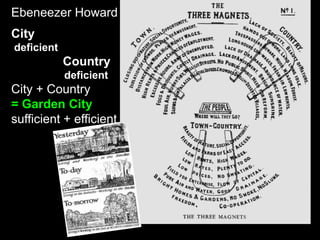
Ebeneezer HowardCity  deficient               Country                   deficientCity + Country= Garden Citysufficient + efficient
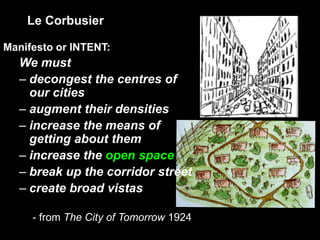
Le CorbusierManifesto or INTENT: We mustdecongest the centres of our cities
augment their densities
increase the means of getting about them
increase the open space
break up the corridor street
create broad vistas          - from The City of Tomorrow 1924
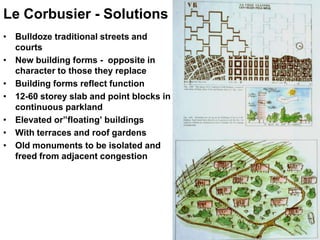
Le Corbusier - SolutionsBulldoze traditional streets and courtsNew building forms -  opposite in character to those they replaceBuilding forms reflect function12-60 storey slab and point blocks in continuous parklandElevated or”floating’ buildings With terraces and roof gardensOld monuments to be isolated and freed from adjacent congestion
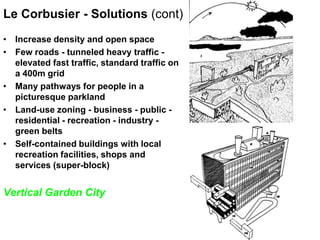
Le Corbusier - Solutions (cont)Increase density and open spaceFew roads - tunneled heavy traffic - elevated fast traffic, standard traffic on a 400m gridMany pathways for people in a picturesque parklandLand-use zoning - business - public - residential - recreation - industry - green beltsSelf-contained buildings with local recreation facilities, shops and services (super-block)Vertical Garden City
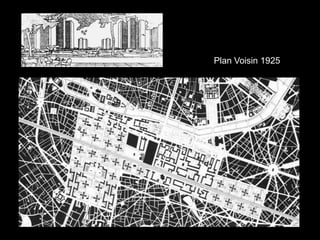
Plan Voisin 1925
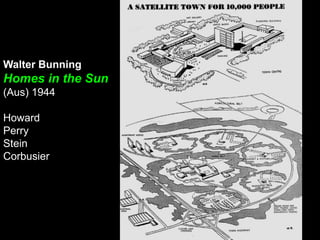
Walter Bunning Homes in the Sun(Aus) 1944Howard Perry Stein Corbusier
C. 1960 - Reaction to the Modernist or ‘Machine’ City: City as Text- of amorphous green space- of buildings as isolated objects - of roads rather than streets- of segregated traffic - vehicles and pedestrians- of separated activities (zoning)- of illegible structures, spaces, landscape- without local identity (placelessness)
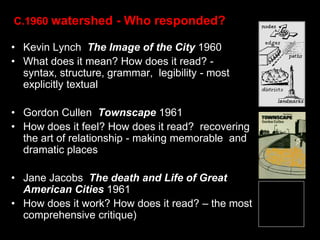
C.1960watershed - Who responded?Kevin Lynch  The Image of the City 1960  What does it mean? How does it read? - syntax, structure, grammar,  legibility - most explicitly textual Gordon Cullen  Townscape1961  How does it feel? How does it read?  recovering the art of relationship - making memorable  and dramatic placesJane Jacobs  The death and Life of Great American Cities 1961  How does it work? How does it read? – the most comprehensive critique)
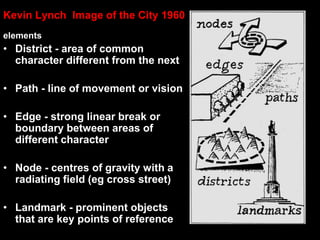
Kevin Lynch  Image of the City 1960elementsDistrict - area of common character different from the nextPath - line of movement or visionEdge - strong linear break or boundary between areas of different characterNode - centres of gravity with a radiating field (eg cross street)Landmark - prominent objects that are key points of reference
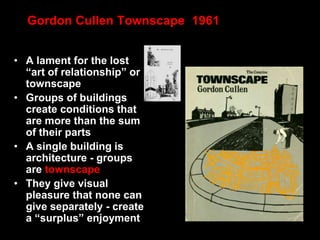
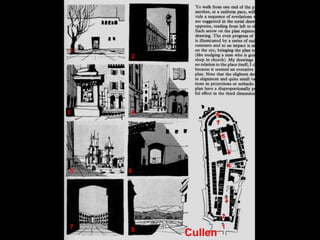
Gordon Cullen Townscape  1961A lament for the lost “art of relationship” or townscapeGroups of buildings create conditions that are more than the sum of their partsA single building is architecture - groups are townscapeThey give visual pleasure that none can give separately - create a “surplus” enjoyment
123487654653217Cullen8
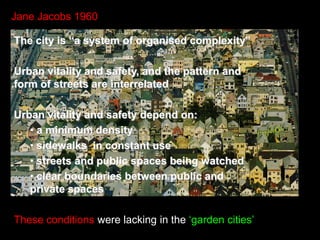
Jane Jacobs 1960The city is “a system of organised complexity”Urban vitality and safety, and the pattern and form of streets are interrelatedUrban vitality and safety depend on: a minimum density
 sidewalks  in constant use
 streets and public spaces being watched
 clear boundaries between public and private spacesThese conditions were lacking in the ‘garden cities’
Jane Jacobs’ principlesMore than one primary useRange of people whose lives are lived to different schedulesShort street blocks; many corner sites, passing and congregation pointsMix of building types, conditions and agesHigh concentrations of people who live, work and own locally, and identify with the place200 plus dwellings per hectare

Mainstream concepts in urban design_Barrie Shelton

  • 1.
    Urban Precinct Studio– week 4Twentieth century urban design– mainstream concepts of space and structureBarrie Shelton
  • 2.
    Fall and RiseofUrban Design1900-50’s Rise of Town/City Planning = Civic Design1960/70’sScope of Planning widens at expense ofUrban Design1980/90’s3. Rise ofUrban DesignUrban Designtoday?
  • 3.
    Planning in AustraliaNon-physicalSocialPlanningEconomic PlanningLaw Administrative ProcessesPolicyPhysicalTown Planning / Civic DesignUrban Design(1989 Master of Urban Design programs commence in Australia)19001920194019601970198019902000
  • 4.
    Urban Design -history of theory, concepts, approaches and models
  • 5.
    Thematic contentCity asa work of ART Late C19th - eg Sitte, Burnham …………..…..City as a MACHINE c. 1920 - Le Corbusier, Stein ……………City as TEXT c. 1960 - Lynch, Cullen, Jacobs …………………..Recenttimesnew urbanism, vertical city, etc (Calthorpe, Yeang, Koolhaas ……………..
  • 6.
  • 7.
    City as MACHINE1920 - post WWII (‘street is dead’)City as TEXT 1960 - late 1980’sBeyondText1990’s -multiple strands - more dynamic concepts - “organized complexity”‘The street is dead’Koolhaas
  • 8.
    BUILDINGS and SPACESasthe Positive or Figure(Rubens & Nolli)
  • 9.
    Street Blocks andStreets as the positive or figure
  • 10.
    City as awork of ArtSITTE1889
  • 11.
    beforeafterCamillo SITTE -spatial composition
  • 12.
    Hegemann & Peets1922American Vitruvius
  • 13.
    “At the beginningof the 20th century two great new inventions took form before our eyes: the aeroplane and the Garden City, both harbingers of new age: the first being gave man wings and the second promised him a better dwelling-place when he came down to earth.”(Lewis Mumford, 1946)City as a Machine
  • 14.
    Ebeneezer HowardCity deficient Country deficientCity + Country= Garden Citysufficient + efficient
  • 15.
    Le CorbusierManifesto orINTENT: We mustdecongest the centres of our cities
  • 16.
  • 17.
    increase the meansof getting about them
  • 18.
  • 19.
    break up thecorridor street
  • 20.
    create broad vistas - from The City of Tomorrow 1924
  • 21.
    Le Corbusier -SolutionsBulldoze traditional streets and courtsNew building forms - opposite in character to those they replaceBuilding forms reflect function12-60 storey slab and point blocks in continuous parklandElevated or”floating’ buildings With terraces and roof gardensOld monuments to be isolated and freed from adjacent congestion
  • 22.
    Le Corbusier -Solutions (cont)Increase density and open spaceFew roads - tunneled heavy traffic - elevated fast traffic, standard traffic on a 400m gridMany pathways for people in a picturesque parklandLand-use zoning - business - public - residential - recreation - industry - green beltsSelf-contained buildings with local recreation facilities, shops and services (super-block)Vertical Garden City
  • 23.
  • 24.
    Walter Bunning Homesin the Sun(Aus) 1944Howard Perry Stein Corbusier
  • 25.
    C. 1960 -Reaction to the Modernist or ‘Machine’ City: City as Text- of amorphous green space- of buildings as isolated objects - of roads rather than streets- of segregated traffic - vehicles and pedestrians- of separated activities (zoning)- of illegible structures, spaces, landscape- without local identity (placelessness)
  • 26.
    C.1960watershed - Whoresponded?Kevin Lynch The Image of the City 1960 What does it mean? How does it read? - syntax, structure, grammar, legibility - most explicitly textual Gordon Cullen Townscape1961 How does it feel? How does it read? recovering the art of relationship - making memorable and dramatic placesJane Jacobs The death and Life of Great American Cities 1961 How does it work? How does it read? – the most comprehensive critique)
  • 27.
    Kevin Lynch Image of the City 1960elementsDistrict - area of common character different from the nextPath - line of movement or visionEdge - strong linear break or boundary between areas of different characterNode - centres of gravity with a radiating field (eg cross street)Landmark - prominent objects that are key points of reference
  • 28.
    Gordon Cullen Townscape 1961A lament for the lost “art of relationship” or townscapeGroups of buildings create conditions that are more than the sum of their partsA single building is architecture - groups are townscapeThey give visual pleasure that none can give separately - create a “surplus” enjoyment
  • 29.
  • 30.
    Jane Jacobs 1960Thecity is “a system of organised complexity”Urban vitality and safety, and the pattern and form of streets are interrelatedUrban vitality and safety depend on: a minimum density
  • 31.
    sidewalks in constant use
  • 32.
    streets andpublic spaces being watched
  • 33.
    clear boundariesbetween public and private spacesThese conditions were lacking in the ‘garden cities’
  • 34.
    Jane Jacobs’ principlesMorethan one primary useRange of people whose lives are lived to different schedulesShort street blocks; many corner sites, passing and congregation pointsMix of building types, conditions and agesHigh concentrations of people who live, work and own locally, and identify with the place200 plus dwellings per hectare
  • 35.
    Modernist’s mistaken assumptions- Jacobs“the street is bad as an environment for humans”Houses to face green space, not streetsFrequent streets were wasteful of spaceBasic unit of the city is the superblock, not the streetShops, offices, etc to be separated from housesNeighbourhood demands can be calculatedGood planning must aim for (an illusion) of isolation and suburban privacyThat the basic unit of ‘good planning’ is self-contained
  • 36.
    Circa 1960the riseof “Text” as metaphorA new kind of urban design literature - learning from experience1960’s + 1970’sTheory to underpin the text metaphorAlexander, Smith, BroadbentDesign primers - circa 1985Responsive Environments 1985 Finding Lost Space 1986New Theory of Urban Design 1987Renewal of interest in pre-Modern texts Re-publication of Sitte (1986) Re-publication of Hegemann & Peets (1988)
  • 37.
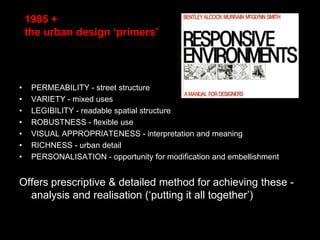
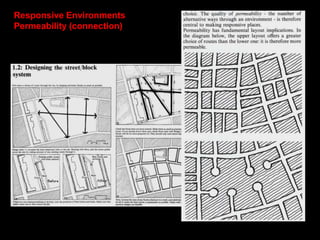
    1985 +the urbandesign ‘primers’7 key qualities for good city form:PERMEABILITY - street structureVARIETY - mixed usesLEGIBILITY - readable spatial structureROBUSTNESS - flexible useVISUAL APPROPRIATENESS - interpretation and meaningRICHNESS - urban detailPERSONALISATION - opportunity for modification and embellishmentOffers prescriptive & detailed method for achieving these - analysisand realisation (‘putting it all together’)
  • 38.
  • 39.
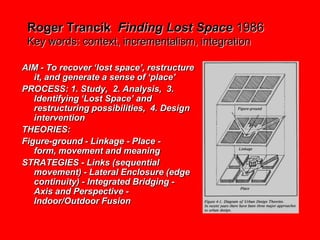
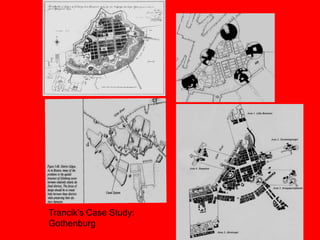
    Roger Trancik Finding Lost Space 1986Key words: context, incrementalism, integrationAIM - To recover ‘lost space’, restructure it, and generate a sense of ‘place’ PROCESS: 1. Study, 2. Analysis, 3. Identifying ‘Lost Space’ and restructuring possibilities, 4. Design interventionTHEORIES: Figure-ground - Linkage - Place - form, movement and meaning STRATEGIES - Links (sequential movement) - Lateral Enclosure (edge continuity) - Integrated Bridging - Axis and Perspective - Indoor/Outdoor Fusion
  • 40.
  • 41.
    Trancik’s referencesSitte, Peets, BurnhamHoward, Le Corbusier, Stein, F L Wright, GruenJane Jacobs - Lynch - CullenAppleyard, Bacon, Bakema, Barnett, Cook, Erskine, Crane,Hertzberger, Rob and Leon Krier, McHarg, Maki, Newman, - Norberg-Schultz, Peterson, Rossi, Team X, Venturi & Scott Brown, Peter & Alison Smithson, Van Eyck, Woods
  • 42.
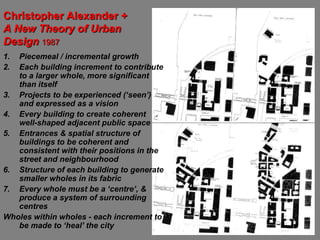
    Christopher Alexander +ANew Theory of Urban Design1987Piecemeal / incremental growthEach building increment to contribute to a larger whole, more significant than itselfProjects to be experienced (‘seen’) and expressed as a visionEvery building to create coherent well-shaped adjacent public spaceEntrances & spatial structure of buildings to be coherent and consistent with their positions in the street and neighbourhoodStructure of each building to generate smaller wholes in its fabricEvery whole must be a ‘centre’, & produce a system of surrounding centresWholes within wholes - each increment to be made to ‘heal’ the city
  • 43.
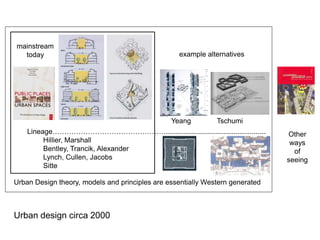
    mainstreamtodayexample alternativesYeang Tschumi Lineage…………………………………………..................................................Hillier, MarshallBentley, Trancik, AlexanderLynch, Cullen, JacobsSitte Other ways of seeingUrban Design theory, models and principles are essentially Western generatedUrban design circa 2000