Preanesthesia evaluation (PAC)
PRESENTED BY Dr. ATTINDER PAL SINGH
MENTOR - Dr. ARVIND ARYA SIR H.O.D.
DEPARTMENT OF NEUROANESTHESIA (IHBAS)
WHAT IS IT ?
• Its a process of clinical assessment that
precede the delivery of anesthesia care for
surgery and for non surgical procedure
(e.g.MECT).
• clinical foundation for guiding perioperative
patient management
OBJECTIVES
• discovery or identification of a disease or disorder that
may affect perioperative anesthetic care
• verification or assessment of an already known
disease, disorder, medical or alternative therapy that
may affect perioperative anesthetic care
• formulation of specific plans and alternatives for
perioperative anesthetic care.
• Inform and educate the patient about anaesthesia,
perioperative care and pain management
• Obtain informed consent for anaesthesia
Components
• Preanesthetic history
• General Physical examination
• Systemic examination
• Airway examination
• investigations
HISTORY TAKING
• demographic details
• presenting complaints
• previous medical history and comorbidities
• previous surgical and anesthetic exposure
• previous history of difficult airway, drug
allergies and postop icu stay
• personal history
• drug and family history
GENERAL PHYSICAL EXAMINATION
• look for pallor ,icterus, clubbing,cyanosis,pedal
edema and lymphadenopathy
• weight and height measurement
• Preoperative Hemodynamic parameters NIBP,
PR, RR & TEMP.
SYSTEMIC EXAMINATION
• respiratory system
• cardiovascular system
• cental nervous system
• GI examination
• special focus : airway examination, spine
examination & peripheral venous access
AIRWAY EXAMINATION
• mouth opening (interincisors distance more than 4.5cm roughly 3 fingers )
• dentition and tongue
• mallampati grading
• thyromental distance 6.5cm
• sternomental distance 12.5
• temparomandibular joint mobility
• cervical joint movements
• position of trachea
Mallampati Grading
RESPIRATORY EXAMINATION
• Inspection • Rate & Rhythm , chest expansion
,symmetry of chest expansion , movements of
the chest wall presence of intercostal recessions
or the use of accessory muscles
• Palpation Position of the Apex beat and Trachea
• Percussion
• Auscultation Breath sounds
CARDIOVASCULAR EXAMINATION
• INSPECTION: apex beat , chest shape, abnornmal
vessels ,any lumps,or previous scars
• PALPATION: confirm apex beat, all peripheral
pulses,presences of any thrills
• PERCUSSION: heart borders
• AUSCULTATION: S1 , S2 & murmurs.
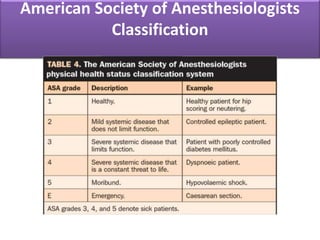
American Society of Anesthesiologists
Classification
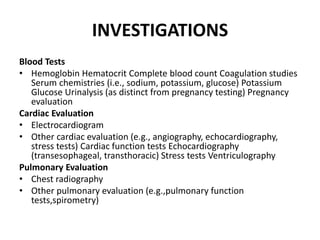
INVESTIGATIONS
Blood Tests
• Hemoglobin Hematocrit Complete blood count Coagulation studies
Serum chemistries (i.e., sodium, potassium, glucose) Potassium
Glucose Urinalysis (as distinct from pregnancy testing) Pregnancy
evaluation
Cardiac Evaluation
• Electrocardiogram
• Other cardiac evaluation (e.g., angiography, echocardiography,
stress tests) Cardiac function tests Echocardiography
(transesophageal, transthoracic) Stress tests Ventriculography
Pulmonary Evaluation
• Chest radiography
• Other pulmonary evaluation (e.g.,pulmonary function
tests,spirometry)
DRUGS TO BE DISCONTINUED
• Antihypertensives: continue except ACE
inhibitors and ARBs
• Oral hypogycemics :skip morning dose
• Thyroid :continue on the day of surgery
• Heparin : 6to8hrs
• Clopidogrel : 5days
• Anticonvulsants : continued
INFORMED CONSENT
• for protecting the legal rights of patients and
guiding the ethical practice of medicine
• We inform the patient / gaurdian about the
procedure,type of anesthesia to be given and
complications involved .
Preanesthesia evaluation (pac)

Preanesthesia evaluation (pac)

  • 1.
    Preanesthesia evaluation (PAC) PRESENTEDBY Dr. ATTINDER PAL SINGH MENTOR - Dr. ARVIND ARYA SIR H.O.D. DEPARTMENT OF NEUROANESTHESIA (IHBAS)
  • 2.
    WHAT IS IT? • Its a process of clinical assessment that precede the delivery of anesthesia care for surgery and for non surgical procedure (e.g.MECT). • clinical foundation for guiding perioperative patient management
  • 3.
    OBJECTIVES • discovery oridentification of a disease or disorder that may affect perioperative anesthetic care • verification or assessment of an already known disease, disorder, medical or alternative therapy that may affect perioperative anesthetic care • formulation of specific plans and alternatives for perioperative anesthetic care. • Inform and educate the patient about anaesthesia, perioperative care and pain management • Obtain informed consent for anaesthesia
  • 4.
    Components • Preanesthetic history •General Physical examination • Systemic examination • Airway examination • investigations
  • 5.
    HISTORY TAKING • demographicdetails • presenting complaints • previous medical history and comorbidities • previous surgical and anesthetic exposure • previous history of difficult airway, drug allergies and postop icu stay • personal history • drug and family history
  • 6.
    GENERAL PHYSICAL EXAMINATION •look for pallor ,icterus, clubbing,cyanosis,pedal edema and lymphadenopathy • weight and height measurement • Preoperative Hemodynamic parameters NIBP, PR, RR & TEMP.
  • 7.
    SYSTEMIC EXAMINATION • respiratorysystem • cardiovascular system • cental nervous system • GI examination • special focus : airway examination, spine examination & peripheral venous access
  • 8.
    AIRWAY EXAMINATION • mouthopening (interincisors distance more than 4.5cm roughly 3 fingers ) • dentition and tongue • mallampati grading • thyromental distance 6.5cm • sternomental distance 12.5 • temparomandibular joint mobility • cervical joint movements • position of trachea
  • 9.
  • 10.
    RESPIRATORY EXAMINATION • Inspection• Rate & Rhythm , chest expansion ,symmetry of chest expansion , movements of the chest wall presence of intercostal recessions or the use of accessory muscles • Palpation Position of the Apex beat and Trachea • Percussion • Auscultation Breath sounds
  • 11.
    CARDIOVASCULAR EXAMINATION • INSPECTION:apex beat , chest shape, abnornmal vessels ,any lumps,or previous scars • PALPATION: confirm apex beat, all peripheral pulses,presences of any thrills • PERCUSSION: heart borders • AUSCULTATION: S1 , S2 & murmurs.
  • 12.
    American Society ofAnesthesiologists Classification
  • 13.
    INVESTIGATIONS Blood Tests • HemoglobinHematocrit Complete blood count Coagulation studies Serum chemistries (i.e., sodium, potassium, glucose) Potassium Glucose Urinalysis (as distinct from pregnancy testing) Pregnancy evaluation Cardiac Evaluation • Electrocardiogram • Other cardiac evaluation (e.g., angiography, echocardiography, stress tests) Cardiac function tests Echocardiography (transesophageal, transthoracic) Stress tests Ventriculography Pulmonary Evaluation • Chest radiography • Other pulmonary evaluation (e.g.,pulmonary function tests,spirometry)
  • 15.
    DRUGS TO BEDISCONTINUED • Antihypertensives: continue except ACE inhibitors and ARBs • Oral hypogycemics :skip morning dose • Thyroid :continue on the day of surgery • Heparin : 6to8hrs • Clopidogrel : 5days • Anticonvulsants : continued
  • 16.
    INFORMED CONSENT • forprotecting the legal rights of patients and guiding the ethical practice of medicine • We inform the patient / gaurdian about the procedure,type of anesthesia to be given and complications involved .