
ADVANCED BUILDING CONSTRUCTION-IX
LONG SPAN STRUCTURES
RISHABH JAIN
B.ARCH(9THSEM)
1/16/FPA/B.ARCH/005
Pre-Tensioning
and
Post-Tensioning
FORMS OF THE PRESTRESSED STEEL:
1: Wires:
It is a single unit made of steel.
2:Strands:
Strands are two, three or seven wires that are wound to form a prestressing strand.
3: Tendons:
Tendons are wires and a group of strands is wound to form a prestressing strand.
4: Cable:
Cables are the series or group of tendons.
5: Bars:
The tendons are simply made up of a single steel bar and the diameter of this steel bar us
larger than that of wire.
Pre-Tensioning :
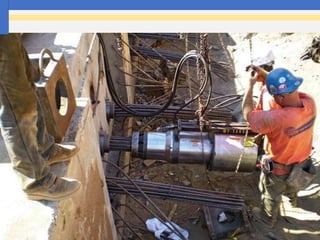
 In Pre-tensioning,wires or strands, called tendons( cables inside plastic ducts or
sleeves), are tensioned before the concrete is cast.
 The tendons are temporarily anchored using hydraulic jacks against some
abutments and then cut or released after the concrete has been placed and
hardened.
 The prestressing force is transferred to this concrete by the bond along
the length of the tendon.
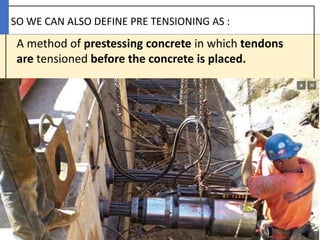
A method of prestessing concrete in which tendons
are tensioned before the concrete is placed.
SO WE CAN ALSO DEFINE PRE TENSIONING AS :
Post-Tensioning :
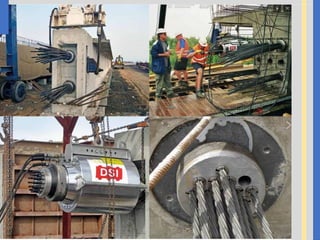
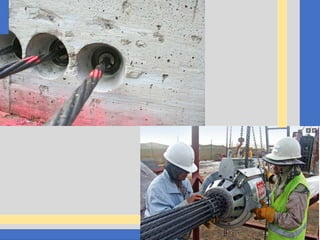
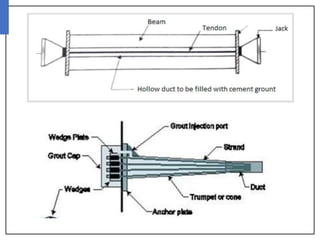
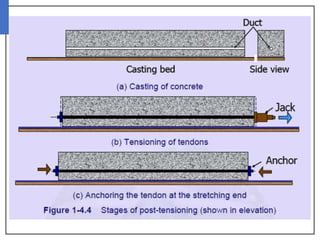
 After adequate curing of concrete, reinforcing tendons (placed in side the
voids of the structure) are tensioned/stretched by jacks on the sides
 These spaces are then pumped full of grout to bond steel tightly to the
concrete.
 tendons are coated with grease or a bituminous material to prevent them
from becoming bonded to concrete. Another method used in preventing
the tendons from bonding to the concrete during placing and curing of
concrete is to encase the tendon in a flexible metal hose before placing it
in the forms. The metal hose is referred to as sheath or duct and remains in
the structure.
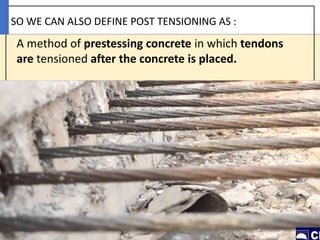
A method of prestessing concrete in which tendons
are tensioned after the concrete is placed.
SO WE CAN ALSO DEFINE POST TENSIONING AS :
Application
 This concrete is used in large-span distance between
which is not possible through the normal RCC
construction because rcc will make slab thickness more.
 Prestressed concrete is used in bridges to increase the possible
span of the bridge and to make the structure more durable
under moving traffic conditions.
 Used for office buildings where larger span, column free
spaces are required.
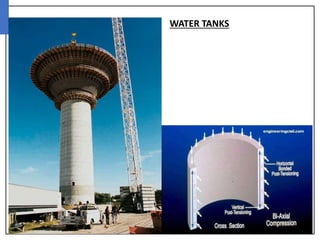
WATER TANKS
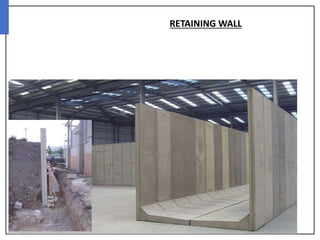
RETAINING WALL
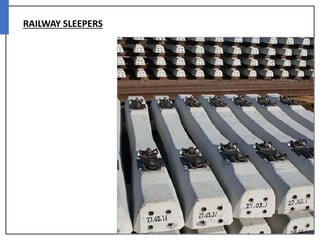
RAILWAY SLEEPERS
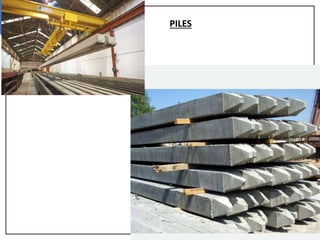
PILES
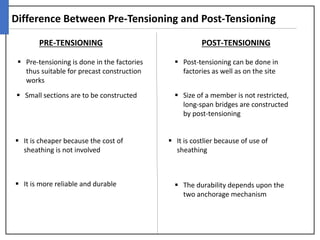
Difference Between Pre-Tensioning and Post-Tensioning
PRE-TENSIONING POST-TENSIONING
 Pre-tensioning is done in the factories
thus suitable for precast construction
works
 Post-tensioning can be done in
factories as well as on the site
 Small sections are to be constructed  Size of a member is not restricted,
long-span bridges are constructed
by post-tensioning
 It is cheaper because the cost of
sheathing is not involved
 It is costlier because of use of
sheathing
 It is more reliable and durable  The durability depends upon the
two anchorage mechanism
BIBLOGRAPHY
• civiljungle.com
• theconstructor.org
• GOOGLE IMAGES
• SLIDE SHARE
• wikipedia.org
• steelconstruction.info

PRE STRESSING

  • 1.
    ADVANCED BUILDING CONSTRUCTION-IX LONGSPAN STRUCTURES RISHABH JAIN B.ARCH(9THSEM) 1/16/FPA/B.ARCH/005
  • 2.
  • 3.
    FORMS OF THEPRESTRESSED STEEL: 1: Wires: It is a single unit made of steel. 2:Strands: Strands are two, three or seven wires that are wound to form a prestressing strand. 3: Tendons: Tendons are wires and a group of strands is wound to form a prestressing strand. 4: Cable: Cables are the series or group of tendons. 5: Bars: The tendons are simply made up of a single steel bar and the diameter of this steel bar us larger than that of wire.
  • 4.
    Pre-Tensioning :  InPre-tensioning,wires or strands, called tendons( cables inside plastic ducts or sleeves), are tensioned before the concrete is cast.  The tendons are temporarily anchored using hydraulic jacks against some abutments and then cut or released after the concrete has been placed and hardened.  The prestressing force is transferred to this concrete by the bond along the length of the tendon.
  • 8.
    A method ofprestessing concrete in which tendons are tensioned before the concrete is placed. SO WE CAN ALSO DEFINE PRE TENSIONING AS :
  • 9.
    Post-Tensioning :  Afteradequate curing of concrete, reinforcing tendons (placed in side the voids of the structure) are tensioned/stretched by jacks on the sides  These spaces are then pumped full of grout to bond steel tightly to the concrete.  tendons are coated with grease or a bituminous material to prevent them from becoming bonded to concrete. Another method used in preventing the tendons from bonding to the concrete during placing and curing of concrete is to encase the tendon in a flexible metal hose before placing it in the forms. The metal hose is referred to as sheath or duct and remains in the structure.
  • 12.
    A method ofprestessing concrete in which tendons are tensioned after the concrete is placed. SO WE CAN ALSO DEFINE POST TENSIONING AS :
  • 13.
    Application  This concreteis used in large-span distance between which is not possible through the normal RCC construction because rcc will make slab thickness more.  Prestressed concrete is used in bridges to increase the possible span of the bridge and to make the structure more durable under moving traffic conditions.  Used for office buildings where larger span, column free spaces are required.
  • 14.
  • 15.
  • 16.
  • 17.
  • 18.
    Difference Between Pre-Tensioningand Post-Tensioning PRE-TENSIONING POST-TENSIONING  Pre-tensioning is done in the factories thus suitable for precast construction works  Post-tensioning can be done in factories as well as on the site  Small sections are to be constructed  Size of a member is not restricted, long-span bridges are constructed by post-tensioning  It is cheaper because the cost of sheathing is not involved  It is costlier because of use of sheathing  It is more reliable and durable  The durability depends upon the two anchorage mechanism
  • 19.
    BIBLOGRAPHY • civiljungle.com • theconstructor.org •GOOGLE IMAGES • SLIDE SHARE • wikipedia.org • steelconstruction.info