PRINCIPLES OF PRESTRESSING
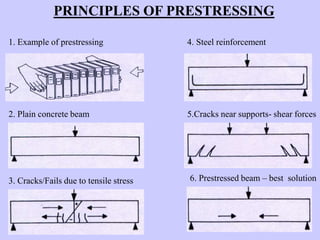
1. Example of prestressing
2. Plain concrete beam
3. Cracks/Fails due to tensile stress
4. Steel reinforcement
5.Cracks near supports- shear forces
6. Prestressed beam – best solution
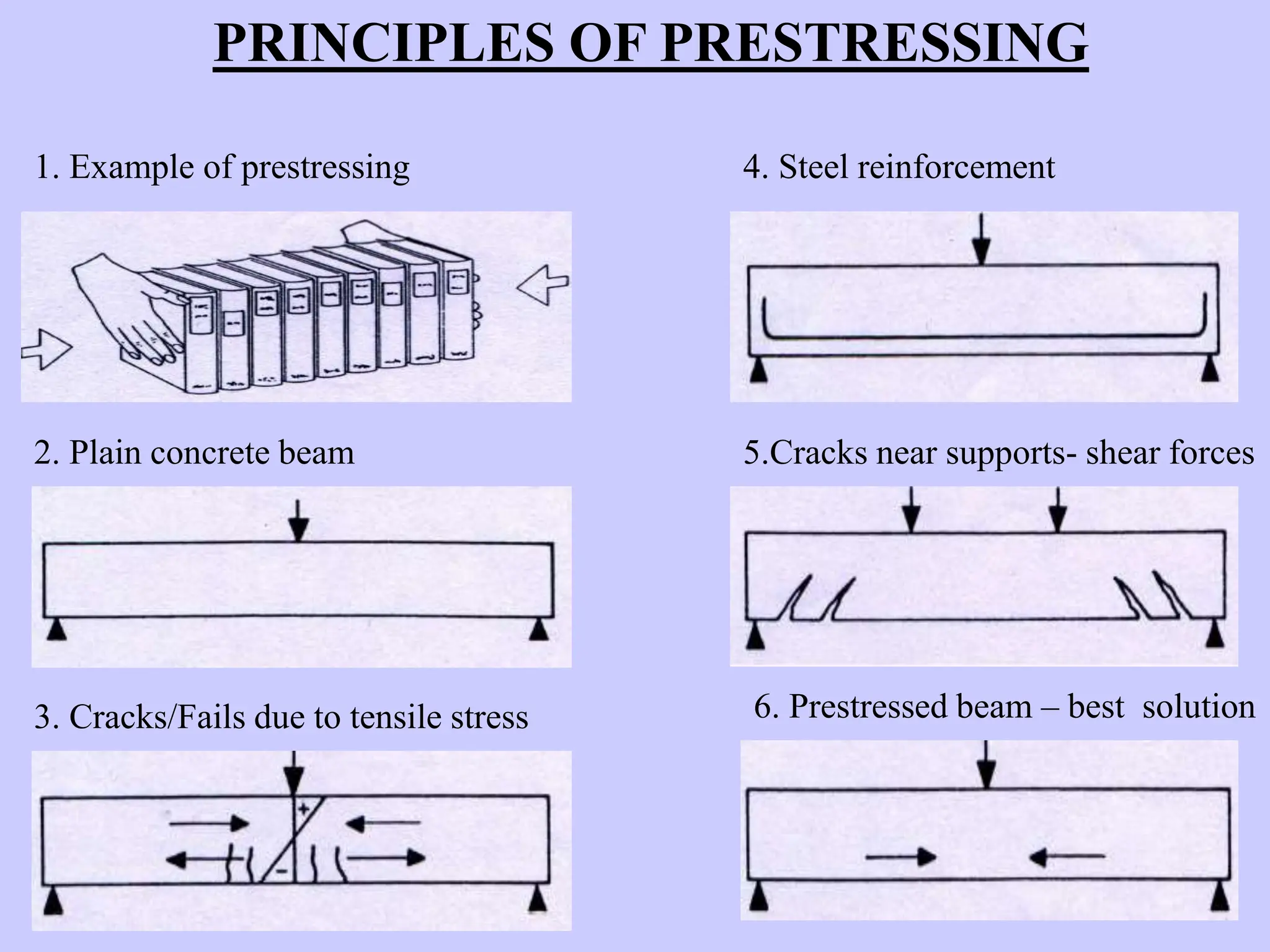
PRINCIPLES OF PRESTRESSING
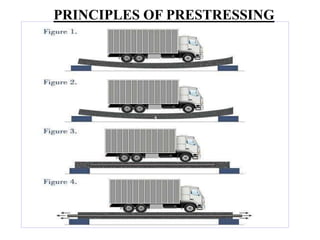
PRINCIPLES OF PRE- TENSIONING
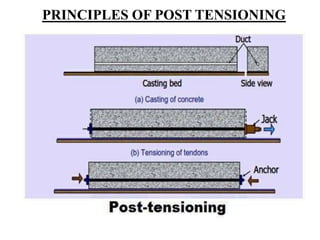
PRINCIPLES OF POST TENSIONING
FOR CONSTRUCTION OF :
 BRIDGES
 FLYOVERS
INDUSTRIAL STRUCTURES (Cement silos, Digesters etc.)
 WATER TANKS
 NUCLEAR REACTORS
BUILDINGS & FACTORIES (Post tensioned slabs and/or beams)
APPLICATION OF PRESTRESSING
ADVANATAGES & BENEFITS OF PRESTRESSING:
Post-tensioned concrete is a very efficient and cost-effective
structural system that has become especially important with the
escalation of steel prices. The other key advantages include:
 Longer spans/reduced structural depth
 Lighter structure weight
 Deflection & vibration control
 Crack control
 Functional flexibility
 Cost Saving
APPLICATIONS OF PRESTRESSING:
PT is used for a wide range of applications including bridges,
flyovers, office buildings, hotels, parking structures, shopping
malls, ground anchors, storage tanks, barriers, nuclear
containment structures, stadiums, silos and cable stays.
TYPES OF PRESTRESSING
PRE-TENSIONING – Stressing is done before concreting
POST-TENSIONING – Stressing is done after concreting
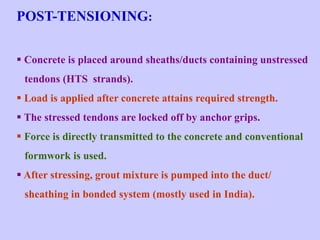
POST-TENSIONING:
 Concrete is placed around sheaths/ducts containing unstressed
tendons (HTS strands).
 Load is applied after concrete attains required strength.
 The stressed tendons are locked off by anchor grips.
 Force is directly transmitted to the concrete and conventional
formwork is used.
 After stressing, grout mixture is pumped into the duct/
sheathing in bonded system (mostly used in India).
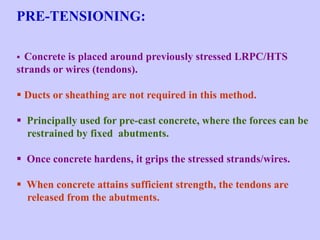
PRE-TENSIONING:
 Concrete is placed around previously stressed LRPC/HTS
strands or wires (tendons).
 Ducts or sheathing are not required in this method.
 Principally used for pre-cast concrete, where the forces can be
restrained by fixed abutments.
 Once concrete hardens, it grips the stressed strands/wires.
 When concrete attains sufficient strength, the tendons are
released from the abutments.
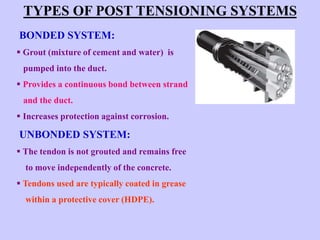
TYPES OF POST TENSIONING SYSTEMS
BONDED SYSTEM:
 Grout (mixture of cement and water) is
pumped into the duct.
 Provides a continuous bond between strand
and the duct.
 Increases protection against corrosion.
UNBONDED SYSTEM:
 The tendon is not grouted and remains free
to move independently of the concrete.
 Tendons used are typically coated in grease
within a protective cover (HDPE).
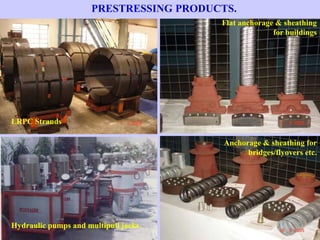
Anchorage & sheathing for
bridges/flyovers etc.
Flat anchorage & sheathing
for buildings
Hydraulic pumps and multipull jacks
LRPC strand and Sheathing pipes
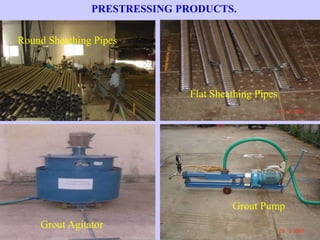
PRESTRESSING PRODUCTS.
LRPC Strands
Round Sheathing Pipes
Flat Sheathing Pipes
Grout Agitator
Grout Pump
PRESTRESSING PRODUCTS.
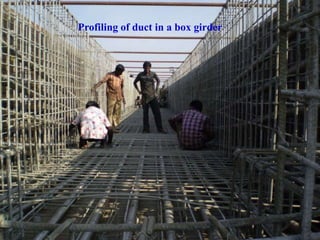
Profiling of duct in a box girder
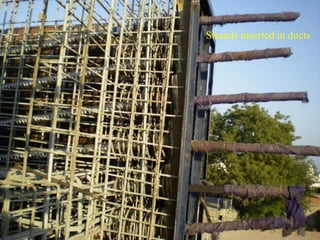
Strands inserted in ducts
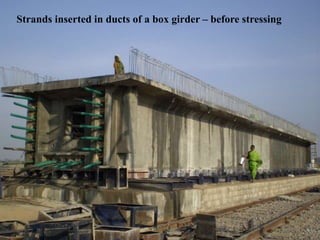
Strands inserted in ducts of a box girder – before stressing
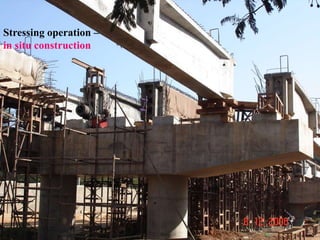
Stressing operation –
in situ construction
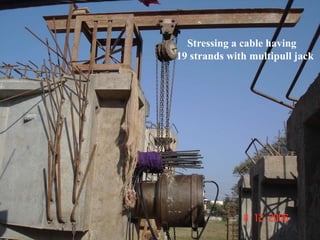
Stressing a cable having
19 strands with multipull jack
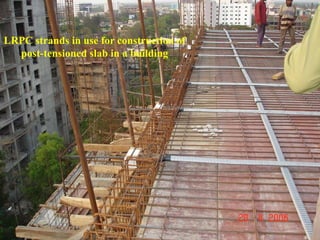
LRPC strands in use for construction of
post-tensioned slab in a building
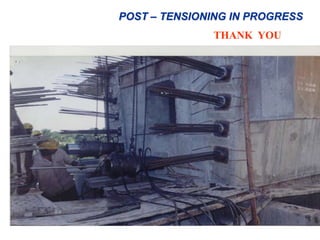
POST – TENSIONING IN PROGRESS
THANK YOU

Prestressing-Principles-TypesPrestressing-Principles-TypesPrestressing-Principles-Types

  • 1.
    PRINCIPLES OF PRESTRESSING 1.Example of prestressing 2. Plain concrete beam 3. Cracks/Fails due to tensile stress 4. Steel reinforcement 5.Cracks near supports- shear forces 6. Prestressed beam – best solution
  • 2.
  • 3.
  • 4.
  • 5.
    FOR CONSTRUCTION OF:  BRIDGES  FLYOVERS INDUSTRIAL STRUCTURES (Cement silos, Digesters etc.)  WATER TANKS  NUCLEAR REACTORS BUILDINGS & FACTORIES (Post tensioned slabs and/or beams) APPLICATION OF PRESTRESSING
  • 6.
    ADVANATAGES & BENEFITSOF PRESTRESSING: Post-tensioned concrete is a very efficient and cost-effective structural system that has become especially important with the escalation of steel prices. The other key advantages include:  Longer spans/reduced structural depth  Lighter structure weight  Deflection & vibration control  Crack control  Functional flexibility  Cost Saving APPLICATIONS OF PRESTRESSING: PT is used for a wide range of applications including bridges, flyovers, office buildings, hotels, parking structures, shopping malls, ground anchors, storage tanks, barriers, nuclear containment structures, stadiums, silos and cable stays.
  • 7.
    TYPES OF PRESTRESSING PRE-TENSIONING– Stressing is done before concreting POST-TENSIONING – Stressing is done after concreting
  • 8.
    POST-TENSIONING:  Concrete isplaced around sheaths/ducts containing unstressed tendons (HTS strands).  Load is applied after concrete attains required strength.  The stressed tendons are locked off by anchor grips.  Force is directly transmitted to the concrete and conventional formwork is used.  After stressing, grout mixture is pumped into the duct/ sheathing in bonded system (mostly used in India).
  • 9.
    PRE-TENSIONING:  Concrete isplaced around previously stressed LRPC/HTS strands or wires (tendons).  Ducts or sheathing are not required in this method.  Principally used for pre-cast concrete, where the forces can be restrained by fixed abutments.  Once concrete hardens, it grips the stressed strands/wires.  When concrete attains sufficient strength, the tendons are released from the abutments.
  • 10.
    TYPES OF POSTTENSIONING SYSTEMS BONDED SYSTEM:  Grout (mixture of cement and water) is pumped into the duct.  Provides a continuous bond between strand and the duct.  Increases protection against corrosion. UNBONDED SYSTEM:  The tendon is not grouted and remains free to move independently of the concrete.  Tendons used are typically coated in grease within a protective cover (HDPE).
  • 11.
    Anchorage & sheathingfor bridges/flyovers etc. Flat anchorage & sheathing for buildings Hydraulic pumps and multipull jacks LRPC strand and Sheathing pipes PRESTRESSING PRODUCTS. LRPC Strands
  • 12.
    Round Sheathing Pipes FlatSheathing Pipes Grout Agitator Grout Pump PRESTRESSING PRODUCTS.
  • 13.
    Profiling of ductin a box girder
  • 14.
  • 15.
    Strands inserted inducts of a box girder – before stressing
  • 16.
    Stressing operation – insitu construction
  • 17.
    Stressing a cablehaving 19 strands with multipull jack
  • 18.
    LRPC strands inuse for construction of post-tensioned slab in a building
  • 19.
    POST – TENSIONINGIN PROGRESS THANK YOU