PRECONCEPTION
CARE
Presented by
Dr Trishna Mohanty, JR II
Department of Community Medicine
Bharti Vidyapeeth (DTU) Medical College, Pune
JOINT PG ACTIVITY Date: 19th July 2019
7/19/2019 2
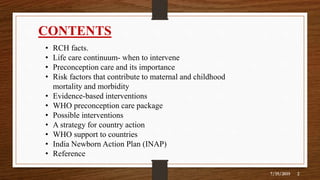
CONTENTS
• RCH facts.
• Life care continuum- when to intervene
• Preconception care and its importance
• Risk factors that contribute to maternal and childhood
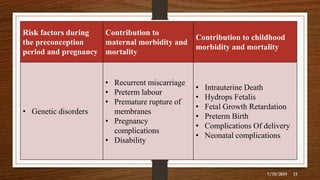
mortality and morbidity
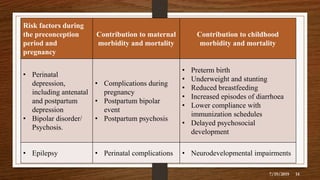
• Evidence-based interventions
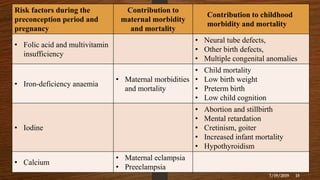
• WHO preconception care package
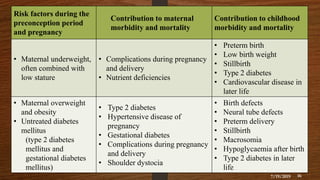
• Possible interventions
• A strategy for country action
• WHO support to countries
• India Newborn Action Plan (INAP)
• Reference
7/19/2019 3
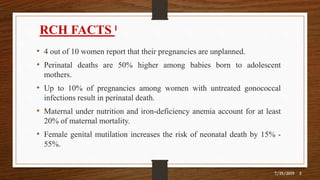
RCH FACTS ˡ
• 4 out of 10 women report that their pregnancies are unplanned.
• Perinatal deaths are 50% higher among babies born to adolescent
mothers.
• Up to 10% of pregnancies among women with untreated gonococcal
infections result in perinatal death.
• Maternal under nutrition and iron-deficiency anemia account for at least
20% of maternal mortality.
• Female genital mutilation increases the risk of neonatal death by 15% -
55%.
7/19/2019 4
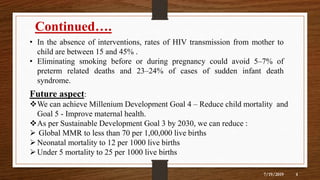
Continued….
• In the absence of interventions, rates of HIV transmission from mother to
child are between 15 and 45% .
• Eliminating smoking before or during pregnancy could avoid 5–7% of
preterm related deaths and 23–24% of cases of sudden infant death
syndrome.
Future aspect:
We can achieve Millenium Development Goal 4 – Reduce child mortality and
Goal 5 - Improve maternal health.
As per Sustainable Development Goal 3 by 2030, we can reduce :
 Global MMR to less than 70 per 1,00,000 live births
Neonatal mortality to 12 per 1000 live births
Under 5 mortality to 25 per 1000 live births
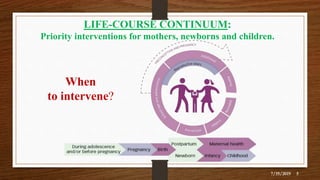
LIFE-COURSE CONTINUUM:
Priority interventions for mothers, newborns and children.
When
to intervene?
7/19/2019 5
7/19/2019 6
Preconception care is the provision of biomedical,
behavioral and social health interventions to women
and couples before conception occurs.
It aims at improving their health status, and reducing
behaviors, individual and environmental factors that
contribute to poor maternal and child health outcomes.
Its ultimate aim is to improve maternal and child
health, in both the short and long term. ˡ
7/19/2019 7
7/19/2019 8
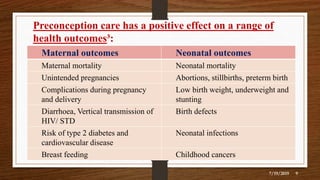
Preconception care has a positive effect on a range of
health outcomes³:
7/19/2019 9
Maternal outcomes Neonatal outcomes
Maternal mortality Neonatal mortality
Unintended pregnancies Abortions, stillbirths, preterm birth
Complications during pregnancy
and delivery
Low birth weight, underweight and
stunting
Diarrhoea, Vertical transmission of
HIV/ STD
Birth defects
Risk of type 2 diabetes and
cardiovascular disease
Neonatal infections
Breast feeding Childhood cancers
7/19/2019 10
Risk factors
that contribute to maternal
and
childhood mortality and
morbidity
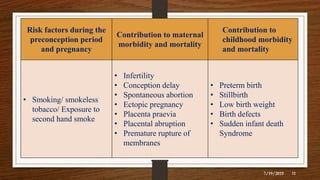
Risk factors during the
preconception period
and pregnancy
Contribution to maternal
morbidity and mortality
Contribution to
childhood morbidity
and mortality
• Smoking/ smokeless
tobacco/ Exposure to
second hand smoke
• Infertility
• Conception delay
• Spontaneous abortion
• Ectopic pregnancy
• Placenta praevia
• Placental abruption
• Premature rupture of
membranes
• Preterm birth
• Stillbirth
• Low birth weight
• Birth defects
• Sudden infant death
Syndrome
7/19/2019 11
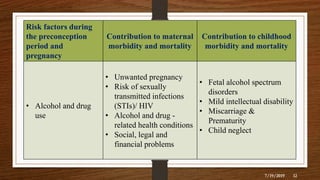
Risk factors during
the preconception
period and
pregnancy
Contribution to maternal
morbidity and mortality
Contribution to childhood
morbidity and mortality
• Alcohol and drug
use
• Unwanted pregnancy
• Risk of sexually
transmitted infections
(STIs)/ HIV
• Alcohol and drug -
related health conditions
• Social, legal and
financial problems
• Fetal alcohol spectrum
disorders
• Mild intellectual disability
• Miscarriage &
Prematurity
• Child neglect
7/19/2019 12
Risk factors during
the preconception
period and pregnancy
Contribution to
maternal morbidity and
mortality
Contribution to childhood
morbidity and mortality
• Genetic disorders
• Recurrent miscarriage
• Preterm labour
• Premature rupture of
membranes
• Pregnancy
complications
• Disability
• Intrauterine Death
• Hydrops Fetalis
• Fetal Growth Retardation
• Preterm Birth
• Complications Of delivery
• Neonatal complications
7/19/2019 13
Risk factors during
the preconception
period and
pregnancy
Contribution to maternal
morbidity and mortality
Contribution to childhood
morbidity and mortality
• Perinatal
depression,
including antenatal
and postpartum
depression
• Bipolar disorder/
Psychosis.
• Complications during
pregnancy
• Postpartum bipolar
event
• Postpartum psychosis
• Preterm birth
• Underweight and stunting
• Reduced breastfeeding
• Increased episodes of diarrhoea
• Lower compliance with
immunization schedules
• Delayed psychosocial
development
• Epilepsy • Perinatal complications • Neurodevelopmental impairments
7/19/2019 14
Risk factors during the
preconception period and
pregnancy
Contribution to
maternal morbidity
and mortality
Contribution to childhood
morbidity and mortality
• Folic acid and multivitamin
insufficiency
• Neural tube defects,
• Other birth defects,
• Multiple congenital anomalies
• Iron-deficiency anaemia
• Maternal morbidities
and mortality
• Child mortality
• Low birth weight
• Preterm birth
• Low child cognition
• Iodine
• Abortion and stillbirth
• Mental retardation
• Cretinism, goiter
• Increased infant mortality
• Hypothyroidism
• Calcium
• Maternal eclampsia
• Preeclampsia
7/19/2019 15
Risk factors during the
preconception period
and pregnancy
Contribution to maternal
morbidity and mortality
Contribution to childhood
morbidity and mortality
• Maternal underweight,
often combined with
low stature
• Complications during pregnancy
and delivery
• Nutrient deficiencies
• Preterm birth
• Low birth weight
• Stillbirth
• Type 2 diabetes
• Cardiovascular disease in
later life
• Maternal overweight
and obesity
• Untreated diabetes
mellitus
(type 2 diabetes
mellitus and
gestational diabetes
mellitus)
• Type 2 diabetes
• Hypertensive disease of
pregnancy
• Gestational diabetes
• Complications during pregnancy
and delivery
• Shoulder dystocia
• Birth defects
• Neural tube defects
• Preterm delivery
• Stillbirth
• Macrosomia
• Hypoglycaemia after birth
• Type 2 diabetes in later
life
7/19/2019 16
Risk factors during
the preconception
period and
pregnancy
Contribution to maternal
morbidity and mortality
Contribution to childhood
morbidity and mortality
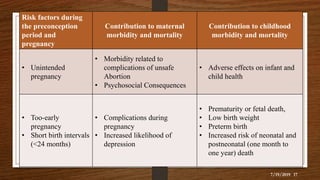
• Unintended
pregnancy
• Morbidity related to
complications of unsafe
Abortion
• Psychosocial Consequences
• Adverse effects on infant and
child health
• Too-early
pregnancy
• Short birth intervals
(<24 months)
• Complications during
pregnancy
• Increased likelihood of
depression
• Prematurity or fetal death,
• Low birth weight
• Preterm birth
• Increased risk of neonatal and
postneonatal (one month to
one year) death
7/19/2019 17
Risk factors during
the preconception
period and pregnancy
Contribution to
maternal morbidity
and mortality
Contribution to childhood
morbidity and mortality
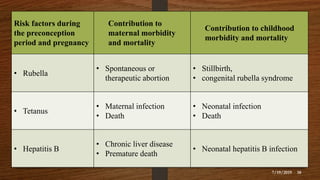
• Rubella
• Spontaneous or
therapeutic abortion
• Stillbirth,
• congenital rubella syndrome
• Tetanus
• Maternal infection
• Death
• Neonatal infection
• Death
• Hepatitis B
• Chronic liver disease
• Premature death
• Neonatal hepatitis B infection
7/19/2019 18
EVIDENCE-
BASED
INTERVENTIONS ˡ
7/19/2019 19
7/19/2019 20
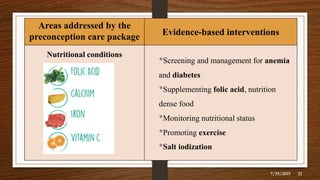
Areas addressed by the
preconception care package Evidence-based interventions
Nutritional conditions
•Screening and management for anemia
and diabetes
•Supplementing folic acid, nutrition
dense food
•Monitoring nutritional status
•Promoting exercise
•Salt iodization
7/19/2019 21
Areas addressed by the
preconception care package
Evidence-based interventions
Tobacco use
•Screening for tobacco use
•Pharmacotherapy and intensive behavioural
counselling services
•Harmful effects of second-hand smoke on
pregnant women and unborn children
7/19/2019 22
Areas addressed by the
preconception care package Evidence-based interventions
Genetic conditions
•Family planning
•Genetic counselling and treatment for
genetic conditions
•Carrier screening and testing
•Screening among populations at high risks
7/19/2019 23
Areas addressed by the
preconception care
package
Evidence-based interventions
Environmental health
•Providing information on environmental hazards and
prevention
•Protecting from unnecessary exposure to radiation,
lead and pesticides
•Informing women of childbearing age about levels of
methyl mercury in fish
•Promoting use of improved stoves and cleaner fuels
7/19/2019 24
Areas addressed by the
preconception care package
Evidence-based interventions
Infertility
•Awareness -preventable and unpreventable
causes of infertility
•Management of underlying causes of infertility,
including past STIs
•Counselling for individuals/couples diagnosed
with unpreventable causes of infertility/sub-
fertility.
7/19/2019 25
Areas addressed by the
preconception care package
Evidence-based interventions
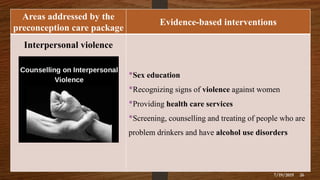
Interpersonal violence
•Sex education
•Recognizing signs of violence against women
•Providing health care services
•Screening, counselling and treating of people who are
problem drinkers and have alcohol use disorders
7/19/2019 26
Areas addressed by the
preconception care package
Evidence-based interventions
Too-early, unwanted and rapid
successive pregnancies
•Education of girls
•Influencing cultural norms that support early
marriage
•Contraceptives
•Engaging men and boys to assess norms and
practices regarding gender-based violence and
coerced sex
•Educating regarding pregnancy with short birth
intervals
7/19/2019 27
Areas addressed by the
preconception care
package
Evidence-based interventions
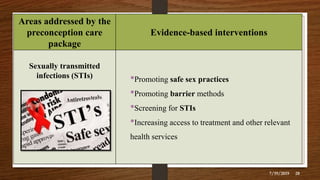
Sexually transmitted
infections (STIs) •Promoting safe sex practices
•Promoting barrier methods
•Screening for STIs
•Increasing access to treatment and other relevant
health services
7/19/2019 28
Areas addressed by the
preconception care
package
Evidence-based interventions
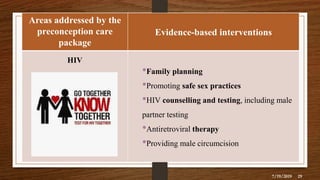
HIV
•Family planning
•Promoting safe sex practices
•HIV counselling and testing, including male
partner testing
•Antiretroviral therapy
•Providing male circumcision
7/19/2019 29
Areas addressed by the
preconception care
package
Evidence-based interventions
Mental health
•Assessing psychosocial problems
•Psychosocial counselling
•Managing depression
•Improving access to education for women of
childbearing age
•Strengthening community networks and promoting
women’s empowerment
7/19/2019 30
Areas addressed by the
preconception care package
Evidence-based interventions
Psychoactive substance use
•Screening and treatment for substance use
•Providing family planning assistance for
families with substance use disorders
•Establishing prevention programmes to reduce
substance use in adolescents
7/19/2019 31
Areas addressed by the
preconception care package
Evidence-based interventions
Vaccine-preventable
diseases
•Vaccination against rubella, tetanus,
diphtheria and Hepatitis B
7/19/2019 32
7/19/2019 33
7/19/2019 34
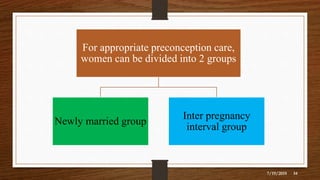
For appropriate preconception care,
women can be divided into 2 groups
Newly married group
Inter pregnancy
interval group
7/19/2019
35
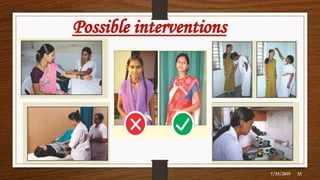
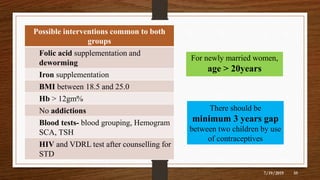
Possible interventions common to both
groups
Folic acid supplementation and
deworming
Iron supplementation
BMI between 18.5 and 25.0
Hb > 12gm%
No addictions
Blood tests- blood grouping, Hemogram
SCA, TSH
HIV and VDRL test after counselling for
STD
For newly married women,
age > 20years
There should be
minimum 3 years gap
between two children by use
of contraceptives
35
7/19/2019 36
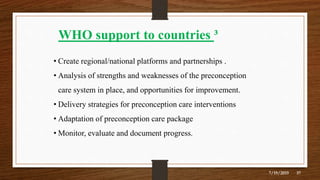
WHO support to countries ³
• Create regional/national platforms and partnerships .
• Analysis of strengths and weaknesses of the preconception
care system in place, and opportunities for improvement.
• Delivery strategies for preconception care interventions
• Adaptation of preconception care package
• Monitor, evaluate and document progress.
7/19/2019 37
7/19/2019 38
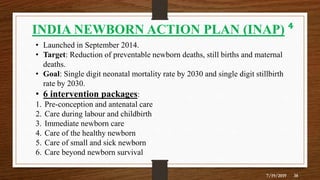
INDIA NEWBORN ACTION PLAN (INAP) ⁴
• Launched in September 2014.
• Target: Reduction of preventable newborn deaths, still births and maternal
deaths.
• Goal: Single digit neonatal mortality rate by 2030 and single digit stillbirth
rate by 2030.
• 6 intervention packages:
1. Pre-conception and antenatal care
2. Care during labour and childbirth
3. Immediate newborn care
4. Care of the healthy newborn
5. Care of small and sick newborn
6. Care beyond newborn survival
REFERENCES
1. Meeting to develop a global consensus on preconception care to reduce maternal and
childhood mortality and morbidity. Geneva, World Health Organization, 2013.
2. Liu et al, “Global, regional, and national causes of child mortality: an updated systematic
analysis for 2010 with time trends since 2000”. The Lancet 2012, 379: 2151–61.
3. World Health Organization. (2013). Preconception Care Policy Brief . 1–8. Website url:
https://doi.org/10.1016/S1002-0721(09)60023-5
4. Govt. of lndia (2014),India Newborn Action Plan (INAP), Sept.2014, Ministry of Health
and Family Welfare, New Delhi.
7/19/2019 39
Preconception care

Preconception care

  • 1.
    PRECONCEPTION CARE Presented by Dr TrishnaMohanty, JR II Department of Community Medicine Bharti Vidyapeeth (DTU) Medical College, Pune JOINT PG ACTIVITY Date: 19th July 2019
  • 2.
    7/19/2019 2 CONTENTS • RCHfacts. • Life care continuum- when to intervene • Preconception care and its importance • Risk factors that contribute to maternal and childhood mortality and morbidity • Evidence-based interventions • WHO preconception care package • Possible interventions • A strategy for country action • WHO support to countries • India Newborn Action Plan (INAP) • Reference
  • 3.
    7/19/2019 3 RCH FACTSˡ • 4 out of 10 women report that their pregnancies are unplanned. • Perinatal deaths are 50% higher among babies born to adolescent mothers. • Up to 10% of pregnancies among women with untreated gonococcal infections result in perinatal death. • Maternal under nutrition and iron-deficiency anemia account for at least 20% of maternal mortality. • Female genital mutilation increases the risk of neonatal death by 15% - 55%.
  • 4.
    7/19/2019 4 Continued…. • Inthe absence of interventions, rates of HIV transmission from mother to child are between 15 and 45% . • Eliminating smoking before or during pregnancy could avoid 5–7% of preterm related deaths and 23–24% of cases of sudden infant death syndrome. Future aspect: We can achieve Millenium Development Goal 4 – Reduce child mortality and Goal 5 - Improve maternal health. As per Sustainable Development Goal 3 by 2030, we can reduce :  Global MMR to less than 70 per 1,00,000 live births Neonatal mortality to 12 per 1000 live births Under 5 mortality to 25 per 1000 live births
  • 5.
    LIFE-COURSE CONTINUUM: Priority interventionsfor mothers, newborns and children. When to intervene? 7/19/2019 5
  • 6.
  • 7.
    Preconception care isthe provision of biomedical, behavioral and social health interventions to women and couples before conception occurs. It aims at improving their health status, and reducing behaviors, individual and environmental factors that contribute to poor maternal and child health outcomes. Its ultimate aim is to improve maternal and child health, in both the short and long term. ˡ 7/19/2019 7
  • 8.
  • 9.
    Preconception care hasa positive effect on a range of health outcomes³: 7/19/2019 9 Maternal outcomes Neonatal outcomes Maternal mortality Neonatal mortality Unintended pregnancies Abortions, stillbirths, preterm birth Complications during pregnancy and delivery Low birth weight, underweight and stunting Diarrhoea, Vertical transmission of HIV/ STD Birth defects Risk of type 2 diabetes and cardiovascular disease Neonatal infections Breast feeding Childhood cancers
  • 10.
    7/19/2019 10 Risk factors thatcontribute to maternal and childhood mortality and morbidity
  • 11.
    Risk factors duringthe preconception period and pregnancy Contribution to maternal morbidity and mortality Contribution to childhood morbidity and mortality • Smoking/ smokeless tobacco/ Exposure to second hand smoke • Infertility • Conception delay • Spontaneous abortion • Ectopic pregnancy • Placenta praevia • Placental abruption • Premature rupture of membranes • Preterm birth • Stillbirth • Low birth weight • Birth defects • Sudden infant death Syndrome 7/19/2019 11
  • 12.
    Risk factors during thepreconception period and pregnancy Contribution to maternal morbidity and mortality Contribution to childhood morbidity and mortality • Alcohol and drug use • Unwanted pregnancy • Risk of sexually transmitted infections (STIs)/ HIV • Alcohol and drug - related health conditions • Social, legal and financial problems • Fetal alcohol spectrum disorders • Mild intellectual disability • Miscarriage & Prematurity • Child neglect 7/19/2019 12
  • 13.
    Risk factors during thepreconception period and pregnancy Contribution to maternal morbidity and mortality Contribution to childhood morbidity and mortality • Genetic disorders • Recurrent miscarriage • Preterm labour • Premature rupture of membranes • Pregnancy complications • Disability • Intrauterine Death • Hydrops Fetalis • Fetal Growth Retardation • Preterm Birth • Complications Of delivery • Neonatal complications 7/19/2019 13
  • 14.
    Risk factors during thepreconception period and pregnancy Contribution to maternal morbidity and mortality Contribution to childhood morbidity and mortality • Perinatal depression, including antenatal and postpartum depression • Bipolar disorder/ Psychosis. • Complications during pregnancy • Postpartum bipolar event • Postpartum psychosis • Preterm birth • Underweight and stunting • Reduced breastfeeding • Increased episodes of diarrhoea • Lower compliance with immunization schedules • Delayed psychosocial development • Epilepsy • Perinatal complications • Neurodevelopmental impairments 7/19/2019 14
  • 15.
    Risk factors duringthe preconception period and pregnancy Contribution to maternal morbidity and mortality Contribution to childhood morbidity and mortality • Folic acid and multivitamin insufficiency • Neural tube defects, • Other birth defects, • Multiple congenital anomalies • Iron-deficiency anaemia • Maternal morbidities and mortality • Child mortality • Low birth weight • Preterm birth • Low child cognition • Iodine • Abortion and stillbirth • Mental retardation • Cretinism, goiter • Increased infant mortality • Hypothyroidism • Calcium • Maternal eclampsia • Preeclampsia 7/19/2019 15
  • 16.
    Risk factors duringthe preconception period and pregnancy Contribution to maternal morbidity and mortality Contribution to childhood morbidity and mortality • Maternal underweight, often combined with low stature • Complications during pregnancy and delivery • Nutrient deficiencies • Preterm birth • Low birth weight • Stillbirth • Type 2 diabetes • Cardiovascular disease in later life • Maternal overweight and obesity • Untreated diabetes mellitus (type 2 diabetes mellitus and gestational diabetes mellitus) • Type 2 diabetes • Hypertensive disease of pregnancy • Gestational diabetes • Complications during pregnancy and delivery • Shoulder dystocia • Birth defects • Neural tube defects • Preterm delivery • Stillbirth • Macrosomia • Hypoglycaemia after birth • Type 2 diabetes in later life 7/19/2019 16
  • 17.
    Risk factors during thepreconception period and pregnancy Contribution to maternal morbidity and mortality Contribution to childhood morbidity and mortality • Unintended pregnancy • Morbidity related to complications of unsafe Abortion • Psychosocial Consequences • Adverse effects on infant and child health • Too-early pregnancy • Short birth intervals (<24 months) • Complications during pregnancy • Increased likelihood of depression • Prematurity or fetal death, • Low birth weight • Preterm birth • Increased risk of neonatal and postneonatal (one month to one year) death 7/19/2019 17
  • 18.
    Risk factors during thepreconception period and pregnancy Contribution to maternal morbidity and mortality Contribution to childhood morbidity and mortality • Rubella • Spontaneous or therapeutic abortion • Stillbirth, • congenital rubella syndrome • Tetanus • Maternal infection • Death • Neonatal infection • Death • Hepatitis B • Chronic liver disease • Premature death • Neonatal hepatitis B infection 7/19/2019 18
  • 19.
  • 20.
  • 21.
    Areas addressed bythe preconception care package Evidence-based interventions Nutritional conditions •Screening and management for anemia and diabetes •Supplementing folic acid, nutrition dense food •Monitoring nutritional status •Promoting exercise •Salt iodization 7/19/2019 21
  • 22.
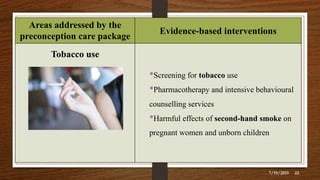
    Areas addressed bythe preconception care package Evidence-based interventions Tobacco use •Screening for tobacco use •Pharmacotherapy and intensive behavioural counselling services •Harmful effects of second-hand smoke on pregnant women and unborn children 7/19/2019 22
  • 23.
    Areas addressed bythe preconception care package Evidence-based interventions Genetic conditions •Family planning •Genetic counselling and treatment for genetic conditions •Carrier screening and testing •Screening among populations at high risks 7/19/2019 23
  • 24.
    Areas addressed bythe preconception care package Evidence-based interventions Environmental health •Providing information on environmental hazards and prevention •Protecting from unnecessary exposure to radiation, lead and pesticides •Informing women of childbearing age about levels of methyl mercury in fish •Promoting use of improved stoves and cleaner fuels 7/19/2019 24
  • 25.
    Areas addressed bythe preconception care package Evidence-based interventions Infertility •Awareness -preventable and unpreventable causes of infertility •Management of underlying causes of infertility, including past STIs •Counselling for individuals/couples diagnosed with unpreventable causes of infertility/sub- fertility. 7/19/2019 25
  • 26.
    Areas addressed bythe preconception care package Evidence-based interventions Interpersonal violence •Sex education •Recognizing signs of violence against women •Providing health care services •Screening, counselling and treating of people who are problem drinkers and have alcohol use disorders 7/19/2019 26
  • 27.
    Areas addressed bythe preconception care package Evidence-based interventions Too-early, unwanted and rapid successive pregnancies •Education of girls •Influencing cultural norms that support early marriage •Contraceptives •Engaging men and boys to assess norms and practices regarding gender-based violence and coerced sex •Educating regarding pregnancy with short birth intervals 7/19/2019 27
  • 28.
    Areas addressed bythe preconception care package Evidence-based interventions Sexually transmitted infections (STIs) •Promoting safe sex practices •Promoting barrier methods •Screening for STIs •Increasing access to treatment and other relevant health services 7/19/2019 28
  • 29.
    Areas addressed bythe preconception care package Evidence-based interventions HIV •Family planning •Promoting safe sex practices •HIV counselling and testing, including male partner testing •Antiretroviral therapy •Providing male circumcision 7/19/2019 29
  • 30.
    Areas addressed bythe preconception care package Evidence-based interventions Mental health •Assessing psychosocial problems •Psychosocial counselling •Managing depression •Improving access to education for women of childbearing age •Strengthening community networks and promoting women’s empowerment 7/19/2019 30
  • 31.
    Areas addressed bythe preconception care package Evidence-based interventions Psychoactive substance use •Screening and treatment for substance use •Providing family planning assistance for families with substance use disorders •Establishing prevention programmes to reduce substance use in adolescents 7/19/2019 31
  • 32.
    Areas addressed bythe preconception care package Evidence-based interventions Vaccine-preventable diseases •Vaccination against rubella, tetanus, diphtheria and Hepatitis B 7/19/2019 32
  • 33.
  • 34.
    7/19/2019 34 For appropriatepreconception care, women can be divided into 2 groups Newly married group Inter pregnancy interval group
  • 35.
    7/19/2019 35 Possible interventions commonto both groups Folic acid supplementation and deworming Iron supplementation BMI between 18.5 and 25.0 Hb > 12gm% No addictions Blood tests- blood grouping, Hemogram SCA, TSH HIV and VDRL test after counselling for STD For newly married women, age > 20years There should be minimum 3 years gap between two children by use of contraceptives 35
  • 36.
  • 37.
    WHO support tocountries ³ • Create regional/national platforms and partnerships . • Analysis of strengths and weaknesses of the preconception care system in place, and opportunities for improvement. • Delivery strategies for preconception care interventions • Adaptation of preconception care package • Monitor, evaluate and document progress. 7/19/2019 37
  • 38.
    7/19/2019 38 INDIA NEWBORNACTION PLAN (INAP) ⁴ • Launched in September 2014. • Target: Reduction of preventable newborn deaths, still births and maternal deaths. • Goal: Single digit neonatal mortality rate by 2030 and single digit stillbirth rate by 2030. • 6 intervention packages: 1. Pre-conception and antenatal care 2. Care during labour and childbirth 3. Immediate newborn care 4. Care of the healthy newborn 5. Care of small and sick newborn 6. Care beyond newborn survival
  • 39.
    REFERENCES 1. Meeting todevelop a global consensus on preconception care to reduce maternal and childhood mortality and morbidity. Geneva, World Health Organization, 2013. 2. Liu et al, “Global, regional, and national causes of child mortality: an updated systematic analysis for 2010 with time trends since 2000”. The Lancet 2012, 379: 2151–61. 3. World Health Organization. (2013). Preconception Care Policy Brief . 1–8. Website url: https://doi.org/10.1016/S1002-0721(09)60023-5 4. Govt. of lndia (2014),India Newborn Action Plan (INAP), Sept.2014, Ministry of Health and Family Welfare, New Delhi. 7/19/2019 39

Editor's Notes

  • #4 Before going in details about preconception care, first let me throw some lights on RCH sector in India.
  • #5 As we can see that the problem statement is so high in our developing country, an intervention like preconception care can help us achieve the MDG goal 4…… and as per SDG 3 by 2030.
  • #6 Life course is simply a sequence of socially defined events and roles that the individual enacts over time. Different life stages are neonatal>infancy>pre school>school age & adolescence> adulthood> ageing During the period before conception i.e, preconception period, parental health, their choices and lifestyle can adversely influence short as well as long term risks of offspring having cardiovascular, metabolic, immune, and neurological morbidities and can have adverse effect on the mother’s health too. We need to intervene during adolescence and/or before pregnancy as the preconception period and pregnancy covers adulthood and a part of adolescence in India.
  • #8 What is preconception care?
  • #10 Preconception care has a positive effect on a range of health outcomes. It can reduce maternal mortality, unintended pregnancies, complications during pregnancy and delivery. It can lower the risk of diarrhea, vertical transmission of HIV/STD and type 2 DM. It can promote breast feeding. It can reduce neonatal mortality, abortions and still birth. It can prevent LBW and stunting, birth defects and neonatal infections and few cancers. Preconception care increases the well being of women and couples and improves subsequent pregnancy and child health outcomes.
  • #14 Depending on the disorder, these may contribute to some of the following: Pregnancy complications like pre-eclampsia, eclapmsia. Disability may be physical or intellectual. Complications Of Delivery (e.g. Early Death, Respiratory Distress, Haemorrhage, Anoxia) Neonatal Complications (e.g. Anaemia, Haemolysis, Convulsions, Respiratory Distress, Cardiac Failure)
  • #17 Complications during pregnancy and delivery- Postpartum haemorrhage and anaemia / Induction of labor or caesarean or instrumental delivery / obstetric trauma/ pre eclampsia, eclampsia.
  • #18  since the pregnancy was unintentional, Less attention to care of self and unborn child during pregnancy, with adverse effects on infant and child health Complications in pregnancy- Preterm labour, Induction of labor or caesarean or instrumental delivery / obstetric trauma
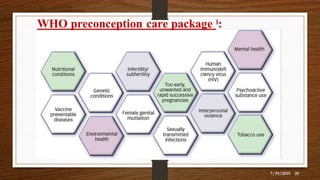
  • #20 In 2012, WHO organized a meeting regarding preconception care and developed care packages having evidence based interventions addressing 13 areas: they are.. Mentioned in next slide.
  • #21 Even if preconception care aims primarily at improving on maternal and child health, it brings health benefits to adolescent, women and men as individuals. We will see the examples now.
  • #22 IEC materials that is information, education and counselling materials regarding nutrition. Monitoring of nutritional status. Counselling regarding balance diet.
  • #23 Screening for tobacco use at all clinical visits using “5 As” (ask, advise, assess, assist, arrange) Providing brief tobacco cessation advice Advising about harm of second-hand smoke and harmful effects on pregnant women and unborn children
  • #24 Taking a thorough family history to identify risk factors for genetic conditions High risks- BOH as the most common cause of recurrent abortion is chromosomal abnormalities. Other high risks are women with family history of down syndrome, cleft lip or palate, NTDs and other genetic disorder..
  • #25 Protecting from unnecessary radiation exposure in occupational, environmental and medical settings Avoiding unnecessary pesticide use/ providing alternatives to pesticides Methyl mercury causes CNS and spinal cord damages. Promoting use of improved stoves and cleaner fuels as it will decrease indoor air pollution.
  • #26 Creating awareness and understanding of fertility and infertility and their preventable and unpreventable causes Screening and diagnosis of couples following 6–12 months of attempting pregnancy, and management of underlying causes of infertility/sub-fertility, including past STIs Defusing stigmatization of infertility and assumptions of fate- providing them with alternatives to having a family.
  • #27 Providing age-appropriate comprehensive sex education that addresses gender equality, human rights and sexual relations Providing health care services (including post-rape care), referral and psychosocial support to victims of violence
  • #28 Keeping the girls at school Contraceptives for preventing early pregnancy and contraceptive provision to adolescents Educating women and couples about the Dangers to the baby and mother of short birth intervals
  • #29 Promoting safe sex practices through individual, group and community –level behavioural interventions. Promoting barrier methods as it will have a dual protection against STIs and unwanted pregnancies and Ensuring increased access to condoms
  • #30 Antiretroviral therapy for prevention and pre-exposure prophylaxis and to prevent mother to child transmission.
  • #31 Psychosocial counselling before and during pregnancy Counselling, treating and Managing depression in women planning pregnancy and other women of childbearing age Strengthening community networks and promoting women’s empowerment and reducing economic insecurity of women of childbearing age
  • #32 Providing brief interventions when needed including pharmacological and psychological interventions Providing family planning assistance for families with substance use disorders (including postpartum and between pregnancies) Establishing prevention programmes to reduce substance use in adolescents like adolescent health clinic.
  • #35 In newly married women we deal with women who will get pregnant for the first time. In inter pregnancy women we deal with women who have been pregnant before.
  • #36 .For newly married women, age should be above 20years. If she is married before 20, she is adviced to wait till 20yrs of age and then conceive.
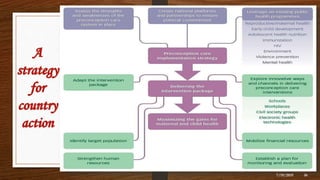
  • #37 This slide shows in a pictorial way main elements of a strategy for country action. WHO supports regions and countries in implementing a step-by-step process to improve availability of and access to preconception care interventions. It explains the specific areas in which WHO can support countries to implement universal access to preconception care.
  • #38 Create regional/national platforms and partnerships to advance preconception care interventions. Introduce professionals in countries to international experience, research, evidence and good practices. Delivery strategies for preconception care interventions, and their comparative advantages in terms of coverage, feasibility, acceptability and cost. Adaptation of preconception care package according to regional and country priorities, and health systems contexts. Monitoring , evaluating and documenting progress of these strategies. Countries that have started implementing preconception care initiatives- Italy, Netherlands, USA, Bangladesh, phillipines, India and UK, which started last month.
  • #39 They are recommended but preconception care is not properly followed in public sector. The elite class consulting obstetrician may get some advice and care as per guidelines of FOGSI
  • #41 Suggestions: Add history of preconception care, different studies going on and health programmes related to preconception care in India and globally. Questions: how will u make people aware about preconception care? Which age group is most appropriate for it?