Course structure and contents for
PRACTICE SCHOOL (BP706PS)
B.Pharm Final year (Sem 7)
Domain – 6
COSMETIC SCIENCE
FORMULATION AND EVALUATION OF HERBAL
ANTI ACNE FACE WASH GEL.
A Review Article By:
Nathe Pranjal Sahebrao.
Final year B.Pharmacy
(1952811823027)
Guided By:
Prof. Soniya Satpute Mam
Index
• Inroduction to Cosmetic
• Abstract
• Introduction
• Definition and Merits of face wash
• Ingredients
• Plan of work
• Marketed formulation
• Composition of developed formulation
• Evaluation of formulation
• Conclusion
• Bibliography
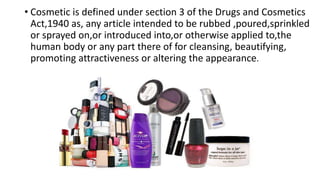
• Cosmetic is defined under section 3 of the Drugs and Cosmetics
Act,1940 as, any article intended to be rubbed ,poured,sprinkled
or sprayed on,or introduced into,or otherwise applied to,the
human body or any part there of for cleansing, beautifying,
promoting attractiveness or altering the appearance.
Abstract:-
• Natural remedies are more acceptable with the belief that they are
safe and having less side effects. Herbal formulations have growing
demand in the world market.
• The present work deals with the development & evaluation of the
herbal anti-acne face wash containing aqueous extract of bael leaves
(Aegle marmelos), turmeric (Curcuma longa), liquorice root, shahi
jeera, orange peel & hydro alcoholic extract of fruit of nutmeg
(Myristica fragrance).
• Although various topical herbal formulations for acne are available in
the market, I propose to make pure herbal formulation without using
any synthetic ingredient. The plants have been reported in literature
having good anti-microbial, anti-oxidant & anti-inflammatory activity.
Introduction:-
• In 1885,the first Medical monograph which was dedicated to acne
was published in USA. Acne i.e.Acne vulgaris is a common skin
disease occurred atleast one time in the life specially at the time of
puberty. It occurs at the age of between 18-25.
• Acne may be divided in the categories like cysts, nodular, postular and
comadones. Comadonal acne are divided into two types
i.e.blackheads and whiteheads.
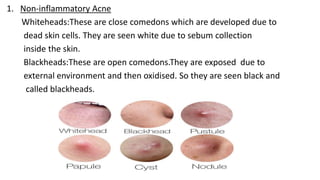
1. Non-inflammatory Acne
Whiteheads:These are close comedons which are developed due to
dead skin cells. They are seen white due to sebum collection
inside the skin.
Blackheads:These are open comedons.They are exposed due to
external environment and then oxidised. So they are seen black and
called blackheads.
2. Inflammatory Acne
These are swollen, red in colour and painful.
There are various types of inflammatory acne.
• Papules-They occur when excessive oil ,bacteria and dead skin cell goes to
the deeper layer of the skin.Skin becomes red and swolled.
• Pustules- These are also infected papules and consist of pus.
• Cysts- Cysts are more severe than the regular pimples and accur very deeply
in the skin.
• Nodule-These may be in red or skinny colour[5]
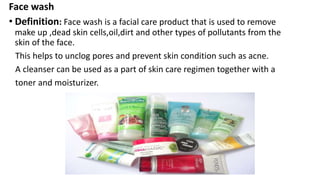
Face wash
• Definition: Face wash is a facial care product that is used to remove
make up ,dead skin cells,oil,dirt and other types of pollutants from the
skin of the face.
This helps to unclog pores and prevent skin condition such as acne.
A cleanser can be used as a part of skin care regimen together with a
toner and moisturizer.
Why you shouldn’t use soap?
• Soap is alkaline-based, but your skin is acidic
The alkaline nature of soap bar can cause your face to become dry and
strip away the natural moisture.
Why face wash?
It helps to maintain the pH balance of your skin while removing dirt
from the pores.
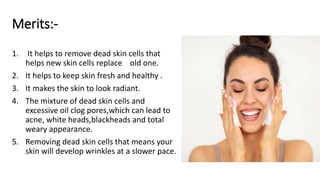
Merits:-
1. It helps to remove dead skin cells that
helps new skin cells replace old one.
2. It helps to keep skin fresh and healthy .
3. It makes the skin to look radiant.
4. The mixture of dead skin cells and
excessive oil clog pores,which can lead to
acne, white heads,blackheads and total
weary appearance.
5. Removing dead skin cells that means your
skin will develop wrinkles at a slower pace.
Ingredients:-
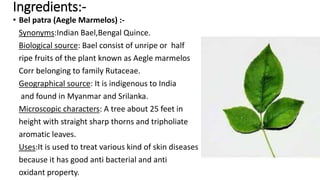
• Bel patra (Aegle Marmelos) :-
Synonyms:Indian Bael,Bengal Quince.
Biological source: Bael consist of unripe or half
ripe fruits of the plant known as Aegle marmelos
Corr belonging to family Rutaceae.
Geographical source: It is indigenous to India
and found in Myanmar and Srilanka.
Microscopic characters: A tree about 25 feet in
height with straight sharp thorns and tripholiate
aromatic leaves.
Uses:It is used to treat various kind of skin diseases
because it has good anti bacterial and anti
oxidant property.
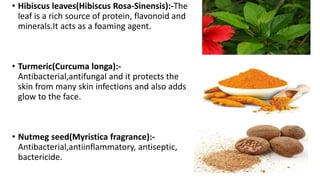
• Hibiscus leaves(Hibiscus Rosa-Sinensis):-The
leaf is a rich source of protein, flavonoid and
minerals.It acts as a foaming agent.
• Turmeric(Curcuma longa):-
Antibacterial,antifungal and it protects the
skin from many skin infections and also adds
glow to the face.
• Nutmeg seed(Myristica fragrance):-
Antibacterial,antiinflammatory, antiseptic,
bactericide.
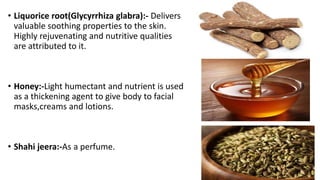
• Liquorice root(Glycyrrhiza glabra):- Delivers
valuable soothing properties to the skin.
Highly rejuvenating and nutritive qualities
are attributed to it.
• Honey:-Light humectant and nutrient is used
as a thickening agent to give body to facial
masks,creams and lotions.
• Shahi jeera:-As a perfume.
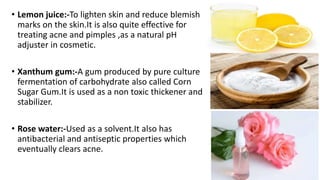
• Lemon juice:-To lighten skin and reduce blemish
marks on the skin.It is also quite effective for
treating acne and pimples ,as a natural pH
adjuster in cosmetic.
• Xanthum gum:-A gum produced by pure culture
fermentation of carbohydrate also called Corn
Sugar Gum.It is used as a non toxic thickener and
stabilizer.
• Rose water:-Used as a solvent.It also has
antibacterial and antiseptic properties which
eventually clears acne.
• Orange peel extract:-Anti oxidant, anti-
inflammatory, anti-microbial. Orange peel
properties can maintain the natural balance
of skin oils and tighten the skin by absorbing
excess oils and removing dead skin cells.
• Walnut:-Scrubbing action of walnut granules
helps break up.The mild oil deposits and
clear away dead skin cells and debris.[3]
Plan of work:-
1.Collection:- Bel patra,Hibiscus leaves are collected from the botanical
garden. Nutmeg, shahi jeera, Orange peel, liquorice root, lemon, rose
water are collected from the local market.
2.Preparation of extract:- Leaves of bael, hibiscus, roots of liquorice,
rhizomes of turmeric, orange peel are kept in a hot air oven for drying
purpose at 45⁰c and grinded into small pieces by using grinder. Seeds
of nutmeg and shahi jeera will be crushed to make powder.
Desired quantities of herbal drugs will be weighed and each herb will
be macerated with rose water in conical flask.Dried herbs will be
allowed to mix with rose water by moderate shaking of conical flask for
3 days separately. After 3 days,contents will be filtered out by using
simple filtration method and filtrates will be collected in vessels
separately.
3.Filtration:-Filtration of extract will be done by using simple filter paper
and funnel for two times.
4.Evaporation:- Evaporation will be done by using electronic water bath.
Filtrates will be allowed to evaporate in evaporating pan at 60⁰c
temperature until the desired concentration of the extract is obtained.
5.Development of formulation:- The desired concentration of gelling
agent i.e. Xanthan Gum will be weighed and dispersed in hot rose water
with moderate stirring, avoiding air entrapment and allowed to soak
overnight.
Desired quantity of lemon juice will be dissolved in desired amount
of honey by gentle stirring.
Desired quantity of herbal extract will be added to the remaining
amount of rose water and mixed with the above honey mixture by
gentle stirring. This will be finally mixed with previously soaked gel
formulation. Exfoliating walnut granules will be added to the
formulation.Prepared formulation will be filled in a suitable
container and labelled accordingly. [3]
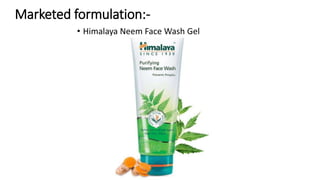
Marketed formulation:-
• Himalaya Neem Face Wash Gel
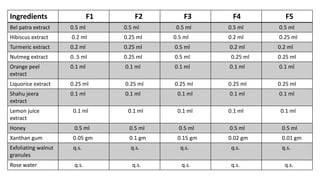
Ingredients F1 F2 F3 F4 F5
Bel patra extract 0.5 ml 0.5 ml 0.5 ml 0.5 ml 0.5 ml
Hibiscus extract 0.2 ml 0.25 ml 0.5 ml 0.2 ml 0.25 ml
Turmeric extract 0.2 ml 0.25 ml 0.5 ml 0.2 ml 0.2 ml
Nutmeg extract 0..5 ml 0.25 ml 0.5 ml 0.25 ml 0.25 ml
Orange peel
extract
0.1 ml 0.1 ml 0.1 ml 0.1 ml 0.1 ml
Liquorice extract 0.25 ml 0.25 ml 0.25 ml 0.25 ml 0.25 ml
Shahu jeera
extract
0.1 ml 0.1 ml 0.1 ml 0.1 ml 0.1 ml
Lemon juice
extract
0.1 ml 0.1 ml 0.1 ml 0.1 ml 0.1 ml
Honey 0.5 ml 0.5 ml 0.5 ml 0.5 ml 0.5 ml
Xanthan gum 0.05 gm 0.1 gm 0.15 gm 0.02 gm 0.01 gm
Exfoliating walnut
granules
q.s. q.s. q.s. q.s. q.s.
Rose water q.s. q.s. q.s. q.s. q.s.
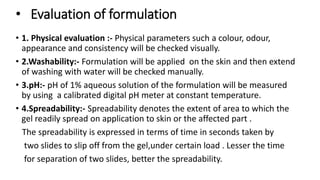
• Evaluation of formulation
• 1. Physical evaluation :- Physical parameters such a colour, odour,
appearance and consistency will be checked visually.
• 2.Washability:- Formulation will be applied on the skin and then extend
of washing with water will be checked manually.
• 3.pH:- pH of 1% aqueous solution of the formulation will be measured
by using a calibrated digital pH meter at constant temperature.
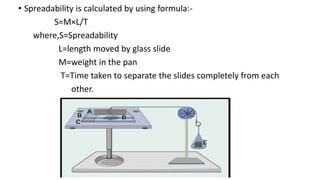
• 4.Spreadability:- Spreadability denotes the extent of area to which the
gel readily spread on application to skin or the affected part .
The spreadability is expressed in terms of time in seconds taken by
two slides to slip off from the gel,under certain load . Lesser the time
for separation of two slides, better the spreadability.
• Spreadability is calculated by using formula:-
S=M×L/T
where,S=Spreadability
L=length moved by glass slide
M=weight in the pan
T=Time taken to separate the slides completely from each
other.
• 5. Foamability:- Small amount of gel will be taken in a beaker containing
water.Initial volume will be noted ,beaker will be shaken for 10 times and
the final volume will be noted.
• 6.Viscosity:- About 10 ml of formulated sample will be taken in the
beaker and checked on digital viscometer. [6]
Conclusion:-
Natural remedies are more acceptable in the belief that they are
safer with fewer side effects than the synthetic ones. Herbal
formulations have growing demand in the world market. It is a very
good attempt to establish the herbal face wash containing aqueous
extracts of bael leaves, turmeric rhizomes, liquorice root, and seed
of nutmeg.
Bibliography:-
• 1. Jadhav J.P., Mane N. A., Gilda S.S, Kumbhar B.V., Jadhav B.M.,
Ghadge A.A., “Formulation & evaluation of poly-herbal anti-acne face
wash gel”, World journal of pharmaceutical research, 2016; 7: 2277-
7105.
• 2. Mali S.A., Karekar P., Dr. Yadav A.V., “Formulation and evaluation of
multipurpose herbal cream”, International journal of science and
research, 2015; 4(11): 2319-7064.
• 3.Dhanashri Sanjay Koli, Abhyangshree Nandkumar Mane, Vina
yak Balu Kumbhar,Kalyani Sanjay Shaha “Formulation and
evaluation of herbal anti acne face wash gel” World journal of
pharmacy and pharmaceutical sciences,volume 5(2001-2007)
• 4.Dhanashri Sanjay Koli, Abhyangshree Nandkumar Mane, Vinayak
Balu Kumbhar, Kalyani Sanjay Shaha “Formulation and Evaluation of
Herbal Anti-acne Face wash” World Journal Of Pharmacy And
Pharmaceutical Science.
Volume 5, Issue 6, 2001-2007
• 5.Singh H.P., Samnhotra N., Gullaiya S., Kaur I., “Anti-acne synergistic
Herbal face wash gel Formulation, Evaluation, & Stability study”,
World Journal of Pharmaceutical Research, 2015; 4(9): 1261-1273.
• 6. Poonam Ankush Jadhav “Formulation and Evaluation of Herbal
Anti-acne Face wash” World Journal Of Pharmacy And Pharmaceutical
Science. Volume 6, Issue 5, 15141518
Thank you!

Formulation and evaluation of herbal anti acne face wash gel (Pranjal Nathe)

  • 2.
    Course structure andcontents for PRACTICE SCHOOL (BP706PS) B.Pharm Final year (Sem 7) Domain – 6 COSMETIC SCIENCE FORMULATION AND EVALUATION OF HERBAL ANTI ACNE FACE WASH GEL.
  • 3.
    A Review ArticleBy: Nathe Pranjal Sahebrao. Final year B.Pharmacy (1952811823027) Guided By: Prof. Soniya Satpute Mam
  • 4.
    Index • Inroduction toCosmetic • Abstract • Introduction • Definition and Merits of face wash • Ingredients • Plan of work • Marketed formulation • Composition of developed formulation • Evaluation of formulation • Conclusion • Bibliography
  • 5.
    • Cosmetic isdefined under section 3 of the Drugs and Cosmetics Act,1940 as, any article intended to be rubbed ,poured,sprinkled or sprayed on,or introduced into,or otherwise applied to,the human body or any part there of for cleansing, beautifying, promoting attractiveness or altering the appearance.
  • 6.
    Abstract:- • Natural remediesare more acceptable with the belief that they are safe and having less side effects. Herbal formulations have growing demand in the world market. • The present work deals with the development & evaluation of the herbal anti-acne face wash containing aqueous extract of bael leaves (Aegle marmelos), turmeric (Curcuma longa), liquorice root, shahi jeera, orange peel & hydro alcoholic extract of fruit of nutmeg (Myristica fragrance). • Although various topical herbal formulations for acne are available in the market, I propose to make pure herbal formulation without using any synthetic ingredient. The plants have been reported in literature having good anti-microbial, anti-oxidant & anti-inflammatory activity.
  • 7.
    Introduction:- • In 1885,thefirst Medical monograph which was dedicated to acne was published in USA. Acne i.e.Acne vulgaris is a common skin disease occurred atleast one time in the life specially at the time of puberty. It occurs at the age of between 18-25. • Acne may be divided in the categories like cysts, nodular, postular and comadones. Comadonal acne are divided into two types i.e.blackheads and whiteheads.
  • 8.
    1. Non-inflammatory Acne Whiteheads:Theseare close comedons which are developed due to dead skin cells. They are seen white due to sebum collection inside the skin. Blackheads:These are open comedons.They are exposed due to external environment and then oxidised. So they are seen black and called blackheads.
  • 9.
    2. Inflammatory Acne Theseare swollen, red in colour and painful. There are various types of inflammatory acne. • Papules-They occur when excessive oil ,bacteria and dead skin cell goes to the deeper layer of the skin.Skin becomes red and swolled. • Pustules- These are also infected papules and consist of pus. • Cysts- Cysts are more severe than the regular pimples and accur very deeply in the skin. • Nodule-These may be in red or skinny colour[5]
  • 10.
    Face wash • Definition:Face wash is a facial care product that is used to remove make up ,dead skin cells,oil,dirt and other types of pollutants from the skin of the face. This helps to unclog pores and prevent skin condition such as acne. A cleanser can be used as a part of skin care regimen together with a toner and moisturizer.
  • 11.
    Why you shouldn’tuse soap? • Soap is alkaline-based, but your skin is acidic The alkaline nature of soap bar can cause your face to become dry and strip away the natural moisture. Why face wash? It helps to maintain the pH balance of your skin while removing dirt from the pores.
  • 12.
    Merits:- 1. It helpsto remove dead skin cells that helps new skin cells replace old one. 2. It helps to keep skin fresh and healthy . 3. It makes the skin to look radiant. 4. The mixture of dead skin cells and excessive oil clog pores,which can lead to acne, white heads,blackheads and total weary appearance. 5. Removing dead skin cells that means your skin will develop wrinkles at a slower pace.
  • 13.
    Ingredients:- • Bel patra(Aegle Marmelos) :- Synonyms:Indian Bael,Bengal Quince. Biological source: Bael consist of unripe or half ripe fruits of the plant known as Aegle marmelos Corr belonging to family Rutaceae. Geographical source: It is indigenous to India and found in Myanmar and Srilanka. Microscopic characters: A tree about 25 feet in height with straight sharp thorns and tripholiate aromatic leaves. Uses:It is used to treat various kind of skin diseases because it has good anti bacterial and anti oxidant property.
  • 14.
    • Hibiscus leaves(HibiscusRosa-Sinensis):-The leaf is a rich source of protein, flavonoid and minerals.It acts as a foaming agent. • Turmeric(Curcuma longa):- Antibacterial,antifungal and it protects the skin from many skin infections and also adds glow to the face. • Nutmeg seed(Myristica fragrance):- Antibacterial,antiinflammatory, antiseptic, bactericide.
  • 15.
    • Liquorice root(Glycyrrhizaglabra):- Delivers valuable soothing properties to the skin. Highly rejuvenating and nutritive qualities are attributed to it. • Honey:-Light humectant and nutrient is used as a thickening agent to give body to facial masks,creams and lotions. • Shahi jeera:-As a perfume.
  • 16.
    • Lemon juice:-Tolighten skin and reduce blemish marks on the skin.It is also quite effective for treating acne and pimples ,as a natural pH adjuster in cosmetic. • Xanthum gum:-A gum produced by pure culture fermentation of carbohydrate also called Corn Sugar Gum.It is used as a non toxic thickener and stabilizer. • Rose water:-Used as a solvent.It also has antibacterial and antiseptic properties which eventually clears acne.
  • 17.
    • Orange peelextract:-Anti oxidant, anti- inflammatory, anti-microbial. Orange peel properties can maintain the natural balance of skin oils and tighten the skin by absorbing excess oils and removing dead skin cells. • Walnut:-Scrubbing action of walnut granules helps break up.The mild oil deposits and clear away dead skin cells and debris.[3]
  • 18.
    Plan of work:- 1.Collection:-Bel patra,Hibiscus leaves are collected from the botanical garden. Nutmeg, shahi jeera, Orange peel, liquorice root, lemon, rose water are collected from the local market. 2.Preparation of extract:- Leaves of bael, hibiscus, roots of liquorice, rhizomes of turmeric, orange peel are kept in a hot air oven for drying purpose at 45⁰c and grinded into small pieces by using grinder. Seeds of nutmeg and shahi jeera will be crushed to make powder. Desired quantities of herbal drugs will be weighed and each herb will be macerated with rose water in conical flask.Dried herbs will be allowed to mix with rose water by moderate shaking of conical flask for 3 days separately. After 3 days,contents will be filtered out by using simple filtration method and filtrates will be collected in vessels separately.
  • 19.
    3.Filtration:-Filtration of extractwill be done by using simple filter paper and funnel for two times. 4.Evaporation:- Evaporation will be done by using electronic water bath. Filtrates will be allowed to evaporate in evaporating pan at 60⁰c temperature until the desired concentration of the extract is obtained. 5.Development of formulation:- The desired concentration of gelling agent i.e. Xanthan Gum will be weighed and dispersed in hot rose water with moderate stirring, avoiding air entrapment and allowed to soak overnight.
  • 20.
    Desired quantity oflemon juice will be dissolved in desired amount of honey by gentle stirring. Desired quantity of herbal extract will be added to the remaining amount of rose water and mixed with the above honey mixture by gentle stirring. This will be finally mixed with previously soaked gel formulation. Exfoliating walnut granules will be added to the formulation.Prepared formulation will be filled in a suitable container and labelled accordingly. [3]
  • 21.
  • 22.
    Ingredients F1 F2F3 F4 F5 Bel patra extract 0.5 ml 0.5 ml 0.5 ml 0.5 ml 0.5 ml Hibiscus extract 0.2 ml 0.25 ml 0.5 ml 0.2 ml 0.25 ml Turmeric extract 0.2 ml 0.25 ml 0.5 ml 0.2 ml 0.2 ml Nutmeg extract 0..5 ml 0.25 ml 0.5 ml 0.25 ml 0.25 ml Orange peel extract 0.1 ml 0.1 ml 0.1 ml 0.1 ml 0.1 ml Liquorice extract 0.25 ml 0.25 ml 0.25 ml 0.25 ml 0.25 ml Shahu jeera extract 0.1 ml 0.1 ml 0.1 ml 0.1 ml 0.1 ml Lemon juice extract 0.1 ml 0.1 ml 0.1 ml 0.1 ml 0.1 ml Honey 0.5 ml 0.5 ml 0.5 ml 0.5 ml 0.5 ml Xanthan gum 0.05 gm 0.1 gm 0.15 gm 0.02 gm 0.01 gm Exfoliating walnut granules q.s. q.s. q.s. q.s. q.s. Rose water q.s. q.s. q.s. q.s. q.s.
  • 23.
    • Evaluation offormulation • 1. Physical evaluation :- Physical parameters such a colour, odour, appearance and consistency will be checked visually. • 2.Washability:- Formulation will be applied on the skin and then extend of washing with water will be checked manually. • 3.pH:- pH of 1% aqueous solution of the formulation will be measured by using a calibrated digital pH meter at constant temperature. • 4.Spreadability:- Spreadability denotes the extent of area to which the gel readily spread on application to skin or the affected part . The spreadability is expressed in terms of time in seconds taken by two slides to slip off from the gel,under certain load . Lesser the time for separation of two slides, better the spreadability.
  • 24.
    • Spreadability iscalculated by using formula:- S=M×L/T where,S=Spreadability L=length moved by glass slide M=weight in the pan T=Time taken to separate the slides completely from each other.
  • 25.
    • 5. Foamability:-Small amount of gel will be taken in a beaker containing water.Initial volume will be noted ,beaker will be shaken for 10 times and the final volume will be noted. • 6.Viscosity:- About 10 ml of formulated sample will be taken in the beaker and checked on digital viscometer. [6]
  • 26.
    Conclusion:- Natural remedies aremore acceptable in the belief that they are safer with fewer side effects than the synthetic ones. Herbal formulations have growing demand in the world market. It is a very good attempt to establish the herbal face wash containing aqueous extracts of bael leaves, turmeric rhizomes, liquorice root, and seed of nutmeg.
  • 27.
    Bibliography:- • 1. JadhavJ.P., Mane N. A., Gilda S.S, Kumbhar B.V., Jadhav B.M., Ghadge A.A., “Formulation & evaluation of poly-herbal anti-acne face wash gel”, World journal of pharmaceutical research, 2016; 7: 2277- 7105. • 2. Mali S.A., Karekar P., Dr. Yadav A.V., “Formulation and evaluation of multipurpose herbal cream”, International journal of science and research, 2015; 4(11): 2319-7064. • 3.Dhanashri Sanjay Koli, Abhyangshree Nandkumar Mane, Vina yak Balu Kumbhar,Kalyani Sanjay Shaha “Formulation and evaluation of herbal anti acne face wash gel” World journal of pharmacy and pharmaceutical sciences,volume 5(2001-2007)
  • 28.
    • 4.Dhanashri SanjayKoli, Abhyangshree Nandkumar Mane, Vinayak Balu Kumbhar, Kalyani Sanjay Shaha “Formulation and Evaluation of Herbal Anti-acne Face wash” World Journal Of Pharmacy And Pharmaceutical Science. Volume 5, Issue 6, 2001-2007 • 5.Singh H.P., Samnhotra N., Gullaiya S., Kaur I., “Anti-acne synergistic Herbal face wash gel Formulation, Evaluation, & Stability study”, World Journal of Pharmaceutical Research, 2015; 4(9): 1261-1273. • 6. Poonam Ankush Jadhav “Formulation and Evaluation of Herbal Anti-acne Face wash” World Journal Of Pharmacy And Pharmaceutical Science. Volume 6, Issue 5, 15141518
  • 29.