Practice what you
preach
Developing information literacy through professional reading groups
Erin Nephin and Alison Park
Leeds Beckett University
No one will read it
• Why and how we created a reading group
• What we chose to read
• How it influenced our work and practice
• What we learned
• Why you might want to do this too
Opening doors that were previously
closed
We needed an outlet
• To see what others were doing and be able to assess our
own practice in regards to information literacy development
• To increase our engagement with research and our
confidence in ourselves as researchers
• To provide a space away from the day to day for team
members to become more research active.
Tomorrow there’ll be more of us
Could a reading group
help us to address our
own fears/insecurities of
our roles as
practitioner/researchers?
It started with a discussion about
journal clubs and professional
practice…
Negotiate a time and place
The announcement of a new Education Strategy
provided an ideal opportunity to experiment.
We pitched our suggestion to the team through a
calendar invite, knowing no one date or place would
suit everyone.
Our one rule: you needed to read the articles to
attend.
Rally the guys
We chose:
• A date that worked for most of the team
• A facilitator
• Two articles (one “scholarly”, one not) on high-impact
practices and assessment
• To create a blog to summarise the points discussed.
Not a moment, but the movement
• Gave a place for us to be honest about our own ways of
approaching IL teaching
• We started to challenge our previous views/techniques
• It put us (back) in the position of what it is like to be a
student
• Exposed us to good practice elsewhere, including means of
assessing our own teaching and teaching materials
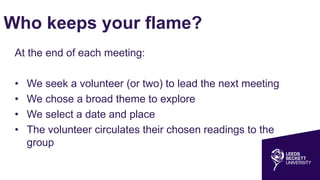
Who keeps your flame?
At the end of each meeting:
• We seek a volunteer (or two) to lead the next meeting
• We chose a broad theme to explore
• We select a date and place
• The volunteer circulates their chosen readings to the
group
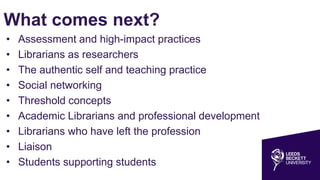
What comes next?
• Assessment and high-impact practices
• Librarians as researchers
• The authentic self and teaching practice
• Social networking
• Threshold concepts
• Academic Librarians and professional development
• Librarians who have left the profession
• Liaison
• Students supporting students
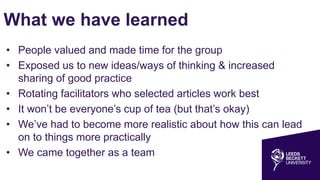
What we have learned
• People valued and made time for the group
• Exposed us to new ideas/ways of thinking & increased
sharing of good practice
• Rotating facilitators who selected articles work best
• It won’t be everyone’s cup of tea (but that’s okay)
• We’ve had to become more realistic about how this can lead
on to things more practically
• We came together as a team
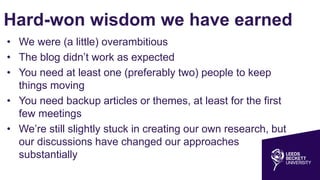
Hard-won wisdom we have earned
• We were (a little) overambitious
• The blog didn’t work as expected
• You need at least one (preferably two) people to keep
things moving
• You need backup articles or themes, at least for the first
few meetings
• We’re still slightly stuck in creating our own research, but
our discussions have changed our approaches
substantially
We aid and abet it
In summary,
• In the group allowed us to develop our own information
literacy skills, as well as improve our own practice
• Even after 2 years, team members continue to be engaged
with the group-- most members have selected the theme
and led at least one group since we started
• It allowed gave people the time and space to reflect upon
our current practice and that of others.
Thinking past tomorrow
Our experience shows that a reading group
• Enables greater engagement with the literature and
new ideas
• Encourages empathy, both within the team and the
communities we serve
• Can be expanded for use with students/other staff
to build confidence and engagement
• Is low/no cost (other than staff time) but is a highly
effective development opportunity
If you’d like to know more about our group or
advice in setting up your own (including a list of
our readings), we’d love to hear from you:
Erin Nephin (e.nephin@leedsbeckett.ac.uk)
Alison Park (a.park@leedsbeckett.ac.uk)

Practice what you preach - Nephin & Park

  • 1.
    Practice what you preach Developinginformation literacy through professional reading groups Erin Nephin and Alison Park Leeds Beckett University
  • 2.
    No one willread it • Why and how we created a reading group • What we chose to read • How it influenced our work and practice • What we learned • Why you might want to do this too
  • 3.
    Opening doors thatwere previously closed We needed an outlet • To see what others were doing and be able to assess our own practice in regards to information literacy development • To increase our engagement with research and our confidence in ourselves as researchers • To provide a space away from the day to day for team members to become more research active.
  • 4.
    Tomorrow there’ll bemore of us Could a reading group help us to address our own fears/insecurities of our roles as practitioner/researchers? It started with a discussion about journal clubs and professional practice…
  • 5.
    Negotiate a timeand place The announcement of a new Education Strategy provided an ideal opportunity to experiment. We pitched our suggestion to the team through a calendar invite, knowing no one date or place would suit everyone. Our one rule: you needed to read the articles to attend.
  • 6.
    Rally the guys Wechose: • A date that worked for most of the team • A facilitator • Two articles (one “scholarly”, one not) on high-impact practices and assessment • To create a blog to summarise the points discussed.
  • 7.
    Not a moment,but the movement • Gave a place for us to be honest about our own ways of approaching IL teaching • We started to challenge our previous views/techniques • It put us (back) in the position of what it is like to be a student • Exposed us to good practice elsewhere, including means of assessing our own teaching and teaching materials
  • 8.
    Who keeps yourflame? At the end of each meeting: • We seek a volunteer (or two) to lead the next meeting • We chose a broad theme to explore • We select a date and place • The volunteer circulates their chosen readings to the group
  • 9.
    What comes next? •Assessment and high-impact practices • Librarians as researchers • The authentic self and teaching practice • Social networking • Threshold concepts • Academic Librarians and professional development • Librarians who have left the profession • Liaison • Students supporting students
  • 10.
    What we havelearned • People valued and made time for the group • Exposed us to new ideas/ways of thinking & increased sharing of good practice • Rotating facilitators who selected articles work best • It won’t be everyone’s cup of tea (but that’s okay) • We’ve had to become more realistic about how this can lead on to things more practically • We came together as a team
  • 11.
    Hard-won wisdom wehave earned • We were (a little) overambitious • The blog didn’t work as expected • You need at least one (preferably two) people to keep things moving • You need backup articles or themes, at least for the first few meetings • We’re still slightly stuck in creating our own research, but our discussions have changed our approaches substantially
  • 12.
    We aid andabet it In summary, • In the group allowed us to develop our own information literacy skills, as well as improve our own practice • Even after 2 years, team members continue to be engaged with the group-- most members have selected the theme and led at least one group since we started • It allowed gave people the time and space to reflect upon our current practice and that of others.
  • 13.
    Thinking past tomorrow Ourexperience shows that a reading group • Enables greater engagement with the literature and new ideas • Encourages empathy, both within the team and the communities we serve • Can be expanded for use with students/other staff to build confidence and engagement • Is low/no cost (other than staff time) but is a highly effective development opportunity
  • 14.
    If you’d liketo know more about our group or advice in setting up your own (including a list of our readings), we’d love to hear from you: Erin Nephin (e.nephin@leedsbeckett.ac.uk) Alison Park (a.park@leedsbeckett.ac.uk)