Start small & set goals: Ask one
question in class; add one comment
to a small-group discxxuxxxssion •
Practice with a language partner at
the Student Learning Center or the
YWCA on Bancroft • Enroll in
public speaking courses: Check out
the College Writing Programs •
Attend & join Toastmasters
International • Look for vxxxunteer
InternationalOffice’s
GETTING ON TRACK • Set priorities to redress
well-being • Seek suppoxxxxxrt from family,
friends, faculty & advisors • Get help from
professionals at Counseling & Psychological
Services (CPS) • uhs.berkeley.edu
WARNING SIGNS • Often feeling sad, anxious,
overwhelmed • Sick or tired frequently •
Negative xxxhxxxnges in behavior or thoughts
uhs.berkeley.edu
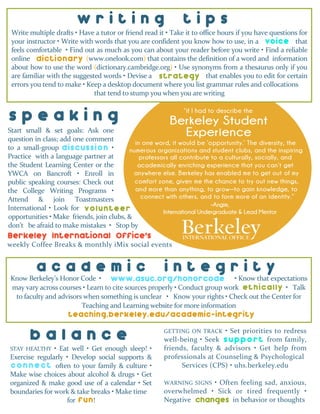
Write multiple drafts • Have a tutor or friend read it • Take it to office hours if you have questions for
your instructor • Write with words that you are confident you know how to use, in a voicevoice that
feels comfortable • Find out as much as you can about your reader before you write • Find a reliable
online onarydictionary (www.onelook.com) that contains the definition of a word and information
about how to use the word (dictionary.cambridge.org) • Use synonyms from a thesaurus only if you
are familiar with the suggested words • Devise a segysxxxtrategy that enables you to edit for certain
errors you tend to make • Keep a desktop document where you list grammar rules and collocations
that tend to stump you when you are writing
–Angie,
International Undergraduate & Lead Mentor
Know Berkeley’s Honor Code • wwwxxxxxx.asxxxxxxxxxxxuc.org/honorcode • Know that expectations
may vary across courses • Learn to cite sources properly • Conduct group work etxxhixxxxcally • Talk
to faculty and advisors when something is unclear • Know your rights • Check out the Center for
Teaching and Learning website for more information
sa.berkeley.edu/conduct
b a l a n c e
STAY HEALTHY • Eat well • Get enough sleep! •
Exercise regularly • Develop social supports &
conxxxxxxnect often to your family & culture •
Make wise choices about alcohol & drugs • Get
organized & make good use of a calendar • Set
boundaries for work & take breaks • Make time
for xxxxx!
a c a d e m i c i n t e g r i t y
s p e a k i n g
w r i t i n g t i p s
voice
dictionary
strategy
discussion
volunteer
www.asuc.org/honorcode
ethically
teaching.berkeley.edu/academic-integrity
c o n n e c t
fun changes
s u p p o r t
Berkeley International Office’s
weekly Coffee Breaks & monthly iMix social events
in one word, it would be ‘opportunity.’ The diversity, the
numerous organizations and student clubs, and the inspiring
professors all contribute to a culturally, socially, and
academically enriching experience that you can’t get
anywhere else. Berkeley has enabled me to get out of my
comfort zone, given me the chance to try out new things,
and more than anything, to grow—to gain knowledge, to
connect with others, and to form more of an identity.”
don’t be afraid to make mistakes • Stop by
opportunities • Make friends, join clubs, &
“if I had to describe the
2299 Piedmont Avenue │ Berkeley, CA 94750-2321 │ 510.642.2818
internationaloffice.berkeley.edu
Open Hours: Monday through Friday │ 9am-12pm and 1-4pm
Student Advising Drop-in Hours: Monday through Friday │ 10am-12pm and 1:30-4pm
BerkeleyINTERNATIONAL OFFICE
Berkeley
Special thanks to our contributors:
Margi Wald & Michelle Baptiste │ College Writing Programs, UC Berkeley
Richard Freishtat │ Center for Teaching and Learning, UC Berkeley
Kin Ming Chan, PhD │ Counseling & Psychological Services, UC Berkeley
Sunshine Oey │ Public Service Center, UC Berkeley
Michel Estefan │ Department of Sociology, UC Berkeley
INTERNATIONAL OFFICE
Campus
Engagement
Jump in! Make Berkeley Your Home
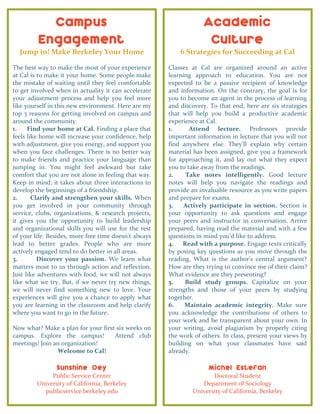
The best way to make the most of your experience
at Cal is to make it your home. Some people make
the mistake of waiting until they feel comfortable
to get involved when in actuality it can accelerate
your adjustment process and help you feel more
like yourself in this new environment. Here are my
top 3 reasons for getting involved on campus and
around the community.
1. Find your home at Cal. Finding a place that
feels like home will increase your confidence, help
with adjustment, give you energy, and support you
when you face challenges. There is no better way
to make friends and practice your language than
jumping in. You might feel awkward but take
comfort that you are not alone in feeling that way.
Keep in mind; it takes about three interactions to
develop the beginnings of a friendship.
2. Clarify and strengthen your skills. When
you get involved in your community through
service, clubs, organizations, & research projects,
it gives you the opportunity to build leadership
and organizational skills you will use for the rest
of your life. Besides, more free time doesn’t always
lead to better grades. People who are more
actively engaged tend to do better in all areas.
3. Discover your passion. We learn what
matters most to us through action and reflection.
Just like adventures with food, we will not always
like what we try. But, if we never try new things,
we will never find something new to love. Your
experiences will give you a chance to apply what
you are learning in the classroom and help clarify
where you want to go in the future.
Now what? Make a plan for your first six weeks on
campus. Explore the campus! Attend club
meetings! Join an organization!
Welcome to Cal!
Sunshine Oey
Public Service Center
University of California, Berkeley
publicservice.berkeley.edu
Academic
Culture
6 Strategies for Succeeding at Cal
Classes at Cal are organized around an active
learning approach to education. You are not
expected to be a passive recipient of knowledge
and information. On the contrary, the goal is for
you to become an agent in the process of learning
and discovery. To that end, here are six strategies
that will help you build a productive academic
experience at Cal.
1. Attend lecture. Professors provide
important information in lecture that you will not
find anywhere else. They’ll explain why certain
material has been assigned, give you a framework
for approaching it, and lay out what they expect
you to take away from the readings.
2. Take notes intelligently. Good lecture
notes will help you navigate the readings and
provide an invaluable resource as you write papers
and prepare for exams.
3. Actively participate in section. Section is
your opportunity to ask questions and engage
your peers and instructor in conversation. Arrive
prepared, having read the material and with a few
questions in mind you’d like to address.
4. Read with a purpose. Engage texts critically
by posing key questions as you move through the
reading. What is the author’s central argument?
How are they trying to convince me of their claim?
What evidence are they presenting?
5. Build study groups. Capitalize on your
strengths and those of your peers by studying
together.
6. Maintain academic integrity. Make sure
you acknowledge the contributions of others to
your work and be transparent about your own. In
your writing, avoid plagiarism by properly citing
the work of others. In class, present your views by
building on what your classmates have said
already.
Michel Estefan
Doctoral Student
Department of Sociology
University of California, Berkeley

International Undergraduate Student Folder

  • 1.
    Start small &set goals: Ask one question in class; add one comment to a small-group discxxuxxxssion • Practice with a language partner at the Student Learning Center or the YWCA on Bancroft • Enroll in public speaking courses: Check out the College Writing Programs • Attend & join Toastmasters International • Look for vxxxunteer InternationalOffice’s GETTING ON TRACK • Set priorities to redress well-being • Seek suppoxxxxxrt from family, friends, faculty & advisors • Get help from professionals at Counseling & Psychological Services (CPS) • uhs.berkeley.edu WARNING SIGNS • Often feeling sad, anxious, overwhelmed • Sick or tired frequently • Negative xxxhxxxnges in behavior or thoughts uhs.berkeley.edu Write multiple drafts • Have a tutor or friend read it • Take it to office hours if you have questions for your instructor • Write with words that you are confident you know how to use, in a voicevoice that feels comfortable • Find out as much as you can about your reader before you write • Find a reliable online onarydictionary (www.onelook.com) that contains the definition of a word and information about how to use the word (dictionary.cambridge.org) • Use synonyms from a thesaurus only if you are familiar with the suggested words • Devise a segysxxxtrategy that enables you to edit for certain errors you tend to make • Keep a desktop document where you list grammar rules and collocations that tend to stump you when you are writing –Angie, International Undergraduate & Lead Mentor Know Berkeley’s Honor Code • wwwxxxxxx.asxxxxxxxxxxxuc.org/honorcode • Know that expectations may vary across courses • Learn to cite sources properly • Conduct group work etxxhixxxxcally • Talk to faculty and advisors when something is unclear • Know your rights • Check out the Center for Teaching and Learning website for more information sa.berkeley.edu/conduct b a l a n c e STAY HEALTHY • Eat well • Get enough sleep! • Exercise regularly • Develop social supports & conxxxxxxnect often to your family & culture • Make wise choices about alcohol & drugs • Get organized & make good use of a calendar • Set boundaries for work & take breaks • Make time for xxxxx! a c a d e m i c i n t e g r i t y s p e a k i n g w r i t i n g t i p s voice dictionary strategy discussion volunteer www.asuc.org/honorcode ethically teaching.berkeley.edu/academic-integrity c o n n e c t fun changes s u p p o r t Berkeley International Office’s weekly Coffee Breaks & monthly iMix social events in one word, it would be ‘opportunity.’ The diversity, the numerous organizations and student clubs, and the inspiring professors all contribute to a culturally, socially, and academically enriching experience that you can’t get anywhere else. Berkeley has enabled me to get out of my comfort zone, given me the chance to try out new things, and more than anything, to grow—to gain knowledge, to connect with others, and to form more of an identity.” don’t be afraid to make mistakes • Stop by opportunities • Make friends, join clubs, & “if I had to describe the
  • 2.
    2299 Piedmont Avenue│ Berkeley, CA 94750-2321 │ 510.642.2818 internationaloffice.berkeley.edu Open Hours: Monday through Friday │ 9am-12pm and 1-4pm Student Advising Drop-in Hours: Monday through Friday │ 10am-12pm and 1:30-4pm BerkeleyINTERNATIONAL OFFICE
  • 3.
    Berkeley Special thanks toour contributors: Margi Wald & Michelle Baptiste │ College Writing Programs, UC Berkeley Richard Freishtat │ Center for Teaching and Learning, UC Berkeley Kin Ming Chan, PhD │ Counseling & Psychological Services, UC Berkeley Sunshine Oey │ Public Service Center, UC Berkeley Michel Estefan │ Department of Sociology, UC Berkeley INTERNATIONAL OFFICE
  • 4.
    Campus Engagement Jump in! MakeBerkeley Your Home The best way to make the most of your experience at Cal is to make it your home. Some people make the mistake of waiting until they feel comfortable to get involved when in actuality it can accelerate your adjustment process and help you feel more like yourself in this new environment. Here are my top 3 reasons for getting involved on campus and around the community. 1. Find your home at Cal. Finding a place that feels like home will increase your confidence, help with adjustment, give you energy, and support you when you face challenges. There is no better way to make friends and practice your language than jumping in. You might feel awkward but take comfort that you are not alone in feeling that way. Keep in mind; it takes about three interactions to develop the beginnings of a friendship. 2. Clarify and strengthen your skills. When you get involved in your community through service, clubs, organizations, & research projects, it gives you the opportunity to build leadership and organizational skills you will use for the rest of your life. Besides, more free time doesn’t always lead to better grades. People who are more actively engaged tend to do better in all areas. 3. Discover your passion. We learn what matters most to us through action and reflection. Just like adventures with food, we will not always like what we try. But, if we never try new things, we will never find something new to love. Your experiences will give you a chance to apply what you are learning in the classroom and help clarify where you want to go in the future. Now what? Make a plan for your first six weeks on campus. Explore the campus! Attend club meetings! Join an organization! Welcome to Cal! Sunshine Oey Public Service Center University of California, Berkeley publicservice.berkeley.edu Academic Culture 6 Strategies for Succeeding at Cal Classes at Cal are organized around an active learning approach to education. You are not expected to be a passive recipient of knowledge and information. On the contrary, the goal is for you to become an agent in the process of learning and discovery. To that end, here are six strategies that will help you build a productive academic experience at Cal. 1. Attend lecture. Professors provide important information in lecture that you will not find anywhere else. They’ll explain why certain material has been assigned, give you a framework for approaching it, and lay out what they expect you to take away from the readings. 2. Take notes intelligently. Good lecture notes will help you navigate the readings and provide an invaluable resource as you write papers and prepare for exams. 3. Actively participate in section. Section is your opportunity to ask questions and engage your peers and instructor in conversation. Arrive prepared, having read the material and with a few questions in mind you’d like to address. 4. Read with a purpose. Engage texts critically by posing key questions as you move through the reading. What is the author’s central argument? How are they trying to convince me of their claim? What evidence are they presenting? 5. Build study groups. Capitalize on your strengths and those of your peers by studying together. 6. Maintain academic integrity. Make sure you acknowledge the contributions of others to your work and be transparent about your own. In your writing, avoid plagiarism by properly citing the work of others. In class, present your views by building on what your classmates have said already. Michel Estefan Doctoral Student Department of Sociology University of California, Berkeley