Pankaj Kumar Ojha
Scholar
Department of Extension Education
Institute of Agricultural sciences
Banaras Hindu University
Varanasi-221005 (U.P) India
pankajojhabhu@gmail.com
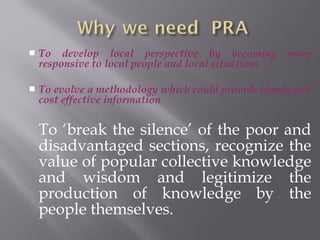
 To develop local perspective by becoming more
responsive to local people and local situations
 To evolve a methodology which could provide timely and
cost effective information
To ‘break the silence’ of the poor and
disadvantaged sections, recognize the
value of popular collective knowledge
and wisdom and legitimize the
production of knowledge by the
people themselves.
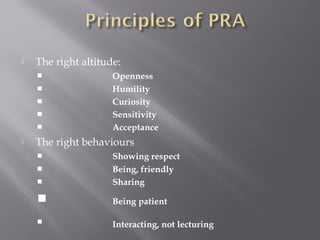
 The right altitude:
 Openness
 Humility
 Curiosity
 Sensitivity
 Acceptance
 The right behaviours
 Showing respect
 Being, friendly
 Sharing
 Being patient
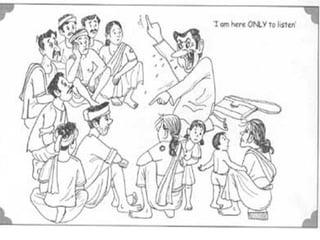
 Interacting, not lecturing
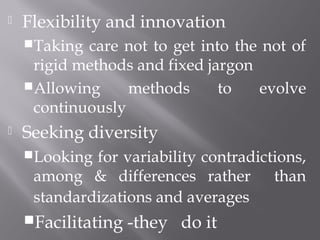
 Flexibility and innovation
Taking care not to get into the not of
rigid methods and fixed jargon
Allowing methods to evolve
continuously
 Seeking diversity
Looking for variability contradictions,
among & differences rather than
standardizations and averages
Facilitating -they do it
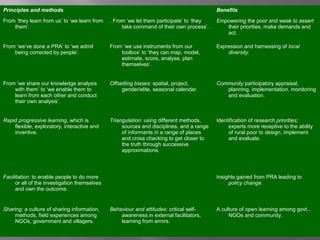
Principles and methods Benefits
From ‘they learn from us’ to ‘we learn from
them’.
. From ‘we let them participate’ to ‘they
take command of their own process’.
Empowering the poor and weak to assert
their priorities, make demands and
act.
From ‘we’ve done a PRA’ to ‘we admit
being corrected by people’.
From ‘we use instruments from our
toolbox’ to ‘they can map, model,
estimate, score, analyse, plan
themselves’.
Expression and harnessing of local
diversity.
From ‘we share our knowledge analysis
with them’ to ‘we enable them to
learn from each other and conduct
their own analysis’.
Offsetting biases: spatial, project,
gender/elite, seasonal calendar.
Community participatory appraisal,
planning, implementation, monitoring
and evaluation.
Rapid progressive learning, which is
flexible, exploratory, interactive and
inventive.
Triangulation: using different methods,
sources and disciplines, and a range
of informants in a range of places
and cross checking to get closer to
the truth through successive
approximations.
Identification of research priorities;
experts more receptive to the ability
of rural poor to design, implement
and evaluate.
Facilitation: to enable people to do more
or all of the investigation themselves
and own the outcome.
Insights gained from PRA leading to
policy change.
Sharing: a culture of sharing information,
methods, field experiences among
NGOs, government and villagers.
Behaviour and attitudes: critical self-
awareness in external facilitators,
learning from errors.
A culture of open learning among govt.,
NGOs and community.
 1.Partcipatory Mapping
 2.Transect Walk
 3.ITK(Indigenous Technical Knowledge)
 4.Time Line
 5.Matrix Ranking
 6.Seasonability
 7.Venn diagram
 8.Wealth Ranking
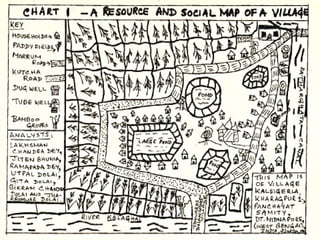
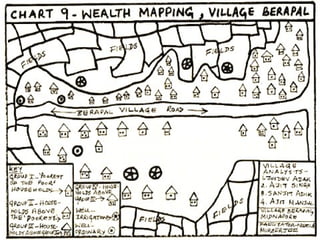
 Construction of Map by the villagers
Purpose
 Impression and understanding on
 social lay out
 Physical structure
 Natural resource environment
Application
 Identifying Pattern of land use
 Identifying beneficiaries
 Water resources
 Soil conservation and forestry
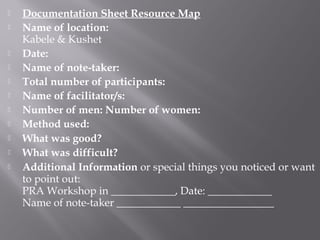
 Documentation Sheet Resource Map
 Name of location:
Kabele & Kushet
 Date:
 Name of note-taker:
 Total number of participants:
 Name of facilitator/s:
 Number of men: Number of women:
 Method used:
 What was good?
 What was difficult?
 Additional Information or special things you noticed or want
to point out:
PRA Workshop in ____________, Date: ____________
Name of note-taker ____________ _________________
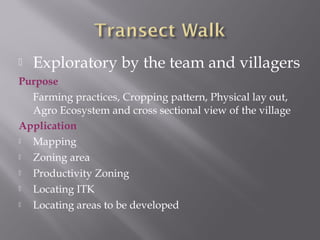
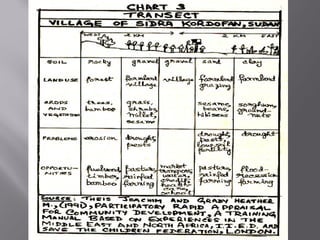
 Exploratory by the team and villagers
Purpose
Farming practices, Cropping pattern, Physical lay out,
Agro Ecosystem and cross sectional view of the village
Application
 Mapping
 Zoning area
 Productivity Zoning
 Locating ITK
 Locating areas to be developed
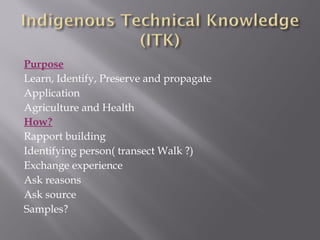
Purpose
Learn, Identify, Preserve and propagate
Application
Agriculture and Health
How?
Rapport building
Identifying person( transect Walk ?)
Exchange experience
Ask reasons
Ask source
Samples?
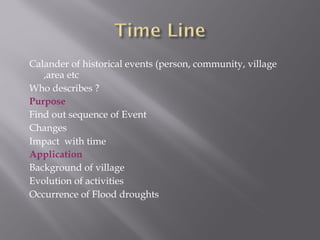
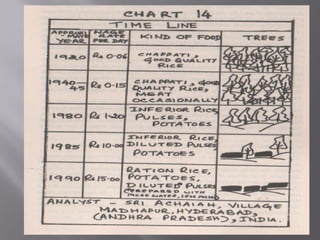
Calander of historical events (person, community, village
,area etc
Who describes ?
Purpose
Find out sequence of Event
Changes
Impact with time
Application
Background of village
Evolution of activities
Occurrence of Flood droughts
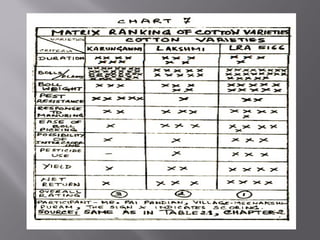
 Rankin the preferences and attitudes, farmers
priorities on verities, crops, tree ,livestock
Purpose
Understand farmers decision making
Identify the criteria and select certain items
(Tree, Fodder,Cattele,Breed)
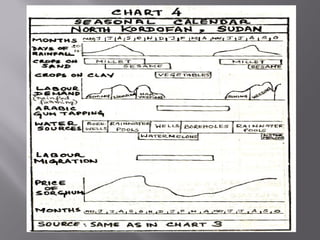
 Exercise to determine seasonal pattern of
rainfall, farming practices, employment, work,
health, food ,fodder, and fuel
 Application
 Indicate rainfall
 Milk yied
 Grazing etc
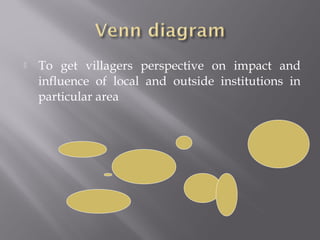
 To get villagers perspective on impact and
influence of local and outside institutions in
particular area
 Process by which members of community
determine the relative wealthiness of all members
by taking in to account of ,assets, resources,
income, diseased person etc
 Purpose
Asses and identify pattern of wealthines
Identify Resourceful and resource poor
Criteria of wealthiness
Pankaj ojha... pra
Pankaj ojha... pra

Pankaj ojha... pra

  • 1.
    Pankaj Kumar Ojha Scholar Departmentof Extension Education Institute of Agricultural sciences Banaras Hindu University Varanasi-221005 (U.P) India pankajojhabhu@gmail.com
  • 6.
     To developlocal perspective by becoming more responsive to local people and local situations  To evolve a methodology which could provide timely and cost effective information To ‘break the silence’ of the poor and disadvantaged sections, recognize the value of popular collective knowledge and wisdom and legitimize the production of knowledge by the people themselves.
  • 7.
     The rightaltitude:  Openness  Humility  Curiosity  Sensitivity  Acceptance  The right behaviours  Showing respect  Being, friendly  Sharing  Being patient  Interacting, not lecturing
  • 8.
     Flexibility andinnovation Taking care not to get into the not of rigid methods and fixed jargon Allowing methods to evolve continuously  Seeking diversity Looking for variability contradictions, among & differences rather than standardizations and averages Facilitating -they do it
  • 9.
    Principles and methodsBenefits From ‘they learn from us’ to ‘we learn from them’. . From ‘we let them participate’ to ‘they take command of their own process’. Empowering the poor and weak to assert their priorities, make demands and act. From ‘we’ve done a PRA’ to ‘we admit being corrected by people’. From ‘we use instruments from our toolbox’ to ‘they can map, model, estimate, score, analyse, plan themselves’. Expression and harnessing of local diversity. From ‘we share our knowledge analysis with them’ to ‘we enable them to learn from each other and conduct their own analysis’. Offsetting biases: spatial, project, gender/elite, seasonal calendar. Community participatory appraisal, planning, implementation, monitoring and evaluation. Rapid progressive learning, which is flexible, exploratory, interactive and inventive. Triangulation: using different methods, sources and disciplines, and a range of informants in a range of places and cross checking to get closer to the truth through successive approximations. Identification of research priorities; experts more receptive to the ability of rural poor to design, implement and evaluate. Facilitation: to enable people to do more or all of the investigation themselves and own the outcome. Insights gained from PRA leading to policy change. Sharing: a culture of sharing information, methods, field experiences among NGOs, government and villagers. Behaviour and attitudes: critical self- awareness in external facilitators, learning from errors. A culture of open learning among govt., NGOs and community.
  • 10.
     1.Partcipatory Mapping 2.Transect Walk  3.ITK(Indigenous Technical Knowledge)  4.Time Line  5.Matrix Ranking  6.Seasonability  7.Venn diagram  8.Wealth Ranking
  • 11.
     Construction ofMap by the villagers Purpose  Impression and understanding on  social lay out  Physical structure  Natural resource environment Application  Identifying Pattern of land use  Identifying beneficiaries  Water resources  Soil conservation and forestry
  • 13.
     Documentation SheetResource Map  Name of location: Kabele & Kushet  Date:  Name of note-taker:  Total number of participants:  Name of facilitator/s:  Number of men: Number of women:  Method used:  What was good?  What was difficult?  Additional Information or special things you noticed or want to point out: PRA Workshop in ____________, Date: ____________ Name of note-taker ____________ _________________
  • 14.
     Exploratory bythe team and villagers Purpose Farming practices, Cropping pattern, Physical lay out, Agro Ecosystem and cross sectional view of the village Application  Mapping  Zoning area  Productivity Zoning  Locating ITK  Locating areas to be developed
  • 16.
    Purpose Learn, Identify, Preserveand propagate Application Agriculture and Health How? Rapport building Identifying person( transect Walk ?) Exchange experience Ask reasons Ask source Samples?
  • 17.
    Calander of historicalevents (person, community, village ,area etc Who describes ? Purpose Find out sequence of Event Changes Impact with time Application Background of village Evolution of activities Occurrence of Flood droughts
  • 19.
     Rankin thepreferences and attitudes, farmers priorities on verities, crops, tree ,livestock Purpose Understand farmers decision making Identify the criteria and select certain items (Tree, Fodder,Cattele,Breed)
  • 21.
     Exercise todetermine seasonal pattern of rainfall, farming practices, employment, work, health, food ,fodder, and fuel  Application  Indicate rainfall  Milk yied  Grazing etc
  • 23.
     To getvillagers perspective on impact and influence of local and outside institutions in particular area
  • 24.
     Process bywhich members of community determine the relative wealthiness of all members by taking in to account of ,assets, resources, income, diseased person etc  Purpose Asses and identify pattern of wealthines Identify Resourceful and resource poor Criteria of wealthiness