Child Protection Issues An Overview for Principals and Vice-Principals
Introduction  Over a  20  year career  89%  of teachers  will   suspect abuse   Over the  last 24 hours  when   have  you  touched  a child?  A question from the New Zealand Elementary Teachers Physical Contact Code of Practice (2003) A  maximum  of  3—4 hours  was devoted to child protection  training  for  new teachers  in 1997;  minimum  1 hour  (Child Abuse Review, 2003) Peel Children's Aid served  more  than  7,800 families  and  16,300 children  in the Region of Peel (2006)   More  than  5,500 investigations  were conducted by the Peel Children's Aid Agency (2006)
Agenda Definitions of child abuse & child protection Child abuse: 4 components Who is involved? Children's Aid Society Rights and Responsibilities Case Studies Evaluation
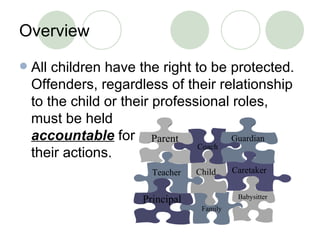
Overview  All children have the right to be protected.  Offenders, regardless of their relationship to the child or their professional roles, must be held  accountable  for  their actions. Caretaker Family Babysitter Child Teacher Principal Coach Guardian Parent
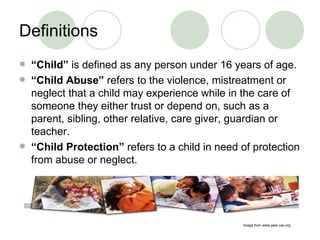
Definitions “ Child”  is defined as any person under 16 years of age. “ Child Abuse”  refers to the violence, mistreatment or neglect that a child may experience while in the care of someone they either trust or depend on, such as a parent, sibling, other relative, care giver, guardian or teacher. “ Child Protection”  refers to a child in need of protection from abuse or neglect. Image from www.peel.cas.org
Emotional & Psychological Abuse A child  has suffered emotional or psychological harm if he/she exhibits anxiety, depression, withdrawal, delayed development, self-destructive and aggressive behaviour because of chronic and persistent ridicule and rejection.  These  behaviours may be the result of actions on the part of parents/guardians/caregivers or their failure to act, prevent, remedy or alleviate such actions.
Physical Abuse Physical abuse is  the intentional use of force against a child resulting in injury or causing bodily harm. Physical abuse is physical force or violence that results in bodily injury, pain, or impairment including assault, battery, and inappropriate restraint. P hysical abuse refers to the infliction of physical harm on a child by a parent or caregiver .
Physical Abuse The  harm standard   considers behaviour as abusive only if it results in  visible  harm or injuries . (ex. bruises, cuts, burns, fractures,…) The  endangerment  standard  considers  physical assault by a parent or caregiver that presents a substantial risk of physical injury is considered abuse .  (ex.  poisoning, suffocating, drowning …)  Although these actions may not result in observable injuries   they are still considered abusive .
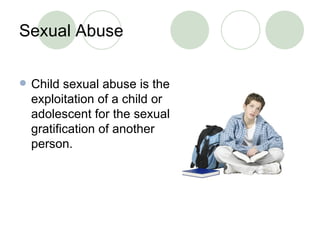
Sexual Abuse Child sexual abuse is the exploitation of a child or adolescent for the sexual gratification of another person.
Sexual Abuse Abusive behaviours include: Voyeurism Fondling  Child prostitution Child pornography Intercourse Sodomy Oral-genital stimulation Verbal stimulation Exhibitionism
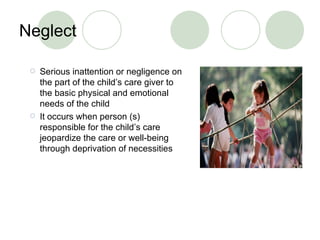
Neglect Serious inattention or negligence on the part of the child’s care giver to the basic physical and emotional needs of the child It occurs when person (s) responsible for the child’s care jeopardize the care or well-being through deprivation of necessities
What are the indicators?
Emotional/Psychological Abuse Physical Indicators The physical indicators for those who suffer emotional or psychological abuse are: Development delay. Frequent headaches, nausea and abdominal pains. Different dressing from members of their family or schoolmates. Substandard living conditions. Unusual appearance manifested by bizarre haircuts and decorations.
Emotional/Psychological Abuse Behavioural Indicators The behavioural indicators for those who suffer emotional or psychological abuse are: Development lags. Prolonged unhappiness, stress, withdrawal.  Regressive behaviour such as constant rocking. Over-compliance, exceptionally good mannerisms. Recklessness, unexplained absences and family disruptions.
Physical Abuse Physical Indicators Sprains, dislocations, fractures, broken bones, burns, abrasions, lacerations, internal injuries and bleeding, non-accidental bruises, head injuries. Injuries are inconsistent with explanation. Numerous injuries in various stages of recovery or healing. Presence of injuries over an extended period of time. Injuries inconsistent with child’s age and developmental phase.
Physical Abuse Behavioural Indicators Injuries are unexplained (include implausible). Family members provide different explanations. A history of similar injuries. Delay between onset of injury and seeking medical care. Wary of adults. Flinch if touched unexpectedly.
Sexual Abuse Physical Indicators Unusual or excess itching or pain in the throat, genital or anal area. Odour or discharge from genital area. Stained or bloody underclothing. Pain on urination, elimination, sitting down, walking or swallowing. Blood or urine in stool.
Sexual Abuse Behavioural Indicators Age-inappropriate sexual play with toys, self & others. Re-enactment of adult sexual activities. Age-inappropriate explicit drawings. Bizarre or sophisticated sexual knowledge. Sexualized behaviour with other children.
Neglect  Physical Indicators Young children display abnormal growth patterns, weight loss, sunken cheeks, paleness, lethargy, unresponsive to stimulation. Inappropriate dress for weather. Poor hygiene, dirty or unbathed state. Severe, persistent diaper rash or other skin disorder (unattended). Consistent hunger. Lack of medical routine. Signs of deprivation (diaper rash, hunger).
Neglect Behavioural Indicators Doesn't meet developmental milestones. Appears lethargic, undemanding, cries very little. Unresponsive to stimulation. Uninterested in surroundings. Demonstrates severe lack of attachment to parent, little fear of strangers. May be very demanding of affection or attention from others.
Emotional/Psychological Abuse Behaviours observed in the abuser Consistently rejects child Consistently degrades child Blames child for problems, difficulties, disappointments
Physical Abuse Behaviours observed in the abuser Gives harsh, unusual punishment Shows lack of self control May give inconsistent explanations about child’s injury
Sexual Abuse Behaviours observed in the abuser May be over-protective Is frequently alone with the child & is socially isolated May be jealous of the child’s relationship with other adults
Neglect Behaviours observed in the abusers Maintains chaotic home life with little evidence of regular healthful routines Overwhelmed with own problems & needs which are put ahead of the child
Who is involved ?
Pre-Report Stage Report Stage Post-Report Stage
A closer look… What happens in the Waterloo Region District School Board? Image from: http://www.wrdsb.on.ca/
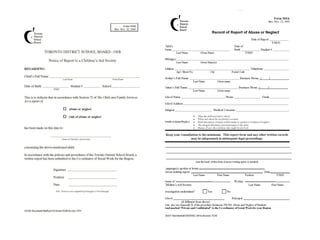
Relevant Legislation Child and Family Services Act s. 72 - Despite the provisions of any other Act, if a person, including a person who performs professional or official duties with respect to children, has reasonable grounds to suspect that a child is or may be suffering or may have suffered abuse, the person shall forthwith report the suspicion and the information which it is based to a society.
 
Children's Aid Society
Case Studies
Summary Definitions for types of abuse Steps to take to inform CAS Importance of training your staff about the indicators
Evaluation Thank-you for your feedback about today’s presentation.

PQP 1 Child Protection

  • 1.
    Child Protection IssuesAn Overview for Principals and Vice-Principals
  • 2.
    Introduction Overa 20 year career 89% of teachers will suspect abuse Over the last 24 hours when have you touched a child? A question from the New Zealand Elementary Teachers Physical Contact Code of Practice (2003) A maximum of 3—4 hours was devoted to child protection training for new teachers in 1997; minimum 1 hour (Child Abuse Review, 2003) Peel Children's Aid served more than 7,800 families and 16,300 children in the Region of Peel (2006) More than 5,500 investigations were conducted by the Peel Children's Aid Agency (2006)
  • 3.
    Agenda Definitions ofchild abuse & child protection Child abuse: 4 components Who is involved? Children's Aid Society Rights and Responsibilities Case Studies Evaluation
  • 4.
    Overview Allchildren have the right to be protected. Offenders, regardless of their relationship to the child or their professional roles, must be held accountable for their actions. Caretaker Family Babysitter Child Teacher Principal Coach Guardian Parent
  • 5.
    Definitions “ Child” is defined as any person under 16 years of age. “ Child Abuse” refers to the violence, mistreatment or neglect that a child may experience while in the care of someone they either trust or depend on, such as a parent, sibling, other relative, care giver, guardian or teacher. “ Child Protection” refers to a child in need of protection from abuse or neglect. Image from www.peel.cas.org
  • 6.
    Emotional & PsychologicalAbuse A child has suffered emotional or psychological harm if he/she exhibits anxiety, depression, withdrawal, delayed development, self-destructive and aggressive behaviour because of chronic and persistent ridicule and rejection. These behaviours may be the result of actions on the part of parents/guardians/caregivers or their failure to act, prevent, remedy or alleviate such actions.
  • 7.
    Physical Abuse Physicalabuse is the intentional use of force against a child resulting in injury or causing bodily harm. Physical abuse is physical force or violence that results in bodily injury, pain, or impairment including assault, battery, and inappropriate restraint. P hysical abuse refers to the infliction of physical harm on a child by a parent or caregiver .
  • 8.
    Physical Abuse The harm standard considers behaviour as abusive only if it results in visible harm or injuries . (ex. bruises, cuts, burns, fractures,…) The endangerment standard considers physical assault by a parent or caregiver that presents a substantial risk of physical injury is considered abuse . (ex. poisoning, suffocating, drowning …) Although these actions may not result in observable injuries they are still considered abusive .
  • 9.
    Sexual Abuse Childsexual abuse is the exploitation of a child or adolescent for the sexual gratification of another person.
  • 10.
    Sexual Abuse Abusivebehaviours include: Voyeurism Fondling Child prostitution Child pornography Intercourse Sodomy Oral-genital stimulation Verbal stimulation Exhibitionism
  • 11.
    Neglect Serious inattentionor negligence on the part of the child’s care giver to the basic physical and emotional needs of the child It occurs when person (s) responsible for the child’s care jeopardize the care or well-being through deprivation of necessities
  • 12.
    What are theindicators?
  • 13.
    Emotional/Psychological Abuse PhysicalIndicators The physical indicators for those who suffer emotional or psychological abuse are: Development delay. Frequent headaches, nausea and abdominal pains. Different dressing from members of their family or schoolmates. Substandard living conditions. Unusual appearance manifested by bizarre haircuts and decorations.
  • 14.
    Emotional/Psychological Abuse BehaviouralIndicators The behavioural indicators for those who suffer emotional or psychological abuse are: Development lags. Prolonged unhappiness, stress, withdrawal. Regressive behaviour such as constant rocking. Over-compliance, exceptionally good mannerisms. Recklessness, unexplained absences and family disruptions.
  • 15.
    Physical Abuse PhysicalIndicators Sprains, dislocations, fractures, broken bones, burns, abrasions, lacerations, internal injuries and bleeding, non-accidental bruises, head injuries. Injuries are inconsistent with explanation. Numerous injuries in various stages of recovery or healing. Presence of injuries over an extended period of time. Injuries inconsistent with child’s age and developmental phase.
  • 16.
    Physical Abuse BehaviouralIndicators Injuries are unexplained (include implausible). Family members provide different explanations. A history of similar injuries. Delay between onset of injury and seeking medical care. Wary of adults. Flinch if touched unexpectedly.
  • 17.
    Sexual Abuse PhysicalIndicators Unusual or excess itching or pain in the throat, genital or anal area. Odour or discharge from genital area. Stained or bloody underclothing. Pain on urination, elimination, sitting down, walking or swallowing. Blood or urine in stool.
  • 18.
    Sexual Abuse BehaviouralIndicators Age-inappropriate sexual play with toys, self & others. Re-enactment of adult sexual activities. Age-inappropriate explicit drawings. Bizarre or sophisticated sexual knowledge. Sexualized behaviour with other children.
  • 19.
    Neglect PhysicalIndicators Young children display abnormal growth patterns, weight loss, sunken cheeks, paleness, lethargy, unresponsive to stimulation. Inappropriate dress for weather. Poor hygiene, dirty or unbathed state. Severe, persistent diaper rash or other skin disorder (unattended). Consistent hunger. Lack of medical routine. Signs of deprivation (diaper rash, hunger).
  • 20.
    Neglect Behavioural IndicatorsDoesn't meet developmental milestones. Appears lethargic, undemanding, cries very little. Unresponsive to stimulation. Uninterested in surroundings. Demonstrates severe lack of attachment to parent, little fear of strangers. May be very demanding of affection or attention from others.
  • 21.
    Emotional/Psychological Abuse Behavioursobserved in the abuser Consistently rejects child Consistently degrades child Blames child for problems, difficulties, disappointments
  • 22.
    Physical Abuse Behavioursobserved in the abuser Gives harsh, unusual punishment Shows lack of self control May give inconsistent explanations about child’s injury
  • 23.
    Sexual Abuse Behavioursobserved in the abuser May be over-protective Is frequently alone with the child & is socially isolated May be jealous of the child’s relationship with other adults
  • 24.
    Neglect Behaviours observedin the abusers Maintains chaotic home life with little evidence of regular healthful routines Overwhelmed with own problems & needs which are put ahead of the child
  • 25.
  • 26.
    Pre-Report Stage ReportStage Post-Report Stage
  • 27.
    A closer look…What happens in the Waterloo Region District School Board? Image from: http://www.wrdsb.on.ca/
  • 28.
    Relevant Legislation Childand Family Services Act s. 72 - Despite the provisions of any other Act, if a person, including a person who performs professional or official duties with respect to children, has reasonable grounds to suspect that a child is or may be suffering or may have suffered abuse, the person shall forthwith report the suspicion and the information which it is based to a society.
  • 29.
  • 30.
  • 31.
  • 32.
    Summary Definitions fortypes of abuse Steps to take to inform CAS Importance of training your staff about the indicators
  • 33.
    Evaluation Thank-you foryour feedback about today’s presentation.