Certification Exam Outline
Effective Date: April 2015
2CISSP Certification Exam Outline
About CISSP
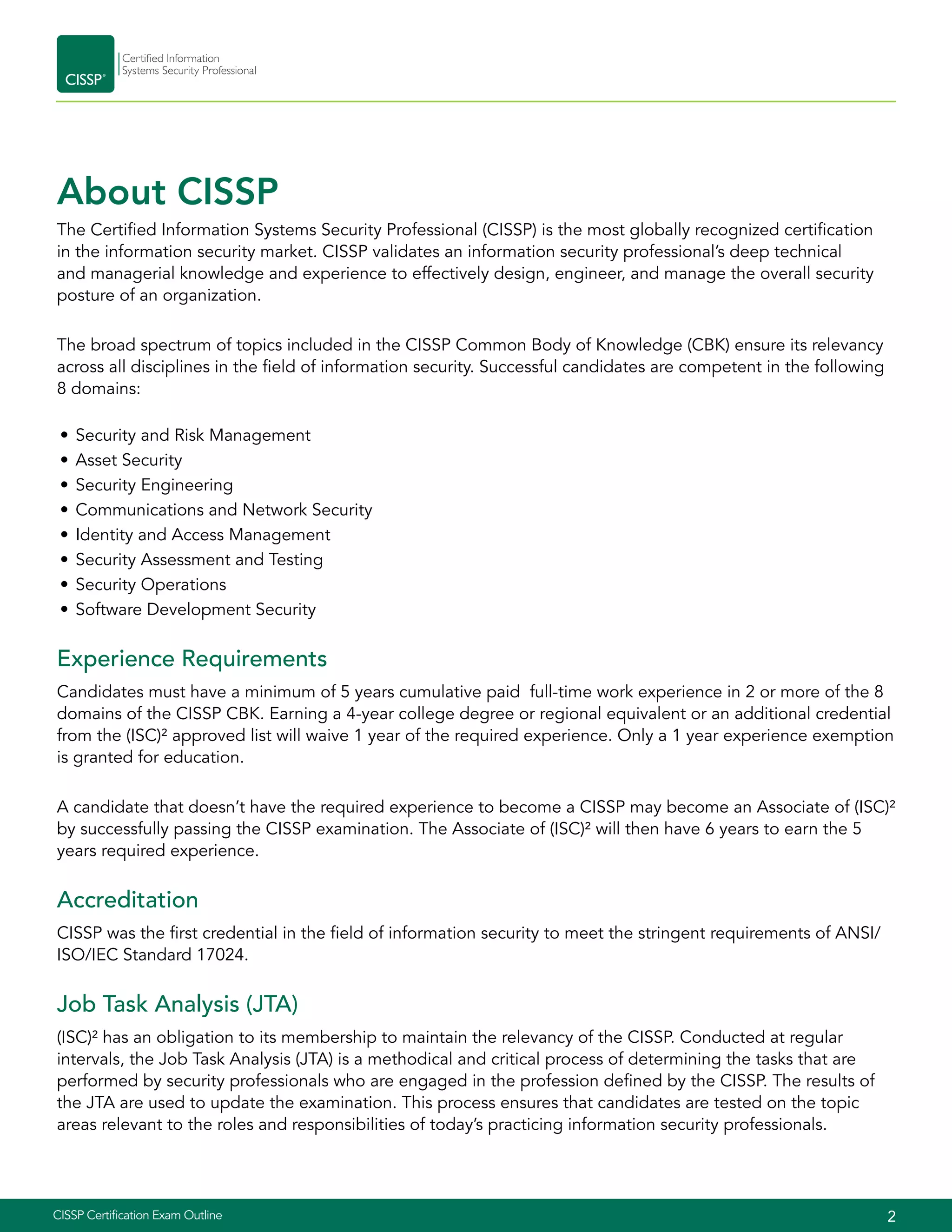
The Certified Information Systems Security Professional (CISSP) is the most globally recognized certification
in the information security market. CISSP validates an information security professional’s deep technical
and managerial knowledge and experience to effectively design, engineer, and manage the overall security
posture of an organization.
The broad spectrum of topics included in the CISSP Common Body of Knowledge (CBK) ensure its relevancy
across all disciplines in the field of information security. Successful candidates are competent in the following
8 domains:
•	Security and Risk Management
•	Asset Security
•	Security Engineering
•	Communications and Network Security
•	Identity and Access Management
•	Security Assessment and Testing
•	Security Operations
•	Software Development Security
Experience Requirements
Candidates must have a minimum of 5 years cumulative paid full-time work experience in 2 or more of the 8
domains of the CISSP CBK. Earning a 4-year college degree or regional equivalent or an additional credential
from the (ISC)² approved list will waive 1 year of the required experience. Only a 1 year experience exemption
is granted for education.
A candidate that doesn’t have the required experience to become a CISSP may become an Associate of (ISC)²
by successfully passing the CISSP examination. The Associate of (ISC)² will then have 6 years to earn the 5
years required experience.
Accreditation
CISSP was the first credential in the field of information security to meet the stringent requirements of ANSI/
ISO/IEC Standard 17024.
Job Task Analysis (JTA)
(ISC)² has an obligation to its membership to maintain the relevancy of the CISSP. Conducted at regular
intervals, the Job Task Analysis (JTA) is a methodical and critical process of determining the tasks that are
performed by security professionals who are engaged in the profession defined by the CISSP. The results of
the JTA are used to update the examination. This process ensures that candidates are tested on the topic
areas relevant to the roles and responsibilities of today’s practicing information security professionals.
3CISSP Certification Exam Outline
CISSP Examination Information
CISSP Examination Weights
Length of exam
Number of questions
Question format
Passing grade
Exam availability
Testing center
6 hours
250
Multiple choice and advanced innovative questions
700 out of 1000 points
English, French, German, Brazilian Portuguese, Spanish,
Japanese, Simplified Chinese, Korean, Visually impaired
Pearson VUE Testing Center
Domains Weight
1. Security and Risk Management 16%
2. Asset Security 10%
3. Security Engineering 12%
4. Communications and Network Security 12%
5. Identity and Access Management 13%
6. Security Assessment and Testing 11%
7. Security Operations 16%
8. Software Development Security 10%
Total: 100%
4CISSP Certification Exam Outline
Domain 1:
Security and Risk Management
1.1	 Understand and apply concepts of confidentiality, integrity and availability
1.2	 Apply security governance principles through:
1.3	 Compliance
»» Legislative and regulatory compliance
»» Privacy requirements compliance
1.4	 Understand legal and regulatory issues that pertain to information security in a global
context
1.5	 Understand professional ethics
»» Exercise (ISC)² Code of Professional Ethics
»» Support organization’s code of ethics
1.6	 Develop and implement documented security policy, standards, procedures, and
guidelines
1.7	 Understand business continuity requirements
»» Develop and document project scope and plan
»» Conduct business impact analysis
»» Alignment of security function to strategy, goals,
mission, and objectives (e.g., business case,
budget and resources)
»» Organizational processes (e.g., acquisitions,
divestitures, governance committees)
»» Security roles and responsibilities
»» Control frameworks
»» Due care
»» Due diligence
»» Computer crimes
»» Licensing and intellectual property (e.g.,
copyright, trademark, digital-rights management)
»» Import/export controls
»» Trans-border data flow
»» Privacy
»» Data breaches
5CISSP Certification Exam Outline
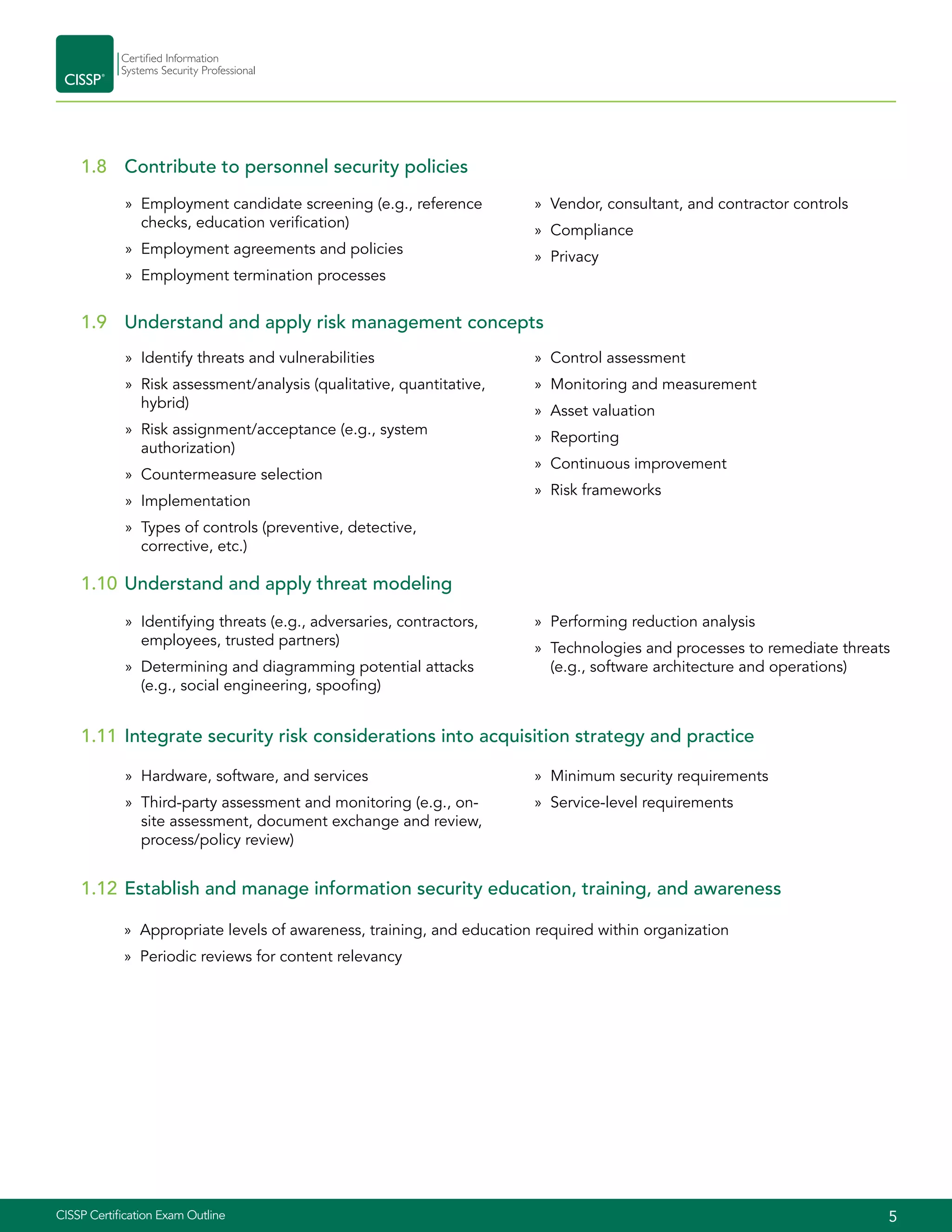
1.8	 Contribute to personnel security policies
1.9	 Understand and apply risk management concepts
1.10	Understand and apply threat modeling
1.11	Integrate security risk considerations into acquisition strategy and practice
1.12	Establish and manage information security education, training, and awareness
»» Appropriate levels of awareness, training, and education required within organization
»» Periodic reviews for content relevancy
»» Employment candidate screening (e.g., reference
checks, education verification)
»» Employment agreements and policies
»» Employment termination processes
»» Vendor, consultant, and contractor controls
»» Compliance
»» Privacy
»» Identify threats and vulnerabilities
»» Risk assessment/analysis (qualitative, quantitative,
hybrid)
»» Risk assignment/acceptance (e.g., system
authorization)
»» Countermeasure selection
»» Implementation
»» Types of controls (preventive, detective,
corrective, etc.)
»» Control assessment
»» Monitoring and measurement
»» Asset valuation
»» Reporting
»» Continuous improvement
»» Risk frameworks
»» Identifying threats (e.g., adversaries, contractors,
employees, trusted partners)
»» Determining and diagramming potential attacks
(e.g., social engineering, spoofing)
»» Performing reduction analysis
»» Technologies and processes to remediate threats
(e.g., software architecture and operations)
»» Hardware, software, and services
»» Third-party assessment and monitoring (e.g., on-
site assessment, document exchange and review,
process/policy review)
»» Minimum security requirements
»» Service-level requirements
6CISSP Certification Exam Outline
Domain 2:
Asset Security
2.1	 Classify information and supporting assets (e.g., sensitivity, criticality)
2.2	 Determine and maintain ownership (e.g., data owners, system owners, business/mission
owners)
2.3	 Protect privacy
2.4	 Ensure appropriate retention (e.g., media, hardware, personnel)
2.5	 Determine data security controls (e.g., data at rest, data in transit)
2.6	 Establish handling requirements (markings, labels, storage, destruction of sensitive
information)
»» Data owners
»» Data processers
»» Data remanence
»» Collection limitation
»» Baselines
»» Scoping and tailoring
»» Standards selection
»» Cryptography
7CISSP Certification Exam Outline
Domain 3:
Security Engineering
3.1	 Implement and manage engineering processes using secure design principles
3.2	 Understand the fundamental concepts of security models (e.g., Confidentiality,
Integrity, and Multi-level Models)
3.3	 Select controls and countermeasures based upon systems security evaluation models
3.4	 Understand security capabilities of information systems (e.g., memory protection,
virtualization, trusted platform module, interfaces, fault tolerance)
3.5	 Assess and mitigate the vulnerabilities of security architectures, designs, and solution
elements
3.6	 Assess and mitigate vulnerabilities in web-based systems (e.g., XML, OWASP)
3.7	 Assess and mitigate vulnerabilities in mobile systems
3.8	 Assess and mitigate vulnerabilities in embedded devices and cyber-physical systems (e.g.,
network-enabled devices, Internet of things (loT))
3.9	 Apply cryptography
»» Client-based (e.g., applets, local caches)
»» Server-based (e.g., data flow control)
»» Database security (e.g., inference, aggregation,
data mining, data analytics, warehousing)
»» Large-scale parallel data systems
»» Distributed systems (e.g., cloud computing, grid
computing, peer to peer)
»» Cryptographic systems
»» Industrial control systems (e.g., SCADA)
»» Cryptographic life cycle (e.g., cryptographic
limitations, algorithm/protocol governance)
»» Cryptographic types (e.g., symmetric, asymmetric,
elliptic curves)
»» Public Key Infrastructure (PKI)
»» Key management practices
»» Digital signatures
»» Digital rights management
»» Non-repudiation
»» Integrity (hashing and salting)
»» Methods of cryptanalytic attacks (e.g., brute force,
cipher-text only, known plaintext)
8CISSP Certification Exam Outline
3.10	Apply secure principles to site and facility design
3.11	Design and implement physical security
»» Wiring closets
»» Server rooms
»» Media storage facilities
»» Evidence storage
»» Restricted and work area security (e.g., operations
centers)
»» Data center security
»» Utilities and HVAC considerations
»» Water issues (e.g., leakage, flooding)
»» Fire prevention, detection and suppression
9CISSP Certification Exam Outline
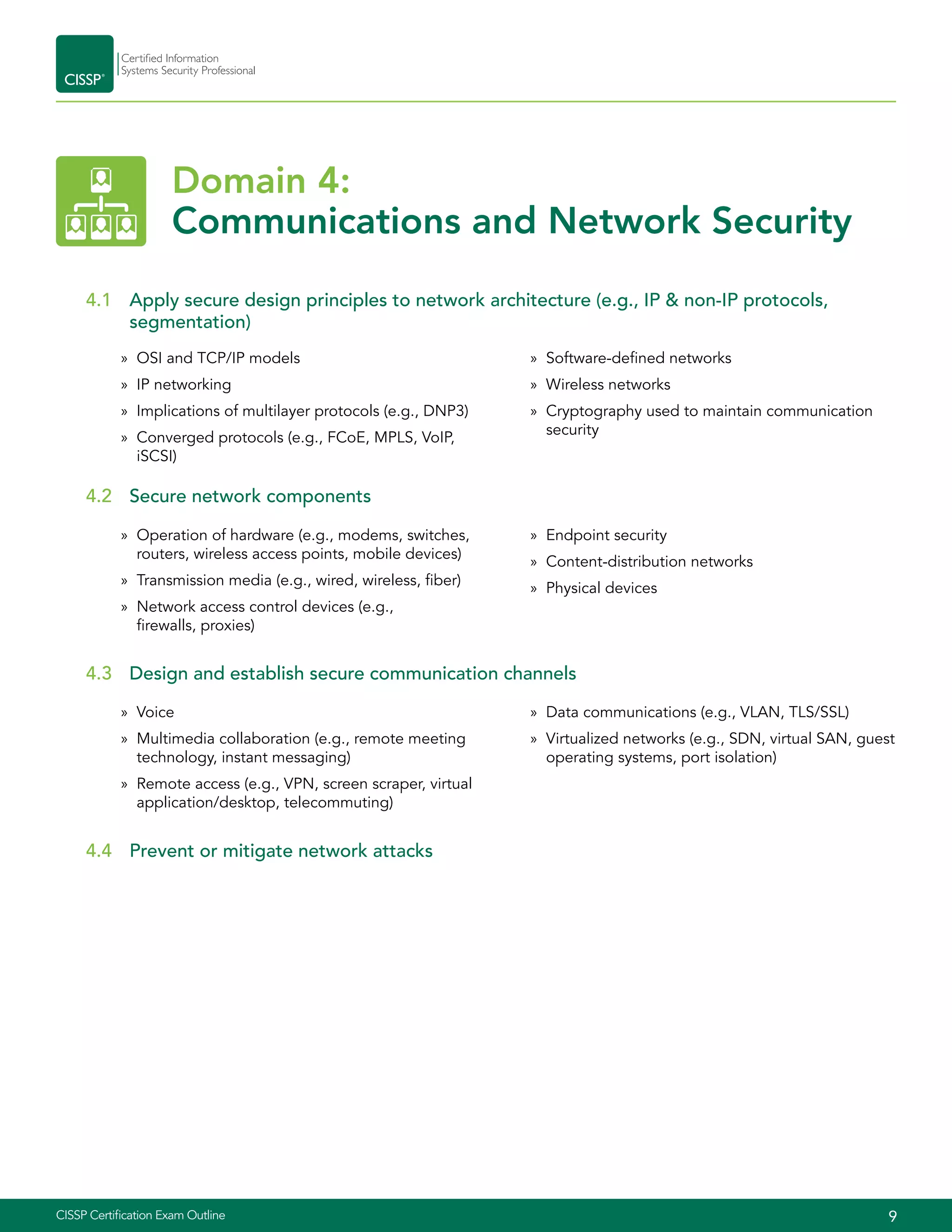
Domain 4:
Communications and Network Security
4.1	 Apply secure design principles to network architecture (e.g., IP & non-IP protocols,
segmentation)
4.2	 Secure network components
4.3	 Design and establish secure communication channels
4.4	 Prevent or mitigate network attacks
»» OSI and TCP/IP models
»» IP networking
»» Implications of multilayer protocols (e.g., DNP3)
»» Converged protocols (e.g., FCoE, MPLS, VoIP,
iSCSI)
»» Software-defined networks
»» Wireless networks
»» Cryptography used to maintain communication
security
»» Operation of hardware (e.g., modems, switches,
routers, wireless access points, mobile devices)
»» Transmission media (e.g., wired, wireless, fiber)
»» Network access control devices (e.g.,
firewalls, proxies)
»» Endpoint security
»» Content-distribution networks
»» Physical devices
»» Voice
»» Multimedia collaboration (e.g., remote meeting
technology, instant messaging)
»» Remote access (e.g., VPN, screen scraper, virtual
application/desktop, telecommuting)
»» Data communications (e.g., VLAN, TLS/SSL)
»» Virtualized networks (e.g., SDN, virtual SAN, guest
operating systems, port isolation)
10CISSP Certification Exam Outline
Domain 5:
Identity and Access Management
5.1	 Control physical and logical access to assets
»» Information
»» Systems
»» Devices
»» Facilities
5.2	 Manage identification and authentication of people and devices
5.3	 Integrate identity as a service (e.g., cloud identity)
5.4	 Integrate third-party identity services (e.g., on-premise)
5.5	 Implement and manage authorization mechanisms
»» Role-Based Access Control (RBAC) methods
»» Rule-based access control methods
»» Mandatory Access Control (MAC)
»» Discretionary Access Control (DAC)
5.6	 Prevent or mitigate access control attacks
5.7	 Manage the identity and access provisioning lifecycle (e.g., provisioning, review)
»» Identity management implementation (e.g., SSO,
LDAP)
»» Single/multi-factor authentication (e.g., factors,
strength, errors)
»» Accountability
»» Session management (e.g., timeouts,
screensavers)
»» Registration and proofing of identity
»» Federated identity management (e.g., SAML)
»» Credential management systems
11CISSP Certification Exam Outline 11
6.1	 Design and validate assessment and test strategies
6.2	 Conduct security control testing
6.3	 Collect security process data (e.g., management and operational controls)
6.4	 Analyze and report test outputs (e.g., automated, manual)
6.5	 Conduct or facilitate internal and third party audits
»» Vulnerability assessment
»» Penetration testing
»» Log reviews
»» Synthetic transactions
»» Code review and testing (e.g., manual, dynamic,
static, fuzz)
»» Misuse case testing
»» Test coverage analysis
»» Interface testing (e.g., API, UI, physical)
»» Account management (e.g., escalation,
revocation)
»» Management review
»» Key performance and risk indicators
»» Backup verification data
»» Training and awareness
»» Disaster recovery and business continuity
Domain 6:
Security Assessment and Testing
12CISSP Certification Exam Outline
7.1	 Understand and support investigations
7.2	 Understand requirements for investigation types
7.3	 Conduct logging and monitoring activities
7.4	 Secure the provisioning of resources
7.5	 Understand and apply foundational security operations concepts
7.6	 Employ resource protection techniques
»» Media management
»» Hardware and software asset management
Domain 7:
Security Operations
»» Evidence collection and handling (e.g., chain of
custody, interviewing)
»» Reporting and documenting
»» Investigative techniques (e.g., root-cause analysis,
incident handling)
»» Digital forensics (e.g., media, network, software,
and embedded devices)
»» Intrusion detection and prevention
»» Security information and event management
»» Continuous monitoring
»» Egress monitoring (e.g., data loss prevention,
steganography, watermarking)
»» Asset inventory (e.g., hardware, software)
»» Configuration management
»» Physical assets
»» Virtual assets (e.g., software-defined network,
virtual SAN, guest operating systems)
»» Cloud assets (e.g., services, VMs, storage,
networks)
»» Applications (e.g., workloads or private clouds,
web services, software as a service)
»» Need-to-know/least privilege (e.g., entitlement,
aggregation, transitive trust)
»» Separation of duties and responsibilities
»» Monitor special privileges (e.g., operators,
administrators)
»» Job rotation
»» Information lifecycle
»» Service-level agreements
»» Operational
»» Criminal
»» Civil
»» Regulatory
»» Electronic discovery (eDiscovery)
13CISSP Certification Exam Outline
7.7	 Conduct incident management
7.8	 Operate and maintain preventative measures
7.9	 Implement and support patch and vulnerability management
7.10	Participate in and understand change management processes (e.g., versioning, baselining,
security impact analysis)
7.11	Implement recovery strategies
7.12	Implement disaster recovery processes
7.13	Test disaster recovery plans
7.14	Participate in business continuity planning and exercises
7.15	Implement and manage physical security
»» Perimeter (e.g., access control and monitoring)
»» Internal security (e.g., escort requirements/visitor control, keys and locks)
7.16	Participate in addressing personnel safety concerns (e.g., duress, travel, monitoring)
»» Detection
»» Response
»» Mitigation
»» Reporting
»» Recovery
»» Remediation
»» Lessons learned
»» Firewalls
»» Intrusion detection and prevention systems
»» Whitelisting/Blacklisting
»» Third-party security services
»» Sandboxing
»» Honeypots/Honeynets
»» Anti-malware
»» Backup storage strategies (e.g., offsite storage,
electronic vaulting, tape rotation)
»» Recovery site strategies
»» Multiple processing sites (e.g., operationally
redundant systems)
»» System resilience, high availability, quality of
service, and fault tolerance
»» Response
»» Personnel
»» Communications
»» Assessment
»» Restoration
»» Training and awareness
»» Read-through
»» Walkthrough
»» Simulation
»» Parallel
»» Full interruption
14CISSP Certification Exam Outline
Domain 8:
Software Development Security
8.1	 Understand and apply security in the software development lifecycle
8.2	 Enforce security controls in development environments
8.3	 Assess the effectiveness of software security
»» Auditing and logging of changes
»» Risk analysis and mitigation
»» Acceptance testing
8.4	 Assess security impact of acquired software
»» Development methodologies (e.g., Agile,
Waterfall)
»» Maturity models
»» Operation and maintenance
»» Change management
»» Integrated product team (e.g., DevOps)
»» Security of the software environments
»» Security weaknesses and vulnerabilities at
the source-code level (e.g., buffer overflow,
escalation of privilege, input/output validation)
»» Configuration management as an aspect of
secure coding
»» Security of code repositories
»» Security of application programming interfaces
15CISSP Certification Exam Outline
Additional Examination Information
Supplementary References
Candidates are encouraged to supplement their education and experience by reviewing
relevant resources that pertain to the CBK and identifying areas of study that may need
additional attention.
View the full list of supplementary references at www.isc2.org/cissp-cbk-references.
Examination Policies and Procedures
(ISC)² recommends that CISSP candidates review exam policies and procedures prior to
registering for the examination. Read the comprehensive breakdown of this important
information at www.isc2.org/exam-policies-procedures.
Legal Info
For any questions related to (ISC)²’s legal policies, please contact the (ISC)2
Legal
Department at legal@isc2.org.
Any Questions?
(ISC)² Candidate Services
311 Park Place Blvd, Suite 400
Clearwater, FL 33759
(ISC)² Americas
Tel: +1.727.785.0189
Email: info@isc2.org
(ISC)² Asia Pacific
Tel: +(852) 28506951
Email: isc2asia@isc2.org
(ISC)² EMEA
Tel: +44 (0)203 300 1625
Email: info-emea@isc2.org
15v217

Cissp exam-outline

  • 1.
  • 2.
    2CISSP Certification ExamOutline About CISSP The Certified Information Systems Security Professional (CISSP) is the most globally recognized certification in the information security market. CISSP validates an information security professional’s deep technical and managerial knowledge and experience to effectively design, engineer, and manage the overall security posture of an organization. The broad spectrum of topics included in the CISSP Common Body of Knowledge (CBK) ensure its relevancy across all disciplines in the field of information security. Successful candidates are competent in the following 8 domains: • Security and Risk Management • Asset Security • Security Engineering • Communications and Network Security • Identity and Access Management • Security Assessment and Testing • Security Operations • Software Development Security Experience Requirements Candidates must have a minimum of 5 years cumulative paid full-time work experience in 2 or more of the 8 domains of the CISSP CBK. Earning a 4-year college degree or regional equivalent or an additional credential from the (ISC)² approved list will waive 1 year of the required experience. Only a 1 year experience exemption is granted for education. A candidate that doesn’t have the required experience to become a CISSP may become an Associate of (ISC)² by successfully passing the CISSP examination. The Associate of (ISC)² will then have 6 years to earn the 5 years required experience. Accreditation CISSP was the first credential in the field of information security to meet the stringent requirements of ANSI/ ISO/IEC Standard 17024. Job Task Analysis (JTA) (ISC)² has an obligation to its membership to maintain the relevancy of the CISSP. Conducted at regular intervals, the Job Task Analysis (JTA) is a methodical and critical process of determining the tasks that are performed by security professionals who are engaged in the profession defined by the CISSP. The results of the JTA are used to update the examination. This process ensures that candidates are tested on the topic areas relevant to the roles and responsibilities of today’s practicing information security professionals.
  • 3.
    3CISSP Certification ExamOutline CISSP Examination Information CISSP Examination Weights Length of exam Number of questions Question format Passing grade Exam availability Testing center 6 hours 250 Multiple choice and advanced innovative questions 700 out of 1000 points English, French, German, Brazilian Portuguese, Spanish, Japanese, Simplified Chinese, Korean, Visually impaired Pearson VUE Testing Center Domains Weight 1. Security and Risk Management 16% 2. Asset Security 10% 3. Security Engineering 12% 4. Communications and Network Security 12% 5. Identity and Access Management 13% 6. Security Assessment and Testing 11% 7. Security Operations 16% 8. Software Development Security 10% Total: 100%
  • 4.
    4CISSP Certification ExamOutline Domain 1: Security and Risk Management 1.1 Understand and apply concepts of confidentiality, integrity and availability 1.2 Apply security governance principles through: 1.3 Compliance »» Legislative and regulatory compliance »» Privacy requirements compliance 1.4 Understand legal and regulatory issues that pertain to information security in a global context 1.5 Understand professional ethics »» Exercise (ISC)² Code of Professional Ethics »» Support organization’s code of ethics 1.6 Develop and implement documented security policy, standards, procedures, and guidelines 1.7 Understand business continuity requirements »» Develop and document project scope and plan »» Conduct business impact analysis »» Alignment of security function to strategy, goals, mission, and objectives (e.g., business case, budget and resources) »» Organizational processes (e.g., acquisitions, divestitures, governance committees) »» Security roles and responsibilities »» Control frameworks »» Due care »» Due diligence »» Computer crimes »» Licensing and intellectual property (e.g., copyright, trademark, digital-rights management) »» Import/export controls »» Trans-border data flow »» Privacy »» Data breaches
  • 5.
    5CISSP Certification ExamOutline 1.8 Contribute to personnel security policies 1.9 Understand and apply risk management concepts 1.10 Understand and apply threat modeling 1.11 Integrate security risk considerations into acquisition strategy and practice 1.12 Establish and manage information security education, training, and awareness »» Appropriate levels of awareness, training, and education required within organization »» Periodic reviews for content relevancy »» Employment candidate screening (e.g., reference checks, education verification) »» Employment agreements and policies »» Employment termination processes »» Vendor, consultant, and contractor controls »» Compliance »» Privacy »» Identify threats and vulnerabilities »» Risk assessment/analysis (qualitative, quantitative, hybrid) »» Risk assignment/acceptance (e.g., system authorization) »» Countermeasure selection »» Implementation »» Types of controls (preventive, detective, corrective, etc.) »» Control assessment »» Monitoring and measurement »» Asset valuation »» Reporting »» Continuous improvement »» Risk frameworks »» Identifying threats (e.g., adversaries, contractors, employees, trusted partners) »» Determining and diagramming potential attacks (e.g., social engineering, spoofing) »» Performing reduction analysis »» Technologies and processes to remediate threats (e.g., software architecture and operations) »» Hardware, software, and services »» Third-party assessment and monitoring (e.g., on- site assessment, document exchange and review, process/policy review) »» Minimum security requirements »» Service-level requirements
  • 6.
    6CISSP Certification ExamOutline Domain 2: Asset Security 2.1 Classify information and supporting assets (e.g., sensitivity, criticality) 2.2 Determine and maintain ownership (e.g., data owners, system owners, business/mission owners) 2.3 Protect privacy 2.4 Ensure appropriate retention (e.g., media, hardware, personnel) 2.5 Determine data security controls (e.g., data at rest, data in transit) 2.6 Establish handling requirements (markings, labels, storage, destruction of sensitive information) »» Data owners »» Data processers »» Data remanence »» Collection limitation »» Baselines »» Scoping and tailoring »» Standards selection »» Cryptography
  • 7.
    7CISSP Certification ExamOutline Domain 3: Security Engineering 3.1 Implement and manage engineering processes using secure design principles 3.2 Understand the fundamental concepts of security models (e.g., Confidentiality, Integrity, and Multi-level Models) 3.3 Select controls and countermeasures based upon systems security evaluation models 3.4 Understand security capabilities of information systems (e.g., memory protection, virtualization, trusted platform module, interfaces, fault tolerance) 3.5 Assess and mitigate the vulnerabilities of security architectures, designs, and solution elements 3.6 Assess and mitigate vulnerabilities in web-based systems (e.g., XML, OWASP) 3.7 Assess and mitigate vulnerabilities in mobile systems 3.8 Assess and mitigate vulnerabilities in embedded devices and cyber-physical systems (e.g., network-enabled devices, Internet of things (loT)) 3.9 Apply cryptography »» Client-based (e.g., applets, local caches) »» Server-based (e.g., data flow control) »» Database security (e.g., inference, aggregation, data mining, data analytics, warehousing) »» Large-scale parallel data systems »» Distributed systems (e.g., cloud computing, grid computing, peer to peer) »» Cryptographic systems »» Industrial control systems (e.g., SCADA) »» Cryptographic life cycle (e.g., cryptographic limitations, algorithm/protocol governance) »» Cryptographic types (e.g., symmetric, asymmetric, elliptic curves) »» Public Key Infrastructure (PKI) »» Key management practices »» Digital signatures »» Digital rights management »» Non-repudiation »» Integrity (hashing and salting) »» Methods of cryptanalytic attacks (e.g., brute force, cipher-text only, known plaintext)
  • 8.
    8CISSP Certification ExamOutline 3.10 Apply secure principles to site and facility design 3.11 Design and implement physical security »» Wiring closets »» Server rooms »» Media storage facilities »» Evidence storage »» Restricted and work area security (e.g., operations centers) »» Data center security »» Utilities and HVAC considerations »» Water issues (e.g., leakage, flooding) »» Fire prevention, detection and suppression
  • 9.
    9CISSP Certification ExamOutline Domain 4: Communications and Network Security 4.1 Apply secure design principles to network architecture (e.g., IP & non-IP protocols, segmentation) 4.2 Secure network components 4.3 Design and establish secure communication channels 4.4 Prevent or mitigate network attacks »» OSI and TCP/IP models »» IP networking »» Implications of multilayer protocols (e.g., DNP3) »» Converged protocols (e.g., FCoE, MPLS, VoIP, iSCSI) »» Software-defined networks »» Wireless networks »» Cryptography used to maintain communication security »» Operation of hardware (e.g., modems, switches, routers, wireless access points, mobile devices) »» Transmission media (e.g., wired, wireless, fiber) »» Network access control devices (e.g., firewalls, proxies) »» Endpoint security »» Content-distribution networks »» Physical devices »» Voice »» Multimedia collaboration (e.g., remote meeting technology, instant messaging) »» Remote access (e.g., VPN, screen scraper, virtual application/desktop, telecommuting) »» Data communications (e.g., VLAN, TLS/SSL) »» Virtualized networks (e.g., SDN, virtual SAN, guest operating systems, port isolation)
  • 10.
    10CISSP Certification ExamOutline Domain 5: Identity and Access Management 5.1 Control physical and logical access to assets »» Information »» Systems »» Devices »» Facilities 5.2 Manage identification and authentication of people and devices 5.3 Integrate identity as a service (e.g., cloud identity) 5.4 Integrate third-party identity services (e.g., on-premise) 5.5 Implement and manage authorization mechanisms »» Role-Based Access Control (RBAC) methods »» Rule-based access control methods »» Mandatory Access Control (MAC) »» Discretionary Access Control (DAC) 5.6 Prevent or mitigate access control attacks 5.7 Manage the identity and access provisioning lifecycle (e.g., provisioning, review) »» Identity management implementation (e.g., SSO, LDAP) »» Single/multi-factor authentication (e.g., factors, strength, errors) »» Accountability »» Session management (e.g., timeouts, screensavers) »» Registration and proofing of identity »» Federated identity management (e.g., SAML) »» Credential management systems
  • 11.
    11CISSP Certification ExamOutline 11 6.1 Design and validate assessment and test strategies 6.2 Conduct security control testing 6.3 Collect security process data (e.g., management and operational controls) 6.4 Analyze and report test outputs (e.g., automated, manual) 6.5 Conduct or facilitate internal and third party audits »» Vulnerability assessment »» Penetration testing »» Log reviews »» Synthetic transactions »» Code review and testing (e.g., manual, dynamic, static, fuzz) »» Misuse case testing »» Test coverage analysis »» Interface testing (e.g., API, UI, physical) »» Account management (e.g., escalation, revocation) »» Management review »» Key performance and risk indicators »» Backup verification data »» Training and awareness »» Disaster recovery and business continuity Domain 6: Security Assessment and Testing
  • 12.
    12CISSP Certification ExamOutline 7.1 Understand and support investigations 7.2 Understand requirements for investigation types 7.3 Conduct logging and monitoring activities 7.4 Secure the provisioning of resources 7.5 Understand and apply foundational security operations concepts 7.6 Employ resource protection techniques »» Media management »» Hardware and software asset management Domain 7: Security Operations »» Evidence collection and handling (e.g., chain of custody, interviewing) »» Reporting and documenting »» Investigative techniques (e.g., root-cause analysis, incident handling) »» Digital forensics (e.g., media, network, software, and embedded devices) »» Intrusion detection and prevention »» Security information and event management »» Continuous monitoring »» Egress monitoring (e.g., data loss prevention, steganography, watermarking) »» Asset inventory (e.g., hardware, software) »» Configuration management »» Physical assets »» Virtual assets (e.g., software-defined network, virtual SAN, guest operating systems) »» Cloud assets (e.g., services, VMs, storage, networks) »» Applications (e.g., workloads or private clouds, web services, software as a service) »» Need-to-know/least privilege (e.g., entitlement, aggregation, transitive trust) »» Separation of duties and responsibilities »» Monitor special privileges (e.g., operators, administrators) »» Job rotation »» Information lifecycle »» Service-level agreements »» Operational »» Criminal »» Civil »» Regulatory »» Electronic discovery (eDiscovery)
  • 13.
    13CISSP Certification ExamOutline 7.7 Conduct incident management 7.8 Operate and maintain preventative measures 7.9 Implement and support patch and vulnerability management 7.10 Participate in and understand change management processes (e.g., versioning, baselining, security impact analysis) 7.11 Implement recovery strategies 7.12 Implement disaster recovery processes 7.13 Test disaster recovery plans 7.14 Participate in business continuity planning and exercises 7.15 Implement and manage physical security »» Perimeter (e.g., access control and monitoring) »» Internal security (e.g., escort requirements/visitor control, keys and locks) 7.16 Participate in addressing personnel safety concerns (e.g., duress, travel, monitoring) »» Detection »» Response »» Mitigation »» Reporting »» Recovery »» Remediation »» Lessons learned »» Firewalls »» Intrusion detection and prevention systems »» Whitelisting/Blacklisting »» Third-party security services »» Sandboxing »» Honeypots/Honeynets »» Anti-malware »» Backup storage strategies (e.g., offsite storage, electronic vaulting, tape rotation) »» Recovery site strategies »» Multiple processing sites (e.g., operationally redundant systems) »» System resilience, high availability, quality of service, and fault tolerance »» Response »» Personnel »» Communications »» Assessment »» Restoration »» Training and awareness »» Read-through »» Walkthrough »» Simulation »» Parallel »» Full interruption
  • 14.
    14CISSP Certification ExamOutline Domain 8: Software Development Security 8.1 Understand and apply security in the software development lifecycle 8.2 Enforce security controls in development environments 8.3 Assess the effectiveness of software security »» Auditing and logging of changes »» Risk analysis and mitigation »» Acceptance testing 8.4 Assess security impact of acquired software »» Development methodologies (e.g., Agile, Waterfall) »» Maturity models »» Operation and maintenance »» Change management »» Integrated product team (e.g., DevOps) »» Security of the software environments »» Security weaknesses and vulnerabilities at the source-code level (e.g., buffer overflow, escalation of privilege, input/output validation) »» Configuration management as an aspect of secure coding »» Security of code repositories »» Security of application programming interfaces
  • 15.
    15CISSP Certification ExamOutline Additional Examination Information Supplementary References Candidates are encouraged to supplement their education and experience by reviewing relevant resources that pertain to the CBK and identifying areas of study that may need additional attention. View the full list of supplementary references at www.isc2.org/cissp-cbk-references. Examination Policies and Procedures (ISC)² recommends that CISSP candidates review exam policies and procedures prior to registering for the examination. Read the comprehensive breakdown of this important information at www.isc2.org/exam-policies-procedures. Legal Info For any questions related to (ISC)²’s legal policies, please contact the (ISC)2 Legal Department at legal@isc2.org. Any Questions? (ISC)² Candidate Services 311 Park Place Blvd, Suite 400 Clearwater, FL 33759 (ISC)² Americas Tel: +1.727.785.0189 Email: info@isc2.org (ISC)² Asia Pacific Tel: +(852) 28506951 Email: isc2asia@isc2.org (ISC)² EMEA Tel: +44 (0)203 300 1625 Email: info-emea@isc2.org 15v217