Development of Advanced Calcium-Lithium Soap
Grease with Minimum Uses of Lithium Hydroxide
Dr. Ashok K. Goyal, N.Parameswaran, Dr. B. Ghosh & Ananda
Sengupta
Balmer Lawrie & Co Ltd
Applications Research Laboratory,
Kolkata
SMART WORLD
 Smart Phones
 Smart Watches
 Smart T.V.
 Laptops
 Tablets
 Electric Vehicles
SMART WORLD OF SMART TECHNOLOGY
Lithium Ion Batteries - Most Popular
 Lithium has the highest electric output per unit weight.
 Battery manufacturers across the world are moving to
lithium.
POWER SOURCE FOR SMART TECHNOLOGY
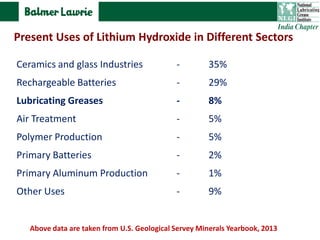
Ceramics and glass Industries - 35%
Rechargeable Batteries - 29%
Lubricating Greases - 8%
Air Treatment - 5%
Polymer Production - 5%
Primary Batteries - 2%
Primary Aluminum Production - 1%
Other Uses - 9%
Above data are taken from U.S. Geological Servey Minerals Yearbook, 2013
Present Uses of Lithium Hydroxide in Different Sectors
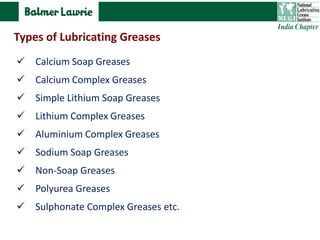
 Calcium Soap Greases
 Calcium Complex Greases
 Simple Lithium Soap Greases
 Lithium Complex Greases
 Aluminium Complex Greases
 Sodium Soap Greases
 Non-Soap Greases
 Polyurea Greases
 Sulphonate Complex Greases etc.
Types of Lubricating Greases
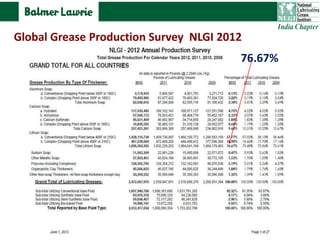
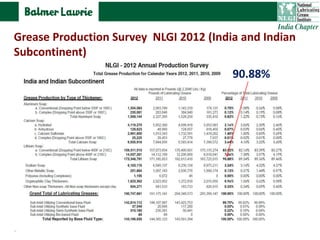
76.67%
Global Grease Production Survey NLGI 2012
90.88%
Grease Production Survey NLGI 2012 (India and Indian
Subcontinent)
 Lesser Availability of Lithium Hydroxide Because of
• Increasing Demand lithium batteries in Smart Devices
• Increasing Demand in Electric Vehicles (EV) and Hybrid
Electric Vehicles (HEV)
• Depleting Natural Sources of Lithium
 The price of Lithium Hydroxide increasing day by day
Present Scenario for Availability of Lithium Hydroxide
for Grease Manufacturing
 Project was taken to develop a grease without or lesser uses of
lithium hydroxide exhibiting properties near to lithium soap
greases.
 Calcium hydroxide was chosen as a main base because calcium
soap greases are the second largest produced greases.
 Calcium hydroxide (Hydrated lime) is easily available every
where at cheaper cost.
 Knowledge about the properties of conventional calcium soap
and calcium complex soap greases alongwith the lithium soap
greases is very essential to overcome the drawbacks in newly
developed grease.
Development of Advanced Calcium-Lithium Soap Grease
 Calcium soap greases are oldest metal soap greases
 Dropping points of calcium soap grease are in between 90-120
⁰C
 Water is very much essential to stabilize the structure of grease
 Upper temperature limit in any application is only 50-70 ⁰C
 At high temperature water evaporates leading to breaking in
grease soap structure
 Applicable only in less demanding applications
 Fair shear stablity
Calcium Soap Greases
 Calcium complex greases have the high dropping point
 On storage at room temperature these greases will slowly
harden when exposed to air.
 The hardening begins at the grease/air interface and slowly
extend further into the bulk of the grease with time.
 This phenomenon is well known as “Case Hardening”
 Calcium complex greases also severely harden under sustained
high temperatures.
 Because of case hardening tendency these greases can not
become popular and acceptable for uses.
 Poor Shear Stability
Calcium Complex Soap Greases
 High Dropping Point (High Heat Resistance)
 Excellent Shear Stability
 Smooth Texture
 No hardening Tendency
 Easily Pumpable
 Good water resistant property
 Very good anti-wear performance
 Can be used in Multipurpose applications
 Easy Manufacturing Process
Simple Lithium Soap Greases
 High Dropping Point (High Heat Resistance)
 Very good Shear Stability
 Smooth Texture
 No significant hardening Tendency
 Easily Pumpable
 Good water resistant property
 Very good anti-wear performance
 Easy Manufacturing Process
 Can be used in Multipurpose applications
Development of Advanced Calcium-Lithium Soap Grease
Manufacturing Process
Similar to the process of simple lithium soap greases or lithium
complex greases
 Fatty Acid / Fat Melting
 Saponification
 Complexation / Chelation
 Cooling
 Additive Mixing
 Homogenization after cooling
Developed grease offers substantial savings in terms of reduced
power and fuel consumption due to lesser processing temperature
required for manufacturing
Development of Advanced Calcium-Lithium Soap Grease
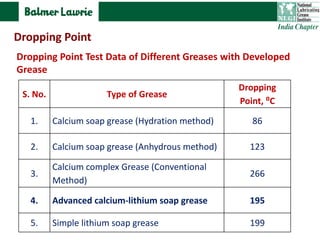
 Dropping point of the developed grease
was checked as per ASTM D 566 test
method
 Results were compared with Calcium
Soap, Calcium complex and lithium soap
greases
 Dropping Point of developed grease was
found near to the lithium soap greases
Dropping Point
Development of Advanced Calcium-Lithium Soap Grease
S. No. Type of Grease
Dropping
Point, ⁰C
1. Calcium soap grease (Hydration method) 86
2. Calcium soap grease (Anhydrous method) 123
3.
Calcium complex Grease (Conventional
Method)
266
4. Advanced calcium-lithium soap grease 195
5. Simple lithium soap grease 199
Dropping Point Test Data of Different Greases with Developed
Grease
Dropping Point
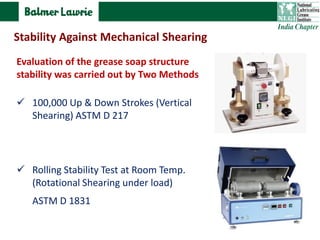
Evaluation of the grease soap structure
stability was carried out by Two Methods
 100,000 Up & Down Strokes (Vertical
Shearing) ASTM D 217
 Rolling Stability Test at Room Temp.
(Rotational Shearing under load)
ASTM D 1831
Stability Against Mechanical Shearing
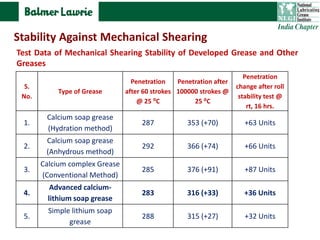
S.
No.
Type of Grease
Penetration
after 60 strokes
@ 25 ⁰C
Penetration after
100000 strokes @
25 ⁰C
Penetration
change after roll
stability test @
rt, 16 hrs.
1.
Calcium soap grease
(Hydration method)
287 353 (+70) +63 Units
2.
Calcium soap grease
(Anhydrous method)
292 366 (+74) +66 Units
3.
Calcium complex Grease
(Conventional Method)
285 376 (+91) +87 Units
4.
Advanced calcium-
lithium soap grease
283 316 (+33) +36 Units
5.
Simple lithium soap
grease
288 315 (+27) +32 Units
Test Data of Mechanical Shearing Stability of Developed Grease and Other
Greases
Stability Against Mechanical Shearing
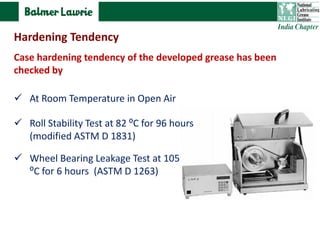
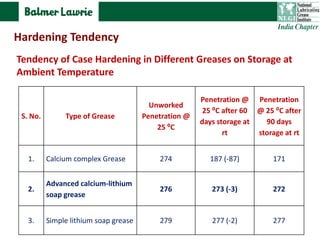
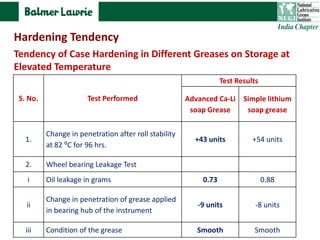
Case hardening tendency of the developed grease has been
checked by
 At Room Temperature in Open Air
 Wheel Bearing Leakage Test at 105
⁰C for 6 hours (ASTM D 1263)
 Roll Stability Test at 82 ⁰C for 96 hours
(modified ASTM D 1831)
Hardening Tendency
S. No. Type of Grease
Unworked
Penetration @
25 ⁰C
Penetration @
25 ⁰C after 60
days storage at
rt
Penetration
@ 25 ⁰C after
90 days
storage at rt
1. Calcium complex Grease 274 187 (-87) 171
2.
Advanced calcium-lithium
soap grease
276 273 (-3) 272
3. Simple lithium soap grease 279 277 (-2) 277
Tendency of Case Hardening in Different Greases on Storage at
Ambient Temperature
Hardening Tendency
S. No. Test Performed
Test Results
Advanced Ca-Li
soap Grease
Simple lithium
soap grease
1.
Change in penetration after roll stability
at 82 ⁰C for 96 hrs.
+43 units +54 units
2. Wheel bearing Leakage Test
i Oil leakage in grams 0.73 0.88
ii
Change in penetration of grease applied
in bearing hub of the instrument
-9 units -8 units
iii Condition of the grease Smooth Smooth
Tendency of Case Hardening in Different Greases on Storage at
Elevated Temperature
Hardening Tendency
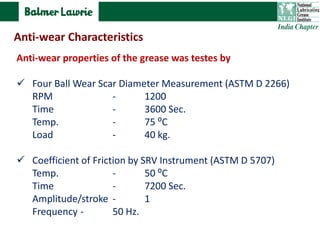
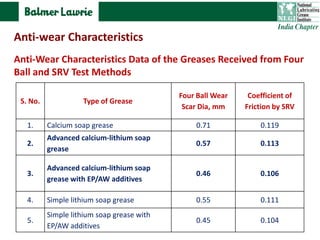
Anti-wear properties of the grease was testes by
 Four Ball Wear Scar Diameter Measurement (ASTM D 2266)
RPM - 1200
Time - 3600 Sec.
Temp. - 75 ⁰C
Load - 40 kg.
 Coefficient of Friction by SRV Instrument (ASTM D 5707)
Temp. - 50 ⁰C
Time - 7200 Sec.
Amplitude/stroke - 1
Frequency - 50 Hz.
Anti-wear Characteristics
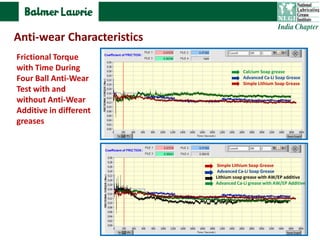
Calcium Soap grease
Advanced Ca-Li Soap Grease
Simple Lithium Soap Grease
Advanced Ca-Li Soap Grease
Lithium soap grease with AW/EP additive
Advanced Ca-Li grease with AW/EP Additive
Frictional Torque
with Time During
Four Ball Anti-Wear
Test with and
without Anti-Wear
Additive in different
greases
Anti-wear Characteristics
S. No. Type of Grease
Four Ball Wear
Scar Dia, mm
Coefficient of
Friction by SRV
1. Calcium soap grease 0.71 0.119
2.
Advanced calcium-lithium soap
grease
0.57 0.113
3.
Advanced calcium-lithium soap
grease with EP/AW additives
0.46 0.106
4. Simple lithium soap grease 0.55 0.111
5.
Simple lithium soap grease with
EP/AW additives
0.45 0.104
Anti-Wear Characteristics Data of the Greases Received from Four
Ball and SRV Test Methods
Anti-wear Characteristics
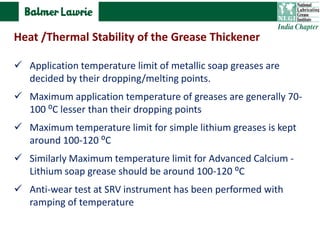
 Application temperature limit of metallic soap greases are
decided by their dropping/melting points.
 Maximum application temperature of greases are generally 70-
100 ⁰C lesser than their dropping points
 Maximum temperature limit for simple lithium greases is kept
around 100-120 ⁰C
 Similarly Maximum temperature limit for Advanced Calcium -
Lithium soap grease should be around 100-120 ⁰C
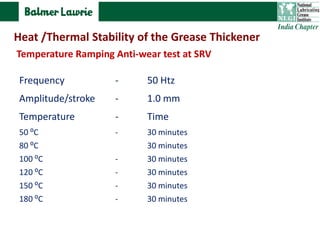
 Anti-wear test at SRV instrument has been performed with
ramping of temperature
Heat /Thermal Stability of the Grease Thickener
Frequency - 50 Htz
Amplitude/stroke - 1.0 mm
Temperature - Time
50 ⁰C - 30 minutes
80 ⁰C 30 minutes
100 ⁰C - 30 minutes
120 ⁰C - 30 minutes
150 ⁰C - 30 minutes
180 ⁰C - 30 minutes
Heat /Thermal Stability of the Grease Thickener
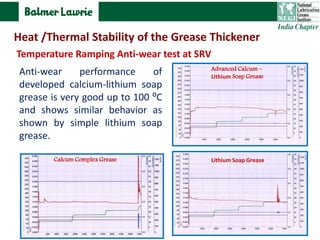
Temperature Ramping Anti-wear test at SRV
Anti-wear performance of
developed calcium-lithium soap
grease is very good up to 100 ⁰C
and shows similar behavior as
shown by simple lithium soap
grease.
Heat /Thermal Stability of the Grease Thickener
Calcum Complex Grease
Advanced Calcum –
Lithium Soap Grease
Lithium Soap Grease
 Advanced calcium-lithium soap grease is substantially non-
corrosive (with additive) under prolonged wet conditions
 The grease also retains its chemical composition for extended
periods of time under operating conditions.
 Advanced calcium –lithium soap grease does not suffer from loss
of lubricating power due to case hardening
 No significant hardening is associated with an improvement in
the pumpability of the developed grease
Miscellaneous Characteristics
S.
No.
Characteristics
Advanced Ca-Li
Non EP Grease
Advanced Ca-Li
EP Grease
Simple Li Soap
Grease
Simple Li Soap
EP Grease
Test Method
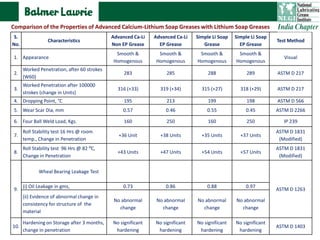
1. Appearance
Smooth &
Homogenous
Smooth &
Homogenous
Smooth &
Homogenous
Smooth &
Homogenous
Visual
2.
Worked Penetration, after 60 strokes
(W60)
283 285 288 289 ASTM D 217
3.
Worked Penetration after 100000
strokes (change in Units)
316 (+33) 319 (+34) 315 (+27) 318 (+29) ASTM D 217
4. Dropping Point, °C 195 213 199 198 ASTM D 566
5. Wear Scar Dia, mm 0.57 0.46 0.55 0.45 ASTM D 2266
6. Four Ball Weld Load, Kgs. 160 250 160 250 IP 239
7.
Roll Stability test 16 Hrs @ room
temp., Change in Penetration
+36 Unit +38 Units +35 Units +37 Units
ASTM D 1831
(Modified)
8.
Roll Stability test 96 Hrs @ 82 ⁰C,
Change in Penetration
+43 Units +47 Units +54 Units +57 Units
ASTM D 1831
(Modified)
9.
Wheal Bearing Leakage Test
ASTM D 1263
(i) Oil Leakage in gms, 0.73 0.86 0.88 0.97
(ii) Evidence of abnormal change in
consistency for structure of the
material
No abnormal
change
No abnormal
change
No abnormal
change
No abnormal
change
10.
Hardening on Storage after 3 months,
change in penetration
No significant
hardening
No significant
hardening
No significant
hardening
No significant
hardening
ASTM D 1403
Comparison of the Properties of Advanced Calcium-Lithium Soap Greases with Lithium Soap Greases
 Advanced calcium-lithium soap grease has been developed by
using easily available calcium hydroxide as a main alkaline
material with minimal use of lesser abundant lithium hydroxide.
 Excellent tribological properties and suitable for use in industrial
applications.
 Very good mechanical shear stability in both vertical and
rotational motion
 Very good dropping point results which are comparable with the
dropping point of simple lithium soap grease.
 Wear characteristics of the developed grease are closer to the
simple lithium soap greases.
Conclusions
 The case hardening tendency has been overcome in the
developed grease
 No significant hardening was also observed at elevated
temperatures
 Equal flexibility to the grease formulators to develop high
performance products by using additives as used in lithium soap
greases.
 Substantial savings in terms of reduced power and fuel
consumption due to lesser processing temperature required for
manufacturing
 Developed grease may be very useful for the grease Industry to
reduce the uses of lithium hydroxide in grease making
Conclusions
Acknowledgments
The Authors are sincerely grateful to the Management
of M/s. Balmer Lawrie & Co. Ltd. for giving an
opportunity to present the paper at 18th NLGI-IC
Conference
T
Thank You
Help theWorld
To
Becoming Smarter

PPT_18th NLGI Paper Final

  • 1.
    Development of AdvancedCalcium-Lithium Soap Grease with Minimum Uses of Lithium Hydroxide Dr. Ashok K. Goyal, N.Parameswaran, Dr. B. Ghosh & Ananda Sengupta Balmer Lawrie & Co Ltd Applications Research Laboratory, Kolkata
  • 2.
  • 3.
     Smart Phones Smart Watches  Smart T.V.  Laptops  Tablets  Electric Vehicles SMART WORLD OF SMART TECHNOLOGY
  • 4.
    Lithium Ion Batteries- Most Popular  Lithium has the highest electric output per unit weight.  Battery manufacturers across the world are moving to lithium. POWER SOURCE FOR SMART TECHNOLOGY
  • 5.
    Ceramics and glassIndustries - 35% Rechargeable Batteries - 29% Lubricating Greases - 8% Air Treatment - 5% Polymer Production - 5% Primary Batteries - 2% Primary Aluminum Production - 1% Other Uses - 9% Above data are taken from U.S. Geological Servey Minerals Yearbook, 2013 Present Uses of Lithium Hydroxide in Different Sectors
  • 6.
     Calcium SoapGreases  Calcium Complex Greases  Simple Lithium Soap Greases  Lithium Complex Greases  Aluminium Complex Greases  Sodium Soap Greases  Non-Soap Greases  Polyurea Greases  Sulphonate Complex Greases etc. Types of Lubricating Greases
  • 7.
  • 8.
    90.88% Grease Production SurveyNLGI 2012 (India and Indian Subcontinent)
  • 9.
     Lesser Availabilityof Lithium Hydroxide Because of • Increasing Demand lithium batteries in Smart Devices • Increasing Demand in Electric Vehicles (EV) and Hybrid Electric Vehicles (HEV) • Depleting Natural Sources of Lithium  The price of Lithium Hydroxide increasing day by day Present Scenario for Availability of Lithium Hydroxide for Grease Manufacturing
  • 10.
     Project wastaken to develop a grease without or lesser uses of lithium hydroxide exhibiting properties near to lithium soap greases.  Calcium hydroxide was chosen as a main base because calcium soap greases are the second largest produced greases.  Calcium hydroxide (Hydrated lime) is easily available every where at cheaper cost.  Knowledge about the properties of conventional calcium soap and calcium complex soap greases alongwith the lithium soap greases is very essential to overcome the drawbacks in newly developed grease. Development of Advanced Calcium-Lithium Soap Grease
  • 11.
     Calcium soapgreases are oldest metal soap greases  Dropping points of calcium soap grease are in between 90-120 ⁰C  Water is very much essential to stabilize the structure of grease  Upper temperature limit in any application is only 50-70 ⁰C  At high temperature water evaporates leading to breaking in grease soap structure  Applicable only in less demanding applications  Fair shear stablity Calcium Soap Greases
  • 12.
     Calcium complexgreases have the high dropping point  On storage at room temperature these greases will slowly harden when exposed to air.  The hardening begins at the grease/air interface and slowly extend further into the bulk of the grease with time.  This phenomenon is well known as “Case Hardening”  Calcium complex greases also severely harden under sustained high temperatures.  Because of case hardening tendency these greases can not become popular and acceptable for uses.  Poor Shear Stability Calcium Complex Soap Greases

  • 13.
     High DroppingPoint (High Heat Resistance)  Excellent Shear Stability  Smooth Texture  No hardening Tendency  Easily Pumpable  Good water resistant property  Very good anti-wear performance  Can be used in Multipurpose applications  Easy Manufacturing Process Simple Lithium Soap Greases
  • 14.
     High DroppingPoint (High Heat Resistance)  Very good Shear Stability  Smooth Texture  No significant hardening Tendency  Easily Pumpable  Good water resistant property  Very good anti-wear performance  Easy Manufacturing Process  Can be used in Multipurpose applications Development of Advanced Calcium-Lithium Soap Grease
  • 15.
    Manufacturing Process Similar tothe process of simple lithium soap greases or lithium complex greases  Fatty Acid / Fat Melting  Saponification  Complexation / Chelation  Cooling  Additive Mixing  Homogenization after cooling Developed grease offers substantial savings in terms of reduced power and fuel consumption due to lesser processing temperature required for manufacturing Development of Advanced Calcium-Lithium Soap Grease
  • 16.
     Dropping pointof the developed grease was checked as per ASTM D 566 test method  Results were compared with Calcium Soap, Calcium complex and lithium soap greases  Dropping Point of developed grease was found near to the lithium soap greases Dropping Point Development of Advanced Calcium-Lithium Soap Grease
  • 17.
    S. No. Typeof Grease Dropping Point, ⁰C 1. Calcium soap grease (Hydration method) 86 2. Calcium soap grease (Anhydrous method) 123 3. Calcium complex Grease (Conventional Method) 266 4. Advanced calcium-lithium soap grease 195 5. Simple lithium soap grease 199 Dropping Point Test Data of Different Greases with Developed Grease Dropping Point
  • 18.
    Evaluation of thegrease soap structure stability was carried out by Two Methods  100,000 Up & Down Strokes (Vertical Shearing) ASTM D 217  Rolling Stability Test at Room Temp. (Rotational Shearing under load) ASTM D 1831 Stability Against Mechanical Shearing
  • 19.
    S. No. Type of Grease Penetration after60 strokes @ 25 ⁰C Penetration after 100000 strokes @ 25 ⁰C Penetration change after roll stability test @ rt, 16 hrs. 1. Calcium soap grease (Hydration method) 287 353 (+70) +63 Units 2. Calcium soap grease (Anhydrous method) 292 366 (+74) +66 Units 3. Calcium complex Grease (Conventional Method) 285 376 (+91) +87 Units 4. Advanced calcium- lithium soap grease 283 316 (+33) +36 Units 5. Simple lithium soap grease 288 315 (+27) +32 Units Test Data of Mechanical Shearing Stability of Developed Grease and Other Greases Stability Against Mechanical Shearing
  • 20.
    Case hardening tendencyof the developed grease has been checked by  At Room Temperature in Open Air  Wheel Bearing Leakage Test at 105 ⁰C for 6 hours (ASTM D 1263)  Roll Stability Test at 82 ⁰C for 96 hours (modified ASTM D 1831) Hardening Tendency
  • 21.
    S. No. Typeof Grease Unworked Penetration @ 25 ⁰C Penetration @ 25 ⁰C after 60 days storage at rt Penetration @ 25 ⁰C after 90 days storage at rt 1. Calcium complex Grease 274 187 (-87) 171 2. Advanced calcium-lithium soap grease 276 273 (-3) 272 3. Simple lithium soap grease 279 277 (-2) 277 Tendency of Case Hardening in Different Greases on Storage at Ambient Temperature Hardening Tendency
  • 22.
    S. No. TestPerformed Test Results Advanced Ca-Li soap Grease Simple lithium soap grease 1. Change in penetration after roll stability at 82 ⁰C for 96 hrs. +43 units +54 units 2. Wheel bearing Leakage Test i Oil leakage in grams 0.73 0.88 ii Change in penetration of grease applied in bearing hub of the instrument -9 units -8 units iii Condition of the grease Smooth Smooth Tendency of Case Hardening in Different Greases on Storage at Elevated Temperature Hardening Tendency
  • 23.
    Anti-wear properties ofthe grease was testes by  Four Ball Wear Scar Diameter Measurement (ASTM D 2266) RPM - 1200 Time - 3600 Sec. Temp. - 75 ⁰C Load - 40 kg.  Coefficient of Friction by SRV Instrument (ASTM D 5707) Temp. - 50 ⁰C Time - 7200 Sec. Amplitude/stroke - 1 Frequency - 50 Hz. Anti-wear Characteristics
  • 24.
    Calcium Soap grease AdvancedCa-Li Soap Grease Simple Lithium Soap Grease Simple Lithium Soap Grease Advanced Ca-Li Soap Grease Lithium soap grease with AW/EP additive Advanced Ca-Li grease with AW/EP Additive Frictional Torque with Time During Four Ball Anti-Wear Test with and without Anti-Wear Additive in different greases Anti-wear Characteristics
  • 25.
    S. No. Typeof Grease Four Ball Wear Scar Dia, mm Coefficient of Friction by SRV 1. Calcium soap grease 0.71 0.119 2. Advanced calcium-lithium soap grease 0.57 0.113 3. Advanced calcium-lithium soap grease with EP/AW additives 0.46 0.106 4. Simple lithium soap grease 0.55 0.111 5. Simple lithium soap grease with EP/AW additives 0.45 0.104 Anti-Wear Characteristics Data of the Greases Received from Four Ball and SRV Test Methods Anti-wear Characteristics
  • 26.
     Application temperaturelimit of metallic soap greases are decided by their dropping/melting points.  Maximum application temperature of greases are generally 70- 100 ⁰C lesser than their dropping points  Maximum temperature limit for simple lithium greases is kept around 100-120 ⁰C  Similarly Maximum temperature limit for Advanced Calcium - Lithium soap grease should be around 100-120 ⁰C  Anti-wear test at SRV instrument has been performed with ramping of temperature Heat /Thermal Stability of the Grease Thickener
  • 27.
    Frequency - 50Htz Amplitude/stroke - 1.0 mm Temperature - Time 50 ⁰C - 30 minutes 80 ⁰C 30 minutes 100 ⁰C - 30 minutes 120 ⁰C - 30 minutes 150 ⁰C - 30 minutes 180 ⁰C - 30 minutes Heat /Thermal Stability of the Grease Thickener Temperature Ramping Anti-wear test at SRV
  • 28.
    Temperature Ramping Anti-weartest at SRV Anti-wear performance of developed calcium-lithium soap grease is very good up to 100 ⁰C and shows similar behavior as shown by simple lithium soap grease. Heat /Thermal Stability of the Grease Thickener Calcum Complex Grease Advanced Calcum – Lithium Soap Grease Lithium Soap Grease
  • 29.
     Advanced calcium-lithiumsoap grease is substantially non- corrosive (with additive) under prolonged wet conditions  The grease also retains its chemical composition for extended periods of time under operating conditions.  Advanced calcium –lithium soap grease does not suffer from loss of lubricating power due to case hardening  No significant hardening is associated with an improvement in the pumpability of the developed grease Miscellaneous Characteristics
  • 30.
    S. No. Characteristics Advanced Ca-Li Non EPGrease Advanced Ca-Li EP Grease Simple Li Soap Grease Simple Li Soap EP Grease Test Method 1. Appearance Smooth & Homogenous Smooth & Homogenous Smooth & Homogenous Smooth & Homogenous Visual 2. Worked Penetration, after 60 strokes (W60) 283 285 288 289 ASTM D 217 3. Worked Penetration after 100000 strokes (change in Units) 316 (+33) 319 (+34) 315 (+27) 318 (+29) ASTM D 217 4. Dropping Point, °C 195 213 199 198 ASTM D 566 5. Wear Scar Dia, mm 0.57 0.46 0.55 0.45 ASTM D 2266 6. Four Ball Weld Load, Kgs. 160 250 160 250 IP 239 7. Roll Stability test 16 Hrs @ room temp., Change in Penetration +36 Unit +38 Units +35 Units +37 Units ASTM D 1831 (Modified) 8. Roll Stability test 96 Hrs @ 82 ⁰C, Change in Penetration +43 Units +47 Units +54 Units +57 Units ASTM D 1831 (Modified) 9. Wheal Bearing Leakage Test ASTM D 1263 (i) Oil Leakage in gms, 0.73 0.86 0.88 0.97 (ii) Evidence of abnormal change in consistency for structure of the material No abnormal change No abnormal change No abnormal change No abnormal change 10. Hardening on Storage after 3 months, change in penetration No significant hardening No significant hardening No significant hardening No significant hardening ASTM D 1403 Comparison of the Properties of Advanced Calcium-Lithium Soap Greases with Lithium Soap Greases
  • 31.
     Advanced calcium-lithiumsoap grease has been developed by using easily available calcium hydroxide as a main alkaline material with minimal use of lesser abundant lithium hydroxide.  Excellent tribological properties and suitable for use in industrial applications.  Very good mechanical shear stability in both vertical and rotational motion  Very good dropping point results which are comparable with the dropping point of simple lithium soap grease.  Wear characteristics of the developed grease are closer to the simple lithium soap greases. Conclusions
  • 32.
     The casehardening tendency has been overcome in the developed grease  No significant hardening was also observed at elevated temperatures  Equal flexibility to the grease formulators to develop high performance products by using additives as used in lithium soap greases.  Substantial savings in terms of reduced power and fuel consumption due to lesser processing temperature required for manufacturing  Developed grease may be very useful for the grease Industry to reduce the uses of lithium hydroxide in grease making Conclusions
  • 33.
    Acknowledgments The Authors aresincerely grateful to the Management of M/s. Balmer Lawrie & Co. Ltd. for giving an opportunity to present the paper at 18th NLGI-IC Conference
  • 34.