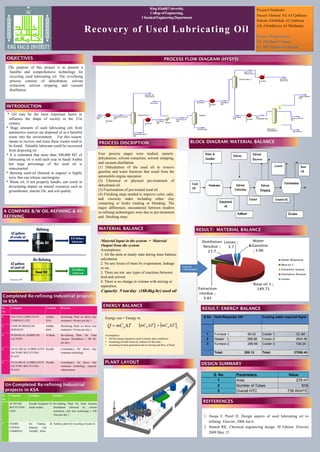
The purpose of this project is to present a
feasible and comprehensive technology for
recycling used lubricating oil. The re-refining
process consists of dehydration, solvent
extraction, solvent stripping, and vacuum
distillation.
1. Awaja F, Pavel D. Design aspects of used lubricating oil re-
refining. Elsevier; 2006 Jun 6.
2. Sinnott RK. Chemical engineering design: SI Edition. Elsevier;
2009 May 15.
Four process stages were studied, namely:
dehydration, solvent extraction, solvent stripping,
and vacuum distillation
(1) Dehydration of the used oil to remove
gasoline and water fractions that result from the
automobile engine operation.
(2) Chemical or physical pre-treatment of
dehydrated oil.
(3) Fractionation of pre-treated used oil.
(4) Finishing steps needed to improve color, odor,
and viscosity index including either clay
contacting or hydro treating or blending. The
major differences encountered between modern
re-refining technologies were due to pre-treatment
and finishing steps.
A COMPARE B/W OIL-REFINING & RE-
REFINING
PROCESS DISCRIPTION
REFFERENCES
PLANT LAYOUT
PROCESS FLOW DIAGRAM (HYSYS)
KingKhalidUniversity,
CollegeofEngineering,
ChemicalEngineeringDepartment
Recovery of Used Lubricating Oil
OBJECTIVES
* Oil may be the most important factor to
influence the shape of society in the 21st
century.
* Huge amounts of used lubricating oils from
automotive sources are disposed of as a harmful
waste into the environment. For this reason,
means to recover and reuse these wastes need to
be found. Valuable lubricant could be recovered
from disposing oil.
* It is estimated that more than 300,000 MT of
lubricating oil is sold each year in Saudi Arabia
but large percentage of the used oil is
unaccounted.
* Burning used-oil (formed in engine) is highly
toxic that can release carcinogens.
* Waste oil, if not properly handle, can result in
devastating impact on natural resources such as
groundwater, marine life, and soil quality.
Material Input in the system = Material
Output from the system
Assumptions:
1. All the units at steady state during mass balance
calculation
2. No any losses of mass by evaporation, leakage
or etc.
3. There are not any types of reactions between
feed and solvent.
4. There is no change in volume with mixing or
separation.
Capacity 5 ton/day (188.8kg/hr) used oil
INTRODUCTION
BLOCK DIAGRAM: MATERIAL BALANCE
MATERIAL BALANCE
Completed Re-refining Industrial projects
in KSA
Sr.
No.
Company Location Remark
1 FALCON LUBRICANTS
COMPANY LTD
Jeddah,
KSA
Rerefining Plant on direct clay
treatment ( 48 tons per day )
2 TASK PETROLEUM
SERVICES
Jeddah,
KSA
Rerefining Plant on direct clay
treatment ( 16 tons per day )
3 HUMAID AL-SOBHI OIL
FACTORY
Al Badr, Re-refining Plant On Total
Vacuum Distillation ( 100 KL
per day )
4 AS AL BILAL LUBRICANTS
FACTORY RECYCLING
PLANT
Riyadh Consultancy for direct clay
treatment technology
5 AS ALBILAL LUBRICANTS
FACTORY RECYCLING
PLANT
Riyadh Consultancy for direct clay
treatment technology capacity
enhancement
RESULT: ENERGY BALANCE
S. No Parameters Value
1 Area 278 m2
2 Number of Tubes 918
3 Overall HTC 738 W/m2oC
S.No Heat Required, kW Cooling water required Kg/hr
1 Furnace 1: 66.52 Cooler 1: 12..94
2 Heater 1: 288.96 Cooler 2: 2604.86
3 Furnace 2: 288.96 Cooler 3: 104.24
Total: 200.12 Total: 27090.45
Un-Completed Re-refining Industrial
projects in KSA
RESULT: MATERIAL BALANCE
ENERGY BALANCE
Energy out = Energy in
Assumptions:
• All the energy equations used in steady state conditions
• Assuming no heat losses by surfaces of the units
• Assuming no heat generation due to mixing and flow of fluid
   21
TmCTmC pp TmCQ p
DESIGN SUMMARY
Sr.
No.
Company Location Remark
1 AUTO OIL
RECYCLING
UNIT
Riyadh, Kingdom Of
Saudi Arabia
Re-refining Plant On Total Vacuum
Distillation followed by solvent
extraction, clay less technology ( 100
Tons per day )
2 YANBU
UNITED
COMPANY
for Trading &
Industry Ltd. ,
YANBU , KSA
Turnkey plant for recycling of used oil.

Lube Oil Poster

  • 1.
    The purpose ofthis project is to present a feasible and comprehensive technology for recycling used lubricating oil. The re-refining process consists of dehydration, solvent extraction, solvent stripping, and vacuum distillation. 1. Awaja F, Pavel D. Design aspects of used lubricating oil re- refining. Elsevier; 2006 Jun 6. 2. Sinnott RK. Chemical engineering design: SI Edition. Elsevier; 2009 May 15. Four process stages were studied, namely: dehydration, solvent extraction, solvent stripping, and vacuum distillation (1) Dehydration of the used oil to remove gasoline and water fractions that result from the automobile engine operation. (2) Chemical or physical pre-treatment of dehydrated oil. (3) Fractionation of pre-treated used oil. (4) Finishing steps needed to improve color, odor, and viscosity index including either clay contacting or hydro treating or blending. The major differences encountered between modern re-refining technologies were due to pre-treatment and finishing steps. A COMPARE B/W OIL-REFINING & RE- REFINING PROCESS DISCRIPTION REFFERENCES PLANT LAYOUT PROCESS FLOW DIAGRAM (HYSYS) KingKhalidUniversity, CollegeofEngineering, ChemicalEngineeringDepartment Recovery of Used Lubricating Oil OBJECTIVES * Oil may be the most important factor to influence the shape of society in the 21st century. * Huge amounts of used lubricating oils from automotive sources are disposed of as a harmful waste into the environment. For this reason, means to recover and reuse these wastes need to be found. Valuable lubricant could be recovered from disposing oil. * It is estimated that more than 300,000 MT of lubricating oil is sold each year in Saudi Arabia but large percentage of the used oil is unaccounted. * Burning used-oil (formed in engine) is highly toxic that can release carcinogens. * Waste oil, if not properly handle, can result in devastating impact on natural resources such as groundwater, marine life, and soil quality. Material Input in the system = Material Output from the system Assumptions: 1. All the units at steady state during mass balance calculation 2. No any losses of mass by evaporation, leakage or etc. 3. There are not any types of reactions between feed and solvent. 4. There is no change in volume with mixing or separation. Capacity 5 ton/day (188.8kg/hr) used oil INTRODUCTION BLOCK DIAGRAM: MATERIAL BALANCE MATERIAL BALANCE Completed Re-refining Industrial projects in KSA Sr. No. Company Location Remark 1 FALCON LUBRICANTS COMPANY LTD Jeddah, KSA Rerefining Plant on direct clay treatment ( 48 tons per day ) 2 TASK PETROLEUM SERVICES Jeddah, KSA Rerefining Plant on direct clay treatment ( 16 tons per day ) 3 HUMAID AL-SOBHI OIL FACTORY Al Badr, Re-refining Plant On Total Vacuum Distillation ( 100 KL per day ) 4 AS AL BILAL LUBRICANTS FACTORY RECYCLING PLANT Riyadh Consultancy for direct clay treatment technology 5 AS ALBILAL LUBRICANTS FACTORY RECYCLING PLANT Riyadh Consultancy for direct clay treatment technology capacity enhancement RESULT: ENERGY BALANCE S. No Parameters Value 1 Area 278 m2 2 Number of Tubes 918 3 Overall HTC 738 W/m2oC S.No Heat Required, kW Cooling water required Kg/hr 1 Furnace 1: 66.52 Cooler 1: 12..94 2 Heater 1: 288.96 Cooler 2: 2604.86 3 Furnace 2: 288.96 Cooler 3: 104.24 Total: 200.12 Total: 27090.45 Un-Completed Re-refining Industrial projects in KSA RESULT: MATERIAL BALANCE ENERGY BALANCE Energy out = Energy in Assumptions: • All the energy equations used in steady state conditions • Assuming no heat losses by surfaces of the units • Assuming no heat generation due to mixing and flow of fluid    21 TmCTmC pp TmCQ p DESIGN SUMMARY Sr. No. Company Location Remark 1 AUTO OIL RECYCLING UNIT Riyadh, Kingdom Of Saudi Arabia Re-refining Plant On Total Vacuum Distillation followed by solvent extraction, clay less technology ( 100 Tons per day ) 2 YANBU UNITED COMPANY for Trading & Industry Ltd. , YANBU , KSA Turnkey plant for recycling of used oil.