Prepared by
Gaikwad Manjusha R.(M.tech )
Introduction
Literature survey
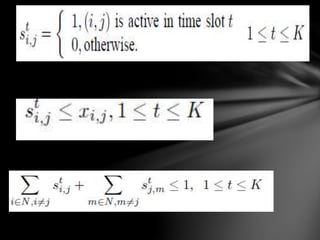
SINR Definition & its constraints
Comparision model
CDMA/CA
Backoff Algorithm
TDMA
Tree formation protocol
Merits & Demerits ofTDMA
Presentation Outline
 WSN
 SINR
 SNIR
 SNR
 SIR
Introduction
Titel of paper Author Publication Year of
publication
Findings
On the
construction of
efficient data
gathering tree
in wireless
sensor
Networks
N.Thepvilojana
pong, Y. Tobe
and K. Sezaki
IEEE ISCAS,
pp. 648-651.
May 2005. Constructed a
data gathering
tree that
maximize
network lifetime
An energy-
efficient data
collection
framework for
wireless sensor
networks by
exploiting
spatiotemporal
correlattion
C. Liu, K. Wu
and J
IEEE Trans.
Parallel and
Distributed
Systems,
pp. 1010-1023
Jul. 2007 An efficient data
gathering
appoarch is
implemented by
combining the
dual prediction &
Clustering
algorithm
Analyzing the
transitional
region in
low power
wireless links
M. Zuniga and B.
Krishnamachari
IEEESECON,
pp. 517-526
Oct 2004 a systematic
medium-scale
measurement of
packet delivery
in three
Titel of paper Author Publication Year of
publication
Findings
Topology control
meets SINR: the
scheduling
complexity of
arbitrary
Topologies
T. Moscibroda,
R.Wattenhofer
and A. Zollinger
ACM MobiHoc,
pp. 310-321
May 2006. Analysis on
topology control
in the context of
the physical
Signal-to-
Interference-
plus-Noise-Ratio
(SINR)
model, focusing
on the question
of how and how
fast the
links of a
resulting
topology can
actually be
realized over
time.
Joint power
control and link
L. Fu, C. Liew
and J. Huang
IEEE ICC, pp.
3066-3072
May 2008. the
minimum-length
Title of paper Author publication Year of
publication
Findings
Optimum
integrated link
scheduling an
power control
for multihop
wireless
networks
A. Behzad and I.
Rubin
IEEETrans.
vehicular
Technology, pp.
194-205
Jan.2007 The joint
routing,
link scheduling
and power
control to
support high
data rates
for broadband
wireless multi-
hop networks.
Mathematical definition=
SINR(x)= P
SINR Constraints
I+N
Protocol Model
Physical Model
-Interference model(SINR)
Comparision Model
CSMA/CA -
D-MAC
B-MAC
B-MAC+
X-MAC
TDMA
MAC Protocols
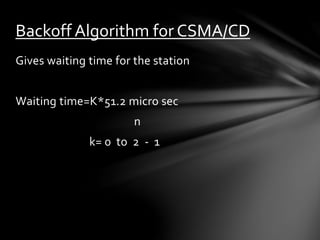
Gives waiting time for the station
Waiting time=K*51.2 micro sec
n
k= 0 to 2 - 1
Backoff Algorithm for CSMA/CD
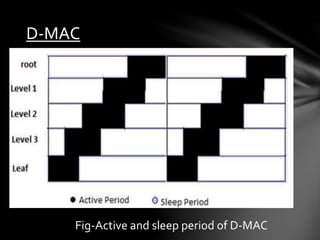
D-MAC
Fig-Active and sleep period of D-MAC
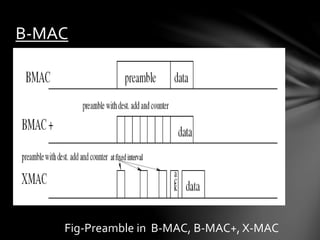
B-MAC
Fig-Preamble in B-MAC, B-MAC+, X-MAC
 LEACH(low energy adaptive clustering hierarchy)
 PEGASIS(power-efficient gathering in sensor
information system)
 Hierarchical-PEGASIS
Hierarchical routing approaches for
sensor networks
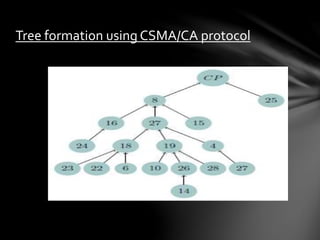
Tree formation using CSMA/CA protocol
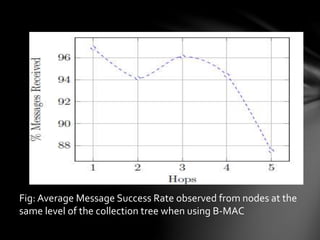
Fig: Average Message Success Rate observed from nodes at the
same level of the collection tree when using B-MAC
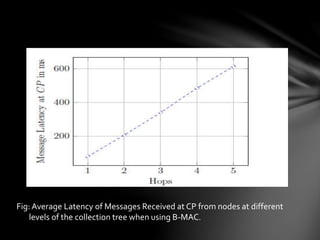
Fig: Average Latency of Messages Received at CP from nodes at different
levels of the collection tree when using B-MAC.
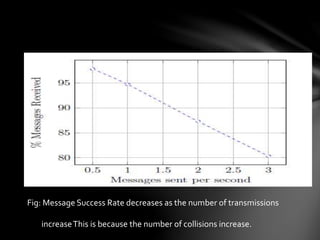
Fig: Message Success Rate decreases as the number of transmissions
increaseThis is because the number of collisions increase.
 Efficient Transmission
 Data & Voice Communication
 Carry Data Rates
 Cost effective Technology
 Extended Battery life
 Efficient Utilization of hierarchical cell
structure
Advantages ofTDMA
 PredefinedTime Slots
 Multipath Distortion
 Synchronization
Disadvantages OfTDMA
The proposed algorithm is energy efficient In
this paper, we studied fast convergecast in WSN where
nodes communicate using a TDMA protocol to minimize
the schedule length. We addressed the fundamental
limitations due to interference and half-duplex
transceivers on the nodes and explored techniques t
overcome the same.
CONCLUSION
[1] N. Thepvilojanapong, Y. Tobe and K. Sezaki, “On the construction of
efficient data gathering tree in wireless sensor networks,” IEEE ISCAS,
pp. 648-651, May 2005.
[2] C. Liu, K. Wu and J. Pei, “An energy-efficient data collection framework
for wireless sensor networks by exploiting spatiotemporal
correlation,”IEEE Trans. Parallel and Distributed Systems, pp. 1010-1023,
Jul. 2007.
[3] M. Zuniga and B. Krishnamachari, “Analyzing the transitional region in
low power wireless links,” IEEE SECON, pp. 517-526, Oct. 2004.
[4] H. Choi, J. Wang and E. A. Hughes, “Scheduling for information
gathering on sensor network,” Wireless Networks, vol. 15, pp. 127-140,
Jan. 2009
References
[5] O. Durmaz Incel, A. Ghosh, B. Krishnamachari and K. Chintalapudi,
“Fast data collection in tree-based wireless sensor networks,”
IEEE Trans. Mobile Computing, vol. 11, no. 1, pp. 86-99, Jan. 2012.
[6] O. Goussevskaia,Y.A. Oswald and R. Wattenhofer, “Complexity in
geometric SINR,” ACM MobiHoc, pp. 100-109, September 2007.
[7] S. Kompella, J. E. Wieselthier and A. Ephremides, “A cross-layer
approach to optimal wireless link scheduling with SINR constraints,”
IEEE Military Communications Conference, pp. 1-7, Oct. 2007.
[8] T. Moscibroda, R. Wattenhofer and A. Zollinger,
“Topology control meets SINR: the scheduling complexity of arbitrary
Topologies,”ACM MobiHoc, pp. 310-321, May 2006.
References
[9] A. Behzad and I. Rubin, “Optimum integrated link
scheduling and
power control for multihop wireless networks,” IEEETrans.
vehicularTechnology, pp. 194-205, Jan. 2007.
[10] L. Fu, C. Liew and J. Huang, “Joint power control and link
scheduling in wireless networks for throughput
optimization,”
IEEE ICC, pp. 3066-3072, May 2008.
Thank You

Ppt on low latency sinr based data gathering model in wireless sensor netwok

  • 1.
  • 2.
    Introduction Literature survey SINR Definition& its constraints Comparision model CDMA/CA Backoff Algorithm TDMA Tree formation protocol Merits & Demerits ofTDMA Presentation Outline
  • 3.
     WSN  SINR SNIR  SNR  SIR Introduction
  • 4.
    Titel of paperAuthor Publication Year of publication Findings On the construction of efficient data gathering tree in wireless sensor Networks N.Thepvilojana pong, Y. Tobe and K. Sezaki IEEE ISCAS, pp. 648-651. May 2005. Constructed a data gathering tree that maximize network lifetime An energy- efficient data collection framework for wireless sensor networks by exploiting spatiotemporal correlattion C. Liu, K. Wu and J IEEE Trans. Parallel and Distributed Systems, pp. 1010-1023 Jul. 2007 An efficient data gathering appoarch is implemented by combining the dual prediction & Clustering algorithm Analyzing the transitional region in low power wireless links M. Zuniga and B. Krishnamachari IEEESECON, pp. 517-526 Oct 2004 a systematic medium-scale measurement of packet delivery in three
  • 5.
    Titel of paperAuthor Publication Year of publication Findings Topology control meets SINR: the scheduling complexity of arbitrary Topologies T. Moscibroda, R.Wattenhofer and A. Zollinger ACM MobiHoc, pp. 310-321 May 2006. Analysis on topology control in the context of the physical Signal-to- Interference- plus-Noise-Ratio (SINR) model, focusing on the question of how and how fast the links of a resulting topology can actually be realized over time. Joint power control and link L. Fu, C. Liew and J. Huang IEEE ICC, pp. 3066-3072 May 2008. the minimum-length
  • 6.
    Title of paperAuthor publication Year of publication Findings Optimum integrated link scheduling an power control for multihop wireless networks A. Behzad and I. Rubin IEEETrans. vehicular Technology, pp. 194-205 Jan.2007 The joint routing, link scheduling and power control to support high data rates for broadband wireless multi- hop networks.
  • 7.
  • 9.
    Protocol Model Physical Model -Interferencemodel(SINR) Comparision Model
  • 10.
  • 11.
    Gives waiting timefor the station Waiting time=K*51.2 micro sec n k= 0 to 2 - 1 Backoff Algorithm for CSMA/CD
  • 12.
  • 13.
  • 14.
     LEACH(low energyadaptive clustering hierarchy)  PEGASIS(power-efficient gathering in sensor information system)  Hierarchical-PEGASIS Hierarchical routing approaches for sensor networks
  • 15.
    Tree formation usingCSMA/CA protocol
  • 16.
    Fig: Average MessageSuccess Rate observed from nodes at the same level of the collection tree when using B-MAC
  • 17.
    Fig: Average Latencyof Messages Received at CP from nodes at different levels of the collection tree when using B-MAC.
  • 18.
    Fig: Message SuccessRate decreases as the number of transmissions increaseThis is because the number of collisions increase.
  • 19.
     Efficient Transmission Data & Voice Communication  Carry Data Rates  Cost effective Technology  Extended Battery life  Efficient Utilization of hierarchical cell structure Advantages ofTDMA
  • 20.
     PredefinedTime Slots Multipath Distortion  Synchronization Disadvantages OfTDMA
  • 21.
    The proposed algorithmis energy efficient In this paper, we studied fast convergecast in WSN where nodes communicate using a TDMA protocol to minimize the schedule length. We addressed the fundamental limitations due to interference and half-duplex transceivers on the nodes and explored techniques t overcome the same. CONCLUSION
  • 22.
    [1] N. Thepvilojanapong,Y. Tobe and K. Sezaki, “On the construction of efficient data gathering tree in wireless sensor networks,” IEEE ISCAS, pp. 648-651, May 2005. [2] C. Liu, K. Wu and J. Pei, “An energy-efficient data collection framework for wireless sensor networks by exploiting spatiotemporal correlation,”IEEE Trans. Parallel and Distributed Systems, pp. 1010-1023, Jul. 2007. [3] M. Zuniga and B. Krishnamachari, “Analyzing the transitional region in low power wireless links,” IEEE SECON, pp. 517-526, Oct. 2004. [4] H. Choi, J. Wang and E. A. Hughes, “Scheduling for information gathering on sensor network,” Wireless Networks, vol. 15, pp. 127-140, Jan. 2009 References
  • 23.
    [5] O. DurmazIncel, A. Ghosh, B. Krishnamachari and K. Chintalapudi, “Fast data collection in tree-based wireless sensor networks,” IEEE Trans. Mobile Computing, vol. 11, no. 1, pp. 86-99, Jan. 2012. [6] O. Goussevskaia,Y.A. Oswald and R. Wattenhofer, “Complexity in geometric SINR,” ACM MobiHoc, pp. 100-109, September 2007. [7] S. Kompella, J. E. Wieselthier and A. Ephremides, “A cross-layer approach to optimal wireless link scheduling with SINR constraints,” IEEE Military Communications Conference, pp. 1-7, Oct. 2007. [8] T. Moscibroda, R. Wattenhofer and A. Zollinger, “Topology control meets SINR: the scheduling complexity of arbitrary Topologies,”ACM MobiHoc, pp. 310-321, May 2006. References
  • 24.
    [9] A. Behzadand I. Rubin, “Optimum integrated link scheduling and power control for multihop wireless networks,” IEEETrans. vehicularTechnology, pp. 194-205, Jan. 2007. [10] L. Fu, C. Liew and J. Huang, “Joint power control and link scheduling in wireless networks for throughput optimization,” IEEE ICC, pp. 3066-3072, May 2008.
  • 25.