Chapter 6
Control Statements Continued
Fundamentals of Java
2
Objectives
 Construct complex Boolean expressions
using the logical operators && (AND), ||
(OR), and ! (NOT).
 Construct truth tables for Boolean
expressions.
 Understand the logic of nested if
statements and extended if statements.
Fundamentals of Java
3
Objectives (cont.)
 Test if statements in a comprehensive
manner.
 Construct nested loops.
 Create appropriate test cases for if
statements and loops.
 Understand the purpose of assertions,
invariants, and loop verification.
Fundamentals of Java
4
Vocabulary
 Arithmetic overflow
 Boundary condition
 Combinatorial explosion
 Complete code coverage
 Equivalence class
 Extended if statement
Fundamentals of Java
5
Vocabulary (cont.)
 Extreme condition
 Input assertion
 Logical operator
 Loop invariant
 Loop variant
 Nested if statement
Fundamentals of Java
6
Vocabulary (cont.)
 Nested loop
 Output assertion
 Quality assurance
 Robust
 Truth table
Fundamentals of Java
7
Logical Operators
 Used in Boolean expressions that control the
behavior of if, while, and for statements
 Three logical operators:
– AND
– OR
– NOT
 Can combine smaller logical expressions into
larger ones
Fundamentals of Java
8
Logical Operators (cont.)
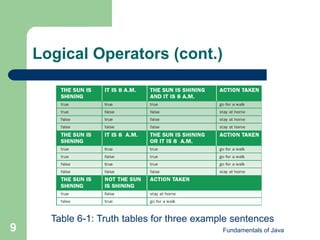
 Truth tables: For complex logical
expressions, shows how value of overall
condition depends on values of operands
– All combinations of values considered
– 2n combinations of true and false for n operands
Fundamentals of Java
9
Logical Operators (cont.)
Table 6-1: Truth tables for three example sentences
Fundamentals of Java
10
Logical Operators (cont.)
Table 6-2: General rules for AND, OR, and NOT
Fundamentals of Java
11
Logical Operators (cont.)
 Can use parentheses with complex
expressions
– If (the sun is shining AND it is 8 a.m.) OR (NOT
your brother is visiting) then let’s go for a walk
else let’s stay at home.
– If the sun is shining AND (it is 8 a.m. OR (NOT
your brother is visiting)) then let’s go for a walk
else let’s stay at home.
 Truth tables would clarify these statements.
Fundamentals of Java
12
Logical Operators (cont.)
 Java’s logical operators:
– AND: &&
– OR: ||
– NOT: !
 Precedence rules:
– ! has same precedence as other unary operators.
– && and || only have higher precedence than the
assignment operators.
 && has higher precedence than ||.
Fundamentals of Java
13
Logical Operators (cont.)
 Example:
Fundamentals of Java
14
Logical Operators (cont.)
 Boolean variables: Can have value of true
or false
– Primitive data type
– Example:
 boolean b1 = true;
if ( b1 ) {
<do something>
}
Fundamentals of Java
15
Logical Operators (cont.)
 Can break down complex Boolean expressions
into a series of simpler ones
 Useful equivalences:
– !(p || q)  !p && !q
– !(p && q) !p || !q
– p || (q && r) (p || q) && (p || r)
– p && (q || r)  (p && q) || (p && r)
Fundamentals of Java
16
Logical Operators (cont.)
 Short-circuit evaluation: JVM may know
result of a Boolean expression before
evaluating all of its parts.
– Stops evaluation as soon as result is known
– Example:
 if( true || false )
 Entire condition is true because first operand of
the Boolean expression is true.
– Second operand not examined at all
Fundamentals of Java
17
Testing if Statements
 Quality assurance: Ongoing process of
making sure that a software product is
developed to the highest standards possible
– Subject to the constraints of time and money
 Test data should try to achieve complete
code coverage.
– Every line in a program executed at least once
Fundamentals of Java
18
Testing if Statements (cont.)
 All sets of test data that exercise a program
in the same manner belong to same
equivalence class.
– Test same paths through the program
 Test data should include cases that assess
program’s behavior under boundary
conditions.
– On or near boundaries between equivalence
classes
Fundamentals of Java
19
Testing if Statements (cont.)
 Test under extreme conditions
– With data at the limits of validity
 Test data validation rules
– Enter values that are valid and invalid.
– Test boundary values between the two.
Fundamentals of Java
20
Nested if Statements
 Placing if statements within other if
statements
 Alternative to using logical operators
Fundamentals of Java
21
Nested if Statements (cont.)
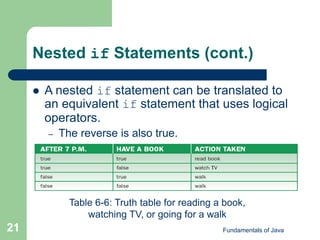
Table 6-6: Truth table for reading a book,
watching TV, or going for a walk
 A nested if statement can be translated to
an equivalent if statement that uses logical
operators.
– The reverse is also true.
Fundamentals of Java
22
Nested if Statements (cont.)
Figure 6-4: Flowchart for reading a book,
watching TV, or going for a walk
Fundamentals of Java
23
Nested if Statements (cont.)
 Example:
Fundamentals of Java
24
Nested if Statements (cont.)
 Extended if statement:
Fundamentals of Java
25
Logical Errors in Nested
if Statements
 Misplaced braces example:
Fundamentals of Java
26
Logical Errors in Nested
if Statements (Cont.)
Table 6-7: Truth table for version 1 and version 2
Fundamentals of Java
27
Logical Errors in Nested
if Statements (cont.)
 If braces removed, Java pairs the else
with closest preceding if.
– Can create logic or syntax errors if not
careful
– Can you spot the error in the following code?
Fundamentals of Java
28
Logical Errors in Nested
if Statements (cont.)
 Better to over-use braces than under-use
 Order of conditions often important in
extended if-else constructs
– Can you spot the logic error?
Fundamentals of Java
29
Logical Errors in Nested
if Statements (cont.)
 Avoiding nested if statements can improve
clarity, as in:
if (90 <= average ) grade is A;
if (80 <= average && average < 90) grade is B;
if (70 <= average && average < 80) grade is C;
if (60 <= average && average < 70) grade is D;
if ( average < 60) grade is F;
Fundamentals of Java
30
Nested Loops
 A loop within another loop
 Example:
Fundamentals of Java
31
Testing Loops
 Loops increase difficulty of testing.
– Often do not iterate some fixed number of times
– Design test data to cover situation where loop
iterates:
 Zero times
 One time
 Multiple times
Fundamentals of Java
32
Testing Loops (cont.)
Table 6-10: Test data for the count divisors program
Fundamentals of Java
33
Testing Loops (cont.)
 Combinatorial Explosion: Creating test
data to verify multiple dependant
components can result in huge amount of
test data.
– Example:
 3 dependent components, each of which requires
5 tests to verify functionality
 Total number of tests to verify entire program is
5*5*5=125.
Fundamentals of Java
34
Testing Loops (cont.)
 Robust program: Tolerates errors in user
inputs and recovers gracefully
 Best and easiest way to write robust
programs is to check user inputs immediately
on entry.
– Reject invalid user inputs.
Fundamentals of Java
35
Loop Verification
 Process of guaranteeing that a loop performs
its intended task
– Independently of testing
 assert statement: Allows programmer to
evaluate a Boolean expression and halt the
program with an error message if the
expression’s value is false
– General form:
 assert <Boolean expression>
Fundamentals of Java
36
Loop Verification (cont.)
 To enable when running the program:
– java -enableassertions AJavaProgram
Example 6.1: Assert that x != 0
Fundamentals of Java
37
Loop Verification (cont.)
Figure 6-6: Failure of an assert statement
Fundamentals of Java
38
Loop Verification: Assertions
with Loops
 Input assertions: State what can be
expected to be true before a loop is entered
 Output assertions: State what can be
expected to be true when the loop is exited
Table 6-12: Sums of the proper divisors of some integers
Fundamentals of Java
39
Loop Verification: Assertions
with Loops (cont.)
 Sum proper divisors of positive integer:
 Input assertions:
– num is a positive integer
– divisorSum == 0
 Output assertion:
– divisorSum is sum of all proper divisors of num
Fundamentals of Java
40
Loop Verification: Invariant and
Variant Assertions
 Loop invariant: Assertion that expresses a
relationship between variables that remains
constant throughout all loop iterations
 Loop variant: Assertion whose truth
changes between the first and final iteration
– Stated so that it guarantees the loop is exited
 Usually occur in pairs
Fundamentals of Java
41
Loop Verification: Invariant and
Variant Assertions (cont.)
Fundamentals of Java
42
Graphics and GUIs: Timers
and Animations
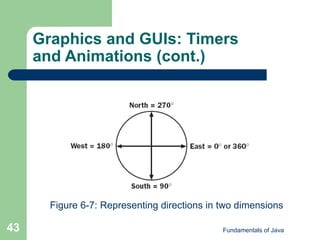
 In animation, slightly different frames are
displayed in order at a rapid rate.
– Produces illusion of continuous movement
 Moving objects have:
– Velocity
 Distance (in pixels) traveled in a given unit of
time
– Direction
Fundamentals of Java
43
Graphics and GUIs: Timers
and Animations (cont.)
Figure 6-7: Representing directions in two dimensions
Fundamentals of Java
44
Graphics and GUIs: Timers
and Animations (cont.)
 Algorithm for animating a graphical object:
 Java provides a timer object to schedule
events at regular intervals.
Fundamentals of Java
45
Graphics and GUIs: Timers
and Animations (cont.)
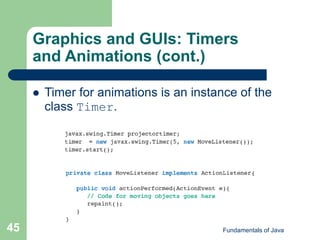
 Timer for animations is an instance of the
class Timer.
Fundamentals of Java
46
Graphics and GUIs: Timers
and Animations (cont.)
Table 6-15: Some commonly used Timer methods
Fundamentals of Java
47
Design, Testing, and Debugging
Hints
 Most errors involving selection statements
and loops are not syntax errors caught at
compile time.
 The presence or absence of braces can
seriously affect the logic of a selection
statement or loop.
Fundamentals of Java
48
Design, Testing, and Debugging
Hints (cont.)
 When testing programs with if or if-else
statements, use data that force the program
to exercise all logical branches.
 When testing programs with if statements,
formulate equivalence classes, boundary
conditions, and extreme conditions.
 Use an if-else statement rather than two
if statements when the alternative courses
of action are mutually exclusive.
Fundamentals of Java
49
Design, Testing, and Debugging
Hints (cont.)
 When testing a loop, use limit values as well
as typical values.
 Check entry and exit conditions for each loop.
 For a loop with errors, use debugging output
statements to verify the control variable’s
value on each pass through the loop.
– Check value before the loop is initially entered,
after each update, and after the loop is exited.
Fundamentals of Java
50
Summary
 A complex Boolean expression contains one
or more Boolean expressions and the logical
operators && (AND), || (OR), and ! (NOT).
 A truth table can determine the value of any
complex Boolean expression.
 Java uses short-circuit evaluation of complex
Boolean expressions.
Fundamentals of Java
51
Summary (cont.)
 Nested if statements are another way of
expressing complex conditions.
 A nested if statement can be translated to
an equivalent if statement that uses logical
operators.
 An extended or multiway if statement
expresses a choice among several mutually
exclusive alternatives.
Fundamentals of Java
52
Summary (cont.)
 Loops can be nested in other loops.
 Equivalence classes, boundary conditions,
and extreme conditions are important
features used in tests of control structures
involving complex conditions.
 Loops can be verified to be correct by using
assertions, loop variants, and loop invariants.

Ppt chapter06

  • 1.
    Chapter 6 Control StatementsContinued Fundamentals of Java
  • 2.
    Fundamentals of Java 2 Objectives Construct complex Boolean expressions using the logical operators && (AND), || (OR), and ! (NOT).  Construct truth tables for Boolean expressions.  Understand the logic of nested if statements and extended if statements.
  • 3.
    Fundamentals of Java 3 Objectives(cont.)  Test if statements in a comprehensive manner.  Construct nested loops.  Create appropriate test cases for if statements and loops.  Understand the purpose of assertions, invariants, and loop verification.
  • 4.
    Fundamentals of Java 4 Vocabulary Arithmetic overflow  Boundary condition  Combinatorial explosion  Complete code coverage  Equivalence class  Extended if statement
  • 5.
    Fundamentals of Java 5 Vocabulary(cont.)  Extreme condition  Input assertion  Logical operator  Loop invariant  Loop variant  Nested if statement
  • 6.
    Fundamentals of Java 6 Vocabulary(cont.)  Nested loop  Output assertion  Quality assurance  Robust  Truth table
  • 7.
    Fundamentals of Java 7 LogicalOperators  Used in Boolean expressions that control the behavior of if, while, and for statements  Three logical operators: – AND – OR – NOT  Can combine smaller logical expressions into larger ones
  • 8.
    Fundamentals of Java 8 LogicalOperators (cont.)  Truth tables: For complex logical expressions, shows how value of overall condition depends on values of operands – All combinations of values considered – 2n combinations of true and false for n operands
  • 9.
    Fundamentals of Java 9 LogicalOperators (cont.) Table 6-1: Truth tables for three example sentences
  • 10.
    Fundamentals of Java 10 LogicalOperators (cont.) Table 6-2: General rules for AND, OR, and NOT
  • 11.
    Fundamentals of Java 11 LogicalOperators (cont.)  Can use parentheses with complex expressions – If (the sun is shining AND it is 8 a.m.) OR (NOT your brother is visiting) then let’s go for a walk else let’s stay at home. – If the sun is shining AND (it is 8 a.m. OR (NOT your brother is visiting)) then let’s go for a walk else let’s stay at home.  Truth tables would clarify these statements.
  • 12.
    Fundamentals of Java 12 LogicalOperators (cont.)  Java’s logical operators: – AND: && – OR: || – NOT: !  Precedence rules: – ! has same precedence as other unary operators. – && and || only have higher precedence than the assignment operators.  && has higher precedence than ||.
  • 13.
    Fundamentals of Java 13 LogicalOperators (cont.)  Example:
  • 14.
    Fundamentals of Java 14 LogicalOperators (cont.)  Boolean variables: Can have value of true or false – Primitive data type – Example:  boolean b1 = true; if ( b1 ) { <do something> }
  • 15.
    Fundamentals of Java 15 LogicalOperators (cont.)  Can break down complex Boolean expressions into a series of simpler ones  Useful equivalences: – !(p || q)  !p && !q – !(p && q) !p || !q – p || (q && r) (p || q) && (p || r) – p && (q || r)  (p && q) || (p && r)
  • 16.
    Fundamentals of Java 16 LogicalOperators (cont.)  Short-circuit evaluation: JVM may know result of a Boolean expression before evaluating all of its parts. – Stops evaluation as soon as result is known – Example:  if( true || false )  Entire condition is true because first operand of the Boolean expression is true. – Second operand not examined at all
  • 17.
    Fundamentals of Java 17 Testingif Statements  Quality assurance: Ongoing process of making sure that a software product is developed to the highest standards possible – Subject to the constraints of time and money  Test data should try to achieve complete code coverage. – Every line in a program executed at least once
  • 18.
    Fundamentals of Java 18 Testingif Statements (cont.)  All sets of test data that exercise a program in the same manner belong to same equivalence class. – Test same paths through the program  Test data should include cases that assess program’s behavior under boundary conditions. – On or near boundaries between equivalence classes
  • 19.
    Fundamentals of Java 19 Testingif Statements (cont.)  Test under extreme conditions – With data at the limits of validity  Test data validation rules – Enter values that are valid and invalid. – Test boundary values between the two.
  • 20.
    Fundamentals of Java 20 Nestedif Statements  Placing if statements within other if statements  Alternative to using logical operators
  • 21.
    Fundamentals of Java 21 Nestedif Statements (cont.) Table 6-6: Truth table for reading a book, watching TV, or going for a walk  A nested if statement can be translated to an equivalent if statement that uses logical operators. – The reverse is also true.
  • 22.
    Fundamentals of Java 22 Nestedif Statements (cont.) Figure 6-4: Flowchart for reading a book, watching TV, or going for a walk
  • 23.
    Fundamentals of Java 23 Nestedif Statements (cont.)  Example:
  • 24.
    Fundamentals of Java 24 Nestedif Statements (cont.)  Extended if statement:
  • 25.
    Fundamentals of Java 25 LogicalErrors in Nested if Statements  Misplaced braces example:
  • 26.
    Fundamentals of Java 26 LogicalErrors in Nested if Statements (Cont.) Table 6-7: Truth table for version 1 and version 2
  • 27.
    Fundamentals of Java 27 LogicalErrors in Nested if Statements (cont.)  If braces removed, Java pairs the else with closest preceding if. – Can create logic or syntax errors if not careful – Can you spot the error in the following code?
  • 28.
    Fundamentals of Java 28 LogicalErrors in Nested if Statements (cont.)  Better to over-use braces than under-use  Order of conditions often important in extended if-else constructs – Can you spot the logic error?
  • 29.
    Fundamentals of Java 29 LogicalErrors in Nested if Statements (cont.)  Avoiding nested if statements can improve clarity, as in: if (90 <= average ) grade is A; if (80 <= average && average < 90) grade is B; if (70 <= average && average < 80) grade is C; if (60 <= average && average < 70) grade is D; if ( average < 60) grade is F;
  • 30.
    Fundamentals of Java 30 NestedLoops  A loop within another loop  Example:
  • 31.
    Fundamentals of Java 31 TestingLoops  Loops increase difficulty of testing. – Often do not iterate some fixed number of times – Design test data to cover situation where loop iterates:  Zero times  One time  Multiple times
  • 32.
    Fundamentals of Java 32 TestingLoops (cont.) Table 6-10: Test data for the count divisors program
  • 33.
    Fundamentals of Java 33 TestingLoops (cont.)  Combinatorial Explosion: Creating test data to verify multiple dependant components can result in huge amount of test data. – Example:  3 dependent components, each of which requires 5 tests to verify functionality  Total number of tests to verify entire program is 5*5*5=125.
  • 34.
    Fundamentals of Java 34 TestingLoops (cont.)  Robust program: Tolerates errors in user inputs and recovers gracefully  Best and easiest way to write robust programs is to check user inputs immediately on entry. – Reject invalid user inputs.
  • 35.
    Fundamentals of Java 35 LoopVerification  Process of guaranteeing that a loop performs its intended task – Independently of testing  assert statement: Allows programmer to evaluate a Boolean expression and halt the program with an error message if the expression’s value is false – General form:  assert <Boolean expression>
  • 36.
    Fundamentals of Java 36 LoopVerification (cont.)  To enable when running the program: – java -enableassertions AJavaProgram Example 6.1: Assert that x != 0
  • 37.
    Fundamentals of Java 37 LoopVerification (cont.) Figure 6-6: Failure of an assert statement
  • 38.
    Fundamentals of Java 38 LoopVerification: Assertions with Loops  Input assertions: State what can be expected to be true before a loop is entered  Output assertions: State what can be expected to be true when the loop is exited Table 6-12: Sums of the proper divisors of some integers
  • 39.
    Fundamentals of Java 39 LoopVerification: Assertions with Loops (cont.)  Sum proper divisors of positive integer:  Input assertions: – num is a positive integer – divisorSum == 0  Output assertion: – divisorSum is sum of all proper divisors of num
  • 40.
    Fundamentals of Java 40 LoopVerification: Invariant and Variant Assertions  Loop invariant: Assertion that expresses a relationship between variables that remains constant throughout all loop iterations  Loop variant: Assertion whose truth changes between the first and final iteration – Stated so that it guarantees the loop is exited  Usually occur in pairs
  • 41.
    Fundamentals of Java 41 LoopVerification: Invariant and Variant Assertions (cont.)
  • 42.
    Fundamentals of Java 42 Graphicsand GUIs: Timers and Animations  In animation, slightly different frames are displayed in order at a rapid rate. – Produces illusion of continuous movement  Moving objects have: – Velocity  Distance (in pixels) traveled in a given unit of time – Direction
  • 43.
    Fundamentals of Java 43 Graphicsand GUIs: Timers and Animations (cont.) Figure 6-7: Representing directions in two dimensions
  • 44.
    Fundamentals of Java 44 Graphicsand GUIs: Timers and Animations (cont.)  Algorithm for animating a graphical object:  Java provides a timer object to schedule events at regular intervals.
  • 45.
    Fundamentals of Java 45 Graphicsand GUIs: Timers and Animations (cont.)  Timer for animations is an instance of the class Timer.
  • 46.
    Fundamentals of Java 46 Graphicsand GUIs: Timers and Animations (cont.) Table 6-15: Some commonly used Timer methods
  • 47.
    Fundamentals of Java 47 Design,Testing, and Debugging Hints  Most errors involving selection statements and loops are not syntax errors caught at compile time.  The presence or absence of braces can seriously affect the logic of a selection statement or loop.
  • 48.
    Fundamentals of Java 48 Design,Testing, and Debugging Hints (cont.)  When testing programs with if or if-else statements, use data that force the program to exercise all logical branches.  When testing programs with if statements, formulate equivalence classes, boundary conditions, and extreme conditions.  Use an if-else statement rather than two if statements when the alternative courses of action are mutually exclusive.
  • 49.
    Fundamentals of Java 49 Design,Testing, and Debugging Hints (cont.)  When testing a loop, use limit values as well as typical values.  Check entry and exit conditions for each loop.  For a loop with errors, use debugging output statements to verify the control variable’s value on each pass through the loop. – Check value before the loop is initially entered, after each update, and after the loop is exited.
  • 50.
    Fundamentals of Java 50 Summary A complex Boolean expression contains one or more Boolean expressions and the logical operators && (AND), || (OR), and ! (NOT).  A truth table can determine the value of any complex Boolean expression.  Java uses short-circuit evaluation of complex Boolean expressions.
  • 51.
    Fundamentals of Java 51 Summary(cont.)  Nested if statements are another way of expressing complex conditions.  A nested if statement can be translated to an equivalent if statement that uses logical operators.  An extended or multiway if statement expresses a choice among several mutually exclusive alternatives.
  • 52.
    Fundamentals of Java 52 Summary(cont.)  Loops can be nested in other loops.  Equivalence classes, boundary conditions, and extreme conditions are important features used in tests of control structures involving complex conditions.  Loops can be verified to be correct by using assertions, loop variants, and loop invariants.