Chapter 39 
Antibiotics Affecting the 
Bacterial Cell Wall 
Copyright © 2012 Wolters Kluwer Health | Lippincott Williams & Wilkins
Physiology 
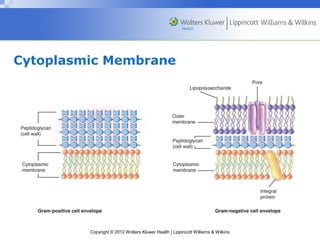
• Bacteria are surrounded by a rigid cell wall that is 
responsible for maintaining the integrity of the internal 
cellular environment. 
• The interior of the cell has a high osmotic pressure. 
• If the bacterial cell wall is not intact, the internal osmotic 
pressure draws fluid into the cell until it bursts. 
• Even when the cell wall is breached by an antibiotic, 
bacterial death may not occur because of bacterial 
resistance. 
Copyright © 2012 Wolters Kluwer Health | Lippincott Williams & Wilkins
Physiology (cont.) 
• Drugs that affect the bacterial cell wall must be able to 
penetrate the cell wall to bind to molecular targets on the 
cell. 
• Beta-lactamases are enzymes that disrupt the beta-lactam 
Copyright © 2012 Wolters Kluwer Health | Lippincott Williams & Wilkins 
ring. 
• This mechanism inactivates beta-lactam drugs.
Cytoplasmic Membrane 
Copyright © 2012 Wolters Kluwer Health | Lippincott Williams & Wilkins
Pathophysiology 
• Bacteria may cause infections in any body organ, 
structure, or fluid. 
• In addition to the original bacterial infection, the loss of 
certain “good” bacteria may result in a superinfection. 
Copyright © 2012 Wolters Kluwer Health | Lippincott Williams & Wilkins
Penicillins 
• Penicillins were the first antibiotics introduced for clinical 
use. 
• Alexander Fleming derived them from Penicillium molds 
in 1929. 
• Subsequent versions of penicillin have been developed to 
decrease the adverse effects of the drug and to modify 
its ability to act on resistant bacteria. 
• Penicillins are also called beta-lactam antibiotics because 
their chemical structure contains a beta-lactam ring that 
is essential for antibacterial activity. 
• Penicillins are classified as narrow spectrum. 
• Prototype drug: penicillin G 
Copyright © 2012 Wolters Kluwer Health | Lippincott Williams & Wilkins
Penicillin G: Core Drug Knowledge 
• Pharmacotherapeutics 
– Infections caused by susceptible gram-positive 
Copyright © 2012 Wolters Kluwer Health | Lippincott Williams & Wilkins 
bacteria 
• Pharmacokinetics 
– Administered: IM or IV. Highly protein bound. 
Excreted: kidneys. 
• Pharmacodynamics 
– Inhibits the third and final stage of bacterial cell wall 
synthesis
Penicillin G: Core Drug Knowledge (cont.) 
• Contraindications and precautions 
– Known allergies to penicillin, cephalosporins, or 
imipenem 
• Adverse effects 
– GI upset, rash, fever, wheezing, possibly anaphylaxis 
and death 
• Drug interactions 
– Tetracyclines, aminoglycosides, and probenecid 
Copyright © 2012 Wolters Kluwer Health | Lippincott Williams & Wilkins
Penicillin G: Core Patient Variables 
• Health status 
– Assess health history and allergies. 
• Life span and gender 
– The drug counteracts the effects of an oral 
contraceptive. 
• Lifestyle, diet, and habits 
– Administer the drug around the clock. 
• Environment 
– Assess the environment where the drug will be given. 
Copyright © 2012 Wolters Kluwer Health | Lippincott Williams & Wilkins
Penicillin G: Nursing Diagnoses and 
Outcomes 
• Risk for Injury related to drug-related allergic reactions 
– Desired outcome: The patient will recognize 
symptoms of allergy and contact the prescriber 
immediately to minimize ill effects. 
• Imbalanced Nutrition: Less than Body Requirements 
related to drug-induced GI effects, such as diarrhea, GI 
upset, altered taste sensation, or superinfection 
– Desired outcome: The patient will maintain 
consistent body weight and consult the prescriber 
about persistent adverse effects that affect 
nutritional status. 
Copyright © 2012 Wolters Kluwer Health | Lippincott Williams & Wilkins
Penicillin G: Nursing Diagnoses and 
Outcomes (cont.) 
• Diarrhea related to drug therapy 
– Desired outcome: The patient will avoid 
dehydration, maintain fluid intake, and contact the 
prescriber about persistent diarrhea. 
• Risk for Infection related to overgrowth of nonsusceptible 
organisms 
– Desired outcome: The patient will report signs of 
superinfection to the prescriber. 
Copyright © 2012 Wolters Kluwer Health | Lippincott Williams & Wilkins
Penicillin G: Planning and Interventions 
• Maximizing therapeutic effects 
– Review culture and sensitivity reports to make sure 
that penicillin G is appropriate for the patient. 
– Optimally, drug therapy should continue for at least 7 
to 10 days. 
• Minimizing adverse effects 
– Provide small, frequent meals; mouth care; and ice 
Copyright © 2012 Wolters Kluwer Health | Lippincott Williams & Wilkins 
chips. 
– Notify the prescriber if a substantial change develops 
in the intake-to-output ratio.
Penicillin G: Teaching, Assessment, and 
Evaluations 
• Patient and family education 
– Stress the importance of completing the full course of 
antibiotics. 
– Emphasize the need to take penicillin G exactly as 
prescribed at evenly spaced intervals. 
• Ongoing assessment and evaluation 
– Monitor for signs of allergic reaction and for 
resolution of the presenting symptoms of infection. 
Copyright © 2012 Wolters Kluwer Health | Lippincott Williams & Wilkins
Copyright © 2012 Wolters Kluwer Health | Lippincott Williams & Wilkins 
Question 
• Penicillin G is given via which of the following route(s)? 
– A. Oral 
– B. IM 
– C. IV 
– D. Both B and C 
– E. All of the above
Copyright © 2012 Wolters Kluwer Health | Lippincott Williams & Wilkins 
Answer 
• D. Both B and C 
• Rationale: Penicillin G is absorbed rapidly from the 
gastrointestinal (GI) tract but is unstable in gastric 
acid. Because of this instability, penicillin G is not 
given orally.
Cephalosporins 
• The cephalosporins were first introduced in the 1960s. 
• They are similar to the penicillins in structure and in 
activity and are also considered beta-lactam antibiotics. 
• Four generations of cephalosporins have been 
introduced, each group with its own spectrum of activity. 
• Selecting an antibiotic from this class depends on the 
sensitivity of the involved organism. 
• The major differences between the generations include 
their activity against gram-negative bacteria, their 
resistance to beta-lactamases, and their ability to 
distribute into cerebrospinal fluid. 
• Prototype drug: cefazolin (Ancef, Kefzol) 
Copyright © 2012 Wolters Kluwer Health | Lippincott Williams & Wilkins
Cefazolin: Core Drug Knowledge 
• Pharmacotherapeutics 
– Treats many kinds of infections 
• Pharmacokinetics 
– Administered: IM. Peak: 1.5 to 2 hours. 
• Pharmacodynamics 
– Binds with PBPs, which disrupts bacterial cell wall 
synthesis 
Copyright © 2012 Wolters Kluwer Health | Lippincott Williams & Wilkins
Cefazolin: Core Drug Knowledge (cont.) 
• Contraindications and precautions 
– Known allergy to cephalosporins 
• Adverse effects 
– Maculopapular rash, GI symptoms, headache, 
dizziness, lethargy, paresthesias, and nephrotoxicity 
• Drug interactions 
– Aminoglycosides 
Copyright © 2012 Wolters Kluwer Health | Lippincott Williams & Wilkins
Cefazolin: Core Patient Variables 
• Health status 
– Assess history and allergies. 
• Life span and gender 
– Assess for pregnancy and lactation. 
• Lifestyle, diet, and habits 
– Assess lifestyle to ensure ability to comply with 
Copyright © 2012 Wolters Kluwer Health | Lippincott Williams & Wilkins 
therapy. 
• Environment 
– Assess the environment where the drug will be given.
Cefazolin: Nursing Diagnoses and 
Outcomes 
• Diarrhea related to drug effects 
– Desired outcome: The patient will avoid dehydration, 
maintain fluid intake, and contact the prescriber if 
diarrhea persists. 
• Imbalanced Nutrition: More or Less than Body Requirements 
related to GI effects, alteration in taste, superinfections 
– Desired outcome: The patient will maintain body weight 
and contact the prescriber if persistent adverse effects 
alter nutritional status. 
• Risk for Infection related to overgrowth of nonsusceptible 
organisms 
– Desired outcome: The patient will report signs of 
superinfection to the prescriber. 
Copyright © 2012 Wolters Kluwer Health | Lippincott Williams & Wilkins
Cefazolin: Planning and Interventions 
• Maximizing therapeutic effects 
– Review culture and sensitivity tests to evaluate the 
efficacy of treatment. 
– Oral suspensions should be kept in the refrigerator. 
• Minimizing adverse effects 
– Cefazolin may be taken with food or fluids to 
decrease GI distress. 
– Evaluate the patient for CNS effects and use safety 
precautions. 
Copyright © 2012 Wolters Kluwer Health | Lippincott Williams & Wilkins
Cefazolin: Teaching, Assessment, and 
Evaluations 
• Patient and family education 
– Because cefazolin and the other cephalosporins are 
similar to penicillins, follow the same guidelines for 
providing patient and family education to a patient 
receiving penicillin. 
• Ongoing assessment and evaluation 
– Monitor the patient for any signs of superinfection 
and notify the prescriber immediately to arrange for 
treatment if superinfection does occur. 
Copyright © 2012 Wolters Kluwer Health | Lippincott Williams & Wilkins
Copyright © 2012 Wolters Kluwer Health | Lippincott Williams & Wilkins 
Question 
• First-generation cephalosporins are effective at treating 
gram-negative infections. 
– A. True 
– B. False
Copyright © 2012 Wolters Kluwer Health | Lippincott Williams & Wilkins 
Answer 
• B. False 
• Rationale: The first-generation cephalosporins have 
little activity against gram-negative bacteria.
Vancomycin 
• Vancomycin (Vancocin) is a complex and unusual tricyclic 
glycopeptide antibiotic. 
• It is the only drug in its class. 
• The use of vancomycin is limited by its ability to produce 
toxic effects. 
• Vancomycin is used only when other antibiotics fail to 
resolve an infection. 
• It has been touted as being able to eradicate most gram-positive 
pathogens. 
Copyright © 2012 Wolters Kluwer Health | Lippincott Williams & Wilkins
Vancomycin: Core Drug Knowledge 
• Pharmacotherapeutics 
– Treating bacterial septicemia, endocarditis, bone and 
joint infections 
• Pharmacokinetics 
– Administered: oral or IV. Excreted: kidneys and 
feces. Peak: 1 hour. 
• Pharmacodynamics 
– Inhibits cell wall synthesis by altering the cell’s 
permeability 
Copyright © 2012 Wolters Kluwer Health | Lippincott Williams & Wilkins
Vancomycin: Core Drug Knowledge (cont.) 
• Contraindications and precautions 
– Hypersensitivity and pregnancy 
• Adverse effects 
– Ototoxicity and nephrotoxicity 
• Drug interactions 
– Antihyperlipidemic drugs and nondepolarizing muscle 
Copyright © 2012 Wolters Kluwer Health | Lippincott Williams & Wilkins 
relaxants
Vancomycin: Core Patient Variables 
• Health status 
– Assess for contraindications to therapy. 
• Life span and gender 
– Assess pregnancy and lactation status. 
• Environment 
– Assess the environment where the drug will be given. 
Copyright © 2012 Wolters Kluwer Health | Lippincott Williams & Wilkins
Vancomycin: Nursing Diagnoses and 
Outcomes 
• Risk for Injury related to drug-induced histamine-release 
reactions 
– Desired outcome: The patient will experience no 
preventable reaction related to vancomycin. 
• Disturbed Sensory Perception (auditory) related to drug-induced 
ototoxicity 
– Desired outcome: The patient will report any 
unusual auditory sensations and have periodic 
audiograms to detect early ototoxicity. 
Copyright © 2012 Wolters Kluwer Health | Lippincott Williams & Wilkins
Vancomycin: Nursing Diagnoses and 
Outcomes (cont.) 
• Excess Fluid Volume related to nephrotoxicity from drug 
therapy 
– Desired outcome: The patient will remain 
normovolemic throughout therapy. 
• Risk for Infection related to overgrowth of nonsusceptible 
organisms 
– Desired outcome: The patient will report signs of 
superinfection to the prescriber. 
Copyright © 2012 Wolters Kluwer Health | Lippincott Williams & Wilkins
Vancomycin: Planning and Interventions 
• Maximizing therapeutic effects 
– Ensure that the patient receives the full course of 
vancomycin as prescribed. 
– Culture and sensitivity results should be monitored. 
• Minimizing adverse effects 
– Administer vancomycin over at least 60 minutes. 
– Assess the IV site frequently for signs of phlebitis. 
Copyright © 2012 Wolters Kluwer Health | Lippincott Williams & Wilkins
Vancomycin: Teaching, Assessment, and 
Evaluations 
• Patient and family education 
– Advise the patient of the importance of completing 
Copyright © 2012 Wolters Kluwer Health | Lippincott Williams & Wilkins 
therapy. 
– Explain the potential adverse effects and need for 
periodic blood monitoring. 
• Ongoing assessment and evaluation 
– Monitor for signs of ototoxicity. 
– For patients receiving long-term or high-dose 
therapy, coordinate periodic audiometric testing and 
lab tests.
Copyright © 2012 Wolters Kluwer Health | Lippincott Williams & Wilkins 
Question 
• The oral form of vancomycin is used to treat 
– A. Gastric ulcers 
– B. Prostatitis 
– C. Rupture of diverticulum 
– D. Pseudomembranous colitis
Copyright © 2012 Wolters Kluwer Health | Lippincott Williams & Wilkins 
Answer 
• D. Pseudomembranous colitis 
• Rationale: Oral administration is used in treating 
some GI infections, such as pseudomembranous 
colitis.

Ppt chapter 39

  • 1.
    Chapter 39 AntibioticsAffecting the Bacterial Cell Wall Copyright © 2012 Wolters Kluwer Health | Lippincott Williams & Wilkins
  • 2.
    Physiology • Bacteriaare surrounded by a rigid cell wall that is responsible for maintaining the integrity of the internal cellular environment. • The interior of the cell has a high osmotic pressure. • If the bacterial cell wall is not intact, the internal osmotic pressure draws fluid into the cell until it bursts. • Even when the cell wall is breached by an antibiotic, bacterial death may not occur because of bacterial resistance. Copyright © 2012 Wolters Kluwer Health | Lippincott Williams & Wilkins
  • 3.
    Physiology (cont.) •Drugs that affect the bacterial cell wall must be able to penetrate the cell wall to bind to molecular targets on the cell. • Beta-lactamases are enzymes that disrupt the beta-lactam Copyright © 2012 Wolters Kluwer Health | Lippincott Williams & Wilkins ring. • This mechanism inactivates beta-lactam drugs.
  • 4.
    Cytoplasmic Membrane Copyright© 2012 Wolters Kluwer Health | Lippincott Williams & Wilkins
  • 5.
    Pathophysiology • Bacteriamay cause infections in any body organ, structure, or fluid. • In addition to the original bacterial infection, the loss of certain “good” bacteria may result in a superinfection. Copyright © 2012 Wolters Kluwer Health | Lippincott Williams & Wilkins
  • 6.
    Penicillins • Penicillinswere the first antibiotics introduced for clinical use. • Alexander Fleming derived them from Penicillium molds in 1929. • Subsequent versions of penicillin have been developed to decrease the adverse effects of the drug and to modify its ability to act on resistant bacteria. • Penicillins are also called beta-lactam antibiotics because their chemical structure contains a beta-lactam ring that is essential for antibacterial activity. • Penicillins are classified as narrow spectrum. • Prototype drug: penicillin G Copyright © 2012 Wolters Kluwer Health | Lippincott Williams & Wilkins
  • 7.
    Penicillin G: CoreDrug Knowledge • Pharmacotherapeutics – Infections caused by susceptible gram-positive Copyright © 2012 Wolters Kluwer Health | Lippincott Williams & Wilkins bacteria • Pharmacokinetics – Administered: IM or IV. Highly protein bound. Excreted: kidneys. • Pharmacodynamics – Inhibits the third and final stage of bacterial cell wall synthesis
  • 8.
    Penicillin G: CoreDrug Knowledge (cont.) • Contraindications and precautions – Known allergies to penicillin, cephalosporins, or imipenem • Adverse effects – GI upset, rash, fever, wheezing, possibly anaphylaxis and death • Drug interactions – Tetracyclines, aminoglycosides, and probenecid Copyright © 2012 Wolters Kluwer Health | Lippincott Williams & Wilkins
  • 9.
    Penicillin G: CorePatient Variables • Health status – Assess health history and allergies. • Life span and gender – The drug counteracts the effects of an oral contraceptive. • Lifestyle, diet, and habits – Administer the drug around the clock. • Environment – Assess the environment where the drug will be given. Copyright © 2012 Wolters Kluwer Health | Lippincott Williams & Wilkins
  • 10.
    Penicillin G: NursingDiagnoses and Outcomes • Risk for Injury related to drug-related allergic reactions – Desired outcome: The patient will recognize symptoms of allergy and contact the prescriber immediately to minimize ill effects. • Imbalanced Nutrition: Less than Body Requirements related to drug-induced GI effects, such as diarrhea, GI upset, altered taste sensation, or superinfection – Desired outcome: The patient will maintain consistent body weight and consult the prescriber about persistent adverse effects that affect nutritional status. Copyright © 2012 Wolters Kluwer Health | Lippincott Williams & Wilkins
  • 11.
    Penicillin G: NursingDiagnoses and Outcomes (cont.) • Diarrhea related to drug therapy – Desired outcome: The patient will avoid dehydration, maintain fluid intake, and contact the prescriber about persistent diarrhea. • Risk for Infection related to overgrowth of nonsusceptible organisms – Desired outcome: The patient will report signs of superinfection to the prescriber. Copyright © 2012 Wolters Kluwer Health | Lippincott Williams & Wilkins
  • 12.
    Penicillin G: Planningand Interventions • Maximizing therapeutic effects – Review culture and sensitivity reports to make sure that penicillin G is appropriate for the patient. – Optimally, drug therapy should continue for at least 7 to 10 days. • Minimizing adverse effects – Provide small, frequent meals; mouth care; and ice Copyright © 2012 Wolters Kluwer Health | Lippincott Williams & Wilkins chips. – Notify the prescriber if a substantial change develops in the intake-to-output ratio.
  • 13.
    Penicillin G: Teaching,Assessment, and Evaluations • Patient and family education – Stress the importance of completing the full course of antibiotics. – Emphasize the need to take penicillin G exactly as prescribed at evenly spaced intervals. • Ongoing assessment and evaluation – Monitor for signs of allergic reaction and for resolution of the presenting symptoms of infection. Copyright © 2012 Wolters Kluwer Health | Lippincott Williams & Wilkins
  • 14.
    Copyright © 2012Wolters Kluwer Health | Lippincott Williams & Wilkins Question • Penicillin G is given via which of the following route(s)? – A. Oral – B. IM – C. IV – D. Both B and C – E. All of the above
  • 15.
    Copyright © 2012Wolters Kluwer Health | Lippincott Williams & Wilkins Answer • D. Both B and C • Rationale: Penicillin G is absorbed rapidly from the gastrointestinal (GI) tract but is unstable in gastric acid. Because of this instability, penicillin G is not given orally.
  • 16.
    Cephalosporins • Thecephalosporins were first introduced in the 1960s. • They are similar to the penicillins in structure and in activity and are also considered beta-lactam antibiotics. • Four generations of cephalosporins have been introduced, each group with its own spectrum of activity. • Selecting an antibiotic from this class depends on the sensitivity of the involved organism. • The major differences between the generations include their activity against gram-negative bacteria, their resistance to beta-lactamases, and their ability to distribute into cerebrospinal fluid. • Prototype drug: cefazolin (Ancef, Kefzol) Copyright © 2012 Wolters Kluwer Health | Lippincott Williams & Wilkins
  • 17.
    Cefazolin: Core DrugKnowledge • Pharmacotherapeutics – Treats many kinds of infections • Pharmacokinetics – Administered: IM. Peak: 1.5 to 2 hours. • Pharmacodynamics – Binds with PBPs, which disrupts bacterial cell wall synthesis Copyright © 2012 Wolters Kluwer Health | Lippincott Williams & Wilkins
  • 18.
    Cefazolin: Core DrugKnowledge (cont.) • Contraindications and precautions – Known allergy to cephalosporins • Adverse effects – Maculopapular rash, GI symptoms, headache, dizziness, lethargy, paresthesias, and nephrotoxicity • Drug interactions – Aminoglycosides Copyright © 2012 Wolters Kluwer Health | Lippincott Williams & Wilkins
  • 19.
    Cefazolin: Core PatientVariables • Health status – Assess history and allergies. • Life span and gender – Assess for pregnancy and lactation. • Lifestyle, diet, and habits – Assess lifestyle to ensure ability to comply with Copyright © 2012 Wolters Kluwer Health | Lippincott Williams & Wilkins therapy. • Environment – Assess the environment where the drug will be given.
  • 20.
    Cefazolin: Nursing Diagnosesand Outcomes • Diarrhea related to drug effects – Desired outcome: The patient will avoid dehydration, maintain fluid intake, and contact the prescriber if diarrhea persists. • Imbalanced Nutrition: More or Less than Body Requirements related to GI effects, alteration in taste, superinfections – Desired outcome: The patient will maintain body weight and contact the prescriber if persistent adverse effects alter nutritional status. • Risk for Infection related to overgrowth of nonsusceptible organisms – Desired outcome: The patient will report signs of superinfection to the prescriber. Copyright © 2012 Wolters Kluwer Health | Lippincott Williams & Wilkins
  • 21.
    Cefazolin: Planning andInterventions • Maximizing therapeutic effects – Review culture and sensitivity tests to evaluate the efficacy of treatment. – Oral suspensions should be kept in the refrigerator. • Minimizing adverse effects – Cefazolin may be taken with food or fluids to decrease GI distress. – Evaluate the patient for CNS effects and use safety precautions. Copyright © 2012 Wolters Kluwer Health | Lippincott Williams & Wilkins
  • 22.
    Cefazolin: Teaching, Assessment,and Evaluations • Patient and family education – Because cefazolin and the other cephalosporins are similar to penicillins, follow the same guidelines for providing patient and family education to a patient receiving penicillin. • Ongoing assessment and evaluation – Monitor the patient for any signs of superinfection and notify the prescriber immediately to arrange for treatment if superinfection does occur. Copyright © 2012 Wolters Kluwer Health | Lippincott Williams & Wilkins
  • 23.
    Copyright © 2012Wolters Kluwer Health | Lippincott Williams & Wilkins Question • First-generation cephalosporins are effective at treating gram-negative infections. – A. True – B. False
  • 24.
    Copyright © 2012Wolters Kluwer Health | Lippincott Williams & Wilkins Answer • B. False • Rationale: The first-generation cephalosporins have little activity against gram-negative bacteria.
  • 25.
    Vancomycin • Vancomycin(Vancocin) is a complex and unusual tricyclic glycopeptide antibiotic. • It is the only drug in its class. • The use of vancomycin is limited by its ability to produce toxic effects. • Vancomycin is used only when other antibiotics fail to resolve an infection. • It has been touted as being able to eradicate most gram-positive pathogens. Copyright © 2012 Wolters Kluwer Health | Lippincott Williams & Wilkins
  • 26.
    Vancomycin: Core DrugKnowledge • Pharmacotherapeutics – Treating bacterial septicemia, endocarditis, bone and joint infections • Pharmacokinetics – Administered: oral or IV. Excreted: kidneys and feces. Peak: 1 hour. • Pharmacodynamics – Inhibits cell wall synthesis by altering the cell’s permeability Copyright © 2012 Wolters Kluwer Health | Lippincott Williams & Wilkins
  • 27.
    Vancomycin: Core DrugKnowledge (cont.) • Contraindications and precautions – Hypersensitivity and pregnancy • Adverse effects – Ototoxicity and nephrotoxicity • Drug interactions – Antihyperlipidemic drugs and nondepolarizing muscle Copyright © 2012 Wolters Kluwer Health | Lippincott Williams & Wilkins relaxants
  • 28.
    Vancomycin: Core PatientVariables • Health status – Assess for contraindications to therapy. • Life span and gender – Assess pregnancy and lactation status. • Environment – Assess the environment where the drug will be given. Copyright © 2012 Wolters Kluwer Health | Lippincott Williams & Wilkins
  • 29.
    Vancomycin: Nursing Diagnosesand Outcomes • Risk for Injury related to drug-induced histamine-release reactions – Desired outcome: The patient will experience no preventable reaction related to vancomycin. • Disturbed Sensory Perception (auditory) related to drug-induced ototoxicity – Desired outcome: The patient will report any unusual auditory sensations and have periodic audiograms to detect early ototoxicity. Copyright © 2012 Wolters Kluwer Health | Lippincott Williams & Wilkins
  • 30.
    Vancomycin: Nursing Diagnosesand Outcomes (cont.) • Excess Fluid Volume related to nephrotoxicity from drug therapy – Desired outcome: The patient will remain normovolemic throughout therapy. • Risk for Infection related to overgrowth of nonsusceptible organisms – Desired outcome: The patient will report signs of superinfection to the prescriber. Copyright © 2012 Wolters Kluwer Health | Lippincott Williams & Wilkins
  • 31.
    Vancomycin: Planning andInterventions • Maximizing therapeutic effects – Ensure that the patient receives the full course of vancomycin as prescribed. – Culture and sensitivity results should be monitored. • Minimizing adverse effects – Administer vancomycin over at least 60 minutes. – Assess the IV site frequently for signs of phlebitis. Copyright © 2012 Wolters Kluwer Health | Lippincott Williams & Wilkins
  • 32.
    Vancomycin: Teaching, Assessment,and Evaluations • Patient and family education – Advise the patient of the importance of completing Copyright © 2012 Wolters Kluwer Health | Lippincott Williams & Wilkins therapy. – Explain the potential adverse effects and need for periodic blood monitoring. • Ongoing assessment and evaluation – Monitor for signs of ototoxicity. – For patients receiving long-term or high-dose therapy, coordinate periodic audiometric testing and lab tests.
  • 33.
    Copyright © 2012Wolters Kluwer Health | Lippincott Williams & Wilkins Question • The oral form of vancomycin is used to treat – A. Gastric ulcers – B. Prostatitis – C. Rupture of diverticulum – D. Pseudomembranous colitis
  • 34.
    Copyright © 2012Wolters Kluwer Health | Lippincott Williams & Wilkins Answer • D. Pseudomembranous colitis • Rationale: Oral administration is used in treating some GI infections, such as pseudomembranous colitis.