Download free for 30 days
Sign in
Upload
Language (EN)
Support
Business
Mobile
Social Media
Marketing
Technology
Art & Photos
Career
Design
Education
Presentations & Public Speaking
Government & Nonprofit
Healthcare
Internet
Law
Leadership & Management
Automotive
Engineering
Software
Recruiting & HR
Retail
Sales
Services
Science
Small Business & Entrepreneurship
Food
Environment
Economy & Finance
Data & Analytics
Investor Relations
Sports
Spiritual
News & Politics
Travel
Self Improvement
Real Estate
Entertainment & Humor
Health & Medicine
Devices & Hardware
Lifestyle
Change Language
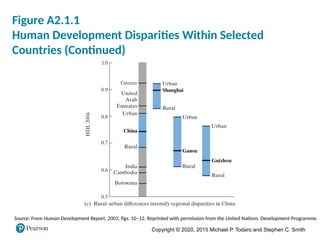
Language
English
Español
Português
Français
Deutsche
Cancel
Save
EN
Uploaded by
RokhediSantoso1
PPTX, PDF
4 views
PPT Chapter 2 Comparative economic development.pptx
Comparative economic development
Economy & Finance
◦
Read more
0
Save
Share
Embed
Embed presentation
Download
Download to read offline
1
/ 49
2
/ 49
3
/ 49
4
/ 49
5
/ 49
6
/ 49
7
/ 49
8
/ 49
9
/ 49
10
/ 49
11
/ 49
12
/ 49
13
/ 49
14
/ 49
15
/ 49
16
/ 49
17
/ 49
18
/ 49
19
/ 49
20
/ 49
21
/ 49
22
/ 49
23
/ 49
24
/ 49
25
/ 49
26
/ 49
27
/ 49
28
/ 49
29
/ 49
30
/ 49
31
/ 49
32
/ 49
33
/ 49
34
/ 49
35
/ 49
36
/ 49
37
/ 49
38
/ 49
39
/ 49
40
/ 49
41
/ 49
42
/ 49
43
/ 49
44
/ 49
45
/ 49
46
/ 49
47
/ 49
48
/ 49
49
/ 49
More Related Content
PPT
TOPIC4A_COMMON CHARACTERISTICS OF DEVELOPING COUNTRIES.ppt
by
CheriesAnnMorales
PPTX
2 COMPARATIVE ECONOMIC DEVELOPMENT (1).pptx
by
TarYar3
PPTX
Decon 03
by
Prof.(Dr.) Hong K. D.Litt, D.Sc., PhD.ក្រោយបណ្ឌិត
PPTX
Todaro12e_PPT_CH02_AS.pptx
by
MohammadGamal22
PPTX
Introduction to Economic development.pptx
by
mirzokm99
PPTX
Human Development Index (HDI) Vs.(GDP) Gross Domestic Product
by
Satish Kumar
PPTX
Human development index
by
kakande alex
PPTX
Human development index
by
kakande alex
TOPIC4A_COMMON CHARACTERISTICS OF DEVELOPING COUNTRIES.ppt
by
CheriesAnnMorales
2 COMPARATIVE ECONOMIC DEVELOPMENT (1).pptx
by
TarYar3
Decon 03
by
Prof.(Dr.) Hong K. D.Litt, D.Sc., PhD.ក្រោយបណ្ឌិត
Todaro12e_PPT_CH02_AS.pptx
by
MohammadGamal22
Introduction to Economic development.pptx
by
mirzokm99
Human Development Index (HDI) Vs.(GDP) Gross Domestic Product
by
Satish Kumar
Human development index
by
kakande alex
Human development index
by
kakande alex
Similar to PPT Chapter 2 Comparative economic development.pptx
PPTX
COMPARATIVE ECONOMIC DEVELOPMENTPOWERPOINT.pptx
by
admittingsectiondbts
PPTX
01hdi-germany0pptx.pptx
by
RumputBiru
PDF
Development
by
yvonne_krishnan
PPTX
Economic aspect of human development index
by
Dr. Mani Madhavan
PPTX
Human Development Index in india isc grade11 eco
by
RakhiDawar1
PPTX
Course - 102.pptx
by
AbhitabhSinha1
PDF
Rr 96 human development indices pakistan
by
Muhammad Asif Iqbal
PPTX
Economic Development Indicators, indices and HDI
by
Shahzaib Khan
PPTX
Presentacion3
by
Fernando Ruíz
PPTX
HDI
by
Sagar PATEL
DOCX
macro_theory_assignment_Seckar_Demirci
by
Harun Demirci
PPTX
Mexico hdi
by
JUANDANIELALDABATORRES10
PDF
MEASURES OF ECONOMIC _____DEVELOPMENT.pdf
by
shivangisinghgaur16
PDF
sm_67a1bc7f35716dcb1a9195ea_382528b8-2159-47be-a7ba-d034a449f849.pdf
by
LeingelCostales
PPTX
Human Development Index
by
GuillermoHernandez187
PPT
Development: Concepts
by
MuruganK52
PPTX
Indicators of Development
by
Manish Purani
PPT
MEASUREMENT OF GROWTH AND DEVELOPMENT: A SPECIAL FOCUS ON HUMAN DEVELOPMENT ...
by
Dr. Avinash S Naik
PPTX
1.1.indicators of development
by
Dr Rajeev Kumar
PPTX
Human development Index
by
Deepali Nagar
COMPARATIVE ECONOMIC DEVELOPMENTPOWERPOINT.pptx
by
admittingsectiondbts
01hdi-germany0pptx.pptx
by
RumputBiru
Development
by
yvonne_krishnan
Economic aspect of human development index
by
Dr. Mani Madhavan
Human Development Index in india isc grade11 eco
by
RakhiDawar1
Course - 102.pptx
by
AbhitabhSinha1
Rr 96 human development indices pakistan
by
Muhammad Asif Iqbal
Economic Development Indicators, indices and HDI
by
Shahzaib Khan
Presentacion3
by
Fernando Ruíz
HDI
by
Sagar PATEL
macro_theory_assignment_Seckar_Demirci
by
Harun Demirci
Mexico hdi
by
JUANDANIELALDABATORRES10
MEASURES OF ECONOMIC _____DEVELOPMENT.pdf
by
shivangisinghgaur16
sm_67a1bc7f35716dcb1a9195ea_382528b8-2159-47be-a7ba-d034a449f849.pdf
by
LeingelCostales
Human Development Index
by
GuillermoHernandez187
Development: Concepts
by
MuruganK52
Indicators of Development
by
Manish Purani
MEASUREMENT OF GROWTH AND DEVELOPMENT: A SPECIAL FOCUS ON HUMAN DEVELOPMENT ...
by
Dr. Avinash S Naik
1.1.indicators of development
by
Dr Rajeev Kumar
Human development Index
by
Deepali Nagar
Recently uploaded
PDF
Unsung Britain conference: Context setting presentation from Resolution Found...
by
ResolutionFoundation
PDF
"Mastering Financial Literacy and Planning with CA Suvidha Chaplot: Your Guid...
by
CA Suvidha Chaplot
PDF
Tisza Párt programjának makroökonómiai elemzése ( EN )
by
Gábor Nagymajtényi
PDF
"Customs & Excise Amendments from Budget 2026 - Key Changes Explained by CA S...
by
CA Suvidha Chaplot
PPTX
Globalisation populism Brexit Varblane2024.pptx
by
varblane
DOCX
Purchase Verified Google Ads Accounts Ready to Launch Campaigns.docx
by
marketing
PPTX
Precious Metals Performance in 2025 and Outlook Outlook 2026
by
James Whitfield
DOCX
7 Step-by-Step Blueprints for Buying a Verified Venmo Accounts.docx
by
Digital Accounts Service Provider TOPSELLERIT
PDF
10 Best Sites to Buy (X) Twitter Accounts for Sellers Top 11....pdf
by
marketing
PPT
Mata Kuliah Pengauditan 1 pertemuan 1 ch01.ppt
by
farhandwinanda47
DOCX
Buy A Verified Remitly Account for Freelancers & Businesses.docx
by
marketing
PPTX
Dr. D. Sundari PRICING STRATEGIES ppt.pptx
by
DrSundariD
PPTX
Choosing The Right Business Structure For SMEs
by
Jordan Arvanitakis
PPTX
PPT Chapter 1 Introducing economic development A global perspective.pptx
by
RokhediSantoso1
PDF
Microeconomics Made Easy: Concepts, Markets & Real-World Applications
by
IPS Team
PDF
"India Budget 2026-2027: Key Economic Reforms, Growth Strategies & Fiscal Pri...
by
CA Suvidha Chaplot
PDF
Veritas Financial Statement presentation 2025
by
Veritas Eläkevakuutus - Veritas Pensionsförsäkring
PPTX
Emerging Operational Risk for Banking Sector
by
bilibahi911
PDF
India_Structural_Re-Rating_Beyond_Gold.pdf
by
ApoorvaRaval1
PDF
Best Sites to Buy Verified Remitly Account Online (1).pdf
by
marketing
Unsung Britain conference: Context setting presentation from Resolution Found...
by
ResolutionFoundation
"Mastering Financial Literacy and Planning with CA Suvidha Chaplot: Your Guid...
by
CA Suvidha Chaplot
Tisza Párt programjának makroökonómiai elemzése ( EN )
by
Gábor Nagymajtényi
"Customs & Excise Amendments from Budget 2026 - Key Changes Explained by CA S...
by
CA Suvidha Chaplot
Globalisation populism Brexit Varblane2024.pptx
by
varblane
Purchase Verified Google Ads Accounts Ready to Launch Campaigns.docx
by
marketing
Precious Metals Performance in 2025 and Outlook Outlook 2026
by
James Whitfield
7 Step-by-Step Blueprints for Buying a Verified Venmo Accounts.docx
by
Digital Accounts Service Provider TOPSELLERIT
10 Best Sites to Buy (X) Twitter Accounts for Sellers Top 11....pdf
by
marketing
Mata Kuliah Pengauditan 1 pertemuan 1 ch01.ppt
by
farhandwinanda47
Buy A Verified Remitly Account for Freelancers & Businesses.docx
by
marketing
Dr. D. Sundari PRICING STRATEGIES ppt.pptx
by
DrSundariD
Choosing The Right Business Structure For SMEs
by
Jordan Arvanitakis
PPT Chapter 1 Introducing economic development A global perspective.pptx
by
RokhediSantoso1
Microeconomics Made Easy: Concepts, Markets & Real-World Applications
by
IPS Team
"India Budget 2026-2027: Key Economic Reforms, Growth Strategies & Fiscal Pri...
by
CA Suvidha Chaplot
Veritas Financial Statement presentation 2025
by
Veritas Eläkevakuutus - Veritas Pensionsförsäkring
Emerging Operational Risk for Banking Sector
by
bilibahi911
India_Structural_Re-Rating_Beyond_Gold.pdf
by
ApoorvaRaval1
Best Sites to Buy Verified Remitly Account Online (1).pdf
by
marketing
PPT Chapter 2 Comparative economic development.pptx
1.
Copyright © 2020,
2015 Michael P. Todaro and Stephen C. Smith Economic Development Thirteenth Edition Chapter 2 Comparative economic development
2.
Copyright © 2020,
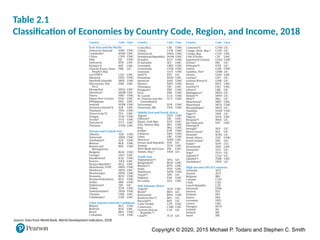
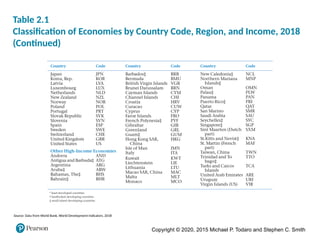
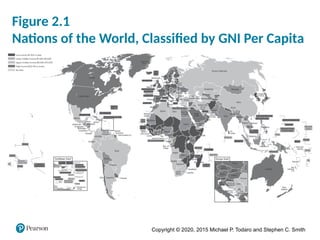
2015 Michael P. Todaro and Stephen C. Smith 2.1 Defining the Developing World • The World Bank ranks countries on Gross National Income (GNI) per capita – Low-Income Countries (LICs) – Lower-Middle Income Countries (LMCs) – Upper-Middle Income Countries (UMCs) – High-income OECD countries – Other high-income countries – (See Table 2.1 and Figure 2.1)
3.
Copyright © 2020,
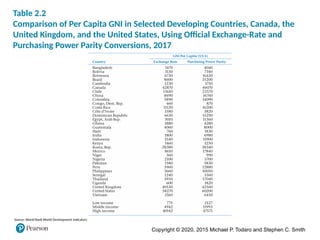
2015 Michael P. Todaro and Stephen C. Smith 2.2 Basic Indicators of Development: Real Income, Health, and Education • Gross National Income (GNI) • Gross Domestic Product (GDP) • PPP method instead of exchange rates as conversion factors (see Table 2.2)
4.
Copyright © 2020,
2015 Michael P. Todaro and Stephen C. Smith Table 2.1 Classification of Economies by Country Code, Region, and Income, 2018 Source: Data from World Bank, World Development Indicators, 2018
5.
Copyright © 2020,
2015 Michael P. Todaro and Stephen C. Smith Table 2.1 Classification of Economies by Country Code, Region, and Income, 2018 (Continued) Source: Data from World Bank, World Development Indicators, 2018
6.
Copyright © 2020,
2015 Michael P. Todaro and Stephen C. Smith Figure 2.1 Nations of the World, Classified by GNI Per Capita
7.
Copyright © 2020,
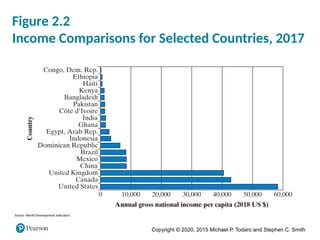
2015 Michael P. Todaro and Stephen C. Smith Figure 2.2 Income Comparisons for Selected Countries, 2017 Source: World Development Indicators
8.
Copyright © 2020,
2015 Michael P. Todaro and Stephen C. Smith Table 2.2 Comparison of Per Capita GNI in Selected Developing Countries, Canada, the United Kingdom, and the United States, Using Official Exchange-Rate and Purchasing Power Parity Conversions, 2017 Source: World Bank World Development Indicators
9.
Copyright © 2020,
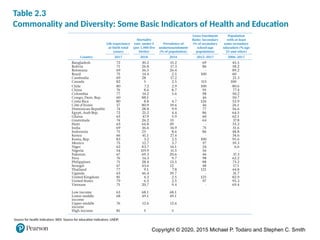
2015 Michael P. Todaro and Stephen C. Smith Source for health indicators: WDI. Source for education indicators: UNDP. Table 2.3 Commonality and Diversity: Some Basic Indicators of Health and Education
10.
Copyright © 2020,
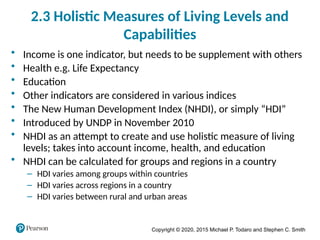
2015 Michael P. Todaro and Stephen C. Smith 2.3 Holistic Measures of Living Levels and Capabilities • Income is one indicator, but needs to be supplement with others • Health e.g. Life Expectancy • Education • Other indicators are considered in various indices • The New Human Development Index (NHDI), or simply “HDI” • Introduced by UNDP in November 2010 • NHDI as an attempt to create and use holistic measure of living levels; takes into account income, health, and education • NHDI can be calculated for groups and regions in a country – HDI varies among groups within countries – HDI varies across regions in a country – HDI varies between rural and urban areas
11.
Copyright © 2020,
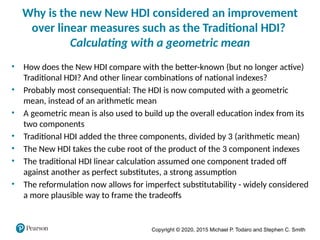
2015 Michael P. Todaro and Stephen C. Smith Why is the new New HDI considered an improvement over linear measures such as the Traditional HDI? Calculating with a geometric mean • How does the New HDI compare with the better-known (but no longer active) Traditional HDI? And other linear combinations of national indexes? • Probably most consequential: The HDI is now computed with a geometric mean, instead of an arithmetic mean • A geometric mean is also used to build up the overall education index from its two components • Traditional HDI added the three components, divided by 3 (arithmetic mean) • The New HDI takes the cube root of the product of the 3 component indexes • The traditional HDI linear calculation assumed one component traded off against another as perfect substitutes, a strong assumption • The reformulation now allows for imperfect substitutability - widely considered a more plausible way to frame the tradeoffs
12.
Copyright © 2020,
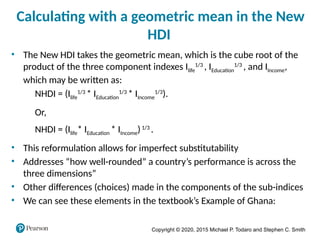
2015 Michael P. Todaro and Stephen C. Smith Calculating with a geometric mean in the New HDI • The New HDI takes the geometric mean, which is the cube root of the product of the three component indexes Ilife 1/3 , IEducation 1/3 , and IIncome, which may be written as: NHDI = (Ilife 1/3 * IEducation 1/3 * IIncome 1/3 ). Or, NHDI = (Ilife* IEducation * IIncome)1/3 . • This reformulation allows for imperfect substitutability • Addresses “how well-rounded” a country’s performance is across the three dimensions” • Other differences (choices) made in the components of the sub-indices • We can see these elements in the textbook’s Example of Ghana:
13.
Copyright © 2020,
2015 Michael P. Todaro and Stephen C. Smith Calculating the New HDI: Example • Example: Ghana • Indicator Value • Life expectancy at birth (years) 64.6 • Mean years of schooling 7.0 • Expected years of schooling 11.4 • GNI per capita (PPP $) 1,684 • Indexes • Life expectancy index = (64.6 – 20)/(83.6 – 20) = 0.701 • Mean years of schooling sub-index = (7.0 - 0)/(13.3 – 0) = 0.527 • Expected years of schooling sub-index = (11.4 – 0)/(18.0 – 0) = 0.634 • Education Index = ([√0.527*0.634] – 0)/(0.971 – 0) = 0.596 • Income index = [ln(1,684) - ln100)]/[ln(87,478) - ln(100)] = 0.417 • NHDI = (0.7011/3 * 0.5961/3 * 0.4171/3 ) = 0.558 • Comparative examples of underlying data and indexes across countries on supplemental slides *Note: Example from 12th Ed. Numbers are rounded. Source: http://hdr.undp.org/sites/default/files/hdr_2013_en_technotes.pdf
14.
Copyright © 2020,
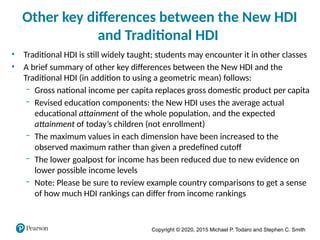
2015 Michael P. Todaro and Stephen C. Smith Other key differences between the New HDI and Traditional HDI • Traditional HDI is still widely taught; students may encounter it in other classes • A brief summary of other key differences between the New HDI and the Traditional HDI (in addition to using a geometric mean) follows: ‒ Gross national income per capita replaces gross domestic product per capita ‒ Revised education components: the New HDI uses the average actual educational attainment of the whole population, and the expected attainment of today’s children (not enrollment) ‒ The maximum values in each dimension have been increased to the observed maximum rather than given a predefined cutoff ‒ The lower goalpost for income has been reduced due to new evidence on lower possible income levels ‒ Note: Please be sure to review example country comparisons to get a sense of how much HDI rankings can differ from income rankings
15.
Copyright © 2020,
2015 Michael P. Todaro and Stephen C. Smith Note on HDI And Policy • Not just that correlation not very strong between income and HDI • Also: HDI can be altered by policy • Example (if a partial one): South Africa
16.
Copyright © 2020,
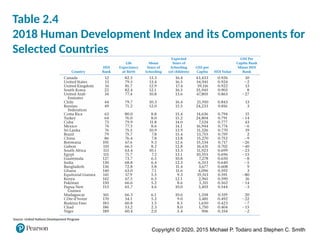
2015 Michael P. Todaro and Stephen C. Smith Source: United Nations Development Program Table 2.4 2018 Human Development Index and its Components for Selected Countries
17.
Copyright © 2020,
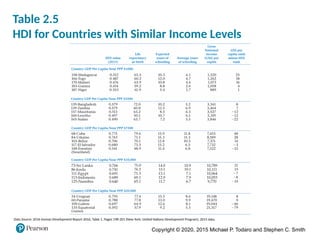
2015 Michael P. Todaro and Stephen C. Smith Table 2.5 HDI for Countries with Similar Income Levels Data Source: 2016 Human Development Report 2016, Table 1, Pages 198-201 (New York: United Nations Development Program), 2015 data.
18.
Copyright © 2020,
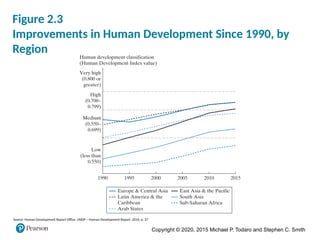
2015 Michael P. Todaro and Stephen C. Smith Figure 2.3 Improvements in Human Development Since 1990, by Region Source: Human Development Report Office, UNDP – Human Development Report, 2016, p. 27
19.
Copyright © 2020,
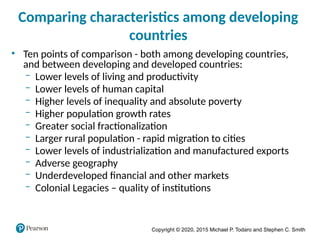
2015 Michael P. Todaro and Stephen C. Smith Comparing characteristics among developing countries • Ten points of comparison - both among developing countries, and between developing and developed countries: ‒ Lower levels of living and productivity ‒ Lower levels of human capital ‒ Higher levels of inequality and absolute poverty ‒ Higher population growth rates ‒ Greater social fractionalization ‒ Larger rural population - rapid migration to cities ‒ Lower levels of industrialization and manufactured exports ‒ Adverse geography ‒ Underdeveloped financial and other markets ‒ Colonial Legacies – quality of institutions
20.
Copyright © 2020,
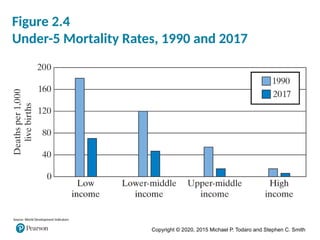
2015 Michael P. Todaro and Stephen C. Smith Figure 2.4 Under-5 Mortality Rates, 1990 and 2017 Source: World Development Indicators
21.
Copyright © 2020,
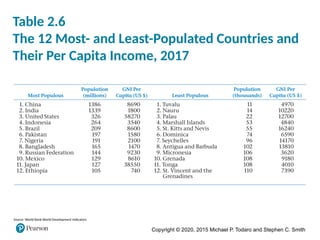
2015 Michael P. Todaro and Stephen C. Smith Table 2.6 The 12 Most- and Least-Populated Countries and Their Per Capita Income, 2017 Source: World Bank World Development Indicators
22.
Copyright © 2020,
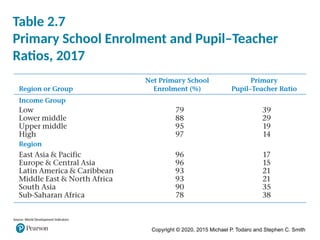
2015 Michael P. Todaro and Stephen C. Smith Table 2.7 Primary School Enrolment and Pupil–Teacher Ratios, 2017 Source: World Development Indicators
23.
Copyright © 2020,
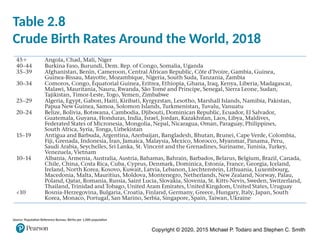
2015 Michael P. Todaro and Stephen C. Smith Source: Population Reference Bureau: Births per 1,000 population Table 2.8 Crude Birth Rates Around the World, 2018
24.
Copyright © 2020,
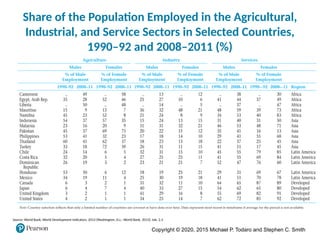
2015 Michael P. Todaro and Stephen C. Smith Source: World Bank, World Development Indicators, 2013 (Washington, D.c.: World Bank, 2013), tab. 2.3 Share of the Population Employed in the Agricultural, Industrial, and Service Sectors in Selected Countries, 1990–92 and 2008–2011 (%)
25.
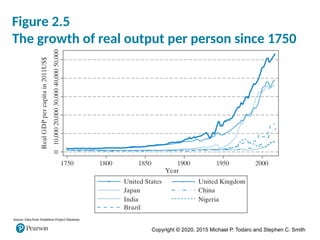
Copyright © 2020,
2015 Michael P. Todaro and Stephen C. Smith Figure 2.5 The growth of real output per person since 1750 Source: Data from Maddison Project Database
26.
Copyright © 2020,
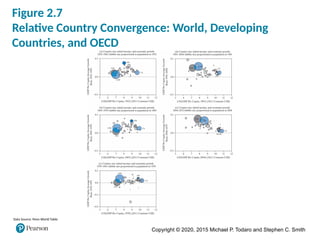
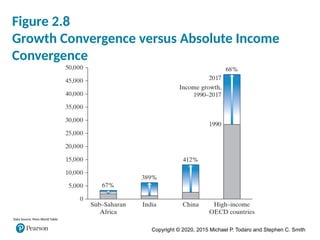
2015 Michael P. Todaro and Stephen C. Smith 2.6 Are Living Standards Converging across Countries? • A Great Divergence followed the Industrial Revolution • Two reasons to think (re-)convergence likely 1) Diminishing returns to capital (though as economies develop they often find ways to compensate) 2) Diffusion of ideas across countries, so can skip trial and error and grow fast while catching up • Latter elated to “advantages of backwardness” (Gerschenkron), or “the latecomer’s advantage” • But - at least until this century - evidence of unconditional national average income convergence has been unconvincing • Continued evidence of divergence between middle and low income countries • There is also evidence of “per capita income convergence,” weighting changes in per capita income by population size • (We consider “conditional” convergence - observed after accounting for other factors - in a general way in context of the Solow neoclassical growth model)
27.
Copyright © 2020,
2015 Michael P. Todaro and Stephen C. Smith Figure 2.7 Relative Country Convergence: World, Developing Countries, and OECD Data Source: Penn World Table
28.
Copyright © 2020,
2015 Michael P. Todaro and Stephen C. Smith Figure 2.8 Growth Convergence versus Absolute Income Convergence Data Source: Penn World Table
29.
Copyright © 2020,
2015 Michael P. Todaro and Stephen C. Smith Nature and Role of Economic Institutions • Institutions provide “rules of the game” of economic life – Follows general framework of Nobel Laureate Douglass North • Salient institutions include the nature and extent of: • Property rights • Contract enforcement • Restriction of coercive, fraudulent and anti-competitive behavior • Provision of access to opportunities for the broad population • Constraining the power of elites • Conflict management • Other institutions provide improved coordination; social insurance; and predictable macroeconomic stability
30.
Copyright © 2020,
2015 Michael P. Todaro and Stephen C. Smith The Nature and Role of Economic Institutions: Some Caveats and Nuances • Most importantly: Good institutions may both cause development, and improve as a result of development • In addition: ‒ The institutions on the previous slide are correlated ‒ It is not clear which of these institutions matter most ‒ Unclear how specific in form institutions must be to fulfill their main function ‒ Progress may be made when only some institutions are of high quality; but further progress may require improving quality of additional institutions ‒ The specifics of their relative importance, and the sequence of improving them, may well vary by country ‒ China provides an important case of transitional institutions, examined in case study for Chapter 4 ‒ Note : A “free market economy” is not the only example of a market economy
31.
Copyright © 2020,
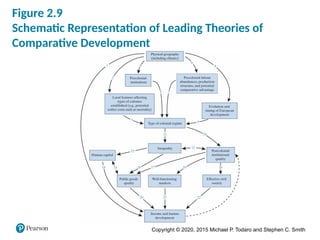
2015 Michael P. Todaro and Stephen C. Smith Figure 2.9 Schematic Representation of Leading Theories of Comparative Development
32.
Copyright © 2020,
2015 Michael P. Todaro and Stephen C. Smith Explaining Long-Run Causes of Comparative Development: Fig. 2.10 Summary • Arrow 1: Geography: Important in pre-modern era; limited effect in modern era • Arrow 2: However, exogenous geography affected how colonists viewed opportunities they could exploit in colonies; and so in part… • Arrow 3: Geography was a determinant of whether colonists created extractive or inclusive institutions; this fact facilitates analysis of role of institutions • Arrow 4: Geography presumably affected indigenous institutions… • Arrow 5: A Note: Difficult to quantify; but colonial institutions may have been influenced by indigenous institutions • Arrow 6: Geography affected comparative advantages: resources and people
33.
Copyright © 2020,
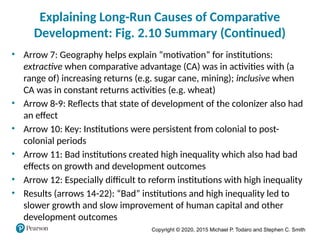
2015 Michael P. Todaro and Stephen C. Smith Explaining Long-Run Causes of Comparative Development: Fig. 2.10 Summary (Continued) • Arrow 7: Geography helps explain “motivation” for institutions: extractive when comparative advantage (CA) was in activities with (a range of) increasing returns (e.g. sugar cane, mining); inclusive when CA was in constant returns activities (e.g. wheat) • Arrow 8-9: Reflects that state of development of the colonizer also had an effect • Arrow 10: Key: Institutions were persistent from colonial to post- colonial periods • Arrow 11: Bad institutions created high inequality which also had bad effects on growth and development outcomes • Arrow 12: Especially difficult to reform institutions with high inequality • Results (arrows 14-22): “Bad” institutions and high inequality led to slower growth and slow improvement of human capital and other development outcomes
34.
Copyright © 2020,
2015 Michael P. Todaro and Stephen C. Smith Role of Institutions and Inequality: Findings • Acemoglu, Johnson, and Robinson: “reversal of fortune” and extractive institutions • Bannerjee and Iyer: “Property rights institutions.” Landlords versus cultivators • Easterly: “Inequality does cause underdevelopment”
35.
Copyright © 2020,
2015 Michael P. Todaro and Stephen C. Smith An Approach to Addressing Causality: Instrumental Variables • Addressing causality by searching for an instrumental variable (IV) • To identify effect of a causal variable c (e.g. inequality) on outcome variable d (e.g. income), find instrument e that affects d only through e’s effect on c. • An instrument has no independent effect on the outcome variable of interest • There are two examples of findings using this method in Chapter 2: 1. Acemoglu, Johnson, Robinson used settler mortality as IV for institutions 2. Easterly used “abundance of land suitable for growing wheat relative to that suitable for growing sugarcane” as an IV for inequality
36.
Copyright © 2020,
2015 Michael P. Todaro and Stephen C. Smith Does Inequality [Negatively] Cause Development? • Among others, Acemoglu, Johnson, Robinson found good institutions cause development (details in Chapter 2, Section 2.6) • Does (extreme) inequality (general, or inequality of opportunity) harm development? • One approach: Painstaking economic history analysis, most prominently of Sokoloff and Engerman (E&S) • Also, quantitative analysis: Inspired by E&S, Easterly used “abundance of land suitable for growing wheat relative to that suitable for growing sugarcane” as an IV for inequality • Confirmed that “agricultural endowments predict inequality and inequality predicts development” • Identified mechanisms by which higher inequality lowers per capita income, via poor institutional quality - and schooling
37.
Copyright © 2020,
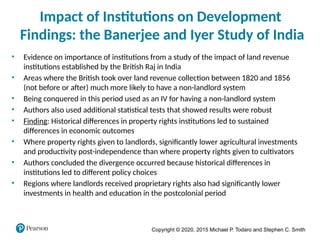
2015 Michael P. Todaro and Stephen C. Smith Impact of Institutions on Development Findings: the Banerjee and Iyer Study of India • Evidence on importance of institutions from a study of the impact of land revenue institutions established by the British Raj in India • Areas where the British took over land revenue collection between 1820 and 1856 (not before or after) much more likely to have a non-landlord system • Being conquered in this period used as an IV for having a non-landlord system • Authors also used additional statistical tests that showed results were robust • Finding: Historical differences in property rights institutions led to sustained differences in economic outcomes • Where property rights given to landlords, significantly lower agricultural investments and productivity post-independence than where property rights given to cultivators • Authors concluded the divergence occurred because historical differences in institutions led to different policy choices • Regions where landlords received proprietary rights also had significantly lower investments in health and education in the postcolonial period
38.
Copyright © 2020,
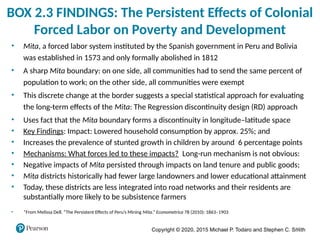
2015 Michael P. Todaro and Stephen C. Smith 38 BOX 2.3 FINDINGS: The Persistent Effects of Colonial Forced Labor on Poverty and Development • Mita, a forced labor system instituted by the Spanish government in Peru and Bolivia was established in 1573 and only formally abolished in 1812 • A sharp Mita boundary: on one side, all communities had to send the same percent of population to work; on the other side, all communities were exempt • This discrete change at the border suggests a special statistical approach for evaluating the long-term effects of the Mita: The Regression discontinuity design (RD) approach • Uses fact that the Mita boundary forms a discontinuity in longitude–latitude space • Key Findings: Impact: Lowered household consumption by approx. 25%; and • Increases the prevalence of stunted growth in children by around 6 percentage points • Mechanisms: What forces led to these impacts? Long-run mechanism is not obvious: • Negative impacts of Mita persisted through impacts on land tenure and public goods; • Mita districts historically had fewer large landowners and lower educational attainment • Today, these districts are less integrated into road networks and their residents are substantially more likely to be subsistence farmers • *From Melissa Dell. “The Persistent Effects of Peru’s Mining Mita.” Econometrica 78 (2010): 1863–1903
39.
Copyright © 2020,
2015 Michael P. Todaro and Stephen C. Smith Appendixes
40.
Copyright © 2020,
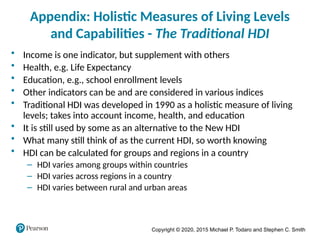
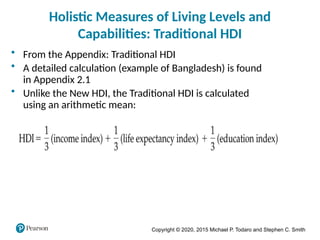
2015 Michael P. Todaro and Stephen C. Smith Appendix: Holistic Measures of Living Levels and Capabilities - The Traditional HDI • Income is one indicator, but supplement with others • Health, e.g. Life Expectancy • Education, e.g., school enrollment levels • Other indicators can be and are considered in various indices • Traditional HDI was developed in 1990 as a holistic measure of living levels; takes into account income, health, and education • It is still used by some as an alternative to the New HDI • What many still think of as the current HDI, so worth knowing • HDI can be calculated for groups and regions in a country – HDI varies among groups within countries – HDI varies across regions in a country – HDI varies between rural and urban areas
41.
Copyright © 2020,
2015 Michael P. Todaro and Stephen C. Smith Holistic Measures of Living Levels and Capabilities: Traditional HDI • From the Appendix: Traditional HDI • A detailed calculation (example of Bangladesh) is found in Appendix 2.1 • Unlike the New HDI, the Traditional HDI is calculated using an arithmetic mean:
42.
Copyright © 2020,
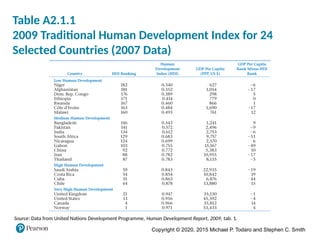
2015 Michael P. Todaro and Stephen C. Smith Table A2.1.1 2009 Traditional Human Development Index for 24 Selected Countries (2007 Data) Source: Data from United Nations Development Programme, Human Development Report, 2009, tab. 1.
43.
Copyright © 2020,
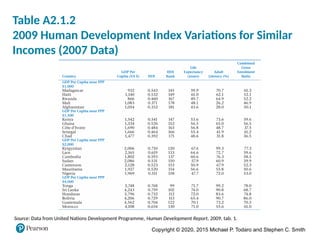
2015 Michael P. Todaro and Stephen C. Smith Table A2.1.2 2009 Human Development Index Variations for Similar Incomes (2007 Data) Source: Data from United Nations Development Programme, Human Development Report, 2009, tab. 1.
44.
Copyright © 2020,
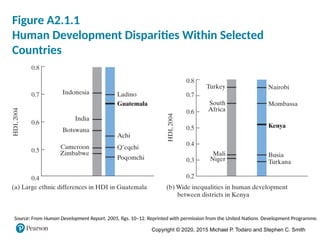
2015 Michael P. Todaro and Stephen C. Smith Figure A2.1.1 Human Development Disparities Within Selected Countries Source: From Human Development Report, 2005, figs. 10–12. Reprinted with permission from the United Nations Development Programme.
45.
Copyright © 2020,
2015 Michael P. Todaro and Stephen C. Smith Figure A2.1.1 Human Development Disparities Within Selected Countries (Continued) Source: From Human Development Report, 2005, figs. 10–12. Reprinted with permission from the United Nations Development Programme.
46.
Copyright © 2020,
2015 Michael P. Todaro and Stephen C. Smith Appendix 2.2: How Low-Income Countries Trying to Launch Accelerated Growth Today Differ from Developed Countries in Their Earlier Stages • Eight Relatively Widespread Aspects of Differences: 1. Physical and human resource endowments 2. Per capita incomes and levels of GDP in relation to the rest of the world 3. Climate 4. Population size, distribution, and growth 5. Historic role of international migration 6. International trade benefits 7. Basic scientific/technological research and development capabilities 8. Efficacy of domestic institutions
47.
Copyright © 2020,
2015 Michael P. Todaro and Stephen C. Smith *Note on National Income Definitions and Calculations* • The “Atlas” method for computing Gross National Income (GNI) is the sum of value added by all resident producers plus any product taxes (less subsidies) not included in the valuation of output plus net receipts of primary income (compensation of employees and property income) from abroad • Data are in current U.S. dollars converted using the World Bank Atlas method • Gross national income, in purchasing power parity, is GNI converted to international dollars using PPP rates. An international dollar has the same purchasing power over GNI that a U.S. dollar has in the United States. • Gross national income per capita is GNI divided by midyear population. • Gross domestic product is the sum of value added by all resident producers plus any product taxes (less subsidies) not included in the valuation of output. • Growth is calculated from constant price GDP data in local currency. • Gross domestic product per capita is GDP divided by midyear population. *For further details see “Sources and Methods,” in World Development Indicators (WDI), 2017
48.
Copyright © 2020,
2015 Michael P. Todaro and Stephen C. Smith Concepts for Review • Absolute poverty • Brain drain • Capital stock • Convergence • Crude birth rate • Dependency burden • Depreciation (of the capital stock) • Diminishing Marginal Utility • Divergence • Economic Institutions • Fractionalization • Free trade • Gross domestic product (GDP) • Gross national income (GNI) • Human capital • Human Development Index (HDI)
49.
Copyright © 2020,
2015 Michael P. Todaro and Stephen C. Smith Concepts for Review (Continued) • Imperfect market • Incomplete information • Infrastructure • Least developed countries • Low-income countries (LICs) • Middle-income countries • Newly industrializing countries (NICs) • Purchasing power parity (PPP) • Research and development (R&D) • Resource endowment • Terms of trade • Value added • World Bank
Download

![Copyright © 2020, 2015 Michael P. Todaro and Stephen C. Smith
Calculating the New HDI: Example
• Example: Ghana
• Indicator Value
• Life expectancy at birth (years) 64.6
• Mean years of schooling 7.0
• Expected years of schooling 11.4
• GNI per capita (PPP $) 1,684
• Indexes
• Life expectancy index = (64.6 – 20)/(83.6 – 20) = 0.701
• Mean years of schooling sub-index = (7.0 - 0)/(13.3 – 0) = 0.527
• Expected years of schooling sub-index = (11.4 – 0)/(18.0 – 0) = 0.634
• Education Index = ([√0.527*0.634] – 0)/(0.971 – 0) = 0.596
• Income index = [ln(1,684) - ln100)]/[ln(87,478) - ln(100)] = 0.417
• NHDI = (0.7011/3
* 0.5961/3
* 0.4171/3
) = 0.558
• Comparative examples of underlying data and indexes across countries on supplemental slides
*Note: Example from 12th
Ed. Numbers are rounded. Source: http://hdr.undp.org/sites/default/files/hdr_2013_en_technotes.pdf](https://image.slidesharecdn.com/pptchapter2comparativeeconomicdevelopment-260210001204-88dedf36/85/PPT-Chapter-2-Comparative-economic-development-pptx-13-320.jpg)
![Copyright © 2020, 2015 Michael P. Todaro and Stephen C. Smith
Does Inequality [Negatively] Cause
Development?
• Among others, Acemoglu, Johnson, Robinson found good institutions
cause development (details in Chapter 2, Section 2.6)
• Does (extreme) inequality (general, or inequality of opportunity) harm
development?
• One approach: Painstaking economic history analysis, most
prominently of Sokoloff and Engerman (E&S)
• Also, quantitative analysis: Inspired by E&S, Easterly used “abundance
of land suitable for growing wheat relative to that suitable for growing
sugarcane” as an IV for inequality
• Confirmed that “agricultural endowments predict inequality and
inequality predicts development”
• Identified mechanisms by which higher inequality lowers per capita
income, via poor institutional quality - and schooling](https://image.slidesharecdn.com/pptchapter2comparativeeconomicdevelopment-260210001204-88dedf36/85/PPT-Chapter-2-Comparative-economic-development-pptx-36-320.jpg)