Chapter 2 
Pharmaceuticals: Development, 
Safeguards, and Delivery 
Copyright © 2012 Wolters Kluwer Health | Lippincott Williams & Wilkins
Sources of Drugs 
• Plants 
• Animals 
• Synthetic chemicals 
• Genetically engineered chemicals 
Copyright © 2012 Wolters Kluwer Health | Lippincott Williams & Wilkins
Plants 
• Date to primitive times 
• Classified according to their physical and chemical 
properties 
– Alkaloids 
– Glycosides 
– Gums 
– Oils 
– Resins 
Copyright © 2012 Wolters Kluwer Health | Lippincott Williams & Wilkins
Copyright © 2012 Wolters Kluwer Health | Lippincott Williams & Wilkins 
Question 
• The advantage of genetically engineered drugs over 
those made from animals is less drug reactions. 
– A. True 
– B. False
Copyright © 2012 Wolters Kluwer Health | Lippincott Williams & Wilkins 
Answer 
• A. True 
• Rationale: Genetically engineered drugs are 
considered to be purer, thereby causing less adverse 
drug reactions.
Copyright © 2012 Wolters Kluwer Health | Lippincott Williams & Wilkins 
Animals 
• Traditionally, drugs from animal sources include agents 
such as insulin. 
• Today, genetically engineered hormones are rapidly 
replacing animal-based drugs. 
• The advantage of genetically engineered drugs is their 
purity.
Synthetic Chemicals 
• Most drugs used today are either partially or wholly 
synthetic chemical compounds. 
• A partially synthetic agent contains a derivative of a 
natural substance combined with a pure chemical. 
• An advantage of synthetic drugs is that they are pure 
chemicals. 
Copyright © 2012 Wolters Kluwer Health | Lippincott Williams & Wilkins
Genetically Engineered Chemicals 
• Genetically engineered drugs are drugs developed using 
DNA technologies. 
• Genomics is the study and identification of genes and 
gene function. 
• This new knowledge has enabled researchers to 
manipulate the chemical formulas of drugs to produce 
more specifically targeted drugs with fewer adverse 
effects. 
• Proteomics is the study of protein structure and function. 
• Proteomic technology is essential in biomarker discovery. 
Copyright © 2012 Wolters Kluwer Health | Lippincott Williams & Wilkins
Genetically Engineered Chemicals (cont.) 
• Transcriptomics is the study of the transcriptome. 
• Transcriptomics aids in understanding the development 
and differentiation of a cell. 
• Metabonomics is the study of metabolic responses to 
drugs, environmental changes, and diseases. 
• In pharmacotherapy, metabonomics can possibly predict 
an individual patient’s response to drug treatment. 
Copyright © 2012 Wolters Kluwer Health | Lippincott Williams & Wilkins
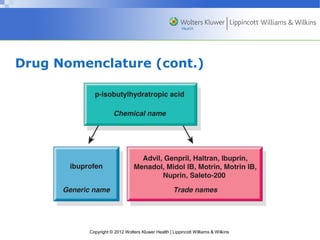
Drug Nomenclature 
• Chemical name 
– Precisely describes the drug’s atomic and molecular 
Copyright © 2012 Wolters Kluwer Health | Lippincott Williams & Wilkins 
structure 
• Generic name 
– Nonproprietary name; identifies the drug’s active 
ingredient 
• Trade name 
– Brand or proprietary name
Drug Nomenclature (cont.) 
Copyright © 2012 Wolters Kluwer Health | Lippincott Williams & Wilkins
Implications for Nursing 
• A drug should be ordered by the generic name. 
• Many trade names sound alike. 
• The nurse should check the drug name at least three 
times. 
• Pharmacy bar code system 
Copyright © 2012 Wolters Kluwer Health | Lippincott Williams & Wilkins
Copyright © 2012 Wolters Kluwer Health | Lippincott Williams & Wilkins 
Question 
• For the drug furosemide (Lasix), furosemide is the _____ 
name of the drug. 
– A. Chemical 
– B. Trade 
– C. Generic 
– D. Therapeutic class
Copyright © 2012 Wolters Kluwer Health | Lippincott Williams & Wilkins 
Answer 
• C. Generic 
• Rationale: Lasix is the trade name of the medication, 
and furosemide is the generic name of the 
medication.
Drug Classifications 
• Drugs that share similar characteristics are classified as a 
pharmacologic group or family. 
• Allows for increased understanding of medications 
• Drugs that share similar characteristics can be classified 
by 
– Chemical classification 
– Physiologic classification 
– Therapeutic classification 
Copyright © 2012 Wolters Kluwer Health | Lippincott Williams & Wilkins
Sources of Drug Information 
• New drugs are continually being developed. 
• Nurses need reliable and up-to-date drug reference. 
• Where can nurses obtain information: 
– Drug publications 
– Pharmacists 
– Internet-based drug guides 
Copyright © 2012 Wolters Kluwer Health | Lippincott Williams & Wilkins
Copyright © 2012 Wolters Kluwer Health | Lippincott Williams & Wilkins 
Question 
• As a new nurse, what would be the most appropriate 
action to take when you administer a medication you are 
unfamiliar with? 
– A. Go ahead and give the drug in an emergency 
situation and look the drug up later 
– B. Ask a co-worker to give the medication 
– C. Ask the patient why he or she is taking the 
medication 
– D. Look up the drug prior to administration
Copyright © 2012 Wolters Kluwer Health | Lippincott Williams & Wilkins 
Answer 
• D. Look up the drug prior to administration 
• Rationale: As the nurse, you are responsible for the 
medication you are administering. You need to know 
the purpose of the medication, dosage, and side 
effects prior to giving the medication. Many sources 
are available to you as a nurse to obtain information 
about medications.
Standards for Drug Purity and Content 
• Pure Food and Drug Acts 
• Federal Food, Drug, and Cosmetics Act of 1938 
• Kefauver-Harris Amendment 
Copyright © 2012 Wolters Kluwer Health | Lippincott Williams & Wilkins
Procedure for Drug Development and 
Approval 
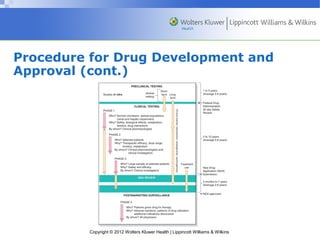
• The first step is in the discovery of a potential new drug 
molecule. 
• Preclinical trials are designed to provide basic safety, 
bioavailability, pharmacokinetic, and initial efficacy data 
about the drug. 
• Clinical trials are performed on humans in several 
phases. 
• Only about 10% of new drugs that begin clinical trials 
are approved. 
Copyright © 2012 Wolters Kluwer Health | Lippincott Williams & Wilkins
Procedure for Drug Development and 
Approval (cont.) 
Copyright © 2012 Wolters Kluwer Health | Lippincott Williams & Wilkins
Copyright © 2012 Wolters Kluwer Health | Lippincott Williams & Wilkins 
Question 
• In this phase of clinical trials, the majority of the risks 
associated with the new drug therapy are identified. 
– A. Phase I 
– B. Phase II 
– C. Phase III 
– D. Phase IV
Copyright © 2012 Wolters Kluwer Health | Lippincott Williams & Wilkins 
Answer 
• C. Phase III 
• Rationale: In phase III of drug trials, 1,000 to 3,000 
patient volunteers are enrolled in double-blind 
studies and crossover design studies. These studies 
are monitored closely to evaluate the safety and 
effectiveness of the drug.
Legislation to Promote Truth in 
Advertising 
• In 1912, Congress passed the Sherley Amendment. 
• The FFDCA of 1938 provided labeling requirements for 
the first time. 
• Today, the Federal Trade Commission regulates the 
advertisement of medications aimed at the general 
public. 
Copyright © 2012 Wolters Kluwer Health | Lippincott Williams & Wilkins
Legislation Regarding Controlled 
Substances 
• Harrison Narcotic Law of 1914 
– Provided regulation regarding the manufacture and 
distribution of certain drugs 
• The 1970 Comprehensive Drug Abuse Prevention and 
Control Act 
– Established the Drug Enforcement Agency (DEA) 
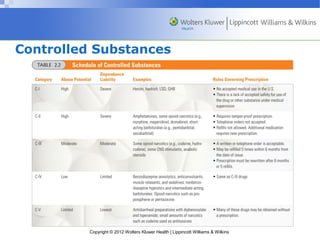
– Five categories, known as schedules, were 
established. 
Copyright © 2012 Wolters Kluwer Health | Lippincott Williams & Wilkins
Controlled Substances 
Copyright © 2012 Wolters Kluwer Health | Lippincott Williams & Wilkins
Nursing Management of Controlled 
Substances 
• The prescribing, dispensing, and storing of controlled 
substances is subject to governmental control. 
• Procedures are precisely defined by law for every step, 
from manufacture to administration to wasting or 
discarding. 
• Many hospitals use an automated system to 
electronically track the use of stock drugs. 
Copyright © 2012 Wolters Kluwer Health | Lippincott Williams & Wilkins
Legislation Regarding Drug Distribution 
• The Durham-Humphrey amendments (1952) 
– Nonprescription drugs (over-the-counter drugs) 
– Legend (prescription) drugs 
• Labeled properly 
• Procedures for the distribution of legend drugs 
Copyright © 2012 Wolters Kluwer Health | Lippincott Williams & Wilkins
Online Pharmacies 
• Increased usage of online pharmacies 
• Not all online pharmacies are regulated 
• The Ryan Haight Internet Pharmacy Consumer Protection 
Act of 2005 
Copyright © 2012 Wolters Kluwer Health | Lippincott Williams & Wilkins
Nongovernmental Institutional Controls 
• Additional regulations may be implemented by the 
institution. 
• Accrediting bodies play an additional role in institutional 
controls. 
Copyright © 2012 Wolters Kluwer Health | Lippincott Williams & Wilkins
Effect of Legal and Institutional Controls 
on Nursing Management of Drug Therapy 
• Drug laws and nurse practice acts vary from state to 
state. 
• Nurses must be familiar with the current regulations in 
their states and in their practice settings. 
• In professional practice, nurses must adhere to and obey 
established drug control laws and protocols. 
• Nurses cannot provide drug therapy without proper 
authorization. 
• Nurses are responsible for drug security and safe 
administration. 
Copyright © 2012 Wolters Kluwer Health | Lippincott Williams & Wilkins
Patient Education as a Safeguard in Drug 
Therapy 
• Educating patients is a key safeguard in drug therapy. 
• Patient learning needs 
• Teaching focus and content 
• Evaluating and documenting educational outcomes 
• Consumer drug information on the Internet 
Copyright © 2012 Wolters Kluwer Health | Lippincott Williams & Wilkins
Importance of Nursing Management of 
Drug Therapy 
• Nurses are legally responsible for the drugs they 
administer. 
• Safe drug administration requires a thorough 
understanding of therapeutic drug actions and adverse 
drug reactions. 
• In some clinical settings, nurses are allowed to modify 
drug regimens. 
• Application of the nursing process to the pharmacologic 
aspects of patient care is especially important because 
long-term use of drug therapy is frequently necessary to 
control chronic disease processes. 
• Nursing management of drug therapy may be considered 
an applied science. 
Copyright © 2012 Wolters Kluwer Health | Lippincott Williams & Wilkins

Ppt chapter 02

  • 1.
    Chapter 2 Pharmaceuticals:Development, Safeguards, and Delivery Copyright © 2012 Wolters Kluwer Health | Lippincott Williams & Wilkins
  • 2.
    Sources of Drugs • Plants • Animals • Synthetic chemicals • Genetically engineered chemicals Copyright © 2012 Wolters Kluwer Health | Lippincott Williams & Wilkins
  • 3.
    Plants • Dateto primitive times • Classified according to their physical and chemical properties – Alkaloids – Glycosides – Gums – Oils – Resins Copyright © 2012 Wolters Kluwer Health | Lippincott Williams & Wilkins
  • 4.
    Copyright © 2012Wolters Kluwer Health | Lippincott Williams & Wilkins Question • The advantage of genetically engineered drugs over those made from animals is less drug reactions. – A. True – B. False
  • 5.
    Copyright © 2012Wolters Kluwer Health | Lippincott Williams & Wilkins Answer • A. True • Rationale: Genetically engineered drugs are considered to be purer, thereby causing less adverse drug reactions.
  • 6.
    Copyright © 2012Wolters Kluwer Health | Lippincott Williams & Wilkins Animals • Traditionally, drugs from animal sources include agents such as insulin. • Today, genetically engineered hormones are rapidly replacing animal-based drugs. • The advantage of genetically engineered drugs is their purity.
  • 7.
    Synthetic Chemicals •Most drugs used today are either partially or wholly synthetic chemical compounds. • A partially synthetic agent contains a derivative of a natural substance combined with a pure chemical. • An advantage of synthetic drugs is that they are pure chemicals. Copyright © 2012 Wolters Kluwer Health | Lippincott Williams & Wilkins
  • 8.
    Genetically Engineered Chemicals • Genetically engineered drugs are drugs developed using DNA technologies. • Genomics is the study and identification of genes and gene function. • This new knowledge has enabled researchers to manipulate the chemical formulas of drugs to produce more specifically targeted drugs with fewer adverse effects. • Proteomics is the study of protein structure and function. • Proteomic technology is essential in biomarker discovery. Copyright © 2012 Wolters Kluwer Health | Lippincott Williams & Wilkins
  • 9.
    Genetically Engineered Chemicals(cont.) • Transcriptomics is the study of the transcriptome. • Transcriptomics aids in understanding the development and differentiation of a cell. • Metabonomics is the study of metabolic responses to drugs, environmental changes, and diseases. • In pharmacotherapy, metabonomics can possibly predict an individual patient’s response to drug treatment. Copyright © 2012 Wolters Kluwer Health | Lippincott Williams & Wilkins
  • 10.
    Drug Nomenclature •Chemical name – Precisely describes the drug’s atomic and molecular Copyright © 2012 Wolters Kluwer Health | Lippincott Williams & Wilkins structure • Generic name – Nonproprietary name; identifies the drug’s active ingredient • Trade name – Brand or proprietary name
  • 11.
    Drug Nomenclature (cont.) Copyright © 2012 Wolters Kluwer Health | Lippincott Williams & Wilkins
  • 12.
    Implications for Nursing • A drug should be ordered by the generic name. • Many trade names sound alike. • The nurse should check the drug name at least three times. • Pharmacy bar code system Copyright © 2012 Wolters Kluwer Health | Lippincott Williams & Wilkins
  • 13.
    Copyright © 2012Wolters Kluwer Health | Lippincott Williams & Wilkins Question • For the drug furosemide (Lasix), furosemide is the _____ name of the drug. – A. Chemical – B. Trade – C. Generic – D. Therapeutic class
  • 14.
    Copyright © 2012Wolters Kluwer Health | Lippincott Williams & Wilkins Answer • C. Generic • Rationale: Lasix is the trade name of the medication, and furosemide is the generic name of the medication.
  • 15.
    Drug Classifications •Drugs that share similar characteristics are classified as a pharmacologic group or family. • Allows for increased understanding of medications • Drugs that share similar characteristics can be classified by – Chemical classification – Physiologic classification – Therapeutic classification Copyright © 2012 Wolters Kluwer Health | Lippincott Williams & Wilkins
  • 16.
    Sources of DrugInformation • New drugs are continually being developed. • Nurses need reliable and up-to-date drug reference. • Where can nurses obtain information: – Drug publications – Pharmacists – Internet-based drug guides Copyright © 2012 Wolters Kluwer Health | Lippincott Williams & Wilkins
  • 17.
    Copyright © 2012Wolters Kluwer Health | Lippincott Williams & Wilkins Question • As a new nurse, what would be the most appropriate action to take when you administer a medication you are unfamiliar with? – A. Go ahead and give the drug in an emergency situation and look the drug up later – B. Ask a co-worker to give the medication – C. Ask the patient why he or she is taking the medication – D. Look up the drug prior to administration
  • 18.
    Copyright © 2012Wolters Kluwer Health | Lippincott Williams & Wilkins Answer • D. Look up the drug prior to administration • Rationale: As the nurse, you are responsible for the medication you are administering. You need to know the purpose of the medication, dosage, and side effects prior to giving the medication. Many sources are available to you as a nurse to obtain information about medications.
  • 19.
    Standards for DrugPurity and Content • Pure Food and Drug Acts • Federal Food, Drug, and Cosmetics Act of 1938 • Kefauver-Harris Amendment Copyright © 2012 Wolters Kluwer Health | Lippincott Williams & Wilkins
  • 20.
    Procedure for DrugDevelopment and Approval • The first step is in the discovery of a potential new drug molecule. • Preclinical trials are designed to provide basic safety, bioavailability, pharmacokinetic, and initial efficacy data about the drug. • Clinical trials are performed on humans in several phases. • Only about 10% of new drugs that begin clinical trials are approved. Copyright © 2012 Wolters Kluwer Health | Lippincott Williams & Wilkins
  • 21.
    Procedure for DrugDevelopment and Approval (cont.) Copyright © 2012 Wolters Kluwer Health | Lippincott Williams & Wilkins
  • 22.
    Copyright © 2012Wolters Kluwer Health | Lippincott Williams & Wilkins Question • In this phase of clinical trials, the majority of the risks associated with the new drug therapy are identified. – A. Phase I – B. Phase II – C. Phase III – D. Phase IV
  • 23.
    Copyright © 2012Wolters Kluwer Health | Lippincott Williams & Wilkins Answer • C. Phase III • Rationale: In phase III of drug trials, 1,000 to 3,000 patient volunteers are enrolled in double-blind studies and crossover design studies. These studies are monitored closely to evaluate the safety and effectiveness of the drug.
  • 24.
    Legislation to PromoteTruth in Advertising • In 1912, Congress passed the Sherley Amendment. • The FFDCA of 1938 provided labeling requirements for the first time. • Today, the Federal Trade Commission regulates the advertisement of medications aimed at the general public. Copyright © 2012 Wolters Kluwer Health | Lippincott Williams & Wilkins
  • 25.
    Legislation Regarding Controlled Substances • Harrison Narcotic Law of 1914 – Provided regulation regarding the manufacture and distribution of certain drugs • The 1970 Comprehensive Drug Abuse Prevention and Control Act – Established the Drug Enforcement Agency (DEA) – Five categories, known as schedules, were established. Copyright © 2012 Wolters Kluwer Health | Lippincott Williams & Wilkins
  • 26.
    Controlled Substances Copyright© 2012 Wolters Kluwer Health | Lippincott Williams & Wilkins
  • 27.
    Nursing Management ofControlled Substances • The prescribing, dispensing, and storing of controlled substances is subject to governmental control. • Procedures are precisely defined by law for every step, from manufacture to administration to wasting or discarding. • Many hospitals use an automated system to electronically track the use of stock drugs. Copyright © 2012 Wolters Kluwer Health | Lippincott Williams & Wilkins
  • 28.
    Legislation Regarding DrugDistribution • The Durham-Humphrey amendments (1952) – Nonprescription drugs (over-the-counter drugs) – Legend (prescription) drugs • Labeled properly • Procedures for the distribution of legend drugs Copyright © 2012 Wolters Kluwer Health | Lippincott Williams & Wilkins
  • 29.
    Online Pharmacies •Increased usage of online pharmacies • Not all online pharmacies are regulated • The Ryan Haight Internet Pharmacy Consumer Protection Act of 2005 Copyright © 2012 Wolters Kluwer Health | Lippincott Williams & Wilkins
  • 30.
    Nongovernmental Institutional Controls • Additional regulations may be implemented by the institution. • Accrediting bodies play an additional role in institutional controls. Copyright © 2012 Wolters Kluwer Health | Lippincott Williams & Wilkins
  • 31.
    Effect of Legaland Institutional Controls on Nursing Management of Drug Therapy • Drug laws and nurse practice acts vary from state to state. • Nurses must be familiar with the current regulations in their states and in their practice settings. • In professional practice, nurses must adhere to and obey established drug control laws and protocols. • Nurses cannot provide drug therapy without proper authorization. • Nurses are responsible for drug security and safe administration. Copyright © 2012 Wolters Kluwer Health | Lippincott Williams & Wilkins
  • 32.
    Patient Education asa Safeguard in Drug Therapy • Educating patients is a key safeguard in drug therapy. • Patient learning needs • Teaching focus and content • Evaluating and documenting educational outcomes • Consumer drug information on the Internet Copyright © 2012 Wolters Kluwer Health | Lippincott Williams & Wilkins
  • 33.
    Importance of NursingManagement of Drug Therapy • Nurses are legally responsible for the drugs they administer. • Safe drug administration requires a thorough understanding of therapeutic drug actions and adverse drug reactions. • In some clinical settings, nurses are allowed to modify drug regimens. • Application of the nursing process to the pharmacologic aspects of patient care is especially important because long-term use of drug therapy is frequently necessary to control chronic disease processes. • Nursing management of drug therapy may be considered an applied science. Copyright © 2012 Wolters Kluwer Health | Lippincott Williams & Wilkins