Written and Second
Language Acquisition
 Is written language acquired naturally or learned consciously?
             Can people acquire a second language?

                           By: Amy Barnes
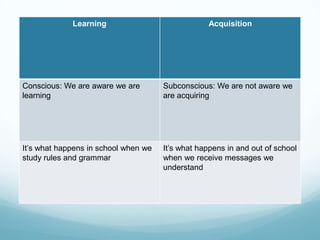
Learning                             Acquisition


Conscious: We are aware we are        Subconscious: We are not aware we
learning                              are acquiring


It’s what happens in school when we   It’s what happens in and out of school
study rules and grammar               when we receive messages we
                                      understand
 In the movie, Matilda, Mrs. Honey is a perfect example
  of using both traditional teaching strategies while
  incorporating the Acquisition View. [click image to see
  more on Matilda]
Methods, Strategies & Views
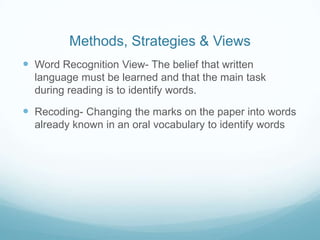
 Word Recognition View- The belief that written
  language must be learned and that the main task
  during reading is to identify words.

 Recoding- Changing the marks on the paper into words
  already known in an oral vocabulary to identify words
Methods, Strategies & Views continued..
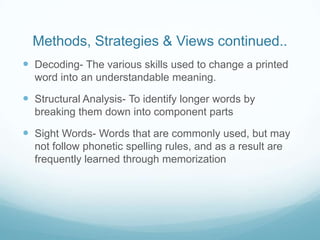
 Decoding- The various skills used to change a printed
  word into an understandable meaning.

 Structural Analysis- To identify longer words by
  breaking them down into component parts

 Sight Words- Words that are commonly used, but may
  not follow phonetic spelling rules, and as a result are
  frequently learned through memorization
Quotes for Thought

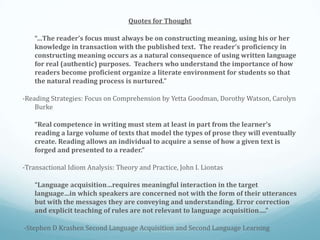
    “…The reader’s focus must always be on constructing meaning, using his or her
    knowledge in transaction with the published text. The reader’s proficiency in
    constructing meaning occurs as a natural consequence of using written language
    for real (authentic) purposes. Teachers who understand the importance of how
    readers become proficient organize a literate environment for students so that
    the natural reading process is nurtured.”

-Reading Strategies: Focus on Comprehension by Yetta Goodman, Dorothy Watson, Carolyn
    Burke

    “Real competence in writing must stem at least in part from the learner's
    reading a large volume of texts that model the types of prose they will eventually
    create. Reading allows an individual to acquire a sense of how a given text is
    forged and presented to a reader.”

-Transactional Idiom Analysis: Theory and Practice, John I. Liontas

    “Language acquisition…requires meaningful interaction in the target
    language…in which speakers are concerned not with the form of their utterances
    but with the messages they are conveying and understanding. Error correction
    and explicit teaching of rules are not relevant to language acquisition….”

-Stephen D Krashen Second Language Acquisition and Second Language Learning
Acquisition vs. Learning Hypothesis from Krashen
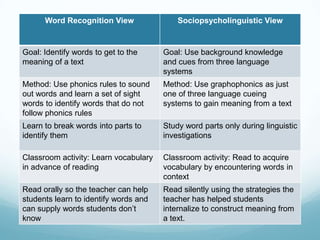
Word Recognition View                Sociopsycholinguistic View


Goal: Identify words to get to the     Goal: Use background knowledge
meaning of a text                      and cues from three language
                                       systems
Method: Use phonics rules to sound     Method: Use graphophonics as just
out words and learn a set of sight     one of three language cueing
words to identify words that do not    systems to gain meaning from a text
follow phonics rules
Learn to break words into parts to     Study word parts only during linguistic
identify them                          investigations

Classroom activity: Learn vocabulary   Classroom activity: Read to acquire
in advance of reading                  vocabulary by encountering words in
                                       context
Read orally so the teacher can help    Read silently using the strategies the
students learn to identify words and   teacher has helped students
can supply words students don’t        internalize to construct meaning from
know                                   a text.
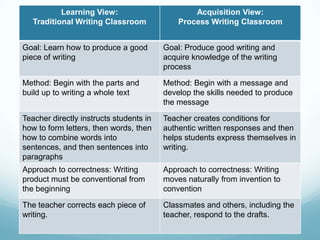
Learning View:                        Acquisition View:
   Traditional Writing Classroom             Process Writing Classroom


Goal: Learn how to produce a good        Goal: Produce good writing and
piece of writing                         acquire knowledge of the writing
                                         process

Method: Begin with the parts and         Method: Begin with a message and
build up to writing a whole text         develop the skills needed to produce
                                         the message

Teacher directly instructs students in   Teacher creates conditions for
how to form letters, then words, then    authentic written responses and then
how to combine words into                helps students express themselves in
sentences, and then sentences into       writing.
paragraphs
Approach to correctness: Writing         Approach to correctness: Writing
product must be conventional from        moves naturally from invention to
the beginning                            convention

The teacher corrects each piece of       Classmates and others, including the
writing.                                 teacher, respond to the drafts.
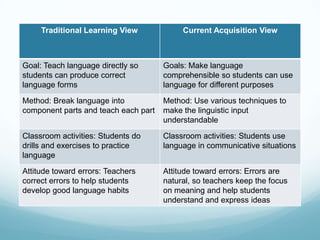
Traditional Learning View             Current Acquisition View


Goal: Teach language directly so      Goals: Make language
students can produce correct          comprehensible so students can use
language forms                        language for different purposes

Method: Break language into           Method: Use various techniques to
component parts and teach each part   make the linguistic input
                                      understandable
Classroom activities: Students do     Classroom activities: Students use
drills and exercises to practice      language in communicative situations
language

Attitude toward errors: Teachers      Attitude toward errors: Errors are
correct errors to help students       natural, so teachers keep the focus
develop good language habits          on meaning and help students
                                      understand and express ideas
Matilda Video
 http://www.youtube.com/watch?v=yFdrYxYIdDI

Ppt amy barnes

  • 1.
    Written and Second LanguageAcquisition Is written language acquired naturally or learned consciously? Can people acquire a second language? By: Amy Barnes
  • 2.
    Learning Acquisition Conscious: We are aware we are Subconscious: We are not aware we learning are acquiring It’s what happens in school when we It’s what happens in and out of school study rules and grammar when we receive messages we understand
  • 3.
     In themovie, Matilda, Mrs. Honey is a perfect example of using both traditional teaching strategies while incorporating the Acquisition View. [click image to see more on Matilda]
  • 4.
    Methods, Strategies &Views  Word Recognition View- The belief that written language must be learned and that the main task during reading is to identify words.  Recoding- Changing the marks on the paper into words already known in an oral vocabulary to identify words
  • 5.
    Methods, Strategies &Views continued..  Decoding- The various skills used to change a printed word into an understandable meaning.  Structural Analysis- To identify longer words by breaking them down into component parts  Sight Words- Words that are commonly used, but may not follow phonetic spelling rules, and as a result are frequently learned through memorization
  • 6.
    Quotes for Thought “…The reader’s focus must always be on constructing meaning, using his or her knowledge in transaction with the published text. The reader’s proficiency in constructing meaning occurs as a natural consequence of using written language for real (authentic) purposes. Teachers who understand the importance of how readers become proficient organize a literate environment for students so that the natural reading process is nurtured.” -Reading Strategies: Focus on Comprehension by Yetta Goodman, Dorothy Watson, Carolyn Burke “Real competence in writing must stem at least in part from the learner's reading a large volume of texts that model the types of prose they will eventually create. Reading allows an individual to acquire a sense of how a given text is forged and presented to a reader.” -Transactional Idiom Analysis: Theory and Practice, John I. Liontas “Language acquisition…requires meaningful interaction in the target language…in which speakers are concerned not with the form of their utterances but with the messages they are conveying and understanding. Error correction and explicit teaching of rules are not relevant to language acquisition….” -Stephen D Krashen Second Language Acquisition and Second Language Learning
  • 7.
    Acquisition vs. LearningHypothesis from Krashen
  • 8.
    Word Recognition View Sociopsycholinguistic View Goal: Identify words to get to the Goal: Use background knowledge meaning of a text and cues from three language systems Method: Use phonics rules to sound Method: Use graphophonics as just out words and learn a set of sight one of three language cueing words to identify words that do not systems to gain meaning from a text follow phonics rules Learn to break words into parts to Study word parts only during linguistic identify them investigations Classroom activity: Learn vocabulary Classroom activity: Read to acquire in advance of reading vocabulary by encountering words in context Read orally so the teacher can help Read silently using the strategies the students learn to identify words and teacher has helped students can supply words students don’t internalize to construct meaning from know a text.
  • 9.
    Learning View: Acquisition View: Traditional Writing Classroom Process Writing Classroom Goal: Learn how to produce a good Goal: Produce good writing and piece of writing acquire knowledge of the writing process Method: Begin with the parts and Method: Begin with a message and build up to writing a whole text develop the skills needed to produce the message Teacher directly instructs students in Teacher creates conditions for how to form letters, then words, then authentic written responses and then how to combine words into helps students express themselves in sentences, and then sentences into writing. paragraphs Approach to correctness: Writing Approach to correctness: Writing product must be conventional from moves naturally from invention to the beginning convention The teacher corrects each piece of Classmates and others, including the writing. teacher, respond to the drafts.
  • 10.
    Traditional Learning View Current Acquisition View Goal: Teach language directly so Goals: Make language students can produce correct comprehensible so students can use language forms language for different purposes Method: Break language into Method: Use various techniques to component parts and teach each part make the linguistic input understandable Classroom activities: Students do Classroom activities: Students use drills and exercises to practice language in communicative situations language Attitude toward errors: Teachers Attitude toward errors: Errors are correct errors to help students natural, so teachers keep the focus develop good language habits on meaning and help students understand and express ideas
  • 11.