1 
How to develop your mentors’ interpersonal 
and communication skills 
Date: 8th November 2014 
Location: Barcelona 
Facilitator: Val Barritt, Head of training & quality 
assurance (val.barritt@mandbf.org)
Aims of the workshop 
To provide an overview of the key stages in a typical mentoring 
relationship – starting out together; getting to know the person; 
identifying issues to work on; action planning; standing alongside and 
concluding the relationship 
To explore the interpersonal and communication skills required 
at each stage and what educators can do to help their mentors 
to develop these skills, for example: rapport building; empathetic 
listening; helpful questioning; setting goals with someone and 
managing the end of the relationship 
2
About MBF 
The Mentoring and Befriending Foundation provides services 
which aim to increase the effectiveness and quality of 
mentoring and befriending as methods of enabling individuals 
to transform their lives and/or reach their full potential: 
Training and resources – we provide high quality training 
and resources to support the development and management of 
mentoring and befriending projects 
Quality Assurance – we encourage organisations to achieve 
our quality standard, the Approved Provider Standard (APS) as 
a way of promoting good practice 
MBF network membership – we provide a membership 
network for individuals and organisations interested in 
mentoring and befriending 
3
Ice breaker
Mentoring is... 
A voluntary, mutually beneficial and purposeful 
relationship in which an individual gives time to 
support another to enable them to make 
changes in their life. 
(MBF) 
5 
Mentoring definition
“Social mentoring is a tool for educational intervention 
which promotes the voluntary relationship between 
people who offer to provide individual support and 
people who are at risk of social exclusion. 
This relationship is motivated and supervised by a 
professional. The volunteer (mentor) “helps the mentee 
make their way” and supports them in their personal 
and/or career development.” 
6 
Social mentoring
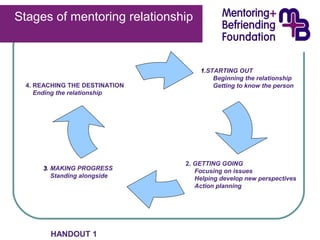
Stages of mentoring relationship 
1.STARTING OUT 
Beginning the relationship 
Getting to know the person 
2. GETTING GOING 
Focusing on issues 
Helping develop new perspectives 
Action planning 
4. REACHING THE DESTINATION 
Ending the relationship 
33. MAKING PROGRESS 
Standing alongside 
HANDOUT 1
Mentoring is about a helping and supporting relationship. 
It involves interaction between people - the mentor and the 
mentee 
A mentor needs to develop and use skills related to: 
Rapport building 
Empathetic listening 
Questioning approaches 
Setting goals 
Managing the end of the relationship 
8 
Skills of mentoring
9 
The learning cycle 
Do something 
(Activist) 
Think about it 
(Reflector) 
Make sense of it 
(Theorist) 
Test it out 
(Pragmatist)
10 
Your role as educator 
1 2 3 4 5 6 7 8 9 10 
Tell, instruct Ask, listen
Rapport – what is it? 
 Close and harmonious relationship in which there is 
common understanding. 
 It’s a relationship in action, our sense of connection 
with each other. 
 The link and mutual understanding that exists 
between two people, often built over time and 
through shared experiences. 
 Rapport works on features of ‘sameness.’
Rapport
13 
Rapport?
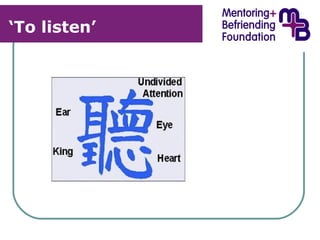
‘To listen’
Empathy is the ability to: 
Listen and attend to the other person and enter their 
reality 
Make sense of what you hear 
Identify key experiences, thoughts and feelings 
and communicate your understanding sensitively 
15 
Empathy
Empathy involves: 
 The skills of active listening 
 Awareness of your own feelings and perceptions 
 Good communication skills 
 Sensitivity and respect towards the other 
person’s viewpoint and frame of reference 
16
It enables the other person to: 
 Feel valued and understood 
 Develop trust and openness towards the listener 
 Open up about what is on their mind 
 Focus on what they are trying to express 
 Express themselves without pressure 
 Feel supported 
17
Empathetic listening skills 
Empathetic listening skills practise 
Working in pairs 
Handout 2: listening skills brief 
Handout 3: 10 steps to positive communication
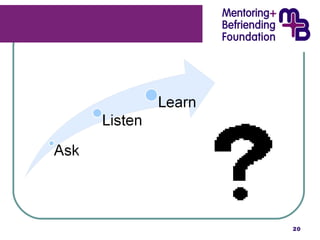
Questions, questions 
Handout 4: questioning styles
20
Stages of mentoring relationship 
1.STARTING OUT 
Beginning the relationship 
Getting to know the person 
2. GETTING GOING 
Focusing on issues 
Helping develop new perspectives 
Action planning 
4. REACHING THE DESTINATION 
Ending the relationship 
33. MAKING PROGRESS 
Standing alongside 
HANDOUT 1
22 
The wheel 
H handout 5 
Finding employment 
Life skills 
Social 
Technical skills 
Education & 
training 
Other 
Personal 
wellbeing 
Soft skills 
0
23 
Goal setting 
What is the goal? 
What are the steps? 
Handout 6
24 
Managing endings 
 What will a good ending look like for mentor and 
mentee? 
 How will you help your mentors to manage the ‘ending’ 
of their mentoring relationship?
Summary 
Final questions 
Find out more about our training, resources, network 
membership and our Quality standard (APS) by visiting 
our website www.mandbf.org 
25 
Wrap up of session

Mentoring&Befriending Foundation: “Training mentors: how to develop mentors’ interpersonal communication skills.

  • 1.
    1 How todevelop your mentors’ interpersonal and communication skills Date: 8th November 2014 Location: Barcelona Facilitator: Val Barritt, Head of training & quality assurance (val.barritt@mandbf.org)
  • 2.
    Aims of theworkshop To provide an overview of the key stages in a typical mentoring relationship – starting out together; getting to know the person; identifying issues to work on; action planning; standing alongside and concluding the relationship To explore the interpersonal and communication skills required at each stage and what educators can do to help their mentors to develop these skills, for example: rapport building; empathetic listening; helpful questioning; setting goals with someone and managing the end of the relationship 2
  • 3.
    About MBF TheMentoring and Befriending Foundation provides services which aim to increase the effectiveness and quality of mentoring and befriending as methods of enabling individuals to transform their lives and/or reach their full potential: Training and resources – we provide high quality training and resources to support the development and management of mentoring and befriending projects Quality Assurance – we encourage organisations to achieve our quality standard, the Approved Provider Standard (APS) as a way of promoting good practice MBF network membership – we provide a membership network for individuals and organisations interested in mentoring and befriending 3
  • 4.
  • 5.
    Mentoring is... Avoluntary, mutually beneficial and purposeful relationship in which an individual gives time to support another to enable them to make changes in their life. (MBF) 5 Mentoring definition
  • 6.
    “Social mentoring isa tool for educational intervention which promotes the voluntary relationship between people who offer to provide individual support and people who are at risk of social exclusion. This relationship is motivated and supervised by a professional. The volunteer (mentor) “helps the mentee make their way” and supports them in their personal and/or career development.” 6 Social mentoring
  • 7.
    Stages of mentoringrelationship 1.STARTING OUT Beginning the relationship Getting to know the person 2. GETTING GOING Focusing on issues Helping develop new perspectives Action planning 4. REACHING THE DESTINATION Ending the relationship 33. MAKING PROGRESS Standing alongside HANDOUT 1
  • 8.
    Mentoring is abouta helping and supporting relationship. It involves interaction between people - the mentor and the mentee A mentor needs to develop and use skills related to: Rapport building Empathetic listening Questioning approaches Setting goals Managing the end of the relationship 8 Skills of mentoring
  • 9.
    9 The learningcycle Do something (Activist) Think about it (Reflector) Make sense of it (Theorist) Test it out (Pragmatist)
  • 10.
    10 Your roleas educator 1 2 3 4 5 6 7 8 9 10 Tell, instruct Ask, listen
  • 11.
    Rapport – whatis it?  Close and harmonious relationship in which there is common understanding.  It’s a relationship in action, our sense of connection with each other.  The link and mutual understanding that exists between two people, often built over time and through shared experiences.  Rapport works on features of ‘sameness.’
  • 12.
  • 13.
  • 14.
  • 15.
    Empathy is theability to: Listen and attend to the other person and enter their reality Make sense of what you hear Identify key experiences, thoughts and feelings and communicate your understanding sensitively 15 Empathy
  • 16.
    Empathy involves: The skills of active listening  Awareness of your own feelings and perceptions  Good communication skills  Sensitivity and respect towards the other person’s viewpoint and frame of reference 16
  • 17.
    It enables theother person to:  Feel valued and understood  Develop trust and openness towards the listener  Open up about what is on their mind  Focus on what they are trying to express  Express themselves without pressure  Feel supported 17
  • 18.
    Empathetic listening skills Empathetic listening skills practise Working in pairs Handout 2: listening skills brief Handout 3: 10 steps to positive communication
  • 19.
    Questions, questions Handout4: questioning styles
  • 20.
  • 21.
    Stages of mentoringrelationship 1.STARTING OUT Beginning the relationship Getting to know the person 2. GETTING GOING Focusing on issues Helping develop new perspectives Action planning 4. REACHING THE DESTINATION Ending the relationship 33. MAKING PROGRESS Standing alongside HANDOUT 1
  • 22.
    22 The wheel H handout 5 Finding employment Life skills Social Technical skills Education & training Other Personal wellbeing Soft skills 0
  • 23.
    23 Goal setting What is the goal? What are the steps? Handout 6
  • 24.
    24 Managing endings  What will a good ending look like for mentor and mentee?  How will you help your mentors to manage the ‘ending’ of their mentoring relationship?
  • 25.
    Summary Final questions Find out more about our training, resources, network membership and our Quality standard (APS) by visiting our website www.mandbf.org 25 Wrap up of session

Editor's Notes

  • #19 Warning: Befriender is not to give advice, make suggestions or try to resolve the issue for the befriendee!