Mentoring Brian Mumby Walden University Dr. Marylou Dantonio Teaching Leadership: Mentoring, Coaching, and Collaboration with Colleagues (EDUC-6655H-2) November 20, 2011
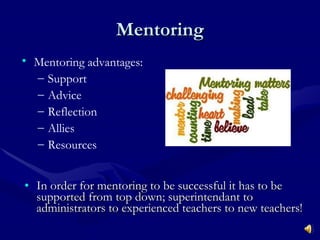
Mentoring In order for mentoring to be successful it has to be supported from top down; superintendant to administrators to experienced teachers to new teachers! Mentoring advantages: Support Advice Reflection Allies Resources
What is Mentoring? “The core of mentoring…is the focus on collaborative participation and mutual critical thinking and reflection about the process, value, and results of jointly derived learning goals established for the mentee (Jonson, 2008).”
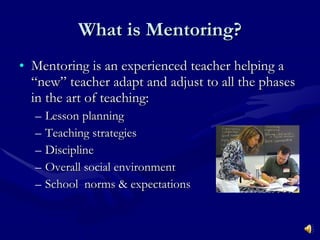
What is Mentoring? Mentoring is an experienced teacher helping a “new” teacher adapt and adjust to all the phases in the art of teaching: Lesson planning Teaching strategies Discipline Overall social environment School  norms & expectations
Phases of Mentoring Mentoring has three phases Induction Orientation Coaching (Portner, 2010)
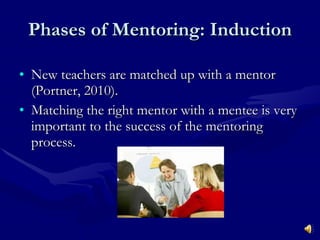
Phases of Mentoring: Induction New teachers are matched up with a mentor (Portner, 2010).  Matching the right mentor with a mentee is very important to the success of the mentoring process.
Phases of Mentoring: Induction The first step in matching a mentor with a mentee is determining the mentee’s experience level. Fresh out of college  Needs extensive mentoring Returning after an extended leave of absence  Needs modified mentoring Experienced but new to the district  Needs brief mentoring (Portner, 2010)
Phases of Mentoring: Induction The mentor should be: Knowledgeable in all aspects of the school Knowledgeable in subject area From the same grade level or department A good communicator and listener An outlet for help and not there to evaluate and critique – not an administrator Confident and understand themselves before attempting to mentor and understand someone else (Knight, 2010)
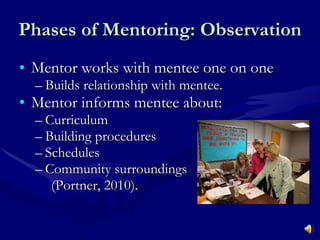
Phases of Mentoring: Observation Mentor works with mentee one on one Builds relationship with mentee. Mentor informs mentee about: Curriculum Building procedures Schedules Community surroundings (Portner, 2010).
Phases of Mentoring: Coaching Mentor helps the mentee with how to teach, what to teach, decision making, reflecting, and making changes (Portner, 2010). Coaching Phase has three stages: Pre-conference Observation Post-Conference (Portner, 2010)
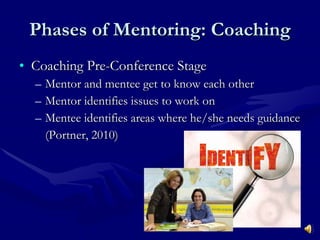
Phases of Mentoring: Coaching Coaching Pre-Conference Stage Mentor and mentee get to know each other Mentor identifies issues to work on Mentee identifies areas where he/she needs guidance (Portner, 2010)
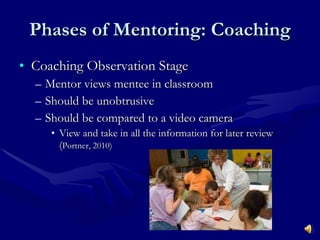
Phases of Mentoring: Coaching Coaching Observation Stage Mentor views mentee in classroom Should be unobtrusive Should be compared to a video camera View and take in all the information for later review ( Portner, 2010)
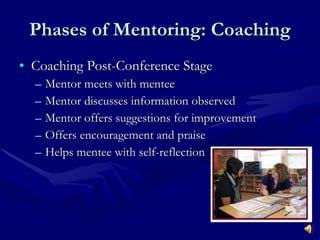
Phases of Mentoring: Coaching Coaching Post-Conference Stage Mentor meets with mentee Mentor discusses information observed Mentor offers suggestions for improvement Offers encouragement and praise Helps mentee with self-reflection
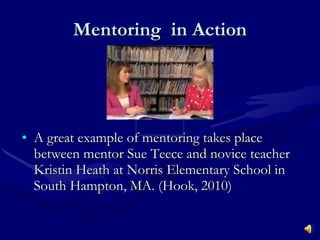
Mentoring  in Action A great example of mentoring takes place between mentor Sue Teece and novice teacher Kristin Heath at Norris Elementary School in South Hampton, MA. (Hook, 2010)
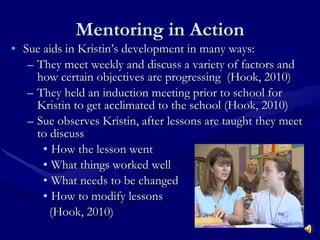
Mentoring in Action Sue aids in Kristin’s development in many ways: They meet weekly and discuss a variety of factors and how certain objectives are progressing  (Hook, 2010) They held an induction meeting prior to school for Kristin to get acclimated to the school (Hook, 2010) Sue observes Kristin, after lessons are taught they meet to discuss  How the lesson went What things worked well What needs to be changed How to modify lessons    (Hook, 2010)
Mentoring in Action Pre-lesson conference - Sue helped Kristin think deeper about her lesson. She helped Kristin analyze every aspect of the lesson to determine objectives and hopeful outcomes. She had Kristin think through every part of her lesson so she was not surprised by anything and to make sure she did not forget anything. Sue helped Kristin make plans for the geo boards and a k-w-l chart (Hook, 2010).
Mentoring in Action Sue and Kristin have an established cooperative relationship. They communicate well together. Sue asks a multitude of questions and Kristin answers those questions without frustration. Sue has helped Kristin build confidence in herself and in her abilities  Helped build trust between mentor/mentee.
Mentoring in Action Sue ensures Kristin is teaching to the correct benchmarks and standards Ensures student learning Sue makes sure Kristin is differentiating instruction and addressing all student’s needs. Ensures student success
Mentoring in Action I believe Sue and Kristin have a great working relationship. They help each other become better teachers. They have the student’s best interest in mind when developing lessons. Sue and Kristin did a good job of reflecting on the lesson during their post-conference. Sue provided praise while offering constructive suggestions.
Mentoring in Action Areas for improvement  They meet weekly for only 10-15 minutes. I would want them to meet for at least 30 minutes weekly. Kristin doing more self reflection  Sue asks a lot of questions that tell Kristin her areas for improvement.  Sue needs to lead Kristin to see some of her mistakes and her inefficiencies for herself.
Mentor Programs Very beneficial to the mentee if The program has support and guidance from the top down. The correct mentor is chosen based on being competent versus just “experienced.” The program is clearly outlined and expectations are known to both the mentor and the mentee. Communication is key!
References Jonson, K. (2008). Mentoring, Coaching, and Collaboration.  Working as a Partner With the Adult Learner. Pg.40.  Corwin Press. Thousand Oaks, CA. Portner, H. (2010). Why Mentoring. [DVD]. Teaching leadership: Mentoring, coaching, and collaboration with colleagues. Laureate Education, Inc. Baltimore, MD.
References Knight, J.(2010). Understanding Self and Others. [DVD]. Teaching leadership: Mentoring, coaching, and collaboration with colleagues. Laureate Education, Inc. Baltimore, MD. Hook, J.(2010).  Virtual Field Experience™: Mentoring Demonstration . [DVD]. Teaching leadership: Mentoring, coaching, and collaboration with colleagues. Laureate Education, Inc. Baltimore, MD.
References Image retrieved on 11-20-11 from:  http://www.nysut.org/newyorkteacher_11388.htm Image retrieved on 11-20-11 from:  http://teachingwithsoul.wordpress.com/2011/10/24/mentoring-mondaysthe-teacher-mentoring-project-ntchat-edchat/ Image retrieved on 11-20-11 from:  http://www.pioneerschools.org/domain/25
Reference Image retrieved on 11-20-11 from:  http://aftma.net/2011/05/teacher-mentor-evaluator/ Image retrieved on 11-20-11 from:  http://www.wcu.edu/9707.asp Image retrieved on 11-20-11 from:  http://www.ecmhc.org/tutorials/consultative_stance/mod2_4.html Image retrieved on 11-20-11 from:  http://teachers.net/wong/SEP11/

App3mumbyb

  • 1.
    Mentoring Brian MumbyWalden University Dr. Marylou Dantonio Teaching Leadership: Mentoring, Coaching, and Collaboration with Colleagues (EDUC-6655H-2) November 20, 2011
  • 2.
    Mentoring In orderfor mentoring to be successful it has to be supported from top down; superintendant to administrators to experienced teachers to new teachers! Mentoring advantages: Support Advice Reflection Allies Resources
  • 3.
    What is Mentoring?“The core of mentoring…is the focus on collaborative participation and mutual critical thinking and reflection about the process, value, and results of jointly derived learning goals established for the mentee (Jonson, 2008).”
  • 4.
    What is Mentoring?Mentoring is an experienced teacher helping a “new” teacher adapt and adjust to all the phases in the art of teaching: Lesson planning Teaching strategies Discipline Overall social environment School norms & expectations
  • 5.
    Phases of MentoringMentoring has three phases Induction Orientation Coaching (Portner, 2010)
  • 6.
    Phases of Mentoring:Induction New teachers are matched up with a mentor (Portner, 2010). Matching the right mentor with a mentee is very important to the success of the mentoring process.
  • 7.
    Phases of Mentoring:Induction The first step in matching a mentor with a mentee is determining the mentee’s experience level. Fresh out of college Needs extensive mentoring Returning after an extended leave of absence Needs modified mentoring Experienced but new to the district Needs brief mentoring (Portner, 2010)
  • 8.
    Phases of Mentoring:Induction The mentor should be: Knowledgeable in all aspects of the school Knowledgeable in subject area From the same grade level or department A good communicator and listener An outlet for help and not there to evaluate and critique – not an administrator Confident and understand themselves before attempting to mentor and understand someone else (Knight, 2010)
  • 9.
    Phases of Mentoring:Observation Mentor works with mentee one on one Builds relationship with mentee. Mentor informs mentee about: Curriculum Building procedures Schedules Community surroundings (Portner, 2010).
  • 10.
    Phases of Mentoring:Coaching Mentor helps the mentee with how to teach, what to teach, decision making, reflecting, and making changes (Portner, 2010). Coaching Phase has three stages: Pre-conference Observation Post-Conference (Portner, 2010)
  • 11.
    Phases of Mentoring:Coaching Coaching Pre-Conference Stage Mentor and mentee get to know each other Mentor identifies issues to work on Mentee identifies areas where he/she needs guidance (Portner, 2010)
  • 12.
    Phases of Mentoring:Coaching Coaching Observation Stage Mentor views mentee in classroom Should be unobtrusive Should be compared to a video camera View and take in all the information for later review ( Portner, 2010)
  • 13.
    Phases of Mentoring:Coaching Coaching Post-Conference Stage Mentor meets with mentee Mentor discusses information observed Mentor offers suggestions for improvement Offers encouragement and praise Helps mentee with self-reflection
  • 14.
    Mentoring inAction A great example of mentoring takes place between mentor Sue Teece and novice teacher Kristin Heath at Norris Elementary School in South Hampton, MA. (Hook, 2010)
  • 15.
    Mentoring in ActionSue aids in Kristin’s development in many ways: They meet weekly and discuss a variety of factors and how certain objectives are progressing (Hook, 2010) They held an induction meeting prior to school for Kristin to get acclimated to the school (Hook, 2010) Sue observes Kristin, after lessons are taught they meet to discuss How the lesson went What things worked well What needs to be changed How to modify lessons (Hook, 2010)
  • 16.
    Mentoring in ActionPre-lesson conference - Sue helped Kristin think deeper about her lesson. She helped Kristin analyze every aspect of the lesson to determine objectives and hopeful outcomes. She had Kristin think through every part of her lesson so she was not surprised by anything and to make sure she did not forget anything. Sue helped Kristin make plans for the geo boards and a k-w-l chart (Hook, 2010).
  • 17.
    Mentoring in ActionSue and Kristin have an established cooperative relationship. They communicate well together. Sue asks a multitude of questions and Kristin answers those questions without frustration. Sue has helped Kristin build confidence in herself and in her abilities Helped build trust between mentor/mentee.
  • 18.
    Mentoring in ActionSue ensures Kristin is teaching to the correct benchmarks and standards Ensures student learning Sue makes sure Kristin is differentiating instruction and addressing all student’s needs. Ensures student success
  • 19.
    Mentoring in ActionI believe Sue and Kristin have a great working relationship. They help each other become better teachers. They have the student’s best interest in mind when developing lessons. Sue and Kristin did a good job of reflecting on the lesson during their post-conference. Sue provided praise while offering constructive suggestions.
  • 20.
    Mentoring in ActionAreas for improvement They meet weekly for only 10-15 minutes. I would want them to meet for at least 30 minutes weekly. Kristin doing more self reflection Sue asks a lot of questions that tell Kristin her areas for improvement. Sue needs to lead Kristin to see some of her mistakes and her inefficiencies for herself.
  • 21.
    Mentor Programs Verybeneficial to the mentee if The program has support and guidance from the top down. The correct mentor is chosen based on being competent versus just “experienced.” The program is clearly outlined and expectations are known to both the mentor and the mentee. Communication is key!
  • 22.
    References Jonson, K.(2008). Mentoring, Coaching, and Collaboration. Working as a Partner With the Adult Learner. Pg.40. Corwin Press. Thousand Oaks, CA. Portner, H. (2010). Why Mentoring. [DVD]. Teaching leadership: Mentoring, coaching, and collaboration with colleagues. Laureate Education, Inc. Baltimore, MD.
  • 23.
    References Knight, J.(2010).Understanding Self and Others. [DVD]. Teaching leadership: Mentoring, coaching, and collaboration with colleagues. Laureate Education, Inc. Baltimore, MD. Hook, J.(2010). Virtual Field Experience™: Mentoring Demonstration . [DVD]. Teaching leadership: Mentoring, coaching, and collaboration with colleagues. Laureate Education, Inc. Baltimore, MD.
  • 24.
    References Image retrievedon 11-20-11 from: http://www.nysut.org/newyorkteacher_11388.htm Image retrieved on 11-20-11 from: http://teachingwithsoul.wordpress.com/2011/10/24/mentoring-mondaysthe-teacher-mentoring-project-ntchat-edchat/ Image retrieved on 11-20-11 from: http://www.pioneerschools.org/domain/25
  • 25.
    Reference Image retrievedon 11-20-11 from: http://aftma.net/2011/05/teacher-mentor-evaluator/ Image retrieved on 11-20-11 from: http://www.wcu.edu/9707.asp Image retrieved on 11-20-11 from: http://www.ecmhc.org/tutorials/consultative_stance/mod2_4.html Image retrieved on 11-20-11 from: http://teachers.net/wong/SEP11/