Volunteering in Social
        Care
 John Eversley and Belinda Pratten
             ppre CIC
About ppre
• Set up January 2003
• Public policy research, education and
  consultancy
• Partnerships with universities, NGOs
• Range of projects and methods
  – Quantitative research using administrative data
  – ‘Emancipatory’ research
  – E.g. Informal and ad hoc Interpreters
Definitions of volunteering 1
United Nations: 3 defining characteristics
• Activity not undertaken for financial reward
• Activity undertaken voluntarily (free will)
• Activity of benefit to someone else or society
Main types of activity
  – Mutual aid or self help;
  – Philanthropy or service to others
  – Participation or civic engagement
  – Advocacy or campaigning
Definitions of volunteering 2
United Kingdom: no common definition, broadly:
  • ‘an unpaid activity where someone gives their
    help to an organisation or an individual to whom
    they are not related.’           (Volunteering England)

UK Citizenship Survey
• Formal volunteering: unpaid help given as part of a
  group, club or organisation...
• Informal volunteering: unpaid help given as an
  individual to someone who is not a relative
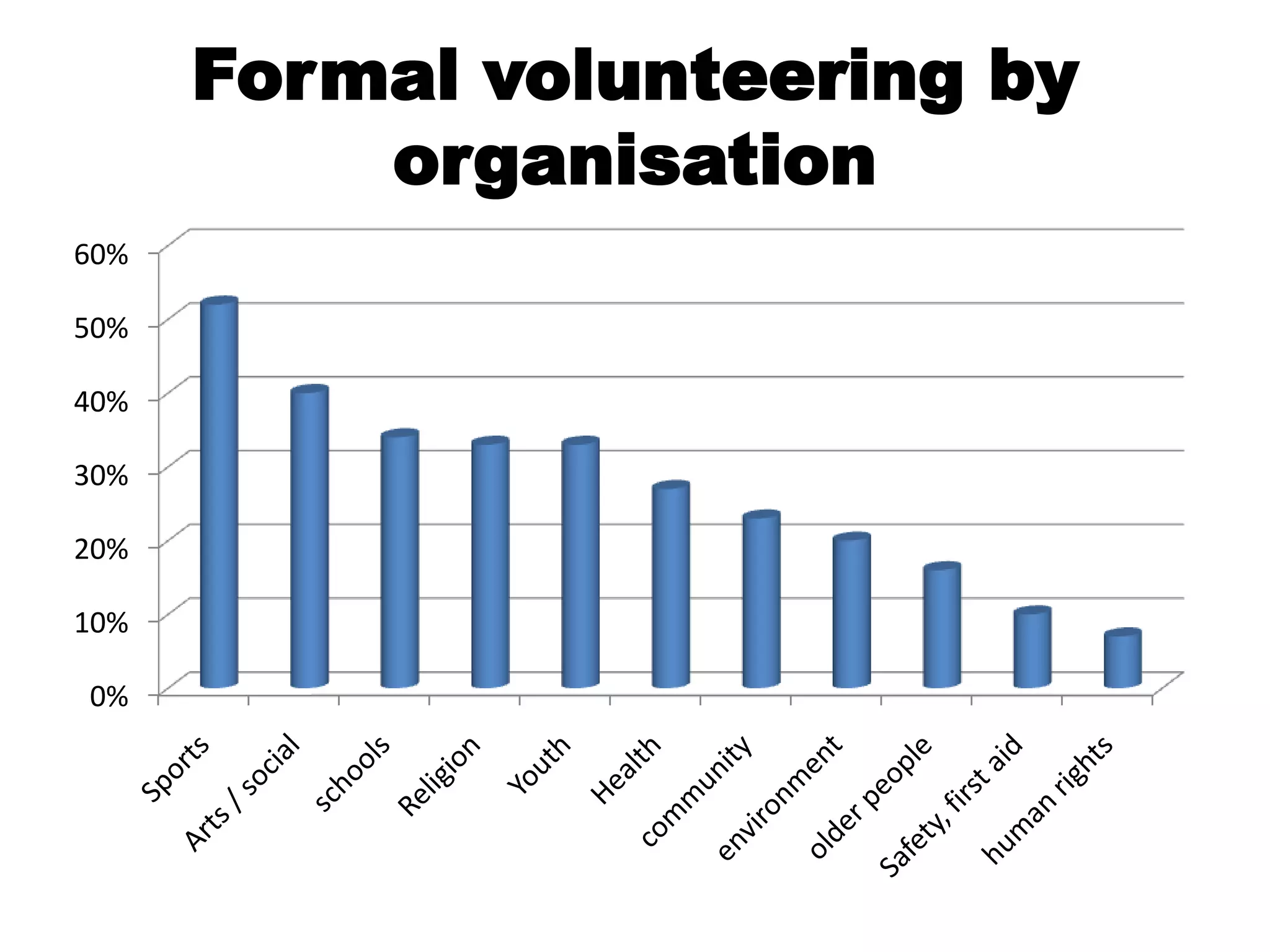
Formal volunteering by
          organisation
60%

50%

40%

30%

20%

10%

0%
The voluntary principle
• Must be freely chosen, ‘no strings attached’
• Must be distinct from paid work, not a
  substitute for it
• Issues re benefit / minimum wage entitlements
  and contractual obligations – that may also
  impact on accreditation
• Volunteering in health and social care – not a
  cheap option
Volunteering in health and
         social care
Coalition Government policy:
 “Our vision is of a society in which social action
  and reciprocity are the norm and where
  volunteering is encouraged, promoted and
  supported because it has the power to
  enhance quality; reduce inequality; or improve
  outcomes in health, public health and social
  care.”
   Department of Health, 2011, Strategic vision for volunteering
Health and Social Care
           Volunteering Fund
• Set up in November 2010 to help ‘recruit, support
  and celebrate volunteers and volunteering’
• Grants to support projects that help meet
  government objectives in relation to:
  – Empowering patients
  – Improving individual and community health outcomes
  – Improving health and social care
• Evaluation of these projects will be used to
  strengthen the evidence-base on volunteering in
  health and social care
Carers
• ‘Any unpaid help, looking after or supporting
  family members, friends, neighbours or others
  because of long-term physical or mental ill-health
  or disability or problems related to old age’
• A continuum, from making or receiving a phone
  call – “caring about” - through to living with
  someone and giving them support twenty-four
  hours a day – “caring for”
• Who Cares? Women, BME Communities, poorer
  people, ‘the pivot generation’
• 4.3m , 2001 , 5.5m by 2030
Informal and ad hoc
      interpreters Context:
• Social: demography e.g. 230 languages in
  London
• Political: attitudes to Minority languages
• Legal: No ‘Official’ language in England; right
  to Interpreter; right to healthcare
• Ethical: use of children as interpreters
Informal and ad hoc
      interpreters Context:
• Economic; the costs and benefits of (not)
  having paid, trained mediators or bilingual
  professionals; who pays for it
• Technical: models and standards of mediation;
  How it is organised
Informal and ad hoc
           interpreters
• Bangladeshi
  – 29/50 patients had used informal or ad hoc
    interpreter
  – 8/50 used<under 18
  – Felt more comfortable with and more reliable
• Turkish
  – 17/27 use an interpreter: pd/informal depends on
    availability and level of concern with respect to
    their health
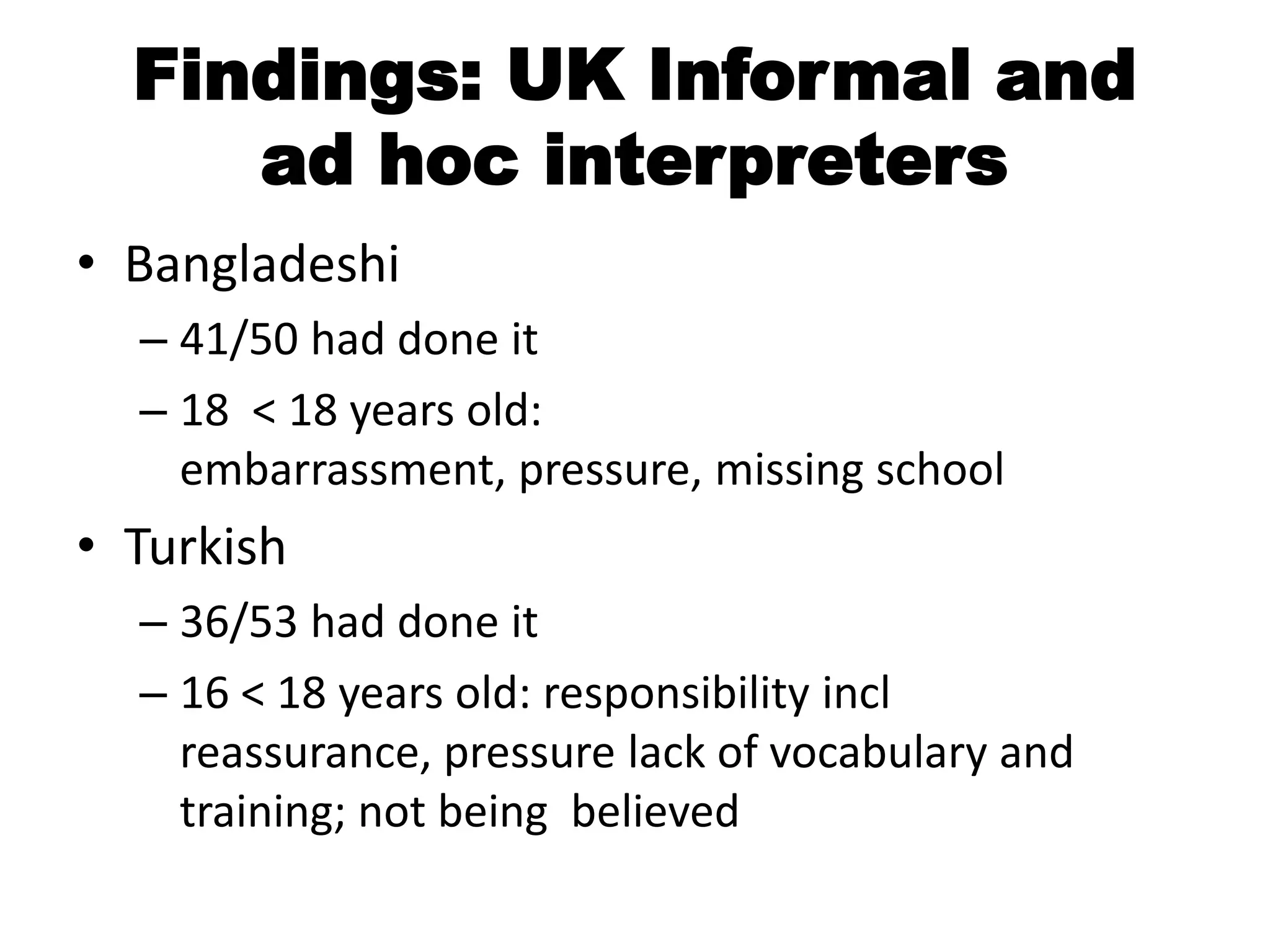
Findings: UK Informal and
     ad hoc interpreters
• Bangladeshi
  – 41/50 had done it
  – 18 < 18 years old:
    embarrassment, pressure, missing school
• Turkish
  – 36/53 had done it
  – 16 < 18 years old: responsibility incl
    reassurance, pressure lack of vocabulary and
    training; not being believed

Ppre presentation 24oct2011

  • 1.
    Volunteering in Social Care John Eversley and Belinda Pratten ppre CIC
  • 2.
    About ppre • Setup January 2003 • Public policy research, education and consultancy • Partnerships with universities, NGOs • Range of projects and methods – Quantitative research using administrative data – ‘Emancipatory’ research – E.g. Informal and ad hoc Interpreters
  • 3.
    Definitions of volunteering1 United Nations: 3 defining characteristics • Activity not undertaken for financial reward • Activity undertaken voluntarily (free will) • Activity of benefit to someone else or society Main types of activity – Mutual aid or self help; – Philanthropy or service to others – Participation or civic engagement – Advocacy or campaigning
  • 4.
    Definitions of volunteering2 United Kingdom: no common definition, broadly: • ‘an unpaid activity where someone gives their help to an organisation or an individual to whom they are not related.’ (Volunteering England) UK Citizenship Survey • Formal volunteering: unpaid help given as part of a group, club or organisation... • Informal volunteering: unpaid help given as an individual to someone who is not a relative
  • 5.
    Formal volunteering by organisation 60% 50% 40% 30% 20% 10% 0%
  • 6.
    The voluntary principle •Must be freely chosen, ‘no strings attached’ • Must be distinct from paid work, not a substitute for it • Issues re benefit / minimum wage entitlements and contractual obligations – that may also impact on accreditation • Volunteering in health and social care – not a cheap option
  • 7.
    Volunteering in healthand social care Coalition Government policy: “Our vision is of a society in which social action and reciprocity are the norm and where volunteering is encouraged, promoted and supported because it has the power to enhance quality; reduce inequality; or improve outcomes in health, public health and social care.” Department of Health, 2011, Strategic vision for volunteering
  • 8.
    Health and SocialCare Volunteering Fund • Set up in November 2010 to help ‘recruit, support and celebrate volunteers and volunteering’ • Grants to support projects that help meet government objectives in relation to: – Empowering patients – Improving individual and community health outcomes – Improving health and social care • Evaluation of these projects will be used to strengthen the evidence-base on volunteering in health and social care
  • 9.
    Carers • ‘Any unpaidhelp, looking after or supporting family members, friends, neighbours or others because of long-term physical or mental ill-health or disability or problems related to old age’ • A continuum, from making or receiving a phone call – “caring about” - through to living with someone and giving them support twenty-four hours a day – “caring for” • Who Cares? Women, BME Communities, poorer people, ‘the pivot generation’ • 4.3m , 2001 , 5.5m by 2030
  • 10.
    Informal and adhoc interpreters Context: • Social: demography e.g. 230 languages in London • Political: attitudes to Minority languages • Legal: No ‘Official’ language in England; right to Interpreter; right to healthcare • Ethical: use of children as interpreters
  • 11.
    Informal and adhoc interpreters Context: • Economic; the costs and benefits of (not) having paid, trained mediators or bilingual professionals; who pays for it • Technical: models and standards of mediation; How it is organised
  • 12.
    Informal and adhoc interpreters • Bangladeshi – 29/50 patients had used informal or ad hoc interpreter – 8/50 used<under 18 – Felt more comfortable with and more reliable • Turkish – 17/27 use an interpreter: pd/informal depends on availability and level of concern with respect to their health
  • 13.
    Findings: UK Informaland ad hoc interpreters • Bangladeshi – 41/50 had done it – 18 < 18 years old: embarrassment, pressure, missing school • Turkish – 36/53 had done it – 16 < 18 years old: responsibility incl reassurance, pressure lack of vocabulary and training; not being believed